Conflict Avoidance in Relationships: What It Costs and How to Change It
You are standing in the pharmacy aisle, holding the prescription you picked up for them, and you notice the date on the label. They were supposed to start this weeks ago. You say nothing. You drive home with the paper bag between you on the seat, and when you hand it over, they say thank you and set it on the counter beside the others, unopened. Later that night you will think about asking. You will even rehearse the words. And then you will decide it is not the right time, that they seem tired, that it will only lead somewhere neither of you wants to go. So you say nothing again.
That is conflict avoidance in relationships. Not the absence of problems, but the quiet agreement not to look at them. And it deserves more honesty than it usually gets, because of all the ways couples struggle, this one is the easiest to mistake for peace.
What conflict avoidance actually looks like
It rarely announces itself. Avoidance wears reasonable clothes: it's not worth the argument. Now isn't a good time. It'll blow over. Sometimes it looks like instant agreement, a quick you're right that ends the conversation without opening it. Sometimes it looks like humor, deployed at the exact moment things were about to get real. Sometimes it is simply scheduling: a life kept so busy that there is never a quiet hour in which a hard thing could be said.
Over time, couples build an unspoken map of everything they don't discuss. In-laws, money, sex, the future, that one fight from three years ago. The map grows. And each topic that gets added to it takes a piece of the relationship with it, because you cannot wall off a subject without also walling off the parts of yourself that live there.
Why someone avoids conflict
Almost never because they don't care. People learn to avoid conflict the way they learn a language: early, at home, without noticing. If disagreement in your childhood house meant shouting, or icy withdrawal, or someone leaving, then your nervous system filed conflict under danger, and it has been filing it there ever since. The person who goes quiet when you raise something hard is often not dismissing you.
They are bracing.
There is a physiology to this. Levenson & Gottman's research on couples in conflict found that when a person becomes physiologically flooded (heart racing, body in alarm) clear thinking and open listening become nearly impossible. Avoidance is what that alarm looks like from the outside. What reads as coldness is very often overwhelm, held very still. If this is your partner, the fuller picture of why a partner avoids conflict and how to reach them is worth sitting with; if it goes as far as going completely silent, that pattern has its own name (stonewalling) and its own way out.
The cost of keeping the peace
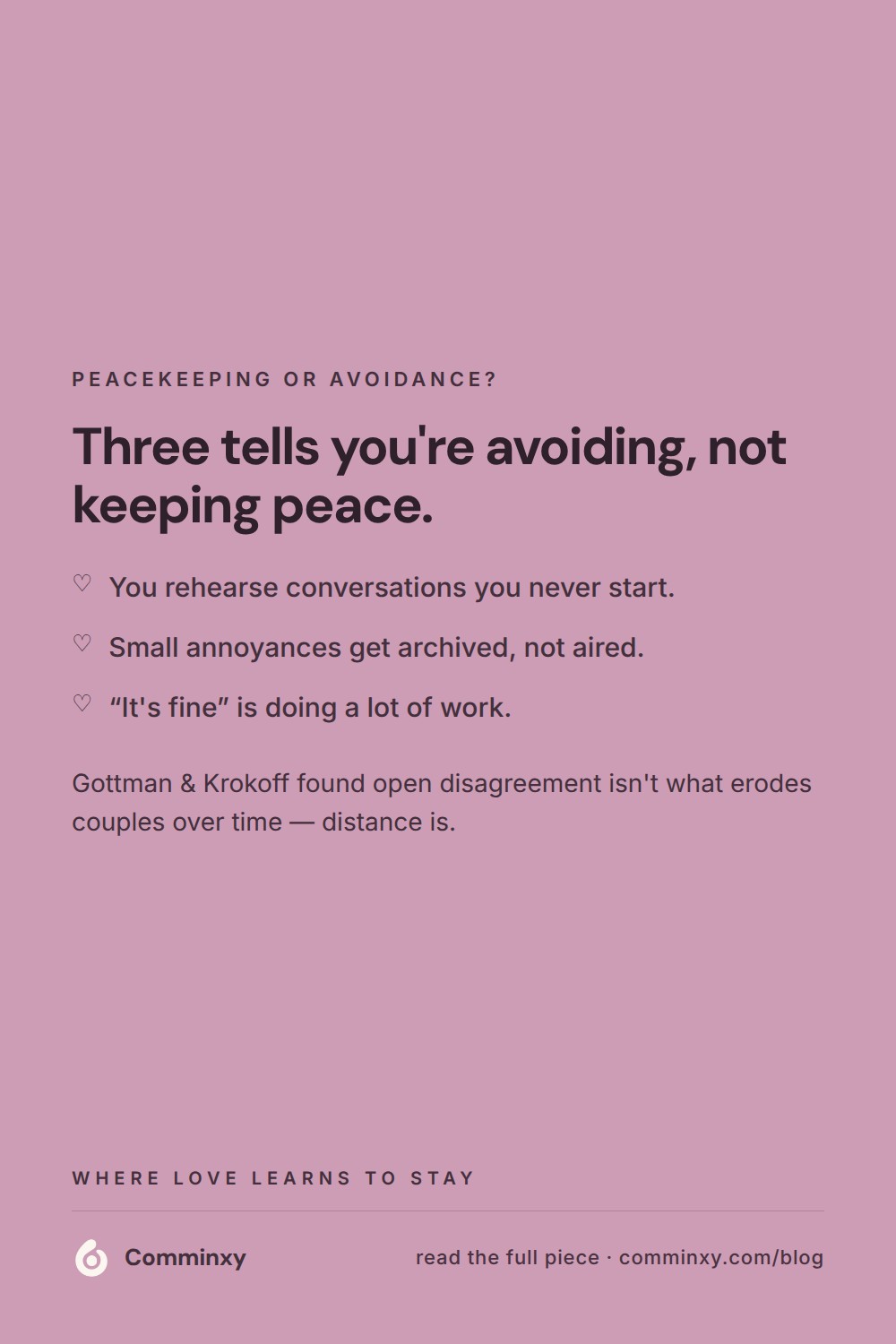
Here is the finding that should change how we talk about low-conflict couples. Gottman and Krokoff, in the Journal of Consulting and Clinical Psychology, followed married couples over time and found that open disagreement, even anger, was not what predicted long-term deterioration. Withdrawal was. The couples who engaged with their conflicts, uncomfortable as it felt in the moment, often ended up more satisfied years later. The couples who avoided them declined slowly and quietly.
This matches what Gottman and Levenson later found about how marriages actually end: not one road, but two distinct paths to divorce. An early one driven by explosive fighting, and a later one driven by distance and emotional disengagement. Conflict avoidance is the second path. Nothing dramatic happens. That is precisely the problem. A feeling that never gets spoken doesn't dissolve; it goes underground, collects interest, and resurfaces as distance, resentment, or the strange loneliness of lying next to someone you no longer really talk to.
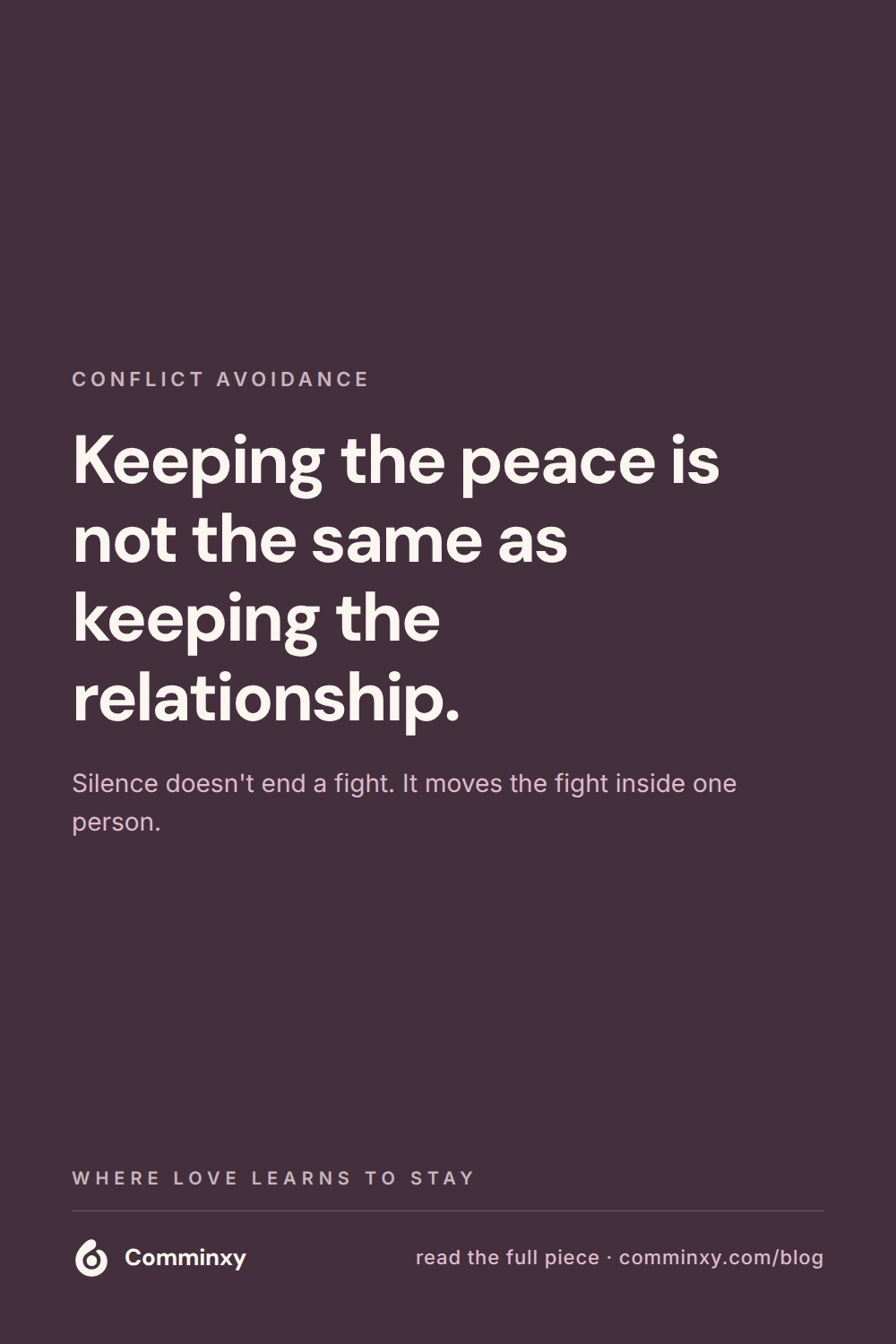
The absence of fighting is not the presence of closeness. Sometimes it is only the distance between you, keeping very still.
How to deal with someone who avoids conflict
The instinct, when you love an avoider, is to push harder: to corner them into the conversation. It backfires almost every time, because to a flooded nervous system, pursuit feels like threat. The work is not to force the conversation open but to make it feel survivable.
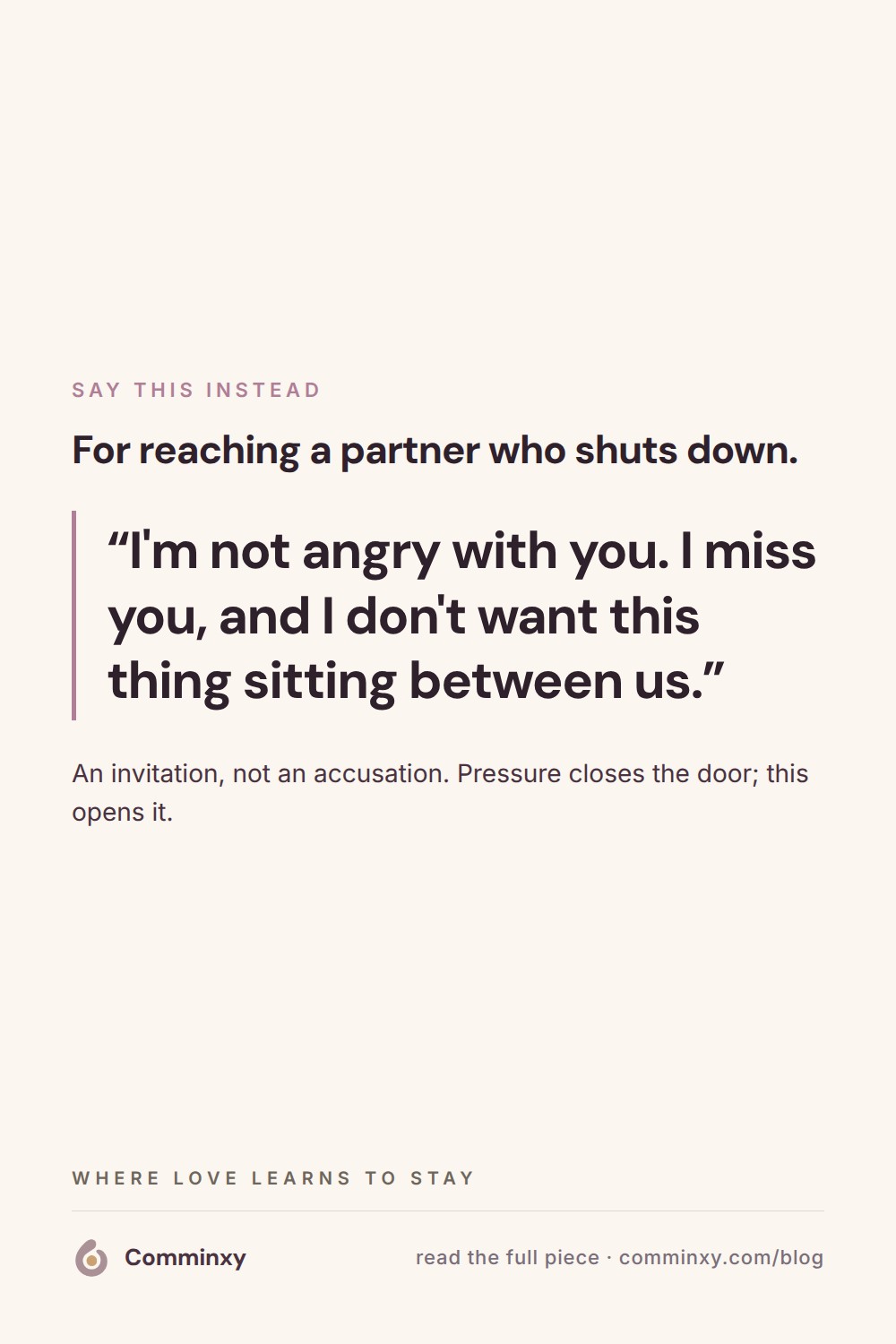
That starts before a single hard word is said. Carrère and Gottman, writing in Family Process, found that how a conflict conversation begins in its first minutes powerfully predicts how it ends. So begin softly, and begin with reassurance: I'm not angry with you. I miss you, and I don't want this thing sitting between us. Make the exit visible (we don't have to solve it tonight) because a door that is allowed to stay open is one nobody needs to bolt. Let them come back an hour later if that's what their body needs; a pause honored is trust deposited. Much of this is the patient building of emotional safety, teaching each other, one survivable conversation at a time, that honesty here doesn't get punished.
If you are the one who avoids
Read this part gently, because you learned your silence for good reasons. But notice what the avoidance is actually buying you. Not peace. Postponement. And the bill arrives either way, usually with interest.
Start smaller than you think you need to. You don't have to initiate the money conversation tomorrow. You could simply stay in the room sixty seconds longer than your body wants to. You could say I can't do this right now, but I will tonight, and then keep the promise, because that sentence, kept, is the single fastest way to make a break during an argument feel like care instead of abandonment. And when a conflict does happen, you don't have to master it in the moment: Finkel and colleagues showed in Psychological Science that even a brief writing exercise (reconsidering a fight from a neutral outsider's view) measurably protected couples' satisfaction over time. Distance from a conflict helps. Disappearance from it doesn't.
It also helps to know what you're avoiding for. Usually it isn't the topic itself but the patterns a hard conversation can fall into: criticism, contempt, defensiveness, stonewalling. Those patterns have well-studied antidotes, and learning them is what makes conflict feel less like a cliff edge and more like weather: real, sometimes rough, passing.
The conversation is the relationship
Every couple has a map of unsaid things. The difference between the couples who last and the couples who quietly drift is not the size of the map, but whether the map is shrinking or growing. One postponed conversation, finally had, redraws a border. One survivable disagreement teaches two nervous systems that the room holds. That is the slow, unglamorous work Comminxy was built to sit beside: not making conflict disappear, but helping the hard sentence get said a little more gently, and heard a little more fully, so the peace in your house can be the real kind.
The prescription is still on the counter. You could still ask. And if you do, you will be clumsy and they might be defensive and it might not go well the first time. But a clumsy question asked is still closer than the silence you have been carefully keeping. The map can start to shrink tonight.
Questions people ask
why does my partner shut down when I try to talk about problems
They are likely experiencing physiological flooding, where their heart races and their body goes into alarm mode, making clear thinking nearly impossible. What looks like dismissal or coldness is often overwhelm held very still. Their nervous system learned early that conflict means danger, so avoidance became a protective reflex.
is it normal to never fight in a relationship
The absence of fighting is not always healthy. Research shows that couples who avoid conflict decline slowly over time, often ending in later divorce driven by emotional distance rather than explosive arguments. Low conflict can mean safety, but it can also mean important feelings are going underground instead of being resolved.
how do I talk to someone who avoids conflict
Begin softly with reassurance, not pursuit, and make the exit visible by saying you do not have to solve it tonight. Let them pause and return when their body is ready, because honoring that pause builds trust. Pushing harder or cornering them into conversation usually backfires because it feels like threat to a flooded nervous system.
how do I stop avoiding hard conversations with my partner
Start smaller than you think you need to, like staying in the room sixty seconds longer than your body wants to. You can also say you cannot talk now but will tonight, and then keep that promise. Even brief distance from a conflict, like writing about it from an outsider's view, helps more than disappearing from it entirely.
Keep the idea with you — pin it, or download the cards.


Comminxy helps the hard sentence get said a little more gently
Get Comminxy free →