Stonewalling in Relationships: Why We Shut Down and How to Find Each Other Again
You are mid-sentence when it happens. You are trying to explain why the thing that happened this morning still stings, and you watch it land on a wall. Your partner's face goes flat. Their shoulders drop, but not in a soft way. In a way that means the shutters are coming down. They look at the floor, or the wall, or a spot just past your shoulder. They say "fine" in a voice with nothing behind it. And you feel it in your chest: they have left the room without moving.
Stonewalling in relationships is that moment. One person keeps reaching, and the other goes quiet and still and somewhere else entirely. It can look like coldness. It can feel like punishment. But almost none of it is what it appears to be from the outside.
What it actually looks like from the inside
Here is what you don't see when you are the one still talking. Behind that flat face, your partner is not calm. They are not indifferent. Their heart is often racing. Their thoughts have gone loud and jumbled. Somewhere in the last few minutes, the conversation stopped feeling like a conversation and started feeling like a threat, and their body responded the way bodies respond to threat, by going very still and waiting for it to pass.
The person who looks the most checked-out is frequently the one who is flooded. John Gottman and Robert Levenson, watching couples in their lab and measuring what was happening in their bodies, found that this shutting-down is tied to physiological overwhelm. The nervous system past the point where it can take anything more in. The wall is not the absence of feeling. It is too much feeling, with nowhere to go.
Which means the silence you are reading as rejection might be, underneath, a person barely holding on.
Why we go quiet instead of staying
Nobody chooses this. The partner who stonewalls did not decide, coolly, to withhold. Their body decided first, before language had a chance. Once the heart is pounding and the ears are ringing, the higher, wiser parts of us go offline. What is left is old and simple: get small, get quiet, wait for the danger to end.
Usually the ones who learned to do this learned it early. In homes where big feelings were unsafe, where the way to survive a storm was to disappear inside yourself until it blew over. So when love gets loud, even in the ordinary way that love sometimes gets loud, the old wiring fires. They are not leaving you. They are doing the thing that once kept them safe.
And the one still reaching is not the villain either. When someone you love goes blank in front of you, the natural response is to reach harder. To raise your voice, to follow them into the next room, to say please just talk to me with more and more urgency. It makes complete sense. It also, unfortunately, tells their nervous system that the threat is growing. So you both get more of what you fear. This is one of the patterns that quietly wears couples down, not because either of you is failing, but because your two survival strategies happen to trigger each other.
The quiet cost of waiting it out
You might think the withdrawing is the safer option. It feels safer in the moment. No explosion, no ugly words, nothing you will regret. But Gottman and Levenson, following couples over many years, found two different roads to a marriage ending. One was loud: high conflict, early on. The other was quiet, a slow drift of withdrawal and fading warmth, arriving later, at around sixteen years in on average.
That second road is the one that stonewalling paves. Not because one silence is dangerous, but because a thousand of them add up to a house where two people live side by side and stop reaching at all. The wall that goes up to protect one hard conversation, left standing, becomes the wall you live behind.
So the goal was never to never shut down. Bodies flood; it happens. The goal is learning how to come back into the room.
How to find each other again
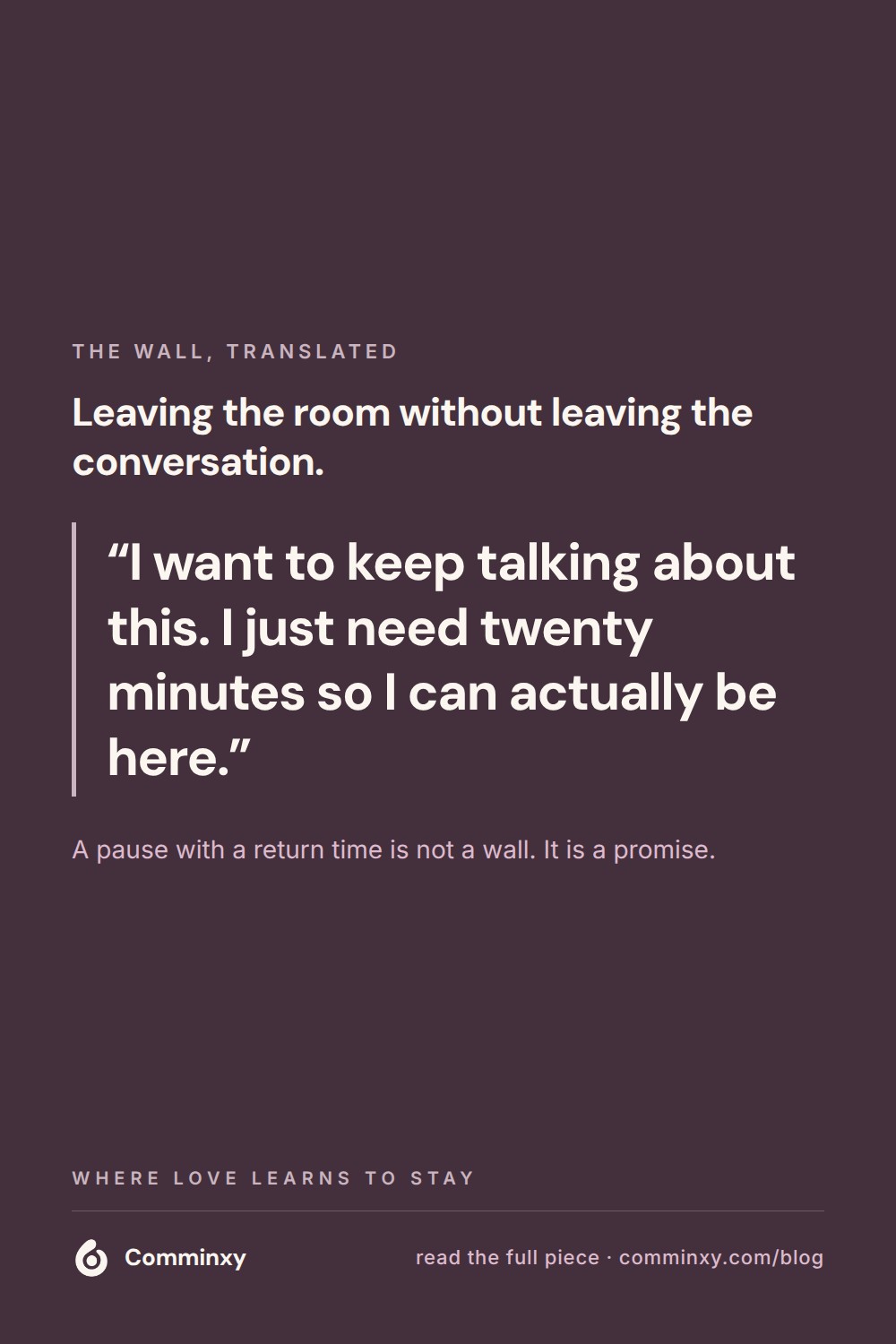
The way back is almost embarrassingly small, and it starts with the thing that feels hardest: stopping. When one of you has gone still and the other feels the panic rising, the most loving move is often to pause the conversation on purpose. Not to storm off, that reads as abandonment. But to say, out loud, I want to keep talking about this, I just need twenty minutes so I can actually be here. The naming matters. It turns disappearing into a promise to return.
Twenty minutes is not arbitrary. It is roughly how long an overwhelmed nervous system needs to come back down to somewhere it can hear you again. What you do in that time matters less than that you use it to soothe rather than to rehearse your case. And when you come back, this is the part people skip, you come back gently. Not straight into the argument. Into each other first.
There is a tenderness to how the couples who last do this. Carstensen, Gottman and Levenson, studying long-married partners, noticed that the happy ones did not avoid conflict. They threaded it with small warmths. A bit of humour. A touch on the arm. A softening in the eyes mid-disagreement, the kind that says we are on the same side even now. These were not techniques. They were the reflexes of people who had decided, over and over, that staying connected mattered more than winning.
What repair actually feels like
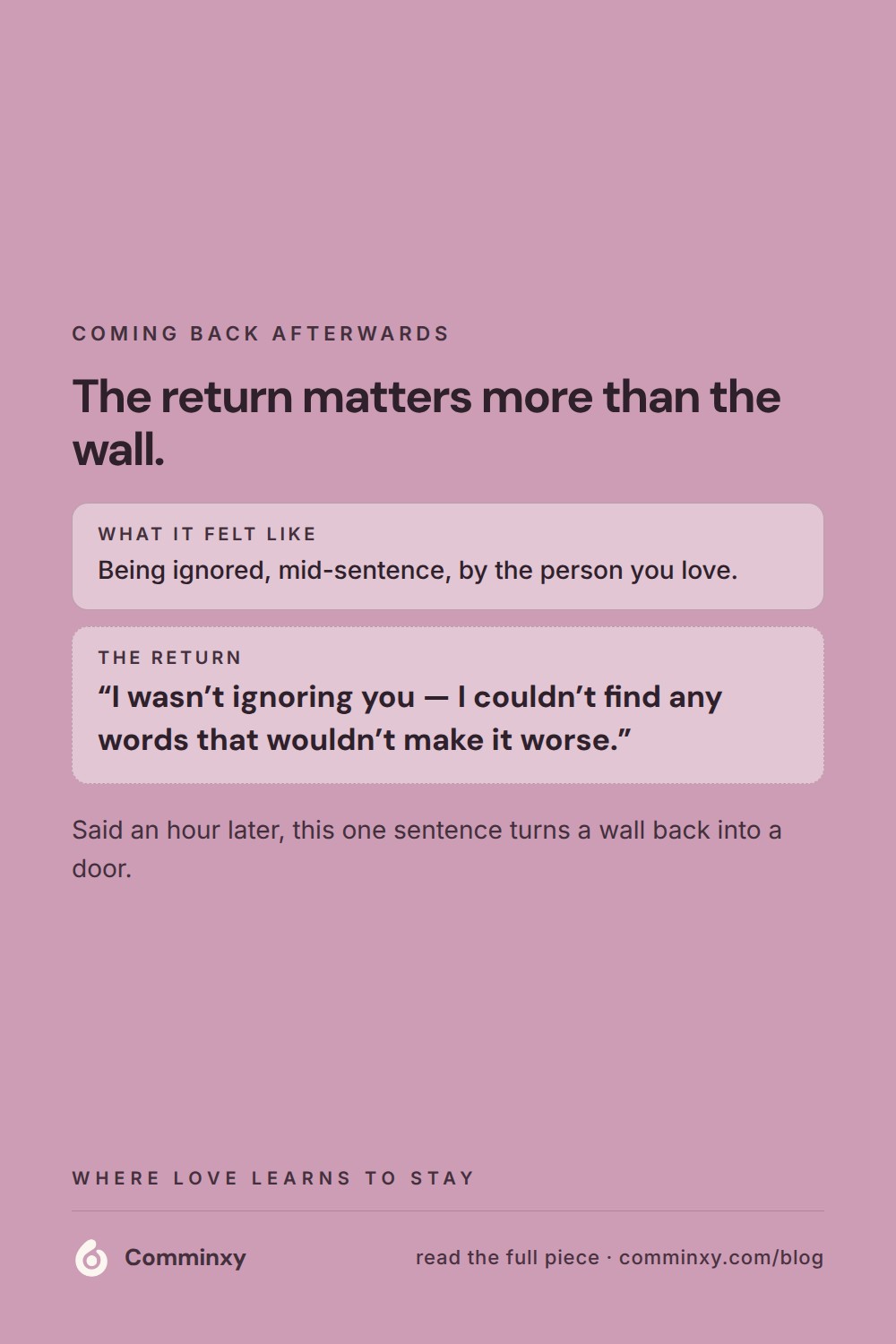
Repair is rarely a grand conversation where everything gets solved. More often it is a hand offered across the couch an hour later. A quiet I hated that, I don't want us to feel like that. An acknowledgment, from the one who went silent, that I wasn't ignoring you, I couldn't find any words that wouldn't make it worse. And from the one who kept reaching, a softer I know. I was scared you'd stopped caring.
When you can say those things to each other, the wall stops being a wall. It becomes information: a signal that one of you got overwhelmed, which is human, and that you both know the way back. This is what people mean by emotional safety. Not a relationship where you never flood, but one where flooding is not the end of the conversation.
So the next time you are mid-sentence and you feel the shutters come down, remember what is usually behind them. Not a person who has stopped loving you. A person who has been flooded by loving you, and has not yet learned the way back to the room. That way back can be learned. It is what Comminxy was built to sit beside you through, the small, real work of finding each other again after the quiet, so that love, even when it goes still for a while, learns to stay.
Questions people ask
why does my partner shut down when we argue
When someone shuts down during conflict, their nervous system is usually flooded and overwhelmed, not calm or indifferent. Their body has responded to the conversation as a threat, triggering an old survival response of going quiet and still. What looks like coldness from the outside is often someone barely holding on inside.
how long does it take to calm down after a fight
An overwhelmed nervous system typically needs around twenty minutes to come back down to a place where it can listen and respond again. During that break, it helps to actually soothe yourself rather than rehearse what you want to say. When you return, come back gently and reconnect with each other first before continuing the hard conversation.
is stonewalling always on purpose
No, stonewalling is almost never a deliberate choice to punish or withhold. The body decides to shut down before conscious thought gets involved, usually because someone learned early in life that going quiet was the safest way to survive emotional storms. The person stonewalling is following old wiring, not making a calculated decision to hurt you.
what happens if someone always shuts down in a relationship
When one partner consistently withdraws and the pattern never gets addressed, it can quietly erode a relationship over many years. Research has found that this kind of slow drift, where people stop reaching for each other, often leads to relationships ending around sixteen years in. The solution is learning to pause intentionally and come back, not avoiding shutting down altogether.
Keep the idea with you — pin it, or download the cards.


Comminxy helps you learn the way back into the room together
Get Comminxy free →