How to Recover After Saying Something Hurtful to Someone You Love
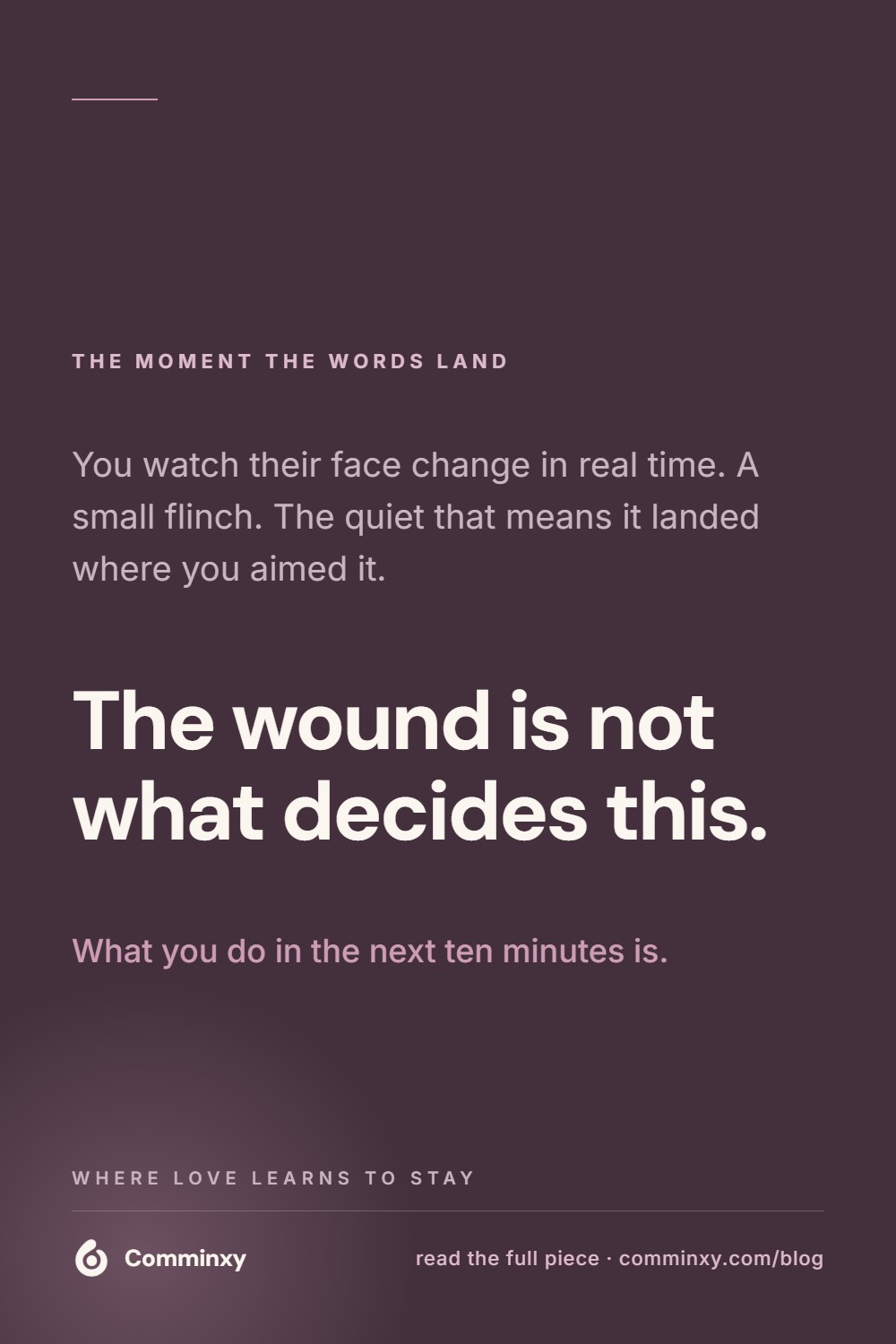
The words are out of your mouth before you've finished deciding whether to say them. You watch your partner's face change in real time, a small flinch, a flattening of the eyes, the way they go quiet in that particular way that means it landed exactly where you aimed it. And in the same breath you'd give anything to pull it back. That's the strange cruelty of it: the part of you that wanted to wound and the part that's already sorry are the same person, sitting in the same kitchen, watching the same hurt spread across the face you love most.
If you're trying to figure out how to recover after saying something hurtful, the first thing worth knowing is that the wanting-to-take-it-back is not weakness or guilt for show. It's the most honest part of you, arriving a half-second too late.
The thing about the words you can't unsay
There's a specific weight to a sentence you regret. Not the same as a normal argument, where you both said too much and you'll laugh about it tomorrow. This is the one that named the thing you swore you'd never use: their deepest insecurity, the family wound, the comparison you knew would cut. Maybe you said you're just like your mother. Maybe you said sometimes I wonder why I'm still here. Maybe it was quieter than that, just a cold little fine, whatever that you both knew meant something much larger.
What makes these moments feel unrecoverable is that they seem to reveal something. You think: I must have meant it, or I wouldn't have said it. But that's not quite how it works. In a heated moment, your body is running ahead of your values. Your heart rate climbs, your thinking narrows, and the part of your brain that knows how to be kind goes temporarily offline. You reach for the sharpest object in the room because you're flooded, not because it's the truth of how you feel.
Why the worst things come out of the people who love most
It feels backwards. You're gentlest with strangers and most savage with the person you'd take a bullet for. But it makes a quiet kind of sense once you see it. Your partner is the only person who knows where all the soft spots are, which means you also know exactly where theirs are. Intimacy hands you the map. In a calm moment, you'd never use it. Flooded, you grab it like a reflex.
Gottman and Levenson, in the Journal of Personality and Social Psychology, spent years watching couples argue while measuring what was happening in their bodies, and what they found is that there's a physiological cascade underneath these moments. Your autonomic nervous system lights up, and once it does, your capacity for repair shrinks dramatically. The cruel sentence isn't a window into your real opinion of your partner. It's what comes out when the system is overwhelmed and reaching for the fastest way to make the unbearable feeling stop.
That doesn't make it hurt less for the person on the receiving end. But it does change what the moment means. You didn't reveal a hidden truth. You revealed that you were drowning and you grabbed whatever was nearest.
What actually happens after (and why repair beats the perfect apology)
Here's the part nobody tells you: it isn't the wound that decides what happens next. It's what you do in the minutes and hours after.
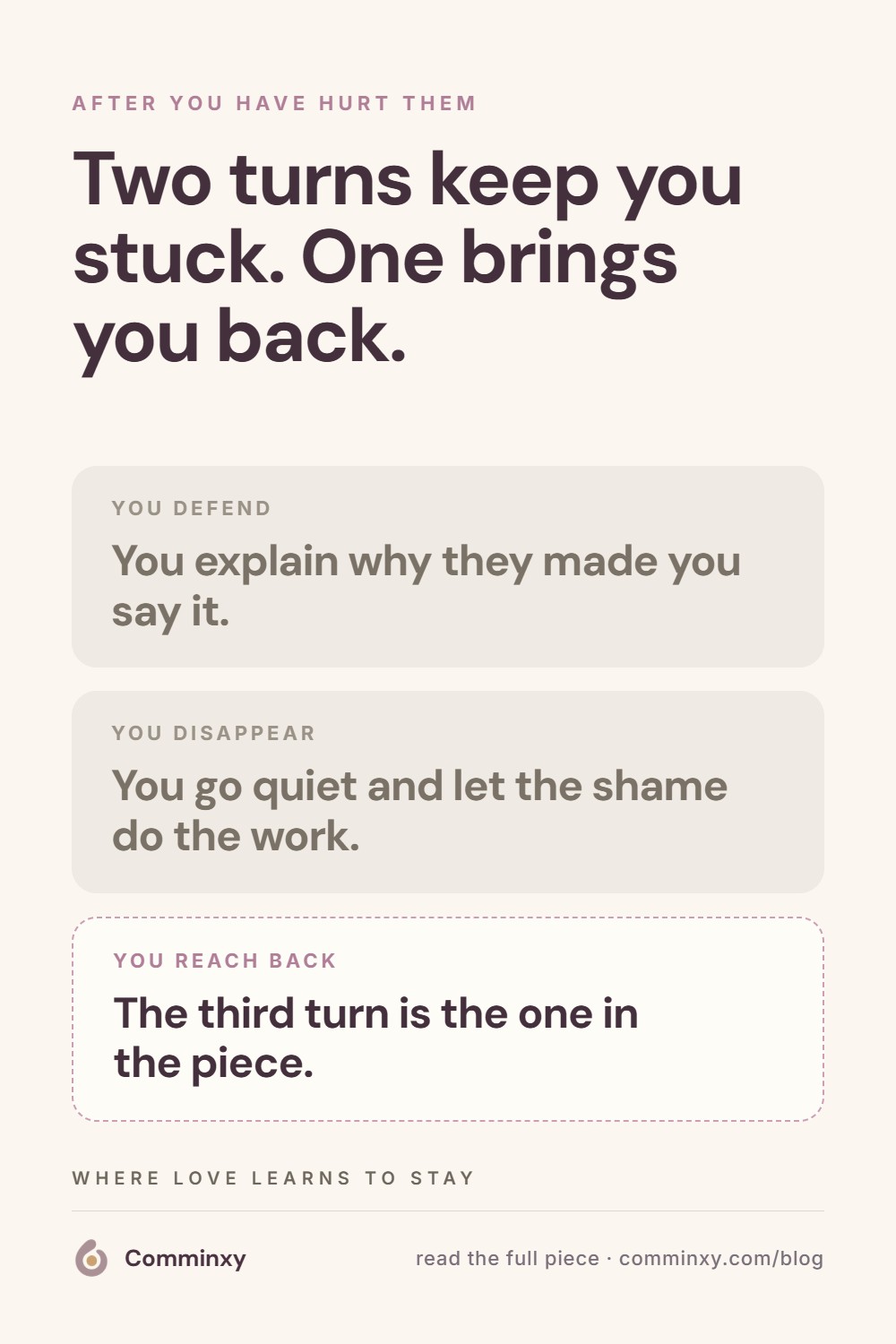
Most of us, in the silence after we've said the unforgivable thing, do one of two things. We defend (well, you started it, you know I didn't mean it like that), which adds a second injury on top of the first. Or we go quiet and disappear into shame, which to our partner feels indistinguishable from not caring. Both are understandable. Both make the next hour harder than it needs to be.
What helps isn't a flawless apology. It's the turn back toward them. The Gottmans call these small reaching-back gestures repair attempts, and they don't have to be eloquent. I shouldn't have said that. That was about my own panic, not about you. Or even just I went too far. Can I try again? The words can be clumsy. What matters is that you're moving toward your partner instead of away. If you tend to fall into the same destructive grooves once a fight starts, it's worth understanding the four communication patterns that destroy relationships, not to grade yourself, but to recognise the moment you've slipped into one so you can step back out.
The repair that comes later (and why a little distance helps)
Sometimes you can't repair in the moment. You're both too raw, and any attempt just reopens it. That's where time, used well, becomes its ally rather than its enemy.
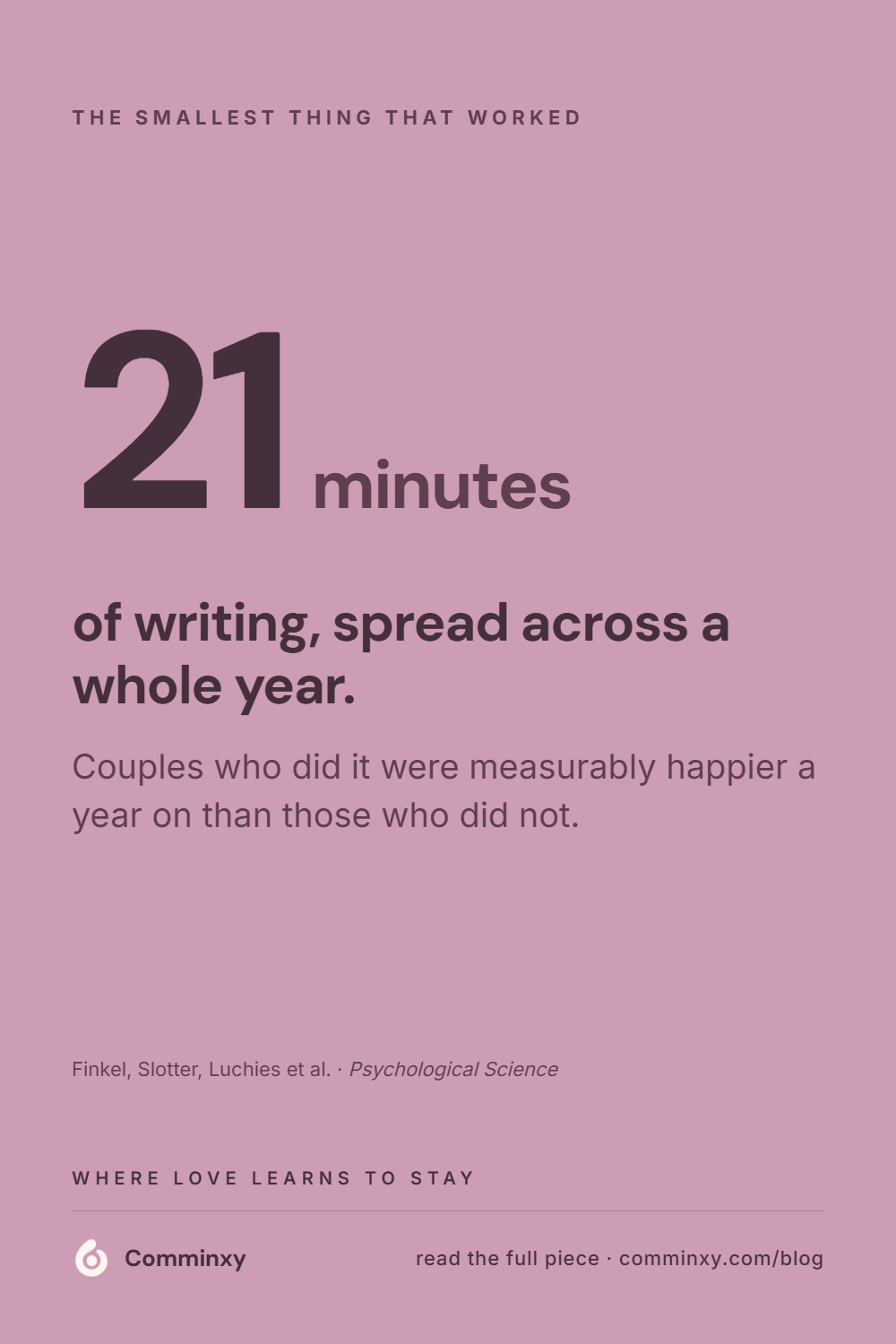
One finding sits close to this. Finkel and his colleagues, writing in Psychological Science, asked couples to spend a few minutes every few months writing about their worst recent conflict, but from the perspective of a neutral outsider who wanted the best for both of them. Twenty-one minutes of writing across an entire year. That was the whole intervention. And it completely flattened the decline in satisfaction that the couples who didn't write experienced.
Twenty-one minutes.
What that tells us is that the cruel sentence loses some of its power the moment you can step outside your own flooded perspective and see the scene the way a kind stranger would: two people who love each other, one of them frightened, both of them hurting. You don't have to wait for a research study to do that. You can do it the next morning, on a walk, in the car. If I were watching us from the outside, what would I see? Usually you'd see that the meanest thing you said was the most scared thing about you.
What you carry forward
You will say things you regret again. Not because something is wrong with you, but because you're a person who loves someone close enough to occasionally hurt them. The couples who last aren't the ones who never wound each other. They're the ones who got good at finding their way back, who learned to turn around in the doorway instead of walking out of it. If you want to keep building that muscle, it's worth exploring how to communicate better with your partner in the quieter moments, long before the next hard one arrives.
So go back to that kitchen, that flinch, that half-second of wishing you could swallow the words. The thing you said is real, but so is the sorrow that arrived right behind it, and your partner needs to know that second part exists. Repair isn't pretending the wound never happened. It's letting them see that the person who hurt them is also the person reaching back. That's the work, and it's the kind of work Comminxy was built to sit beside you for, not to script your apology or fix what broke, but to help you find your way back to each other a little sooner, in the quiet after the door almost slammed. Because that's where love learns to stay: not in never falling, but in turning around.
Questions people ask
how do you apologize after saying something really hurtful
The apology doesn't need to be flawless, it needs to acknowledge what you did and turn back toward your partner instead of defending or retreating into shame. Something as simple as 'I shouldn't have said that, I went too far' works better than a scripted apology if it's genuine. What matters most is that you're moving toward them, not away.
why do i say mean things to people i love
You say the meanest things to the people you love because intimacy gives you the map to their soft spots, and when you're flooded or panicked, you reflexively grab the sharpest tool available to make the unbearable feeling stop. It's not a reflection of your real feelings, it's what happens when your nervous system is overwhelmed and your capacity for kindness goes temporarily offline. Strangers don't get this treatment because they don't know where your wounds are and you don't know theirs.
can a relationship recover after saying something unforgivable
Yes, because it's not the wound itself that decides what happens next, it's what you do in the minutes and hours after. Couples who last aren't the ones who never hurt each other, they're the ones who got good at repair and learned to turn back toward each other instead of defending or disappearing. The cruel sentence loses power once both people can step outside the flooded moment and see two people who love each other, both hurting.
what to do when you can't apologize right away after a fight
Give it a little distance, then come back when you're both less raw and can see the fight from outside your own flooded perspective. Time used well becomes an ally, especially if you can later reflect on what a neutral outsider who cared about both of you would see. The repair that comes later still counts as long as you eventually turn back toward your partner.
Keep the idea with you — pin it, or download the cards.


Comminxy helps you find your way back to each other a little sooner
Get Comminxy free →