How to Communicate Better With Your Partner When the First Three Minutes Matter Most
The outcome of most hard conversations is decided before you reach the actual problem. Not by what you say once you're angry, but by how you sound in the first handful of sentences. If you've ever wondered how to communicate better with your partner, this is the part most advice skips: the doorway matters more than the room.
Research on married couples found something quietly startling. The tone you bring to the first three minutes of a difficult conversation predicts where you'll both be fifteen minutes later with 96% accuracy. Not the content. Not who's right. The opening.
The conversation was over before you noticed it started
When Carrère and Gottman, Family Process, watched newlyweds discuss a point of conflict, they could tell from just the first three minutes how the rest would go. Sit with that. The hardest part of a conversation isn't the middle, where you're both tired and repeating yourselves. It's the doorway. How you begin tells you almost everything about where you'll end up.
This isn't a reason to panic about every rough start. It's a strange kind of relief. Doorways are small enough to change.
Why the start goes wrong before you mean it to
Nobody decides to start harshly. It happens underneath thought. You walk into the room already carrying the last three versions of this argument, and your body braces before your mind catches up.
Gottman and Levenson, Journal of Personality and Social Psychology, found that in couples heading toward decline, the nervous system fires first. Heart rate climbing, the body flooding, and the harsh words follow the physiology, not the other way around. You're not being difficult. You're being flooded. And a flooded body reaches for the fastest tool it has: criticism, defensiveness, the sharp opening line.
So the "you always" that leaves your mouth isn't really about the dishes, this text, this forgotten thing. It's the sound of a body that walked in already expecting a wall. The problem was never that you don't love each other. It's that the doorway got wired to danger.
What a softer doorway actually sounds like
What changes a beginning is smaller than you'd think. Not staying perfectly calm. Not never being upset. It's the difference between "You never think about anyone but yourself" and "I felt kind of alone tonight."
Same feeling underneath. Completely different door.
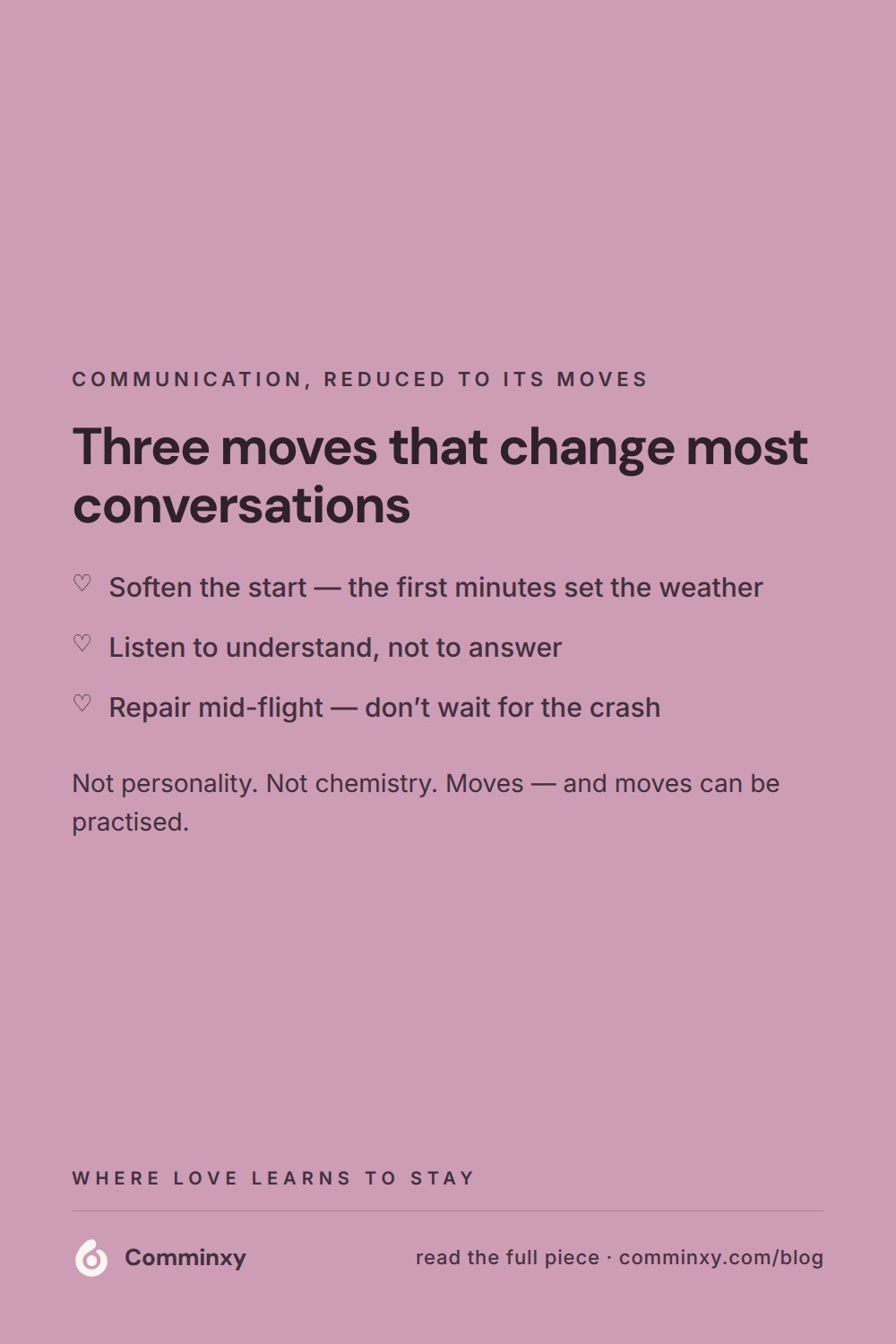
The second one is still honest. It still says the hard thing. But it hands your partner something they can reach for instead of something they have to defend against. Researchers call this a soft start-up. In real life it just feels like walking into the room as two people with a problem, rather than one person who is the problem.
And it works alongside something else the research keeps finding. Carstensen, Gottman and Levenson, Psychology and Aging, watched couples who'd stayed close for decades and noticed they used small doses of humor and affection right in the middle of conflict. Not to dodge the issue, but to soothe each other's bodies enough to keep talking. A gentle joke. A hand on a shoulder. A "come here, we're both tired." These aren't distractions from the conversation. They're what makes the conversation survivable.
When the start has already gone wrong
Most nights you won't catch the doorway. You'll be three sentences in, both of you already sharp, before anyone remembers to soften anything. This is where most advice quietly abandons you.
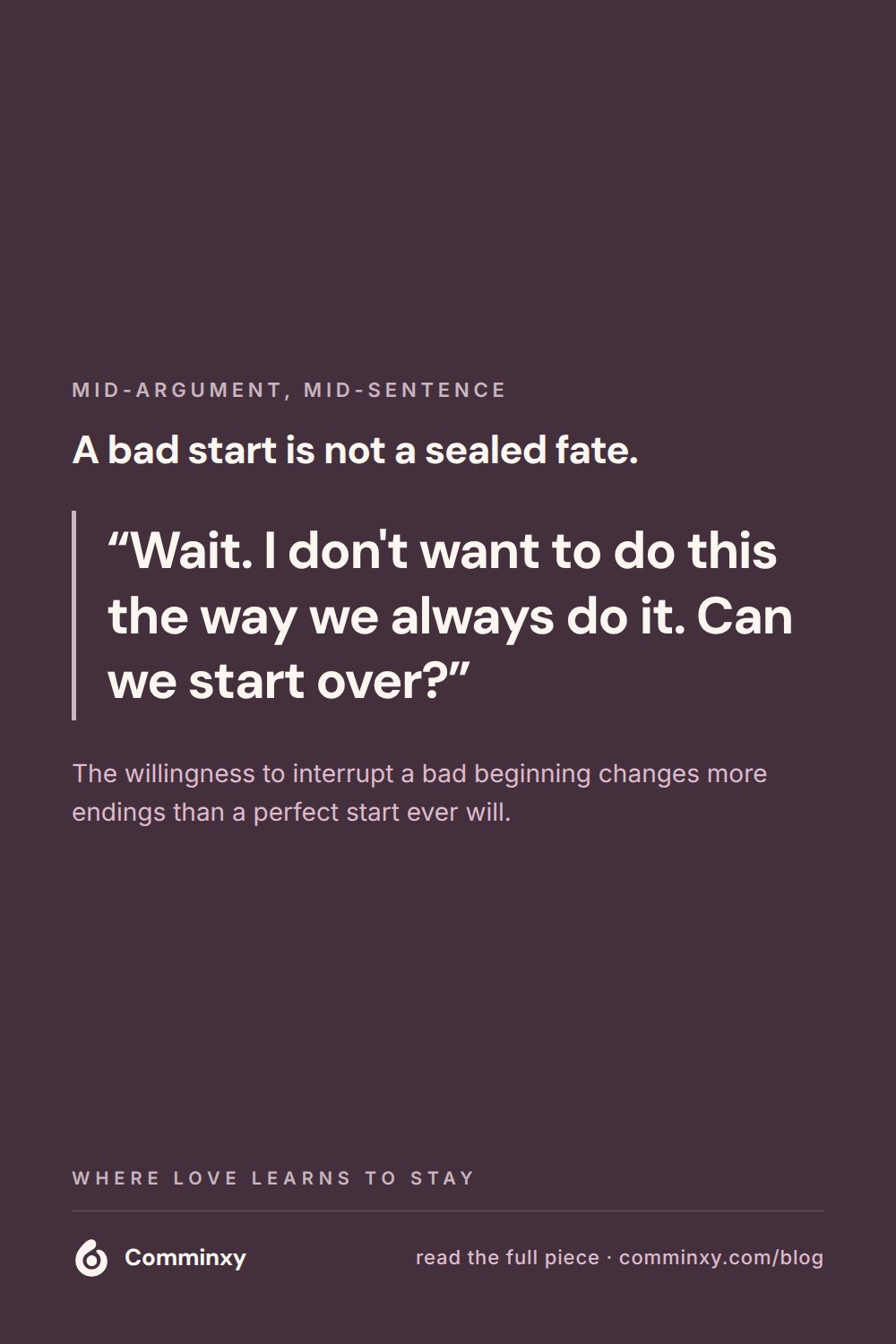
So hear this plainly: a bad start is not a sealed fate. That 96% number describes what usually happens, not what must. What changes the ending isn't a perfect beginning. It's the willingness to interrupt a bad one. To stop mid-sentence and say, "Wait. I don't want to do this the way we always do it. Can we start over?"
That single sentence is one of the most powerful things in a relationship. It's a repair attempt, and it doesn't require you to be calm or wise or right. It only requires you to notice the door you walked through and choose a different one. If you want to understand the deeper mechanics of why some starts curdle so fast, the four patterns Gottman named are worth sitting with in the four communication patterns that destroy relationships, not as a verdict, but as a map.
The part nobody tells you about repair
Withdrawal is the one to watch. Gottman and Krokoff, Journal of Consulting and Clinical Psychology, found something counterintuitive: open disagreement, even heated, sometimes led couples to more satisfaction over time, while pulling away, going quiet, refusing the doorway altogether, predicted the slow deterioration.
Which means the goal was never to stop having hard conversations. It was to keep starting them gently, and coming back when you don't. A softer start isn't about avoiding conflict. It's about staying reachable inside it. That reachability, the sense that even mid-argument, your partner is still someone you can turn toward, is the quiet foundation underneath everything, and it's worth understanding what emotional safety in a relationship actually looks like.
The doorway is smaller than the room
Think back to that moment. Your partner walks in, your shoulders climb, and you can already feel where this is going. What the research is really offering you isn't a warning about those three minutes. It's permission to treat them as the whole game. You don't have to fix the entire conversation. You just have to change how you cross the threshold. One softer sentence. One "can we start again." One breath before the sharp thing.
That's a smaller thing to carry than "communicate better." It's just a doorway, and it belongs to you. Comminxy exists to sit beside you in exactly those first fragile minutes, noticing the tone before it hardens, offering you the softer sentence when your body reaches for the sharp one, because this is where love learns to stay: not in never bracing at the door, but in learning, again and again, to walk through it gently.
Questions people ask
how do you start a difficult conversation with your partner
Start by naming your own feeling rather than attacking their character, like 'I felt hurt' instead of 'You always do this.' The opening tone matters more than the content because it sets whether your partner can hear you or has to defend themselves. Small additions like brief humor or physical touch help keep both bodies calm enough to stay in the conversation.
what does it mean when your partner shuts down during an argument
Shutting down usually means they are physiologically flooded and their nervous system has gone into withdrawal, not that they do not care. Research shows that going quiet during conflict predicts long-term relationship decline more than heated disagreement does. The goal is not to avoid all conflict but to start gently enough that neither person has to retreat completely.
how can I fix a conversation that started badly
Stop mid-conversation and say something like 'Wait, I do not want to do this the way we always do it, can we start over.' A bad start is not a sealed outcome if one of you is willing to interrupt the pattern and name it. This is called a repair attempt and it works even when you are still upset.
why do I get so defensive when my partner brings up a problem
Your body is likely flooding before your mind registers the conversation, especially if past versions of this argument taught your nervous system to brace for danger. Defensiveness follows the physical reaction rather than causing it. The harsh words are your body reaching for the fastest tool when it feels under threat, not a character flaw.
Keep the idea with you — pin it, or download the cards.


Comminxy helps you notice the tone in those first three fragile minutes before it hardens
Get Comminxy free →