When Your Partner Shuts Down During a Conversation: How to Reach Them Again
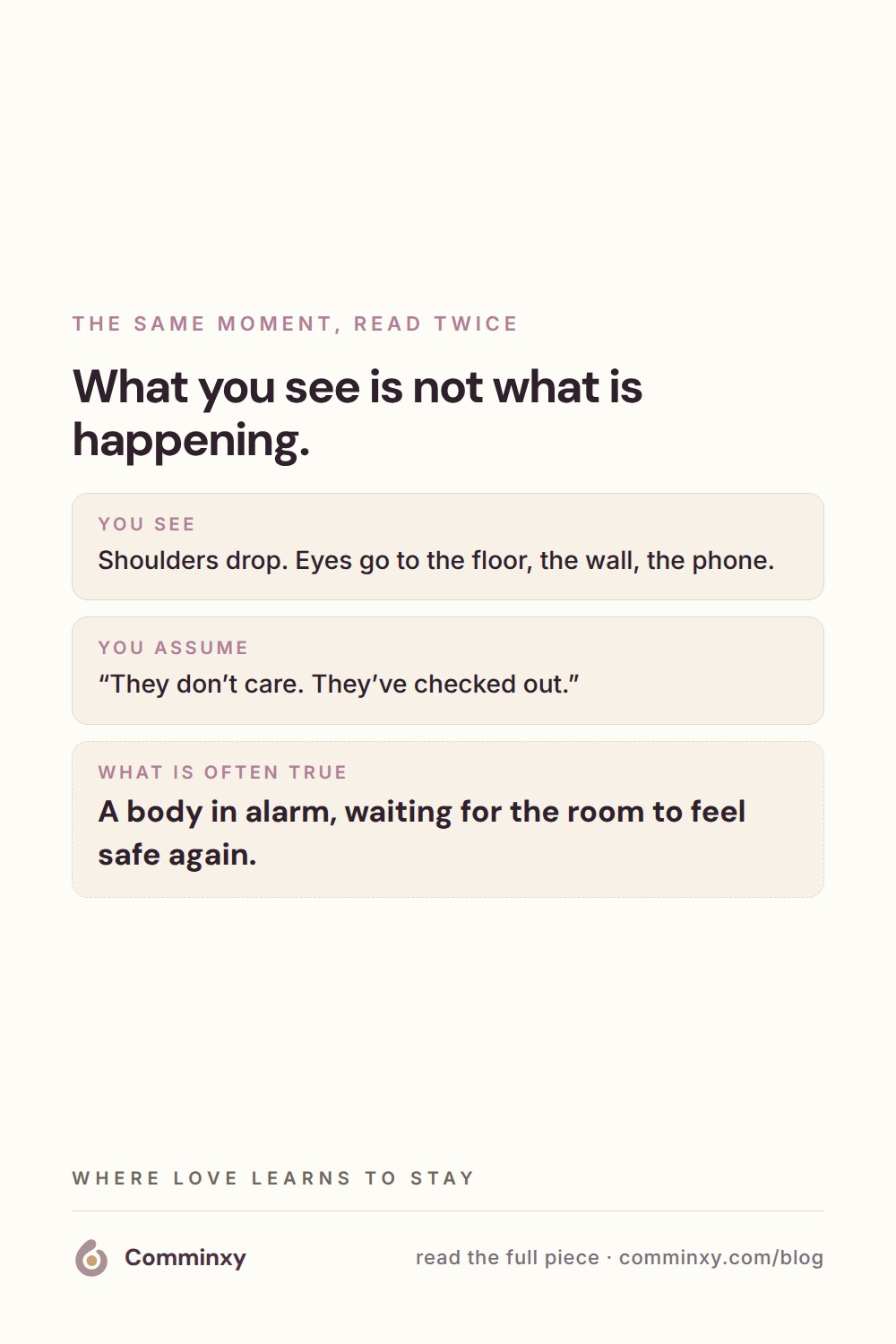
You're explaining something that matters, choosing your words carefully, and then you see it. Their face changes. Not anger, not a flinch, just a kind of emptying. The muscles around their eyes go slack. Their gaze drifts past your shoulder to the window, the bookshelf, anywhere but you. You finish the sentence anyway, but you both know the truth. When your partner shuts down during a conversation, the person you were speaking to has already left the room, even though their body hasn't moved an inch.
The strange cruelty of it is this: most of the time, you weren't even trying to fight. You were trying to be heard. And now you're alone with your own voice, speaking into a silence that feels less like a pause and more like a verdict.
What looks like not caring is often the opposite
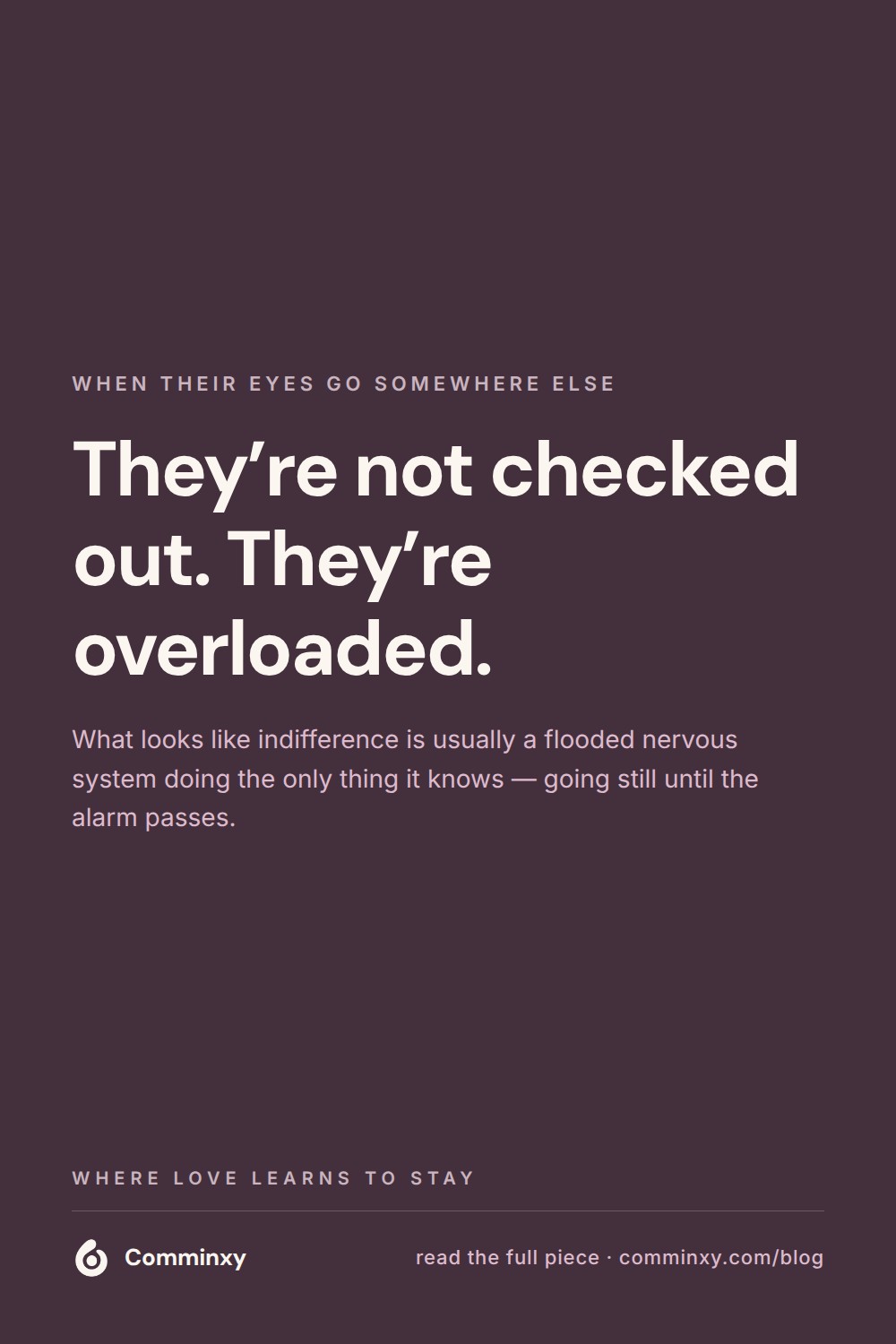
The story that arrives in that moment is almost always the harshest one available. They'd rather shut me out than deal with this. I don't matter enough for them to stay. But if you watch closely, you might notice something that doesn't fit the story. A jaw clenched tight. Hands that won't settle. A stillness that takes effort to hold.
That isn't indifference.
When John Gottman and Robert Levenson tracked couples' bodies during conflict, measuring heart rate, skin conductance, the small betrayals of the autonomic nervous system, they found that the partner who goes quiet is often the one whose body is most overwhelmed (Journal of Personality and Social Psychology, 1992). The shutdown isn't a tactic. It's a flood. Somewhere inside, the volume became unbearable, and a very old part of the brain pulled the circuit breaker to survive it.
Which changes what you're looking at, doesn't it? Not someone who feels nothing. Someone who might be feeling too much to stay present.
Why withdrawal hurts more than the argument itself
It would be simpler if the silence were harmless. A pause, a breather, nothing to fear. But the instinct that tells you something is genuinely at risk turns out to be accurate, though not for the reason you imagine. We tend to think the danger in a relationship is the fighting: raised voices, sharp words, doors slammed. The research quietly disagrees.
When Gottman and Krokoff followed couples over years, they found that open disagreement, even anger, didn't predict which relationships would collapse. Withdrawal did (Journal of Consulting and Clinical Psychology, 1989). The slow drift into not engaging at all was the pattern that mattered. So the shutdown stings for a real reason. Your partner isn't fighting you. For a moment, they've stopped fighting for the conversation. And some part of you registers that absence as the more frightening thing, because it is.
This is one of the four patterns Gottman identified as most corrosive to a bond. If you want to see how it fits alongside the others, it's worth reading about the four communication patterns that quietly wear relationships down. Naming the thing isn't a diagnosis. It's just a way to see more clearly what's happening in the room.
What actually helps when the wall goes up
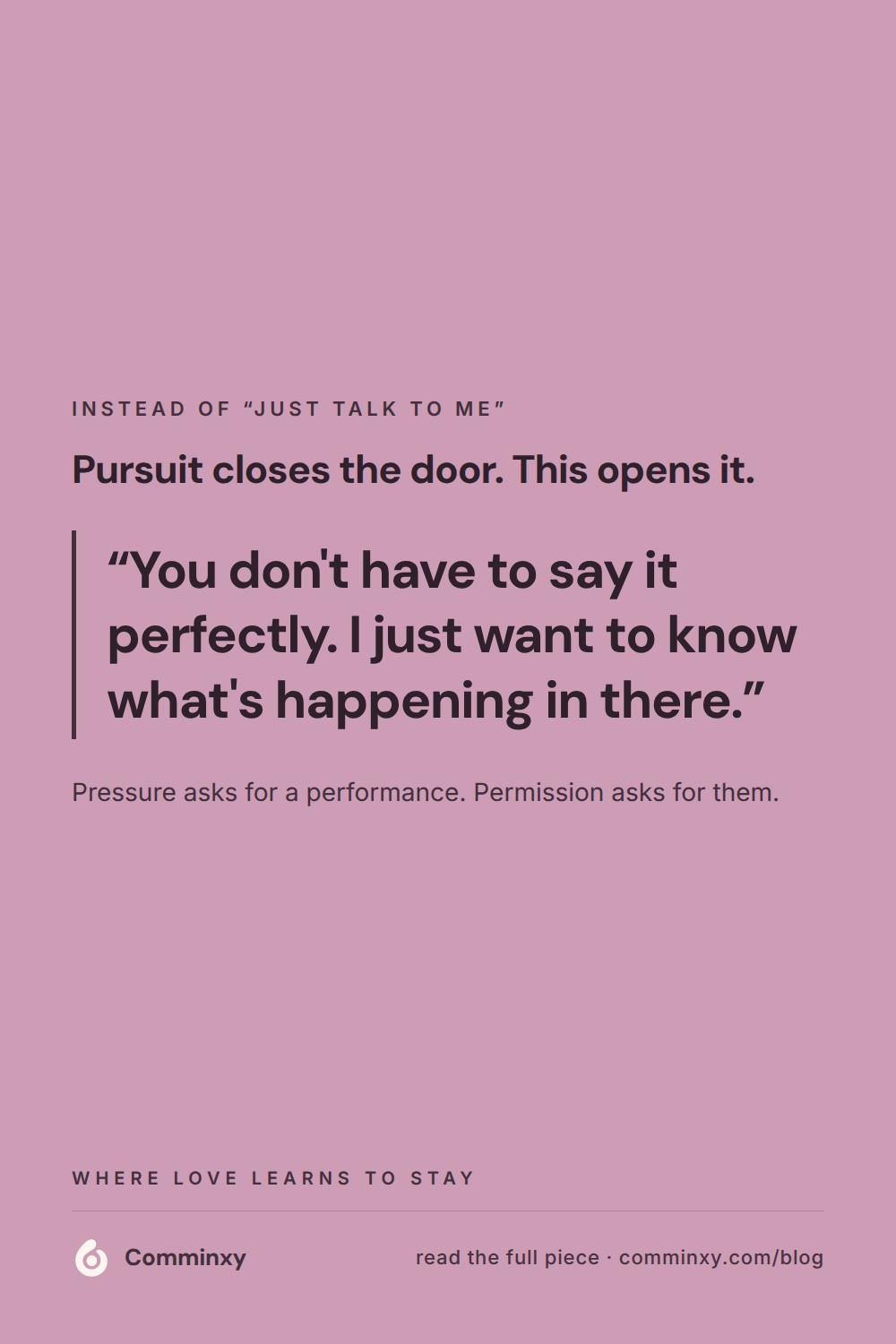
The instinct, when someone goes silent, is to turn up the volume. To add words, urgency, proof. Just talk to me. Why won't you say something. This is exactly the problem. It feels like reaching. To a flooded nervous system, it feels like rising water.
What helps is almost embarrassingly simple: less.
A flooded body cannot reason, cannot absorb nuance, cannot find words it doesn't currently have. It needs to come down first. Carrère and Gottman found that the entire trajectory of a conflict can often be predicted from how it begins, that the first few minutes set the tone for everything after (Family Process, 1999). And if the start matters that much, so does the moment you choose to pause the start and let two bodies settle before continuing.
That might sound like, "I can see this got big fast. I don't want to lose you in it. Can we sit for a minute and come back?" Not a retreat from the issue. A retreat from the flood. You're not abandoning the conversation, you're protecting the two people trying to have it. If the practical shape of that pause feels hard to picture, this piece on how to have a calm conversation when you're both upset sits right beside this moment.
The way back is smaller than you think
The couples who stay together aren't the ones who never shut down. They're the ones who found their way back. And the way back is rarely a grand repair.
When Carstensen, Gottman, and Levenson studied couples in long, steady marriages, they noticed something threading quietly through even the hardest conversations: small moments of warmth dropped into the tension. A bit of humor. A softening. A touch of affection right in the middle of conflict that worked to calm the body and keep the bond intact (Psychology and Aging, 1995). Not because these couples were avoiding the hard thing. Because they'd learned that a flooded body opens to tenderness long before it opens to logic.
So the way back might be a hand on a shoulder. A half-smile that says we're still us. A sentence as plain as, "I'm not going anywhere, I just got overwhelmed." It's small on purpose. The shutdown was never asking for the perfect argument. It was asking, underneath everything, whether it was still safe to come back.
The repair is simply you answering yes.
Leaving the light on
Think again about that moment. Your words still hanging in the air, their eyes somewhere else. What if the silence in front of you isn't a closed door but a held breath? Not someone walking away from you, but someone who hasn't yet found the path back into the room, and is quietly hoping you'll leave the light on while they do.
You won't always get this right in the moment. Almost no one does. The flood comes too fast and the old story arrives too loud. But you can get better at noticing, at catching the held breath instead of only the silence, at offering a smaller, softer way back. That noticing is something Comminxy was built to sit beside you in: helping you read the moment a little more clearly, and find your way back to each other a little sooner. The silence was never the end of the conversation. It was your partner, somewhere inside it, still waiting for the chance to return.
Questions people ask
why does my partner shut down when we argue
Their nervous system is likely flooded and overwhelmed, not refusing to engage. Research shows the partner who goes quiet often has the highest physiological stress response during conflict. The shutdown is a survival response, not a choice to ignore you.
what to do when your partner shuts down during a fight
Pause the conversation and give them space to regulate before continuing. A flooded body cannot process words or reason until it calms down. Try saying something like you can take a break and come back when you are both settled.
is stonewalling the same as shutting down
Shutting down is often an involuntary flood response, while stonewalling can be more deliberate withdrawal. Both look similar from the outside but shutting down usually means the person is overwhelmed, not punishing you. The distinction matters because the response needed is different.
how to reconnect after partner shuts down
Small gestures of warmth work better than logic or more words. A touch, a bit of humor, or a simple statement like I am not going anywhere can help their nervous system settle. Wait until they have calmed before returning to the conversation.
Keep the idea with you — pin it, or download the cards.


Comminxy helps you notice the flood sooner and find your way back together
Get Comminxy free →