The 4 Communication Patterns That Destroy Relationships (and How to Catch Them Early)
You are standing outside the hospital room where your father is recovering, and your partner has just said something about needing to get back for work in the morning. The sentence itself is reasonable. The timing is not. You feel something tighten in your chest, something you cannot quite name yet, but you know this shape. You have been here before. Not in this corridor, but in this feeling: the sense that you are about to have the same fight you have already had, using different words but landing in the same silence.
That feeling is not wrong. The communication patterns that destroy relationships are rarely single events. They are shapes that repeat, grooves worn so deep you stop noticing you are walking in them. And because they repeat, they can be learned. Which means they can also be unlearned.
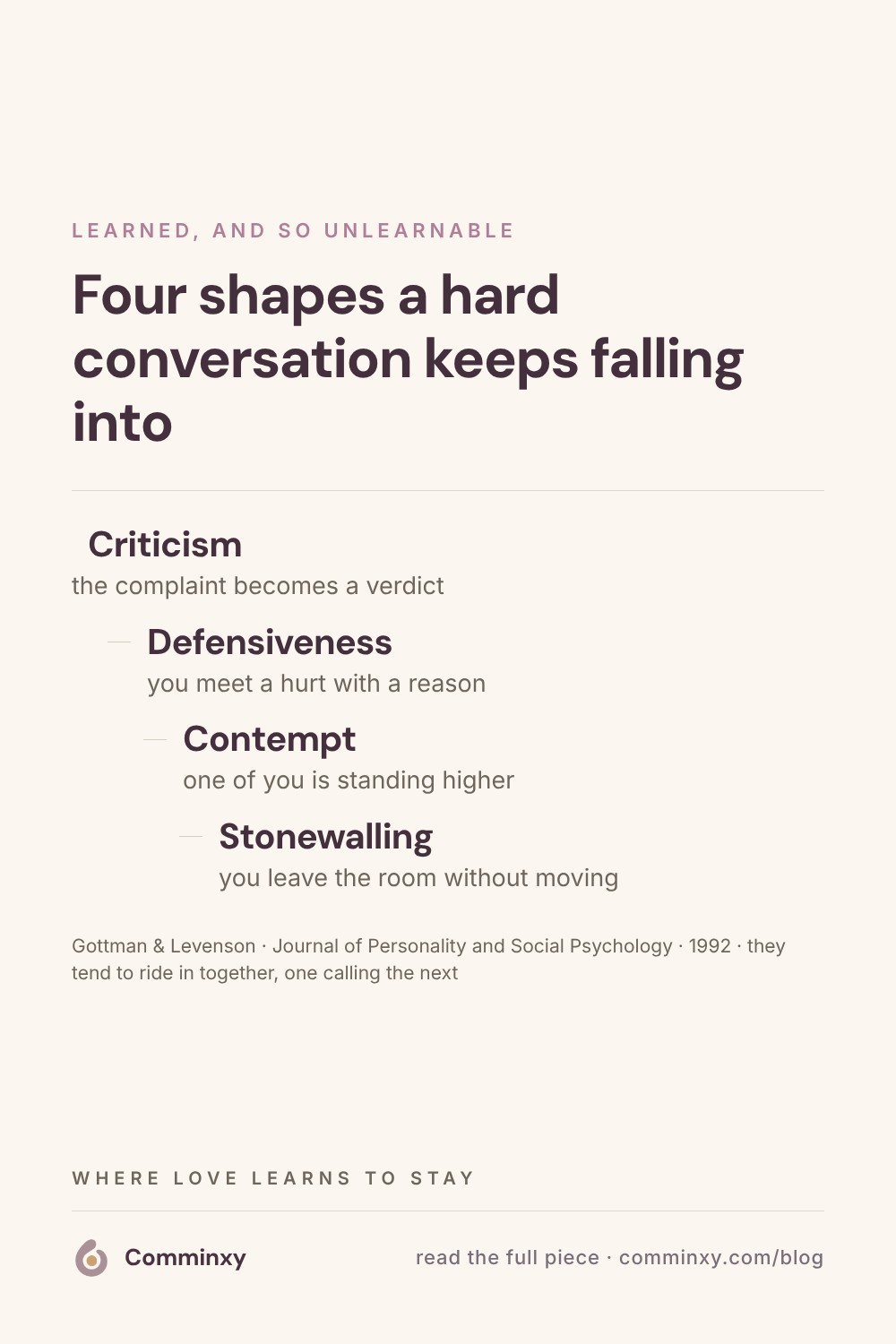
Four shapes a hard conversation keeps falling into
There is criticism, the moment a specific complaint becomes a verdict about who someone is. Not "you didn't answer my call," but "you never think about anyone but yourself." There is defensiveness, the reflex to meet hurt with reasons, to explain instead of receive. There is contempt, the eye-roll or the small sneer, the sense that one person has quietly climbed onto higher ground. And there is stonewalling, the partner who goes silent mid-argument, who looks away, who leaves the room without moving.
These four matter because they predict what happens next. When Gottman and Levenson tracked couples over time, criticism, defensiveness, contempt, and stonewalling predicted divorce with striking accuracy. They named them the Four Horsemen, not to frighten anyone, but because they tend to ride in together, one calling the next.
Your body gets there before your words do
By the time you say the cruel thing, your body decided long before. The partners who slid toward separation were the ones whose hearts were racing, whose hands had gone cold, whose nervous systems had quietly flooded with alarm (Gottman & Levenson, Journal of Personality and Social Psychology, 1992). Stonewalling especially is rarely the coldness it looks like from the outside. More often it is someone so overwhelmed they have gone numb, not refusing to engage but physically unable to.
This changes who the enemy is. You are not a cruel person married to a cold one. You are two people whose bodies are sounding an alarm faster than either of you can think. The contempt, the defending, the going quiet: these are what frightened nervous systems do when they have run out of better options.
The fight is mostly decided before it begins
If you have ever felt that an argument was lost in the first thirty seconds, you were not imagining it. When Carrère and Gottman watched newlyweds begin a disagreement, they found that the outcome of a fifteen-minute conversation could be predicted from the first three minutes, ninety-six percent of the time.
Three minutes.
That is not a sentence about doom. It is a sentence about leverage. The most important part of a hard conversation is not the resolution you reach at the end but the way you walk in at the start. A complaint that opens softly invites a different ending than a verdict that opens hard. The whole shape of the thing bends around those first words. If you have felt the two of you spiral the instant a conversation begins, there are gentler ways to walk into the room when you're both already upset.
The way back is smaller than you think
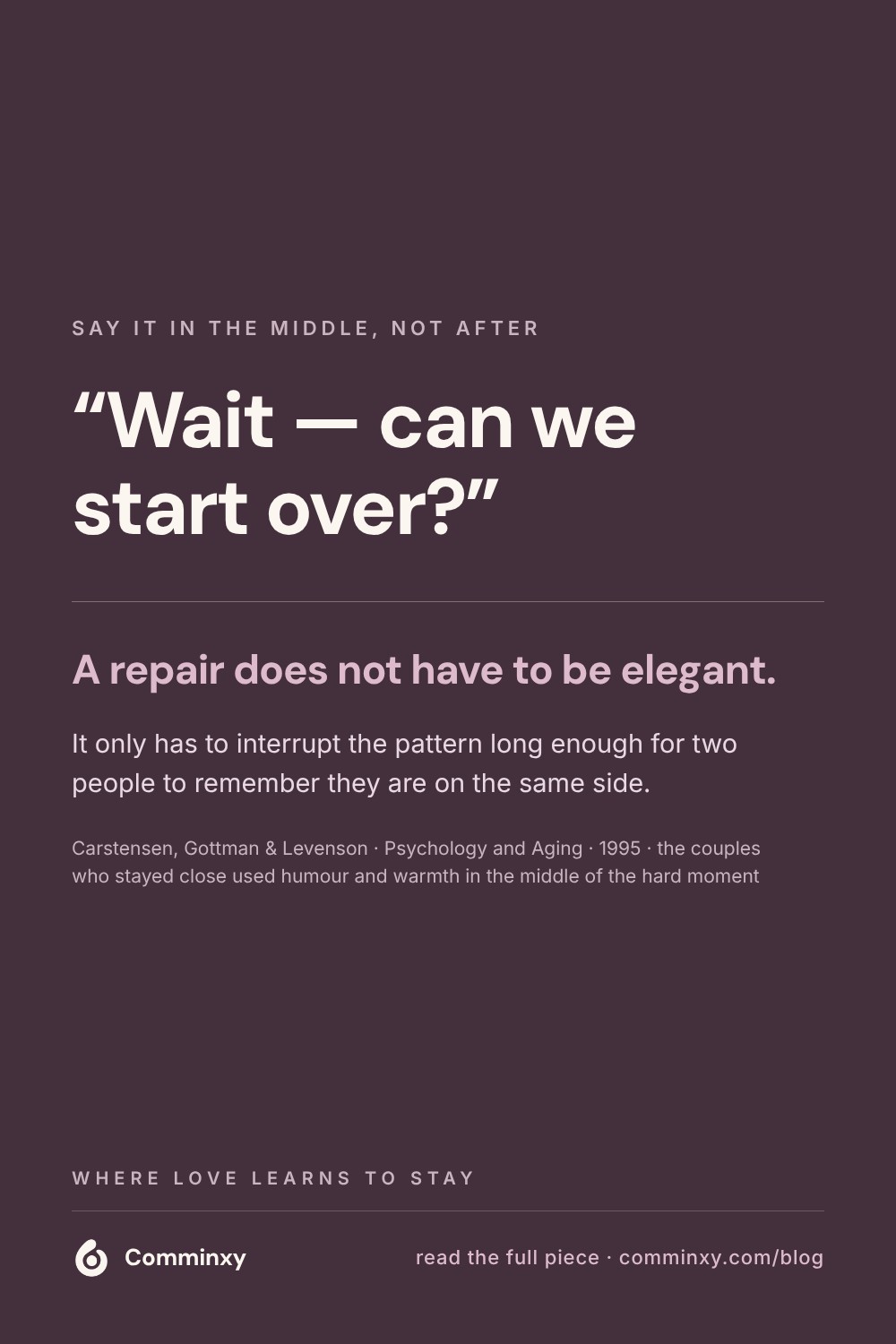
Couples who last are not the ones who never reach for criticism or contempt. What sets steady couples apart is what they do during the hard moment, the small repairs they offer while the fight is still going. Carstensen, Gottman, and Levenson watched older couples who had stayed close for decades, and found that the happy ones used humor and affection right in the middle of conflict, soothing their own bodies and each other's as they went.
A repair is not a grand apology delivered later, when you have both cooled down and rehearsed your lines. It is a hand reaching across the table mid-argument. It is "wait, can we start over?" It is a clumsy joke that lands at the worst possible moment and somehow saves the whole evening. It doesn't have to be elegant. It only has to interrupt the pattern long enough for two nervous systems to remember they are on the same side.
And if a conversation has already gone past that, if words were said that are still sitting in the air between you, that too has a path back. What comes after the words you can't unsay matters far more than the words themselves.
What this means for the corridor you're standing in
So here you are again, outside the hospital room, the old script rising in your throat. Nothing in the research says this moment has to end the way it always has. The pattern is real, but it is only a pattern, a groove the two of you have worn into the floor by walking the same way so many times. Grooves can be walked out of. Not perfectly, not all at once, but in small turns: a softer first sentence, a hand offered before the body floods, a joke that breaks the spell.
You do not have to catch every horseman or get the opening three minutes right every time. You only have to notice, once, that you are following the script, and choose a different next line. That noticing is the beginning of everything. It is what Comminxy was built to help with: not to fix you, but to help you see the pattern a little sooner, while there is still time to turn. Love learns to stay not in the absence of hard conversations, but in the small, stubborn ways you find your way back to each other inside them.
Questions people ask
what are the four horsemen in relationships
The four horsemen are criticism (turning a complaint into a character verdict), defensiveness (meeting hurt with explanations), contempt (communicating from a place of superiority), and stonewalling (shutting down or going silent during conflict). Research shows these four patterns predict divorce with striking accuracy because they tend to call each other in, one triggering the next. They matter not because they appear once, but because they become grooves couples fall into repeatedly.
why does my partner shut down during arguments
Stonewalling usually happens when someone is so physiologically overwhelmed that their nervous system has flooded and they go numb, not because they refuse to engage but because they physically cannot in that moment. Their heart is racing, their hands may be cold, and their body has sounded an alarm that makes thinking clearly nearly impossible. It looks like coldness from the outside but is more often a sign that someone has hit their limit and needs the conversation to pause.
how do you stop repeating the same fight with your partner
Start by noticing the pattern while it is happening, especially in the first three minutes when the outcome is usually decided. A softer opening sentence, a small repair attempt mid-argument (like a hand across the table or asking to start over), or a moment of humor can interrupt the groove long enough for both nervous systems to settle. You do not need to get it right every time, just once in a while, to begin walking a different path.
what is a repair attempt in a relationship
A repair attempt is a small gesture made during a conflict, not after, that interrupts the negative pattern and helps both people remember they are on the same side. It can be asking to start over, reaching for a hand mid-argument, or even a clumsy joke that lands at the worst moment but somehow breaks the tension. It does not need to be elegant or perfectly timed, just genuine enough to stop the spiral before it goes too far.
Keep the idea with you — pin it, or download the cards.



Comminxy helps you see the pattern early, while there is still time to turn
Get Comminxy free →