When Couples Cannot Talk to Each Other, Divorce Often Begins in the First Three Minutes
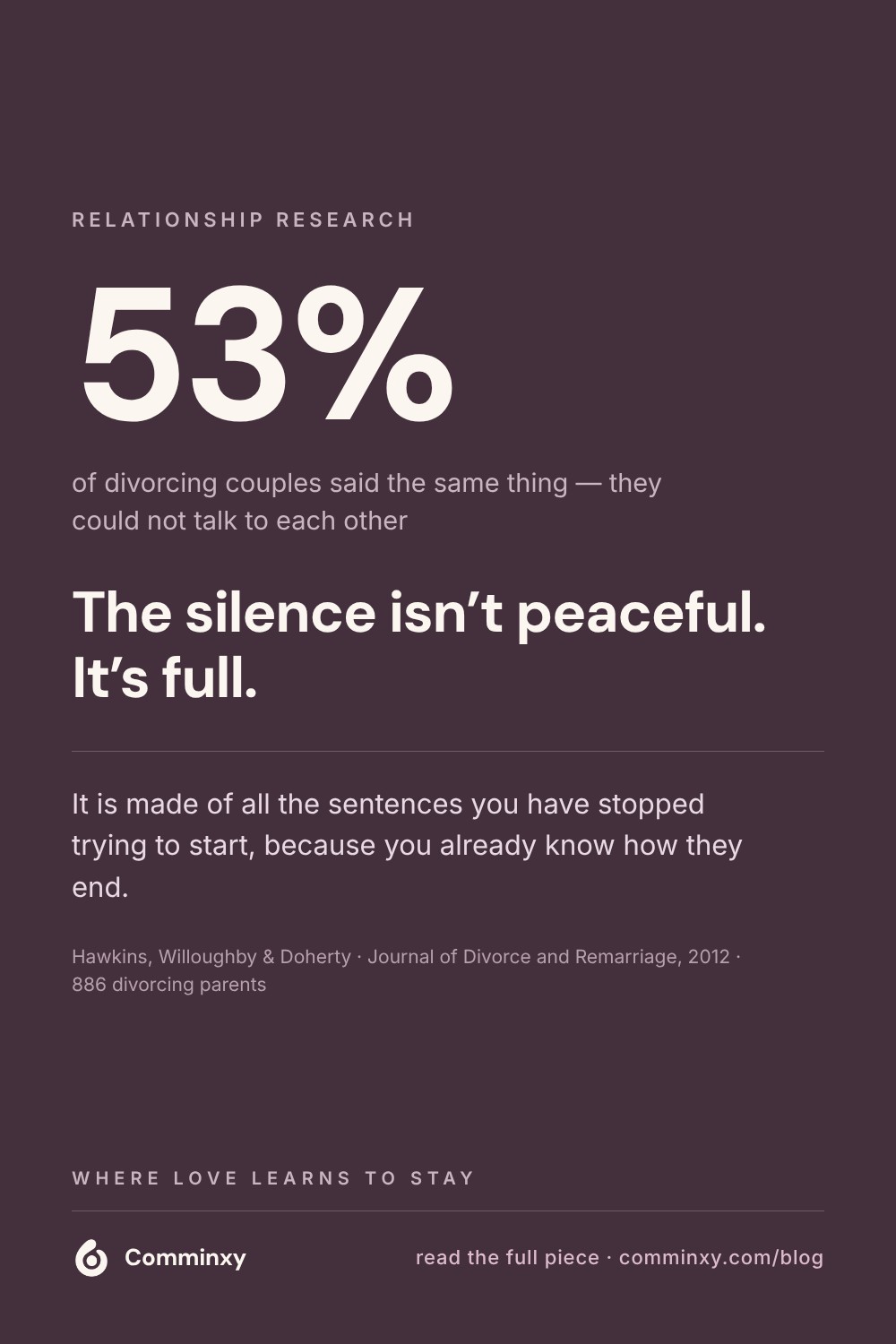
You have started this sentence four times in the last month. Once in the queue at the chemist, once with your hand already on the door, twice at three in the morning. Each time you got as far as the first few words and stopped, because you already know the shape of what comes back. The silence isn't peaceful. It's full. It is made of all the sentences you've stopped trying to start because you already know how they end.
If that is where you are, you are not failing at love. You are living through one of the most common and least talked-about experiences in long relationships. When couples cannot talk to each other, divorce can feel less like a decision and more like a slow forgetting of how you used to reach each other. More than half of divorcing couples, fifty-three percent in some surveys, name communication as the thing that broke. That number hides something gentler than it first appears.
It rarely starts as silence
The silence did not begin as silence. It began earlier, in the first few seconds of a hundred small conversations.
Relationships are imagined to end in one great argument, the kind that slams doors. Far more often they end in something quieter than that. The trouble lives in the opening. In the tone of the first sentence. In whether the very first thing said carries toward the other person or away from them.
Carrère and Gottman, writing in Family Process, found that the way a couple begins a conflict discussion in its first three minutes predicted the outcome of the whole fifteen-minute conversation ninety-six percent of the time, and went on to predict marital stability or divorce six years later. Three minutes. Barely long enough to put the kettle on.
That is not a fact to be frightened by. It means the problem is smaller and far more specific than the heavy word communication suggests. You have not lost the ability to talk to each other. What has happened is that the first three minutes have learned to brace for impact.
Why the opening turns hard
The harshness in those first three minutes usually comes from exhaustion rather than from cruelty.
When you have raised the same subject many times and felt unheard each time, your nervous system stops expecting tenderness. So you lead with the strongest version of your feeling, because the soft version got lost before. You open loud because quiet did not work. Your partner, hearing the loudness, braces too. And now two people who love each other are each defending against a threat neither of them sent.
Fincham, Harold and Gano-Phillips, in the Journal of Family Psychology, traced a loop running in both directions between how partners explain each other's behaviour and how satisfied they feel, each quietly feeding the other over time. Once a partner's sigh reads as against you rather than tired beside you, the next conversation starts a little further back. Not because anyone is bad. Pain teaches caution, and caution sounds a lot like distance.
The first sentence is the one you can change
If the first three minutes carry that much weight, they are also where the smallest change does the most work.
This is not about scripts or clever phrases. It is the difference between walking in with "You never think about me" and walking in with "I felt far from you tonight and I don't want to." Both come from the same ache. One opens a door. The other braces it shut.
You do not have to fix the whole conversation. You only have to soften how it starts. When an opening is gentle, the body listening to it does not have to defend itself, and a person who is not defending can actually hear you. This is why learning how to have a calm conversation when you're both upset has less to do with staying calm throughout and more to do with how you set the first sentence down on the table between you.
What a way back actually looks like
Couples who find their way back have not stopped having bad openings. They have learned to notice one while it is still happening, and turn round.
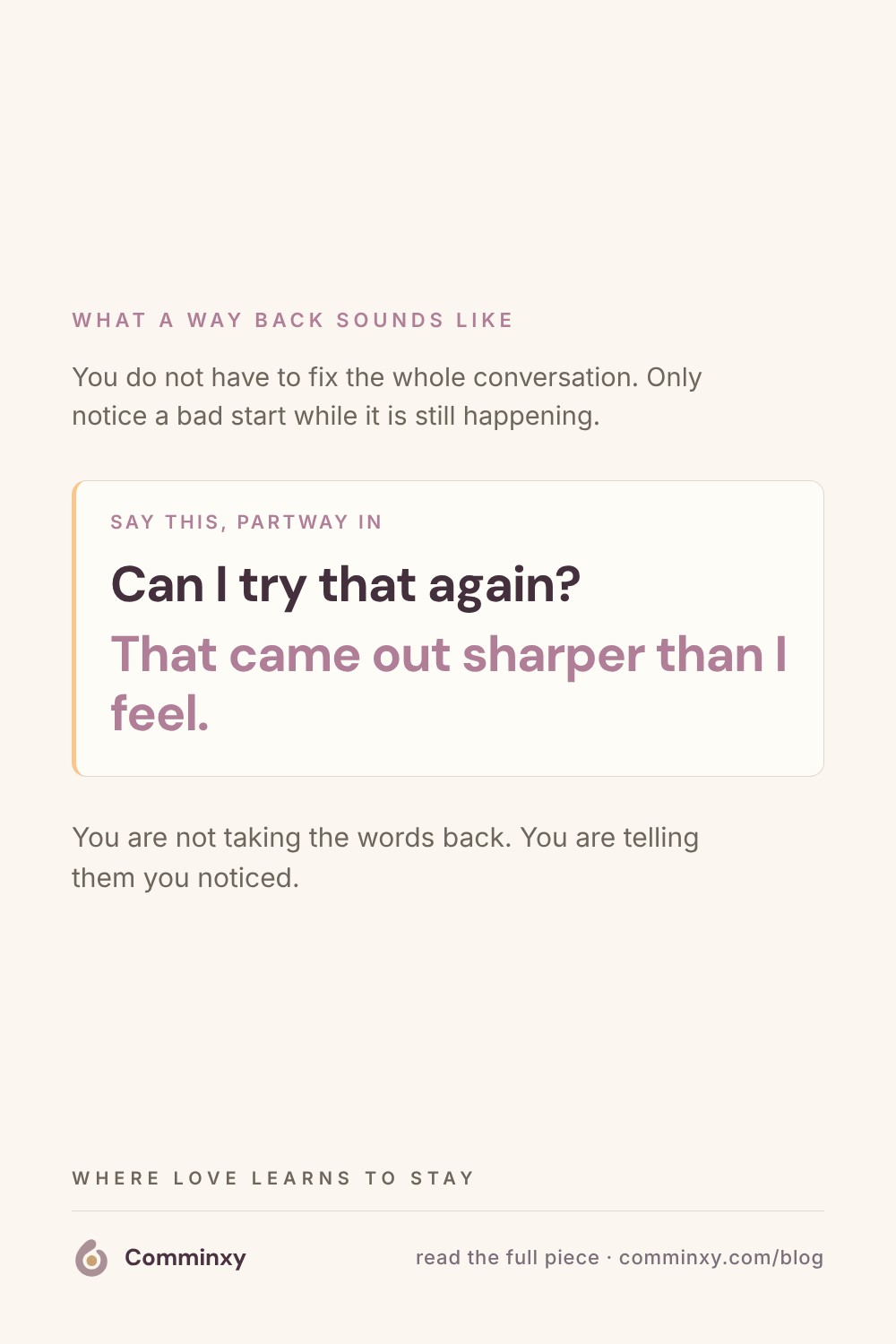
It looks small. One person saying, partway in, "Can I try that again? That came out sharper than I feel." A hand reaching across a counter mid-sentence. Someone laughing at themselves and admitting they walked in armed for a fight that was not there.
That is repair, and it is the most underrated skill in a long relationship. Not the absence of rupture. The return after it. It works through a screen too, where so many of the hardest openings now happen. A text stripped of warmth starts the same braced reaction a sharp voice does, which is why it helps to understand why tone gets lost in text and how to add it back. The first three minutes of a message thread matter as much as the first three across a table.
You have not forgotten how to reach each other
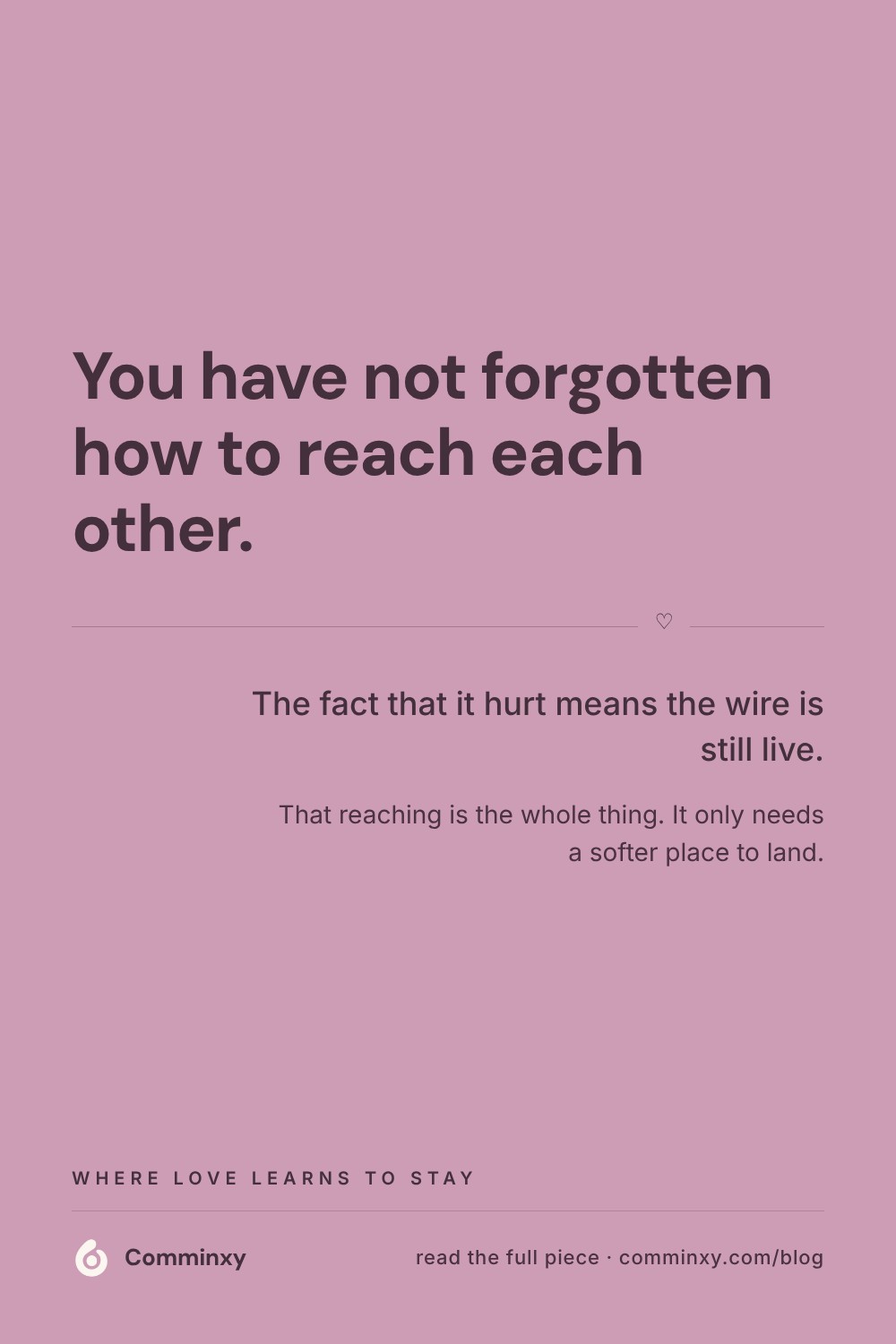
For anyone reading this in the dark, replaying a conversation that went sideways tonight: the fact that it hurt means the wire is still live. People who have genuinely stopped caring do not lie awake editing a first sentence in their head. They do not feel a silence as a weight. You feel it because some part of you is still trying to reach across, and that reaching is the whole thing.
You will also get this wrong. You will read all of this, mean every word, and open the next hard conversation badly anyway, probably this week. That is not proof of anything except that you have a nervous system. The couples who come back are not the ones who stopped bracing. They got quicker at noticing.
So go back to that sentence you keep starting. The one you have abandoned four times. It does not have to arrive perfectly and it does not have to arrive tonight. But the next time you get as far as the first few words, you might set them down gently instead of bracing them, and find that the person across from you does not have to defend. Comminxy sits in that moment with you, inside your own first three minutes, offering a softer way in. Not so that you never struggle. So that the way back stays open.
Questions people ask
Can a marriage survive when you cannot talk to each other?
Often yes, because the problem is usually narrower than it feels. What breaks down is typically how conversations start rather than the ability to talk at all. Couples who recover tend to change the opening, not their whole way of relating.
Why do our conversations go wrong so fast?
Because the first few seconds set the tone and both of you are braced before anyone has finished a sentence. After enough unheard attempts, the nervous system stops expecting a gentle reply and opens loud instead.
Is bad communication really the main cause of divorce?
It is the most commonly named reason, cited by more than half of divorcing couples in some surveys. That figure is less bleak than it sounds, because it points at something specific and learnable rather than at incompatibility.
What do I say when a conversation has already started badly?
Stop partway and say so. Something as plain as that came out sharper than I meant, let me try again does more than pushing through. Turning round mid conversation is a skill, and it is the one that matters most.
Keep the idea with you — pin it, or download the cards.


The sentence you keep abandoning is worth one gentler attempt.
Get Comminxy free →