How to Rebuild After Hurting Your Partner When You Are the One Who Caused the Pain
You saw the look on their face. That second when something in them closed. Maybe you said the thing you knew would land hardest. Maybe you forgot something that mattered, or chose wrong, or let them down in a way you can't pretend was small. And now you're lying there replaying it, sick with the knowing: this time, you were the one who caused the pain.
There is no comfort in being the one who hurt someone you love. You don't get to feel wronged. You don't get the clean ache of being the injured party. You just have to sit with what you did and the face that closed. If you're trying to figure out how to rebuild after hurting your partner, the first thing worth saying is this: the wish to rebuild is already something. Plenty of people don't get that far.
The instinct that makes it worse
When we hurt someone, the body does something unhelpful. It wants to defend. To explain. To say but you don't understand why I did it. The explanation might even be true. But to the person who is hurting, an explanation arriving too early sounds like an argument. It sounds like you are trying to win back the moral ground rather than sit with what you cost them.
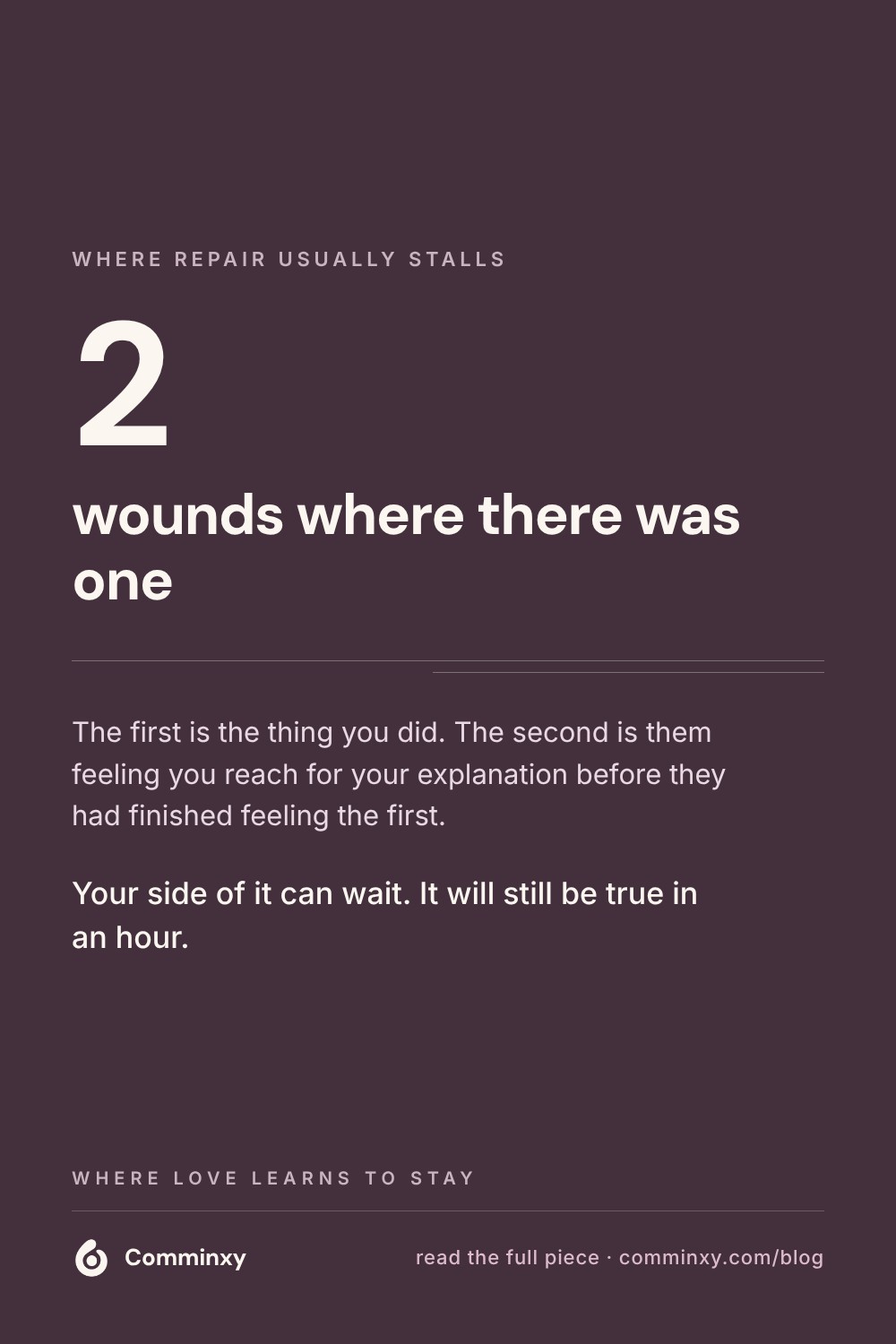
This is where so many repairs die. Not in the original wound, but in the rush to be understood before the other person has even been allowed to feel hurt. You reach for your side of the story. They feel you slipping away from their pain. And now there are two wounds where there was one.
Why the defending feels so urgent
It isn't weakness or selfishness. It's biology. Gottman and Levenson found that during conflict, partners experience real physiological arousal (racing heart, flooding nervous system) and that this flooding is what separates couples who recover from couples who decline over time. When you are flooded, you cannot think clearly about repair. You can only protect yourself.
So that urge to defend, to explain, to fix it in the next thirty seconds? That's a flooded body trying to make the danger stop. Knowing this doesn't excuse anything. But it tells you something useful: if you feel that frantic pull to justify yourself, you are probably not in a state to repair well yet. The most honest thing you can do in that moment is not speak better. It's wait until your own body settles. If you're not sure how to get there together, having a calm conversation when you're both upset is its own skill, and it's learnable.
What an apology is actually for
Most of us were taught that an apology is a transaction. You say sorry, they say it's okay, the debt clears. So we apologise and then we wait, slightly impatient, for absolution. And when it doesn't come fast enough, we feel hard done by, as though we've paid and not received our change.
But an apology isn't a payment. It's a message. The message is: I see what I did to you, and your pain matters to me more than my comfort does. The words barely matter. What matters is whether your partner believes the message underneath them. You can say sorry perfectly and communicate nothing. You can say it clumsily and communicate everything, if your whole self is turned toward them rather than toward your own defence.
This is why "I'm sorry you feel that way" lands like a slap. It's an apology with the message removed. It hands the hurt back to them and keeps your hands clean. They hear it instantly, every time.
What repair actually looks like
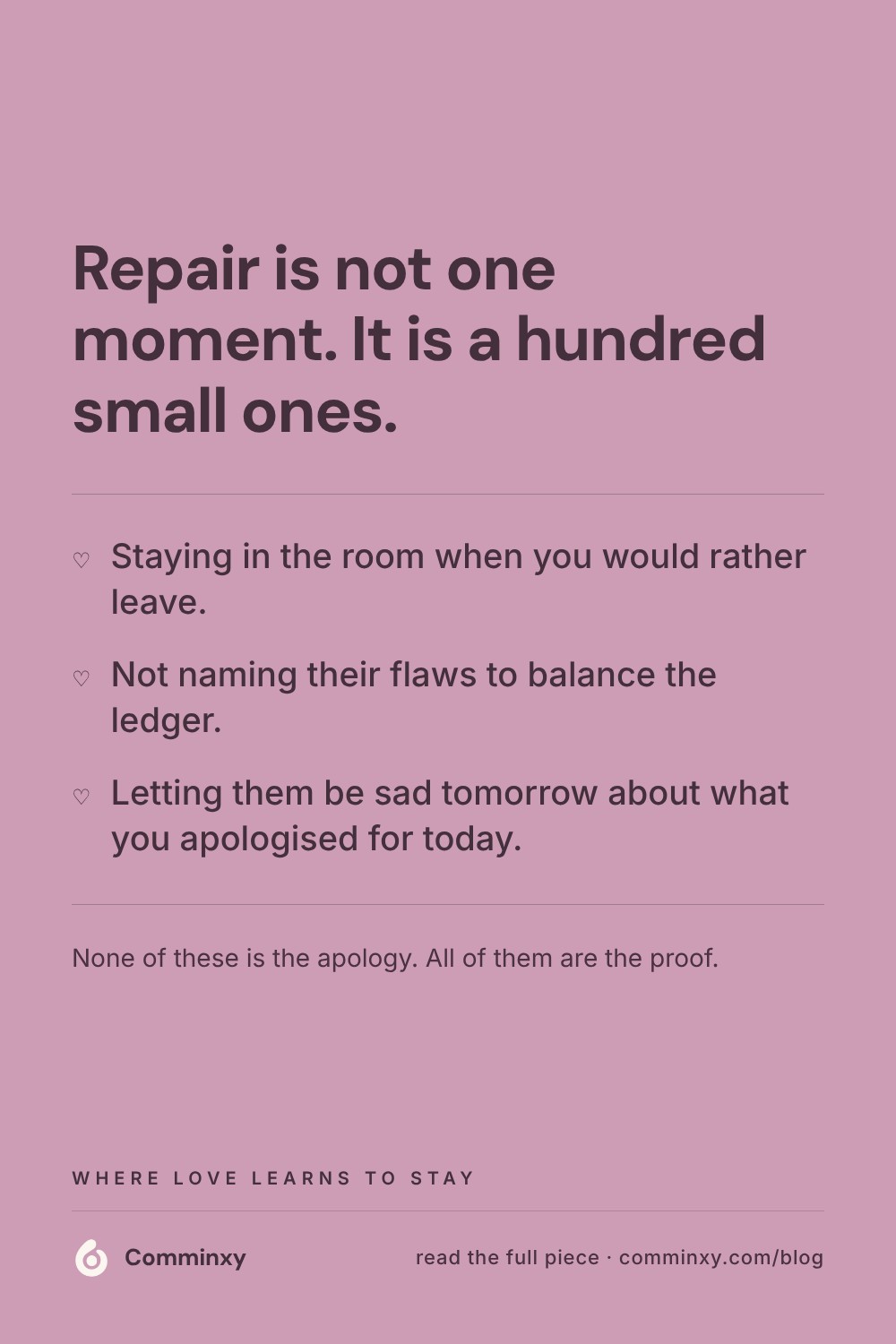
Repair is not one grand moment its a hundred small ones. It's staying in the room when you'd rather leave. It's not bringing up their flaws to balance the ledger. It's letting them be angry tomorrow about the thing you apologised for today, without sighing as if they should be over it by now.
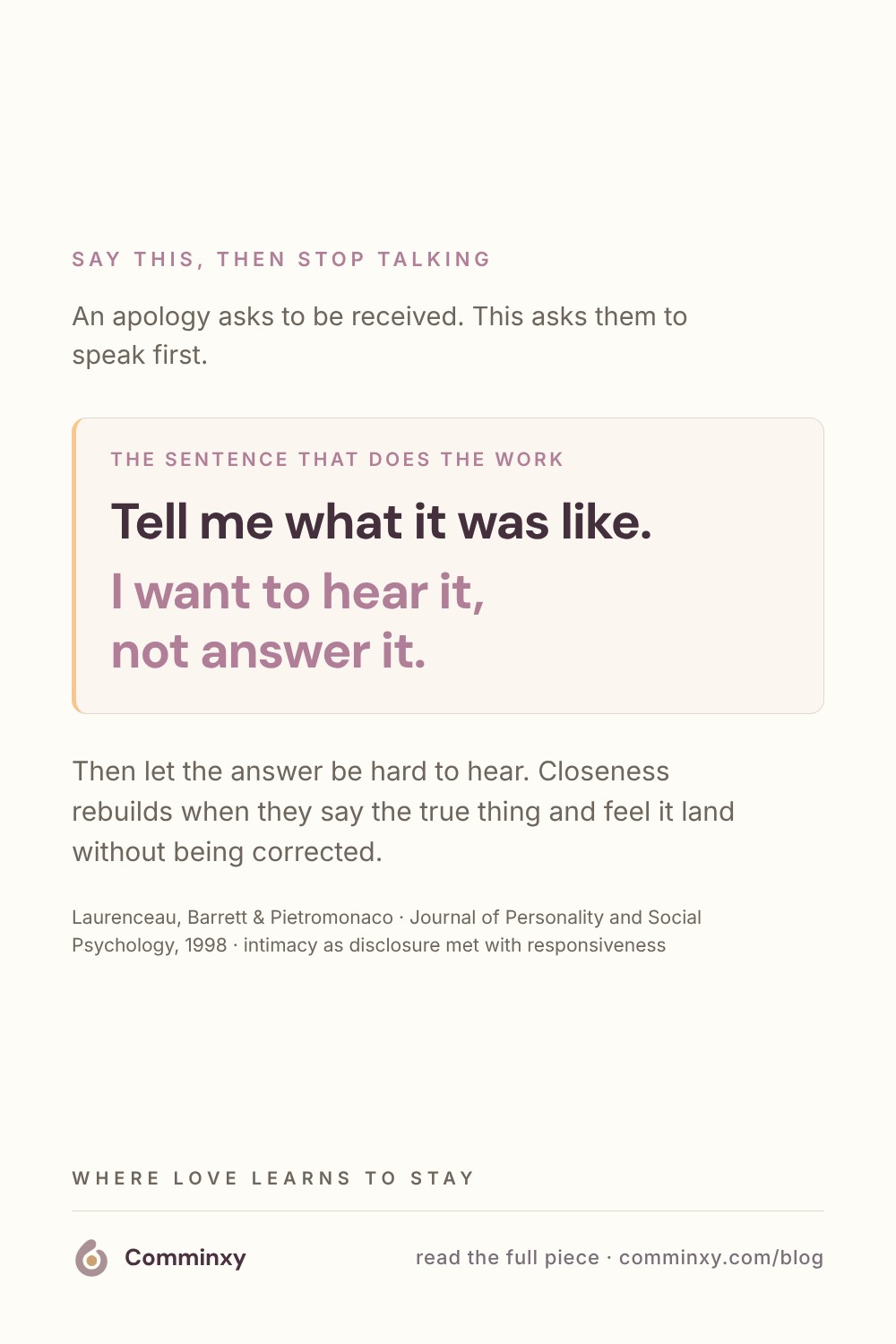
Laurenceau and colleagues found that intimacy is built through a back-and-forth process: one person discloses something real, the other responds in a way that makes them feel understood, and that sense of being responded to is what actually deepens closeness. What this means after you've caused hurt is quietly enormous. Repair doesn't happen when you deliver the perfect sentence. It happens when your partner tells you how it felt, and you receive it without flinching, defending, or correcting. Their disclosure. Your responsiveness. That's the actual mechanism of getting close again.
Which is why the most important thing you can do after hurting someone is often to stop talking and start listening. Ask what it was like for them. Then let the answer be hard to hear. The willingness to hear it (fully, without managing it) is the repair. Not the apology before it.
The part nobody tells you
You will want forgiveness to arrive on a schedule. It won't. Trust doesn't rebuild because you've decided enough time has passed. It rebuilds in the small evidence: that you can be trusted again, that the thing that happened isn't happening again, that you've actually changed something and not just felt bad for a weekend.
And here's the part that's genuinely hard: some of rebuilding has nothing to do with your partner. It's about becoming someone who wouldn't do the thing again. That's slower and lonelier work, and no apology substitutes for it. If you said something you can't take back, there's a particular path through recovering after words you wish you hadn't said, but the principle is the same everywhere. Repair is proven, not promised.
So go back to that moment. The closed face, the silence, the sick feeling in your chest. You can't unmake it. But you can be the person who turned fully toward it instead of away. Most hurt in a relationship isn't ended by being right. It's softened by being present, again and again, until the person you hurt starts to feel safe near you once more. That doesn't happen in a night. It happens in the staying. Comminxy exists for exactly these stretches (the ones where you want to find your way back but keep tripping over your own defences) because this is where love learns to stay.
Questions people ask
how long does it take to rebuild trust after hurting your partner
There is no set timeline because trust rebuilds through accumulated evidence that you have changed, not because enough days have passed. It happens in small repeated moments where your partner sees you are different, which can take weeks or months depending on the hurt and the consistency of your actions. Wanting it to move faster is normal but does not speed it up.
why does my partner keep bringing up what I did even after I apologised
Because an apology is not a transaction that clears the slate, and your partner may still be processing the hurt or testing whether you truly understand the impact. Repair happens over time through you staying present and listening, not through one perfect sorry. Getting impatient about them still being hurt often signals to them that you want to move on more than you want to understand.
what to do when you keep defending yourself instead of apologising properly
That defensive urge means your nervous system is flooded and you are in self-protection mode, which makes real repair impossible in that moment. The most honest move is to pause, let your body calm down, and return to the conversation when you can actually listen without justifying. Recognising you are flooded is not an excuse but it helps you avoid making things worse.
Keep the idea with you — pin it, or download the cards.


Comminxy helps you stay when your instinct is to defend or run
Get Comminxy free →