How to Stop Fighting Over Text With Your Partner Before the First Word Lands Wrong
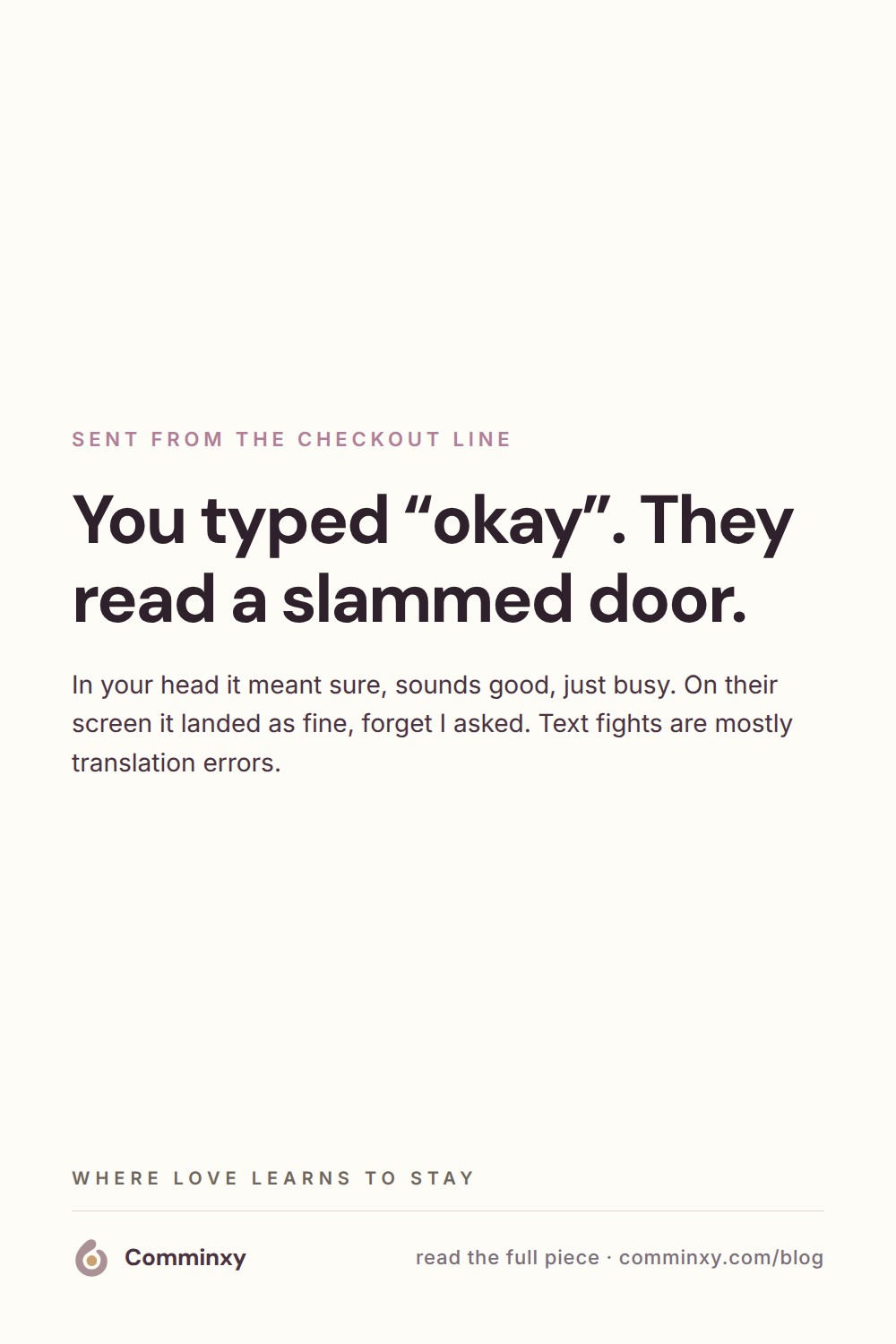
You typed okay. Just that. One word, no period, sent from the checkout line while the person behind you loaded their groceries onto the belt. In your head it meant okay, sure, sounds good, I'm just busy right now. Three hours later you come back to your phone and there are four messages waiting, each one a little cooler than the last, and somewhere in there is the sentence fine, forget I asked. And you stand there, bags in hand, thinking: what just happened? This is how most people start to stop fighting over text with a partner: by understanding that the fight wasn't started by cruelty or distance, but by a single word that carried an entire tone the other person never heard.
You weren't there when they read it. That's the whole thing. You didn't get to lean it a certain way, to soften it with your face, to send the small laugh that would have told them you weren't annoyed. They received a word stripped of everything that usually rides alongside it, and their mind filled the silence with the worst plausible version.
The words arrived, but you didn't
A text fight is strange because nothing was actually said. Everything that mattered wasn't said, because it couldn't be. When you speak to someone across a table, most of what you mean travels in the parts that aren't words: the pause before you answer, the warmth or flatness in your voice, the eyes that stay soft even when the sentence is sharp. Strip all that away and hand someone eight characters on a lit screen, and you've asked them to guess. And people under stress don't guess generously.
So the reframe worth sitting with is this: you didn't have a conflict about what you texted. You had a conflict about what got added to what you texted. The tone wasn't in the message. It was assembled, on the other end, out of whatever your partner was already carrying that day. The meeting that went long, the tiredness, the older ache of feeling unimportant. Your okay was a blank canvas, and it got painted.
Why the first few lines decide everything
There's a reason the fight was practically over before either of you had explained yourselves. Carrère and Gottman, studying how newlyweds began conflict conversations in Family Process, found that the way a couple started a disagreement in its first three minutes predicted the outcome of the whole fifteen-minute discussion ninety-six percent of the time. The beginning wasn't a warm-up. It was the verdict.
Now imagine that principle inside a phone, where the "first three minutes" is a single opening line with no face to soften it. If a text lands as slightly cold (okay, whatever works, we'll see), the reader's nervous system flags it, and every message after that gets read through that flag. You've probably felt this from the inside. Once a thread tips, you find yourself re-reading their earlier texts and suddenly they all look clipped. Nothing changed except your reading of them. The harsh start-up doesn't need harsh words on a screen. It just needs one ambiguous phrase and a tired person to interpret it.
The repair that fits in a text bubble
The good news: if a text fight is built almost entirely out of missing tone, then tone is also the thing that can dismantle it. And you can add it back deliberately. This isn't about becoming a more careful texter forever. It's about knowing where the leak is.
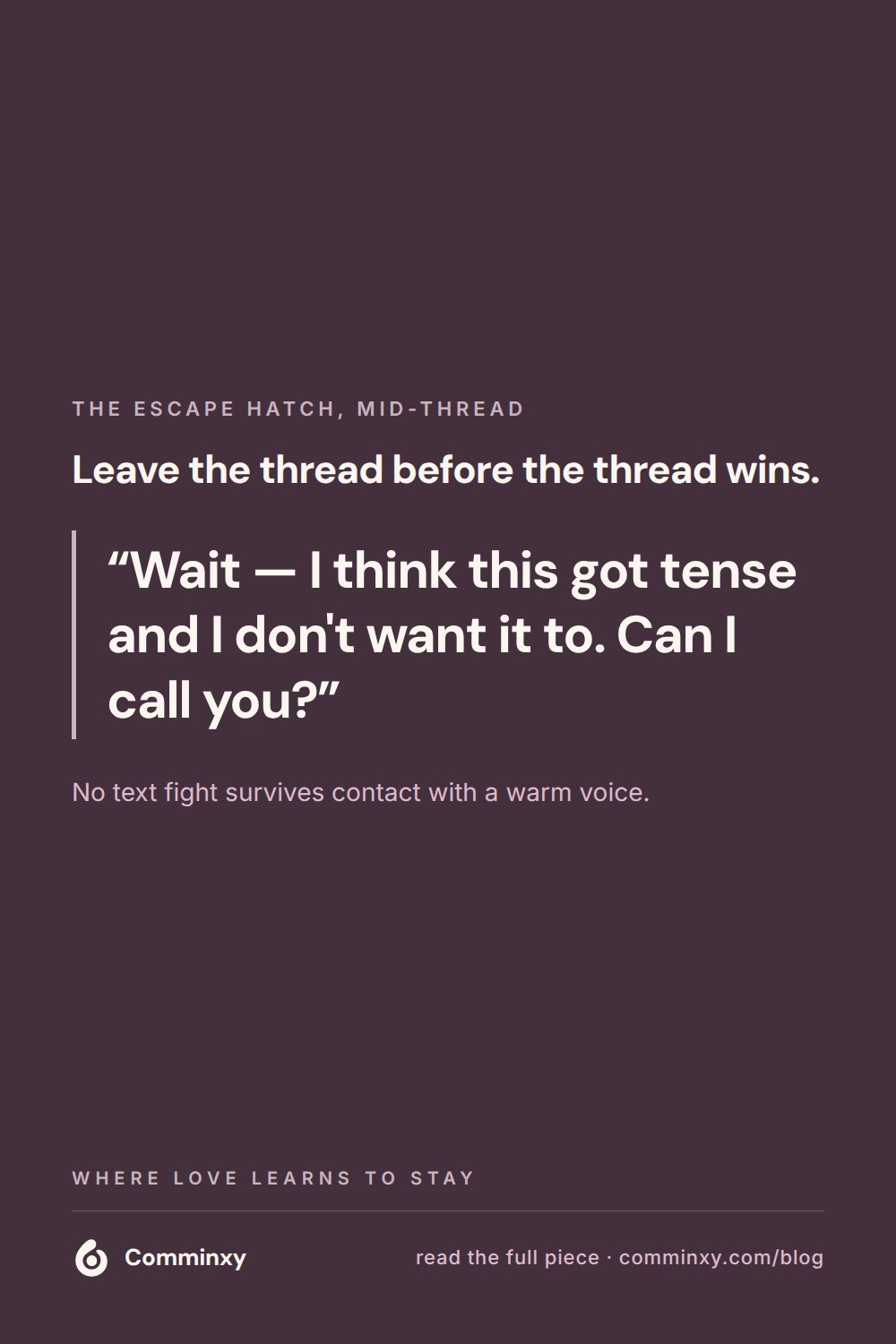
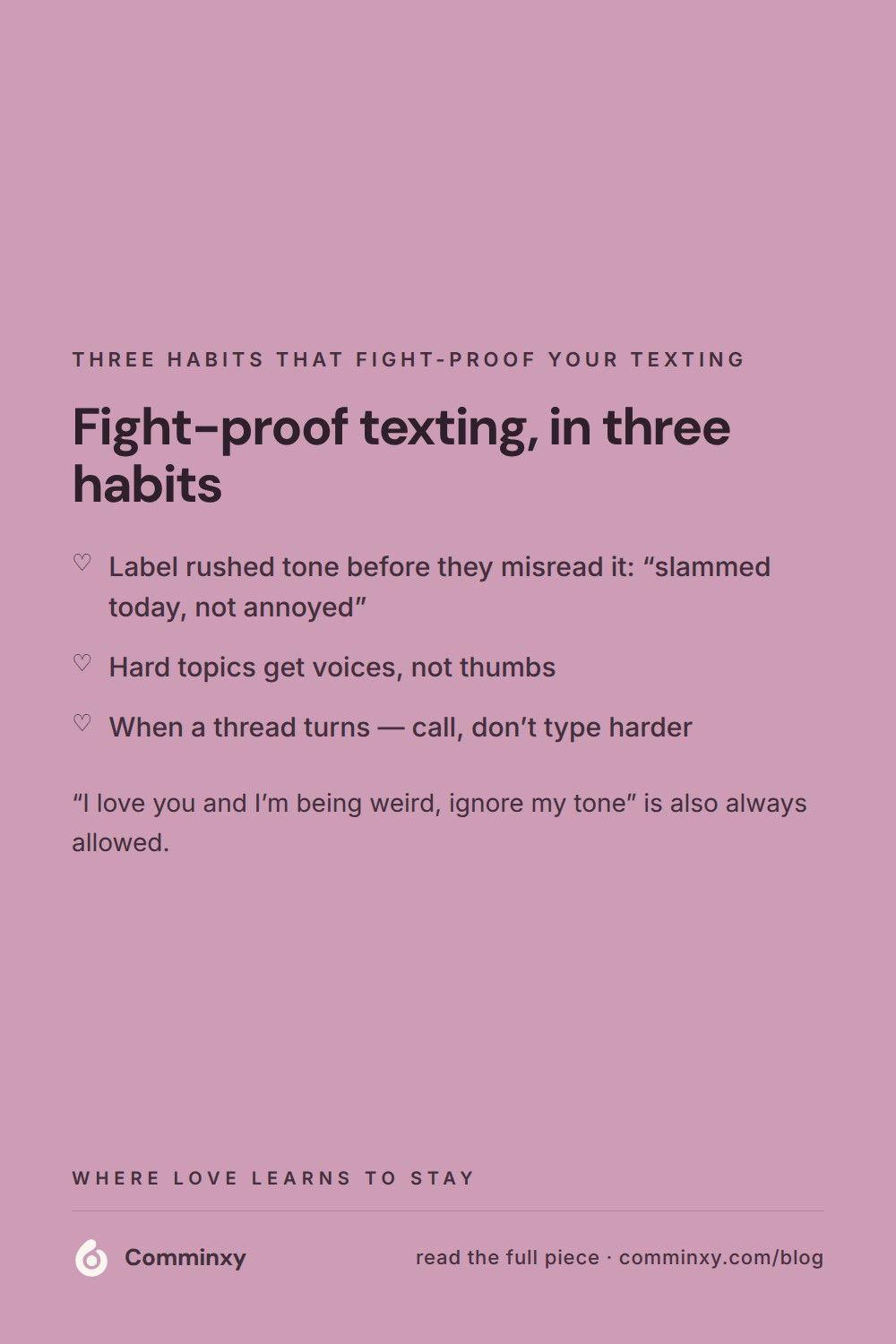
The move that changes the most is naming your own tone before your partner has to invent one. Sending this in a rush, not annoyed at all, just slammed today. It feels almost silly to spell out. But you're doing on purpose what your face and voice would do for free in the room. You're closing the gap the guess would otherwise fill. And when a thread has already tipped, the repair is smaller than you'd expect: one line that steps out of the content entirely. Wait. I think this got tense and I don't want it to. Can I call you? You're not conceding the argument. You're changing the medium back to one where tone can survive.
Carstensen, Gottman, and Levenson, watching long-married couples navigate conflict in Psychology and Aging, noticed that the ones who stayed steady used small doses of warmth and humor mid-disagreement to physically calm themselves and each other. A text thread can carry that too. A single soft line, a gentle joke about how badly this is going, an I love you and I'm being weird, ignore my tone. These aren't decorations. They're the thing that lets two escalating nervous systems stand down. If you notice you keep firing off things you don't mean the second a thread heats up, it's worth understanding why you keep saying things you regret over text, because the pattern almost always lives in the body, not the phone.
What it looks like when you catch it early
The couples who fight less over text aren't better writers. They've simply learned to notice the moment a thread stops being about logistics and starts being about the relationship, that subtle shift where what time? becomes you always do this. And in that moment, they stop typing. They pick up the phone, or they wait until they're in the same room, or they send the one honest line that admits the medium is failing them. The skill isn't in the words. It's in recognizing when words on a screen have run out of what they can carry. If you want to widen that skill beyond the phone, it lives inside the larger practice of learning to communicate better as a couple.
So think back to that checkout line. The bags in your hand, the four messages waiting, the fine, forget I asked that made no sense to you at all. Nothing was actually wrong between you. A word simply travelled without its tone, and two people filled the silence in opposite directions. That's not a sign of a broken bond. It's a sign that you were both reaching, from separate places, with a tool that couldn't hold everything you meant. The reaching was real. The reaching is the whole point.
Comminxy exists for exactly that gap, the space between what you meant and what landed, helping you catch a tone before it hardens, so the small things stay small. Because most of what we call fighting is really just two people missing each other by an inch, and love, given the chance to try again, tends to learn how to stay.
Questions people ask
why does my partner always think I'm mad when I text
Your partner is reading your words without your face, voice, or timing, so they fill in the missing tone using whatever stress or worry they're already carrying. Ambiguous words like okay or fine become blank canvases that get painted with fear. You can close that gap by naming your tone before you send, like adding just busy, not annoyed to the end of a short reply.
how do you fix a fight that started over text
The fastest repair is to step out of the text thread entirely and call or wait until you're together. If you can't do that, send one line that names the tension without continuing the argument, like I think this got tense and I don't want it to. That shifts the focus from content back to connection, and it gives both of you a chance to calm down.
should couples stop texting about important things
Couples don't need to avoid texting entirely, but it helps to notice when a thread stops being about logistics and starts being about the relationship. When that shift happens, that's the moment to stop typing and pick up the phone or wait until you're in the same room. Texting works fine for plans, but it can't carry the full weight of a disagreement.
why do I say things I don't mean over text
When a text thread heats up, your body reacts the same way it would in person, but you're alone with a screen instead of across from another human. That combination makes it easier to fire off words without the natural brakes that eye contact or a pause would provide. The pattern usually lives in your nervous system, not in the texting itself.
Keep the idea with you — pin it, or download the cards.


Comminxy helps you catch the tone before it tips, so the small things stay small
Get Comminxy free →