Why You Regret Things Said to Your Partner Over Text (And How Your Body Sets the Trap)
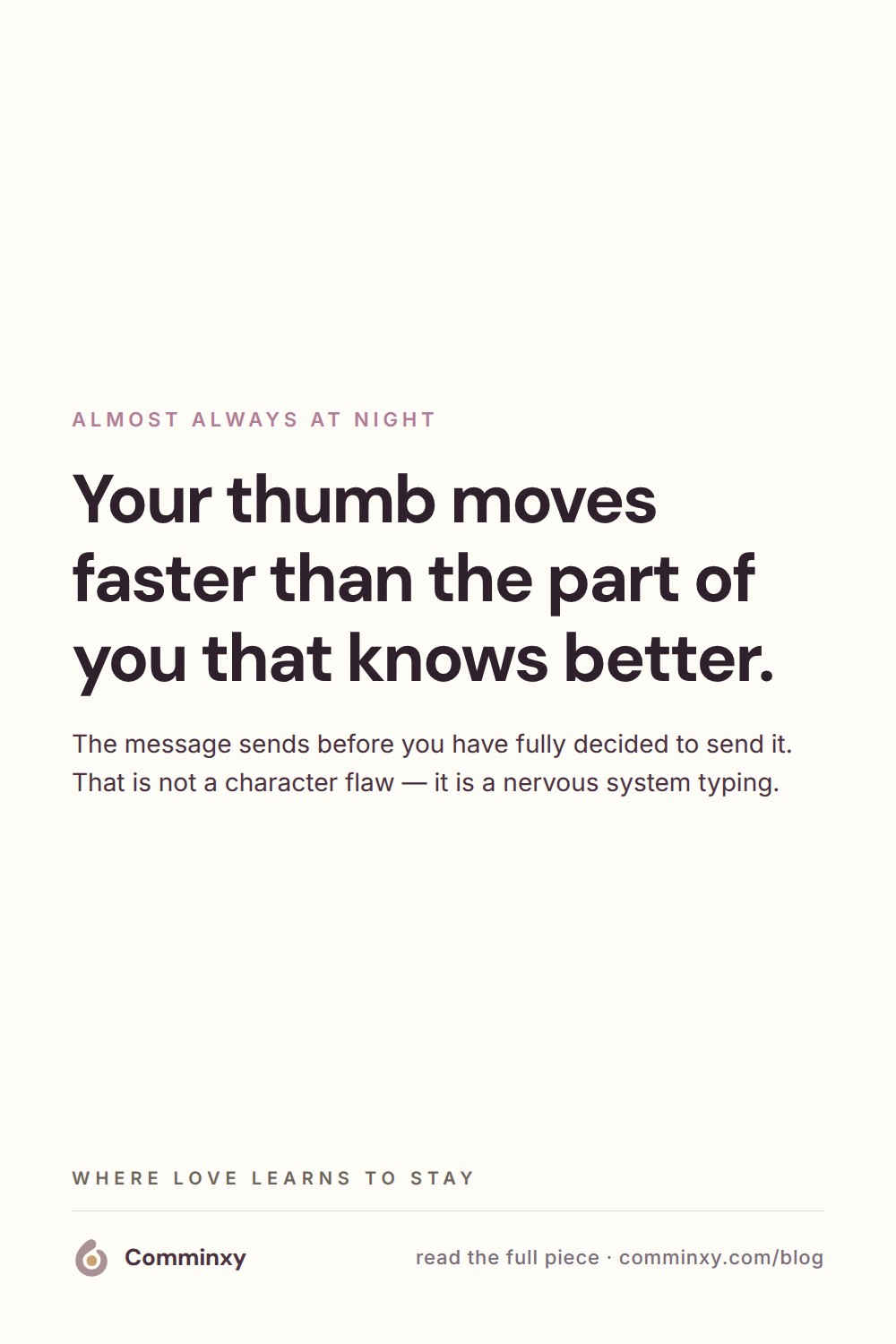
You are lying in bed, or standing somewhere you don't quite remember walking to, and your thumb is moving faster than the part of you that knows better. The message sends before you have fully decided to send it. And in the silence that follows, that long hollow silence after the little arrow turns grey, you already know. You have done the thing again. You have said something you regret to your partner over text, something sharper than you meant, something truer in its cruelty than in its honesty.
Most people who regret things said to a partner over text are not careless people. They are not cruel people. They are people who love someone and somehow keep wounding them through a small glowing rectangle, and they cannot understand why. If you are reading this at night, still holding the phone, that confusion is part of the problem too. The gap between who you are and what you just sent feels unbridgeable. But that gap tells us something important: the message did not come from your character. It came from your body, in a particular state, at a particular moment. And bodies set traps that the thinking mind walks straight into.
The message that didn't sound like you
The regretted text rarely feels like you wrote it. When people read it back, they often say quietly, "I don't even talk like that." And they don't. The person who typed that message was not the person they are at dinner, or the person who reaches for their partner's hand in a film.
That gap matters. It tells us the message did not come from your character. It came from your body, flooded, at a moment when the thinking part of you had gone offline.
Why your body sends the text your heart didn't mean
When Gottman and Levenson, writing in the Journal of Personality and Social Psychology, watched partners during conflict, they were not only watching faces and words. They were measuring heart rate, sweat, the quiet machinery of the nervous system. And they found that what separates couples who recover from couples who slowly come undone is not how much they disagree, but what happens inside the body when they do. When we become physiologically flooded, heart pounding, system braced as though for danger, the part of us capable of warmth and nuance goes quietly offline.
This is the trap. Your body cannot tell the difference between a threat to your safety and a text that reads, in that moment, like a threat to your worth. The same flood arrives either way. And a phone is the worst possible place to be flooded, because there is no pause built into it. No breath between feeling and sending. No face across from you softening, no voice catching, none of the small mercies that slow us down in person. Just a flat screen waiting, patiently, for you to do the thing you'll regret.
So the message that "didn't sound like you" is, in a sense, accurate. It sounded like your nervous system. The real you was somewhere underneath, already wincing.
The trap is in the medium, not in you
Text was never built to hold a flooded heart. When you are calm, you can write a careful sentence. When you are activated, the same medium that felt convenient becomes a loaded thing: fast, silent, permanent. You can't see them flinch, so you can't stop. You only learn the damage afterward, in the grey silence.
The patterns that quietly erode a relationship over time nearly all move faster over text, because the friction that usually slows us down has been removed. Knowing this doesn't make you weak. It makes you human in a medium that asks something almost impossible of humans: to stay tender while flooded, with no one's face to remind you who you're talking to.
What helps, and it is smaller than you think
The way back is not a grand act of willpower. It is mostly about reintroducing the pause that the phone deleted. The body that floods will also, given a little time, settle on its own. Twenty minutes, often less, and the warmth comes back online. So the most useful thing you can learn is not what to type, but how to recognise the flood before your thumb does.
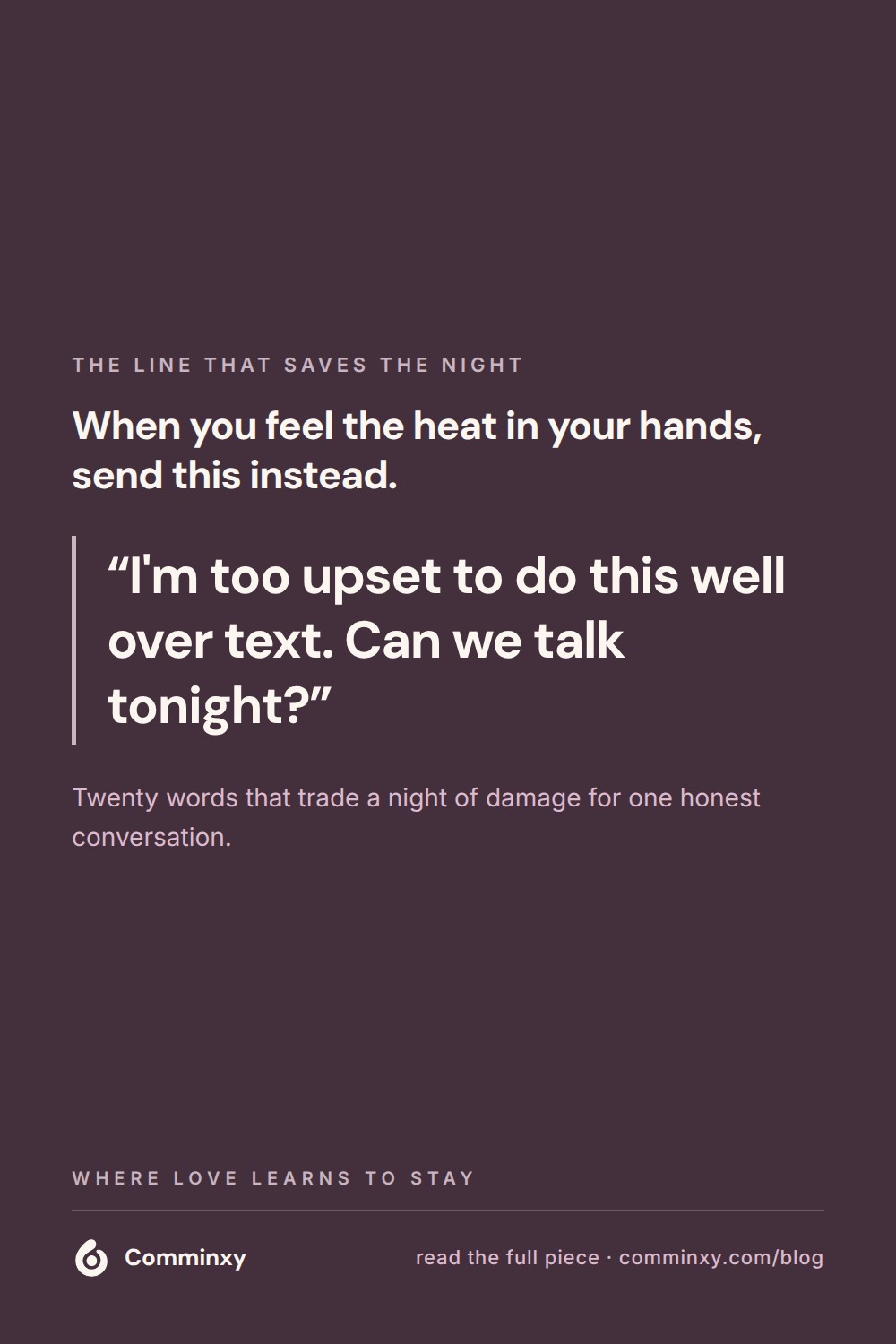
It feels like heat in the chest. A narrowing. A certainty that you must respond right now or something terrible will happen. That certainty is the lie the flood tells. Nothing terrible happens if you set the phone face down and breathe for a few minutes. What happens is that you return to yourself. And from there, even a short message ("I'm too upset to do this well over text, can we talk tonight?") protects something that a flooded message would have broken.
If you want a gentler way through these moments, this on having a calm conversation when you're both upset sits close to what we mean.
And if you've already sent it
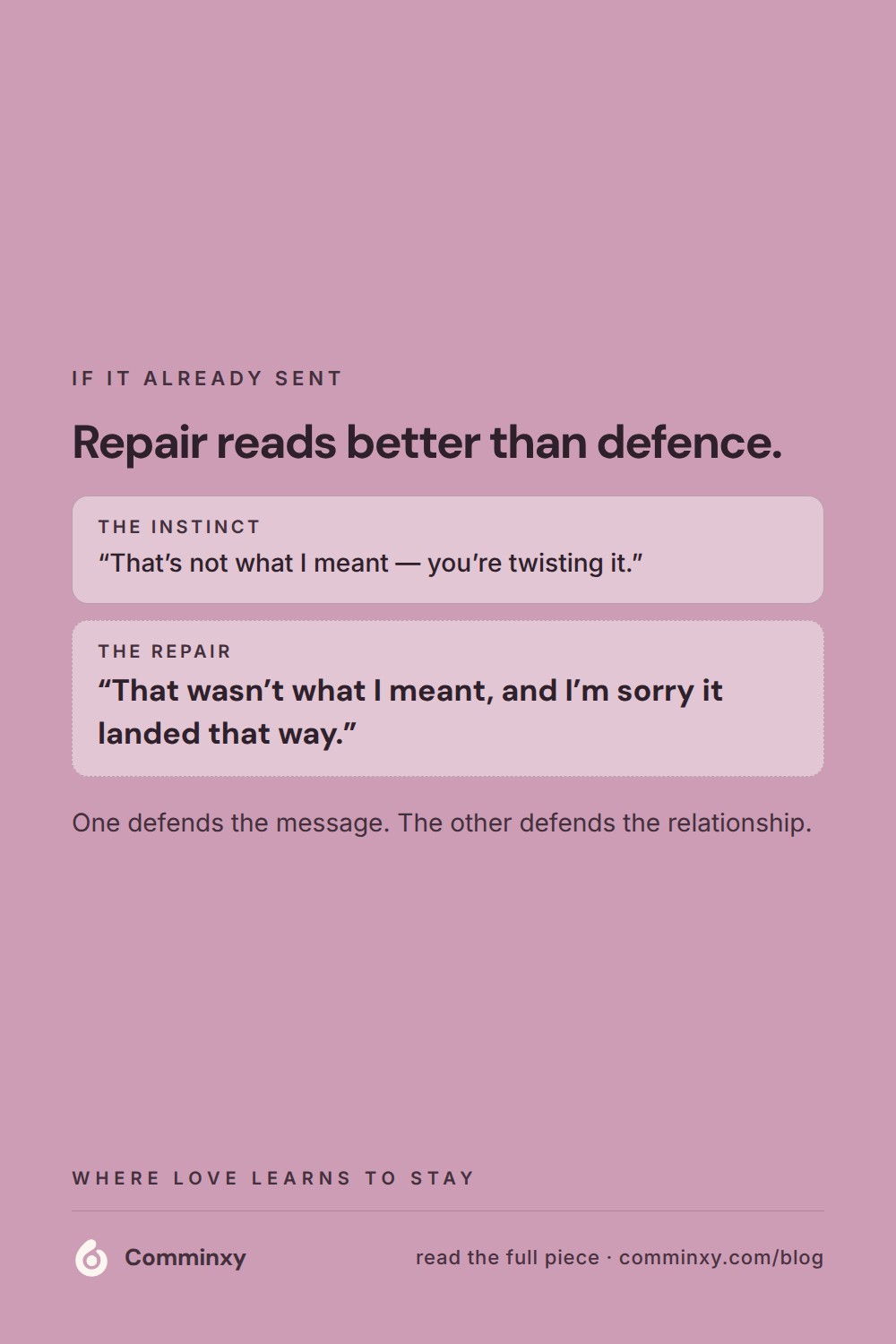
Most of you reading this have already sent the text. A relationship is not decided by a single regretted message. It is decided by what comes after. The same researchers who measured those flooded bodies also watched couples find their way back, again and again, through repair: through one person being brave enough to say, "That wasn't what I meant, and I'm sorry it landed that way."
Repair does not erase the message. It does something better. It tells your partner that the cruel text was the exception and your care is the rule. If you're not sure how to begin, there is a way to recover after saying something you can't take back, and it is more available to you than the shame is letting you believe right now.
So come back to that dark bedroom, phone still warm in your hand. The thing you regret is not proof of who you are. It is proof that you were overwhelmed in a medium that gave you no room to be overwhelmed gently. The grey silence will pass. And in the morning you will have a chance, as you always do, to be the truer version of yourself, the one who loves this person, and to say so. Something like Comminxy exists for exactly that small, hard moment between the flood and the send, so the words that reach your partner are the ones you actually mean. That is, in the end, where love learns to stay: not in never flooding, but in finding your way back each time you do.
Questions people ask
why do i say mean things to my boyfriend over text
When your body gets flooded during conflict, the part of you capable of warmth goes offline, and texting gives you no pause between feeling upset and sending the message. The mean text came from your activated nervous system, not from who you actually are. Your body can't tell the difference between real danger and a message that feels like a threat to your worth.
how long does it take to calm down after an argument
Most people's nervous systems settle within twenty minutes or less after getting flooded. Once you step away from the phone and breathe, the warmth and clarity come back on their own. That's why waiting even a short time before replying protects you from sending something you'll regret.
how do i apologize for a mean text to my partner
Start by acknowledging that what you said wasn't what you meant and that you're sorry for how it landed. Repair doesn't erase the message, but it shows your partner that your care is the rule and the cruel text was the exception. The apology matters more than perfection.
Keep the idea with you — pin it, or download the cards.


Comminxy helps you find the pause between the flood and the send
Get Comminxy free →