When Your Partner Avoids Conflict: How to Reach Someone Who Shuts Down
You said the thing you'd been rehearsing all day. Something like, Can we talk about what happened last night? And you watched it land. You watched the shift. His shoulders came up a little. Her eyes went somewhere else. The room got quieter than it had any right to be. And then came the sentence you've heard a hundred times. I'm fine, or there's nothing to talk about, or nothing at all, just a busyness that arrived out of nowhere, dishes suddenly needing washing, a phone suddenly needing checking. You were reaching for them, and they were already gone.
If your partner avoids conflict completely, you know this exact loneliness: the strange ache of standing in the same room as someone who has quietly left it. You are not too much. You are not imagining the distance. You are simply trying to reach someone who has learned, long before you ever met them, that the safest thing to do with a hard feeling is to disappear underneath it.
What it looks like when someone leaves without moving
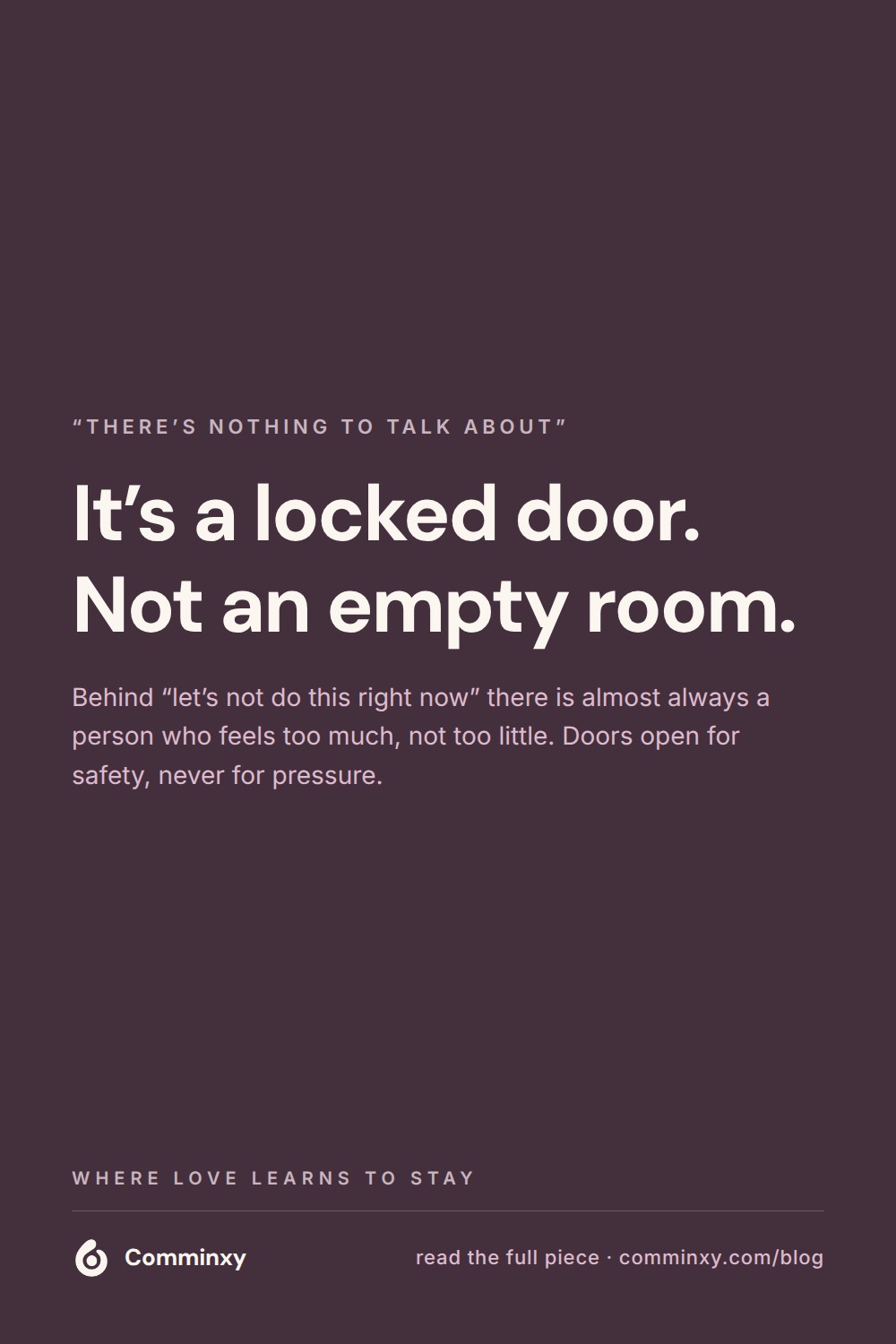
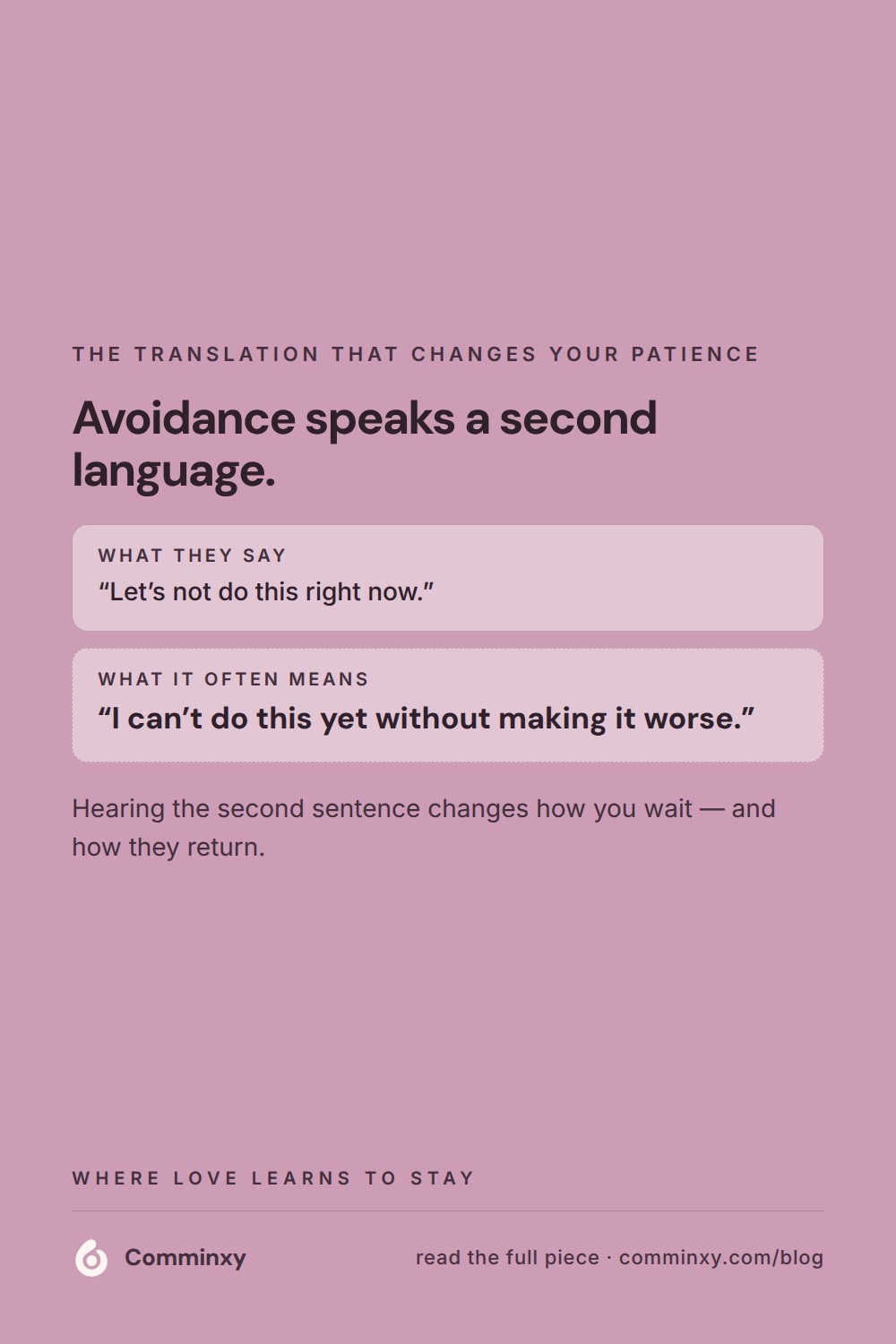
It rarely looks like a slammed door. More often it's softer than that, and somehow harder to name. A subject change so smooth you almost don't notice it. A shrug. A lets not do this right now that becomes a let's not do this ever. Sometimes it's agreement, a quick, hollow you're right, I'm sorry that ends the conversation without touching a single thing inside it.
What makes this so disorienting is that nothing dramatic has happened. There was no fight. And yet you're left holding all of it: the feeling, the question, the wanting. You start to wonder if you're the difficult one for even needing the conversation.
You're not. You're the one still standing in the room, still willing to look at what's real. That takes a particular kind of courage, and it is not a flaw.
Why going quiet feels safer than staying
Here is something worth sitting with. Avoidance is almost never about not caring. It's usually the opposite. The person who shuts down is often the person who feels the most, so much that their body treats a hard conversation like a threat and does the only thing it learned to do a long time ago, which is to go still and wait for the danger to pass.
Gottman and Levenson, writing in the Journal of Personality and Social Psychology, found that when someone becomes physiologically flooded during conflict (heart racing, system overwhelmed) thinking clearly becomes almost impossible. The withdrawal isn't a choice made in words. It's a body pulling the emergency brake. What looks like indifference from the outside is very often panic on the inside, held so quietly you'd never guess it was there.
And this is the tender, complicated truth: the more you reach, the more they may retreat. Not because your reaching is wrong, but because to a flooded nervous system, being pursued feels like being cornered. Two people, both frightened, both certain they're the only one trying. This is one of the oldest patterns a hard conversation falls into, and it is far more common than either of you feels in the moment.
The cost of always keeping the peace
There's a quieter reason this matters, and it's worth being honest about without dressing it in fear. Gottman and Krokoff, writing in the Journal of Consulting and Clinical Psychology, followed couples over time and found something that surprises people: it wasn't the couples who disagreed openly who drifted apart. It was the ones who withdrew. Active disagreement, difficult as it felt, sometimes led to greater satisfaction later. Withdrawal predicted the slow deterioration.
Sit with what that really means. The peace you're keeping by not pushing, the calm surface you're both maintaining, may be costing you the very closeness you're trying to protect. Not because conflict is good, but because a feeling that never gets spoken doesn't disappear. It just goes underground and waits. The absence of a fight is not the presence of intimacy. Sometimes it's only the distance between you, keeping very still.
How to reach someone without cornering them
So how do you get near a person who vanishes the moment you get close? Gently, and sideways, and slower than feels natural.
Start by lowering the temperature before you say the hard thing. Carrère and Gottman, writing in Family Process, found something remarkable: they could predict the outcome of a fifteen-minute conflict conversation with ninety-six percent accuracy from just the first three minutes. How you begin isn't a small thing. It's almost the whole thing. For someone who floods easily, the first thirty seconds decide whether they can stay in the room at all.
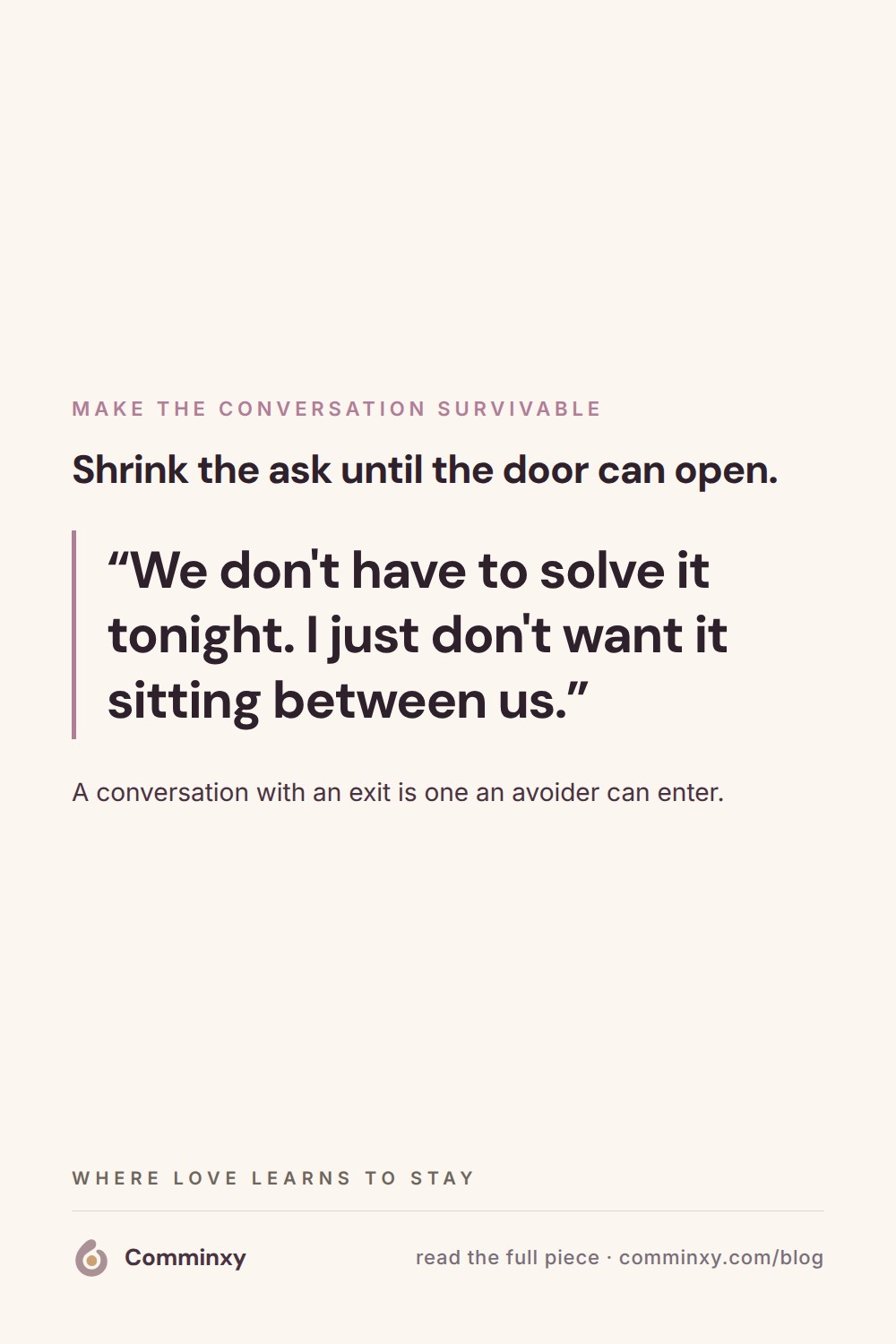
That means leading with the reassurance, not the accusation. I'm not upset with you. I just miss you, and I don't want us to keep circling this. It means making the conversation feel survivable. Naming that you don't need it resolved tonight, that they don't have to have the perfect answer, that leaving the room for a moment isn't the same as leaving you. Much of this is simply the work of emotional safety: the felt sense that being honest here won't be punished.
And keep in mind that reaching doesn't only happen inside conflict. Lambert and Fincham, in the Journal of Personality and Social Psychology, found that expressing gratitude to a partner made people more comfortable voicing concerns afterward. Warmth, given freely in ordinary moments, quietly builds the ground a harder conversation can later stand on. The person who feels appreciated on a Tuesday is far more able to stay present on a Thursday.
What coming back together can actually look like
It won't be one grand conversation where everything opens at once. That's not how avoidance heals. It heals in small returns. A partner who shuts down but comes back an hour later and says, I couldn't do that earlier, but I can now. A moment where you let them leave the room without following, and they learn that leaving didn't cost them your love. Trust rebuilt not by force but by repetition, one safe conversation teaching the nervous system that this one didn't end in disaster.
Think back to that room, the one where you asked to talk and watched them slip away. Imagine it going differently, not because either of you became a different person, but because the room itself felt safer. You reaching a little more slowly. Them staying a moment longer than they thought they could. Nobody flooded. Nobody gone. Just two people, still learning how to stay in the same room when it's hard, which is, in the end, most of what love asks of us. That's the quiet work Comminxy was made to sit beside you in: not fixing anyone, just helping the reaching and the staying meet a little more gently, so that love has the chance to learn how to stay.
Questions people ask
why does my partner shut down when I try to talk about problems
When someone shuts down during conflict, their nervous system is often flooded and treating the conversation like a physical threat. Their body goes into an emergency response that makes clear thinking nearly impossible, so withdrawal is a protective reflex rather than a deliberate choice to ignore you. This reaction usually developed long before your relationship began.
how do I talk to someone who avoids conflict
Start by lowering the emotional temperature before raising the hard topic, and lead with reassurance rather than accusation. Make it clear the conversation does not need to be resolved immediately and that they will not be punished for being honest. Give them permission to take breaks without it meaning they are abandoning you or the issue.
is it normal to feel lonely when your partner won't talk about issues
Yes, it is completely normal to feel lonely when your partner shuts down, because you are left holding all the emotional weight alone. You are not too much for wanting to address what is real between you. The loneliness comes from being physically near someone who has emotionally left the room.
Keep the idea with you — pin it, or download the cards.


Comminxy helps you practice the reaching and staying conflict asks of you
Get Comminxy free →