The Two Paths to Divorce Research Reveals — and How Couples Quietly Avoid Both
You are standing in the supermarket on a Tuesday and you realise you cannot remember the last time your partner asked about your day and meant it. Not the polite version. The real one. Nothing happened this morning. Nobody fought. The milk still needs buying. And yet you are standing there with the feeling that something has already been lost, quietly, while you were both just trying to get through the week.
When researchers studied how marriages actually end, they did not find one road. They found two. The two paths to divorce research keeps pointing to are almost opposites of each other, and most of us only ever brace for one of them. The other one slips in through the quiet, on an ordinary afternoon, in the gap between one question and the next.
The loud road, and the silent one
The first path is the one everyone pictures. The fights that get sharper over the years. The voice that turns cold. The slammed door. John Gottman and Robert Levenson tracked couples through conflict and found that four behaviours during arguments (criticism, defensiveness, contempt, and stonewalling) predicted divorce with striking accuracy. This is the road we know how to fear. It has volume. It leaves marks.
But there is a second path, and it makes almost no sound at all.
It is the slow drift of two people who stopped fighting because they stopped reaching. No contempt. No slammed doors. Just less. Fewer questions about each other's day. Fewer hands finding each other in the dark. A meta-analysis of 137 longitudinal studies spanning thirty years found that the strongest predictors of a relationship ending were not how badly couples fought, but how much commitment, closeness, and inclusion of the other in the self had quietly eroded (Le, Dove, Agnew, Korn, & Mutso, Personal Relationships, 2010). The relationship doesn't break. It thins.
Why the quiet road is the harder one to see
The loud road announces itself. You know when an argument went too far. You feel the residue of it the next morning. It is painful, but it is legible.
The silent road gives you nothing to hold. Nothing happened today, so there is nothing to repair. And then nothing happens tomorrow, and the day after, and the absence accumulates without ever becoming an event. This is how two people who genuinely love each other can grow apart without ever deciding to. There is no moment to point at. There is only the slow forgetting of how it used to feel to be reached for.
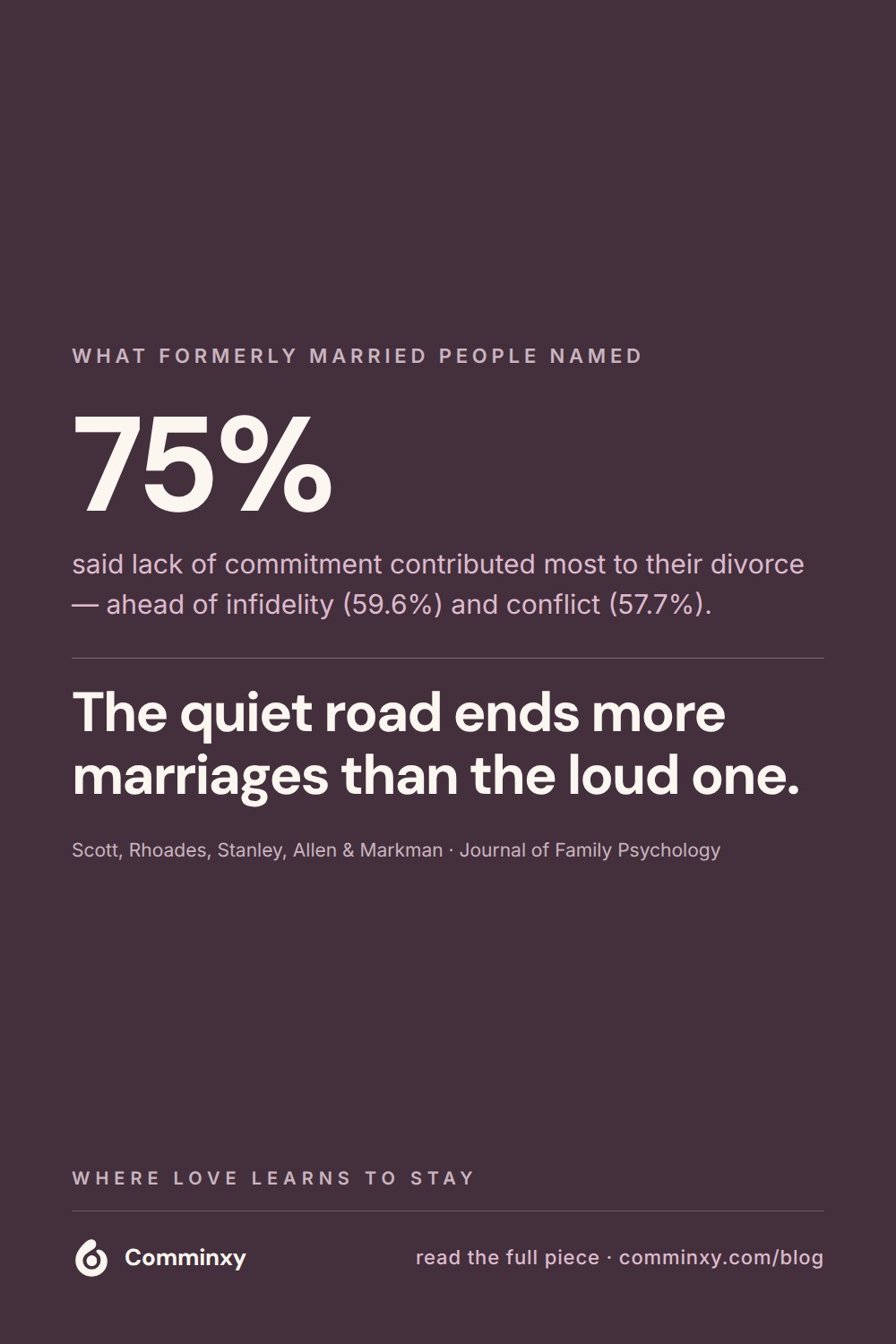
When formerly married individuals were asked what most contributed to their divorce, the most common answer was not infidelity, and not conflict. It was lack of commitment, named by 75% of them, ahead of infidelity at 59.6% and conflict at 57.7% (Scott, Rhoades, Stanley, Allen, & Markman, Journal of Family Psychology, 2013). The quiet road, it turns out, is the more travelled one. Nobody sees it coming, because everyone was watching for the storm.
What the storm road is really asking for
If you are on the loud road (if your arguments have started to feel like the same fight wearing different clothes) the research offers something oddly hopeful. Carrère and Gottman found that 96% of the time, the outcome of a fifteen-minute conflict conversation could be predicted from just the first three minutes (Carrère & Gottman, Family Process, 1999).
That sounds frightening at first. But sit with what it actually means. The fight is mostly decided before any of the hard things get said. The damage usually lives in how you open, not in the disagreement itself. The content was rarely the problem. The first sentence was. And the first sentence is the one thing you can still change. If that lands true for you, it may be worth understanding the patterns that tend to take over once a conversation goes sideways, not to grade yourself against them, but to recognise them early enough to choose differently.
What the quiet road is really asking for
The silent road needs something gentler, and stranger. It needs to be interrupted on a day when nothing is wrong.
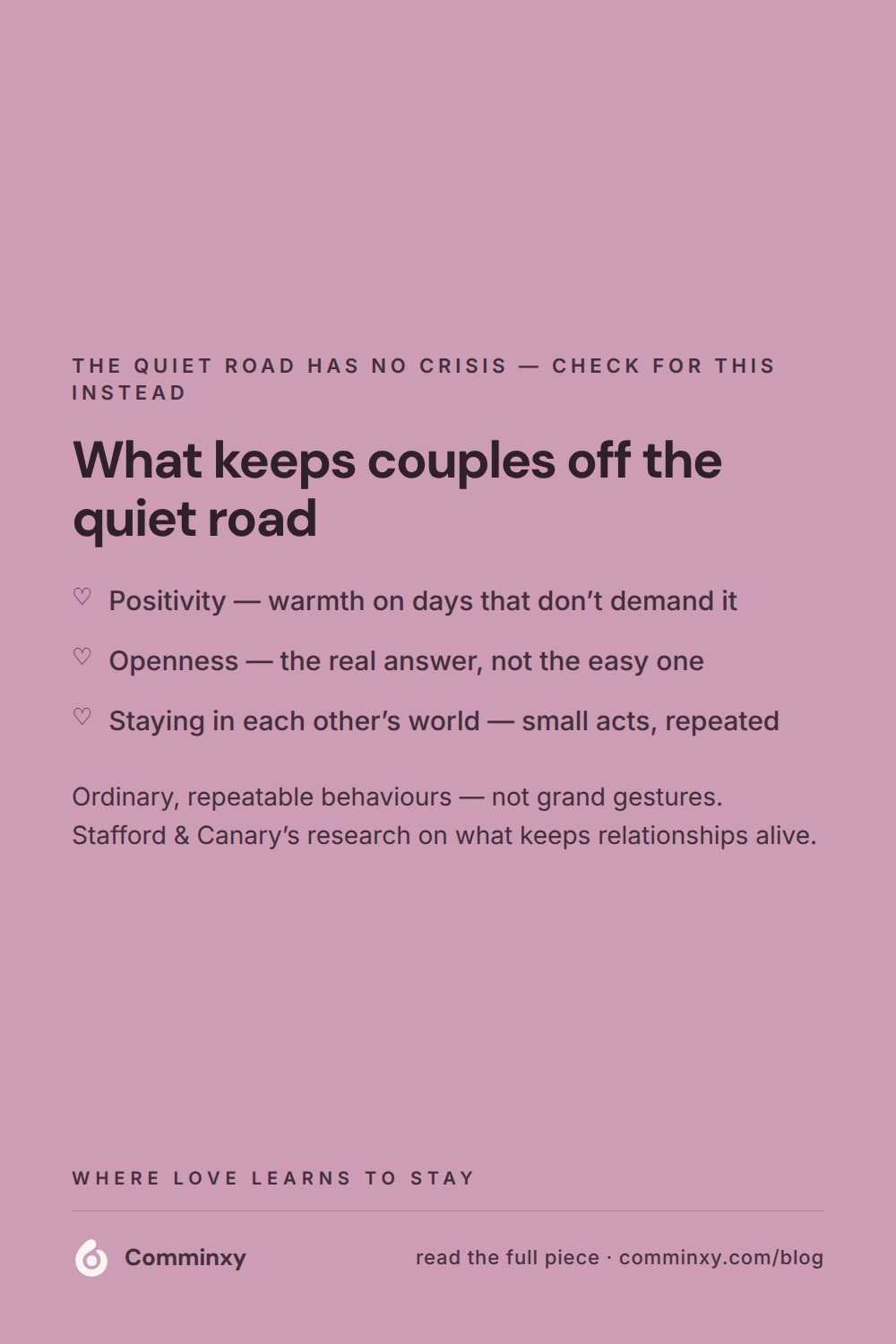
This is where most of us get stuck, because we are taught to fix relationships during crises. But the quiet road has no crisis. Stafford and Canary studied what people actually do to keep a relationship alive and found that it came down to a handful of ordinary, repeatable behaviours: positivity, openness, and the small acts of staying in each other's world. These strategies explained up to 56% of how satisfied and committed partners stayed (Stafford & Canary, Journal of Marriage and the Family, 1991).
None of that is grand. It is the text in the middle of the afternoon. The real question instead of "how was your day." The hand on the back while passing in the hallway. The silent road isn't reversed by a big conversation. It's reversed by a hundred small reaches, most of which feel almost too minor to count.
They count.
The good news hiding underneath both
Neither road is a sentence. The loud road is loud precisely because both people are still trying, still fighting for something, even when it comes out sideways. And the quiet road is reversible because reaching is a muscle, not a lost organ. It can be used again.
It also helps to remember that long love is not a myth. In a study of people married more than ten years, 40% reported still being "very intensely in love." Not nostalgic. Not comfortable. In love. Those couples were not luckier than you. They simply kept reaching, on the loud days and the quiet ones both.
So picture that supermarket again. The milk. The Tuesday. The feeling that something has already been lost. You don't need a speech to change what happens next. You need one small reach: a question, a touch, a moment of being genuinely curious about the person you've stopped seeing clearly. That is the whole repair, repeated. Tools like Comminxy exist to help you notice those moments and find the words for them when they don't come easily, not to fix anything, but to keep the reaching alive. Because both roads have an exit, and the exit is always the same. It is the turning back toward each other. That is where love learns to stay.
Questions people ask
what are the two paths to divorce
The two paths are the loud road of escalating conflict marked by criticism and contempt, and the quiet road where couples slowly drift apart without fighting at all. Research shows the quiet road is actually more common, with emotional distance and fading commitment causing more divorces than explosive arguments.
how do you fix a marriage that is drifting apart
You reverse drift through small daily acts of reconnection like asking real questions about their day, physical touch while passing by, and staying genuinely curious about them. Research found these ordinary repeatable behaviors explained up to 56% of relationship satisfaction and commitment. The quiet road does not need a big conversation, it needs consistent small reaches.
can you predict divorce from how couples argue
Yes, researchers can predict divorce with high accuracy based on how arguments start in the first three minutes. The opening tone and approach matter far more than the content of the disagreement itself. Four specific behaviors during conflict (criticism, defensiveness, contempt, and stonewalling) are particularly strong predictors.
what percentage of long married couples are still in love
40% of people married more than ten years report still being very intensely in love, not just comfortable or nostalgic. These couples were not luckier but kept actively reaching toward each other on both difficult and ordinary days.
Keep the idea with you — pin it, or download the cards.


Comminxy helps you find the words to reach when the distance feels quiet
Get Comminxy free →