Why Couples Who Love Each Other Grow Apart — And the Quiet Drift No One Warns You About
You are lying next to someone you love, and there is a foot of space between you that feels like a mile. Nothing is wrong, exactly. There was no fight. You said goodnight. And still, something in you reaches across that small distance and finds it colder than it used to be. You are not unhappy. You are not leaving. You just have the quiet, unsettling sense that the two of you have been slowly walking in slightly different directions, and you cannot remember when it started.
This is the thing no one warns you about: couples who love each other grow apart not in a single dramatic moment, but in a thousand small ones nobody thought to count. It rarely looks like the endings we are taught to fear. It looks like two people who still care, still cook dinner, still ask about each other's day, and who slowly stop being known by each other.
The drift doesn't announce itself
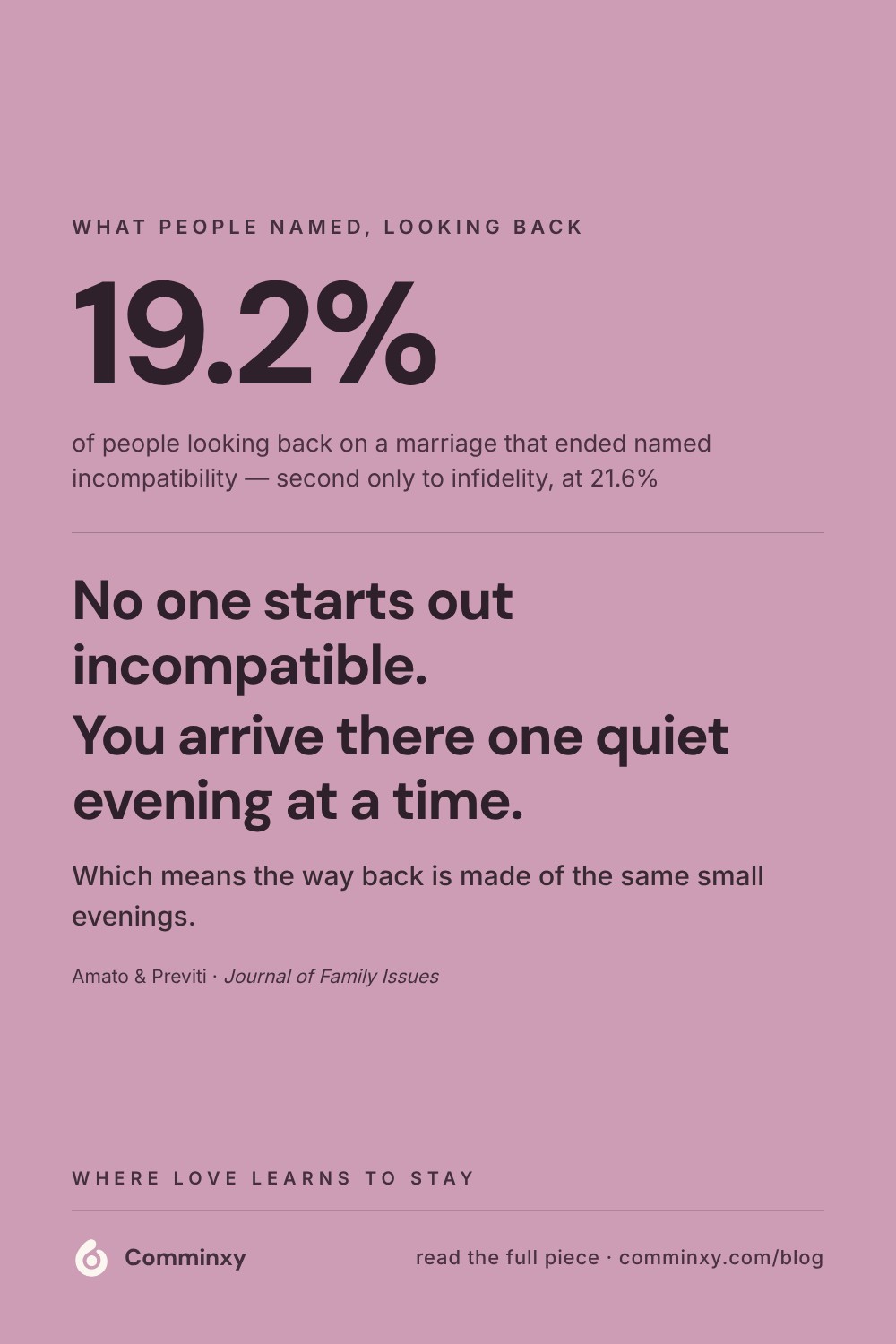
We brace for the big betrayals. We imagine that if something goes wrong, it will be loud: an affair, a screaming match, a door slammed hard enough to mean it. And sometimes it is. When people are asked openly why their marriage ended, infidelity comes up most, cited by 21.6% of formerly married individuals in Amato and Previti's study in the Journal of Family Issues.
But notice the next thing on that list. Right behind infidelity, at 19.2%, was something far quieter: incompatibility. Not cruelty. Not betrayal. Just the slow realisation that two people had become strangers under the same roof. That word, incompatibility, is often the polite name we give to the drift after it has already happened. Very few couples start out incompatible. They become that way one unspoken evening at a time.
Why love alone isn't the thing that keeps you close
When researchers went looking for what actually predicts whether a relationship survives, love was not the strongest signal. In a meta-analysis of 137 longitudinal studies spanning thirty years, Le, Dove, Agnew, Korn, and Mutso, writing in Personal Relationships, found that commitment, dependence, and something they call the inclusion of the other in the self (the sense that your partner is woven into who you are) were among the strongest predictors of whether couples stayed together.
Read that slowly, because it reframes everything. You can love someone deeply and still feel them sliding out of your sense of us. The feeling of love is the easy part to keep. The hard part is staying inside each other's daily life: staying interested, staying reachable, staying a little tangled up in one another. When that thread loosens, the love can remain fully intact while the closeness quietly leaves the building.
So if you have been lying awake wondering how you can still love someone and feel so far from them, you are not broken, and your relationship is not a contradiction. You are noticing the exact gap the research describes. The space between loving and belonging.
The ordinary boredom that gets mistaken for the end
There is a particular flavour of drift that arrives not in crisis but in sameness. The conversations get functional. The weekends get predictable. You finish each other's sentences, and somehow that stops feeling like intimacy and starts feeling like a script.
Tsapelas, Aron, and Orbuch found something quietly important about this in Psychological Science: relational boredom measured around year seven of marriage predicted lower satisfaction nine years later. The boredom wasn't harmless. It was a soft early signal, whispering long before anyone would have called it a problem.
What matters about that finding is how undramatic the cause is. No one did anything wrong. Two people simply stopped surprising each other and mistook the comfort for the whole of the relationship. The good news folded inside that research is that boredom is not a verdict. It is a flag planted years before the outcome, which means there is almost always more time than the drift would have you believe.
What it looks like to walk back toward each other
The way back is almost embarrassingly small. Not a grand gesture. Just the willingness to become curious about a person you assumed you already knew completely.
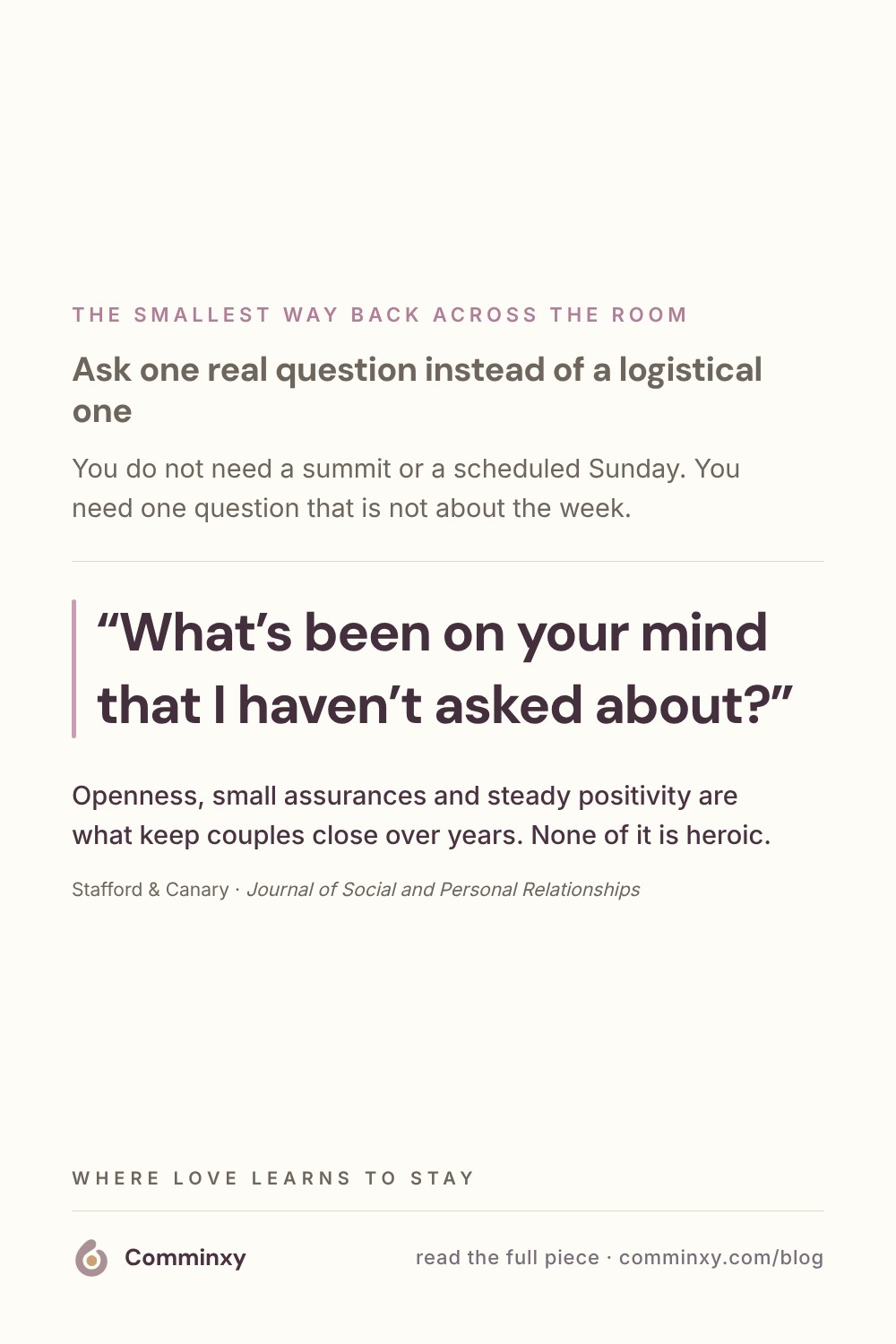
Stafford and Canary, in the Journal of Social and Personal Relationships, identified the everyday habits that keep couples close over the long run: things like openness, small assurances that you are still chosen, and a basic, steady positivity in how you treat each other. None of it is heroic. It is the texture of ordinary attention. Asking a real question instead of a logistical one. Saying the thing you usually swallow. Letting your partner see a part of you they haven't seen in a while.
Sometimes the drift has hardened into the kind of silence where you both have things to say and no safe way to say them. If that is where you are, it can help to understand the communication patterns that quietly erode closeness, and to find a way to have a real conversation when the words keep coming out wrong. Learning how to talk when you're both already tender is often the first small step back across that foot of cold space.
The drift is reversible far longer than it feels
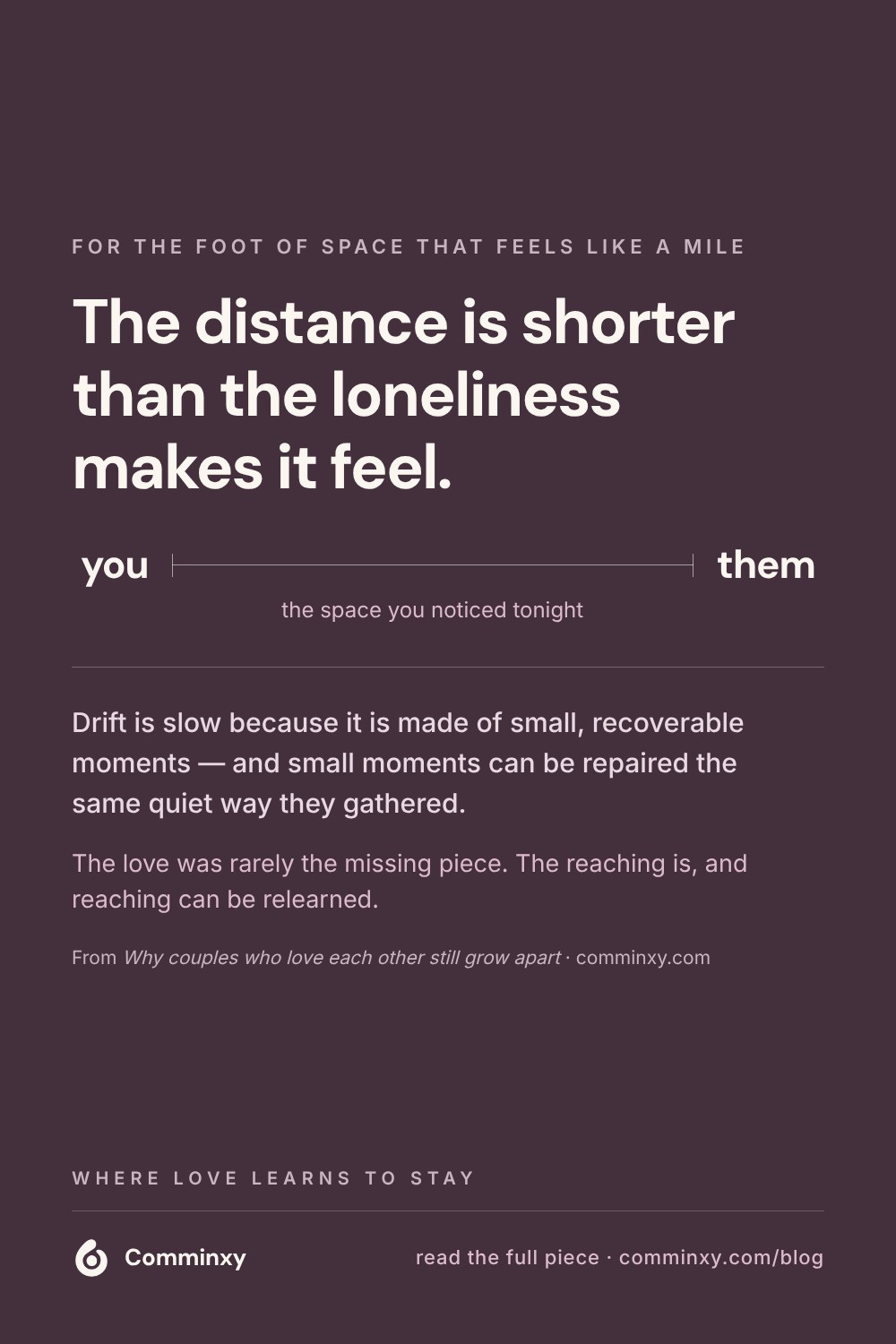
The distance is almost never as permanent as the loneliness makes it seem. Drift is slow precisely because it is made of small, recoverable moments, and small, recoverable moments can be repaired one at a time, in the same quiet way they accumulated. You do not have to fix everything. You only have to turn back toward each other once, and then again.
So when you are lying there tonight with that foot of space between you, try to see it not as proof of how far you have come from each other, but as a distance short enough to reach across. Most couples who feel the drift still have everything they need to close it. The love was never the missing piece. The reaching is. And reaching can be relearned, slowly, in the small honest exchanges that make two people feel known again. That is the quiet work Comminxy was made to sit beside you for: not to fix what is between you, but to help the two of you find your way back into each other's daily life, which is, in the end, where love learns to stay.
Questions people ask
why do couples who love each other grow apart
They grow apart through small accumulated moments of not staying curious, not asking real questions, and slowly stopping being known by each other, even while love remains intact. The drift happens in ordinary sameness, not dramatic conflict, as two people stop being woven into each other's daily lives. Love stays but closeness quietly leaves because they stop reaching across the distance.
how do you know if you and your partner are drifting apart
You feel a cold distance even when nothing is technically wrong, conversations become functional instead of intimate, and you have the sense you are walking in slightly different directions without knowing when it started. You still care and go through the motions but feel less known by each other over time.
can a relationship recover from drifting apart
Yes, drift is reversible far longer than the loneliness makes it seem because it accumulated slowly through small moments that can be repaired the same way. The way back involves becoming curious again, asking real questions instead of logistical ones, and turning toward each other repeatedly in small honest exchanges. You do not have to fix everything at once, only reach across the distance one moment at a time.
Keep the idea with you — pin it, or download the cards.


Comminxy helps you find your way back into each other's daily life
Get Comminxy free →