What Boredom in Long Relationships Research Reveals About the Quiet Drift Between Partners
You're folding laundry from a basket that never empties, and he's at the table sorting through bills. The room is warm. You're not fighting. You haven't fought in weeks. But when he asks if you want tea, you realize you haven't looked at each other properly in days. Not with attention. Not with anything that could be called interest. You say yes to the tea, and you feel the flatness settle a little deeper.
If you've felt that, you're not broken and neither is your relationship. What you're brushing up against has a name, and the boredom in long relationships research has more to say about it than you'd expect. Not as a verdict, but as a quiet clue about what your relationship might be asking for.
The flatness has a name, and it lives alongside love
Boredom in a long relationship usually has nothing to do with how much you care. You can be deeply attached, genuinely committed, still choosing each other every morning, and still feel the air going still.
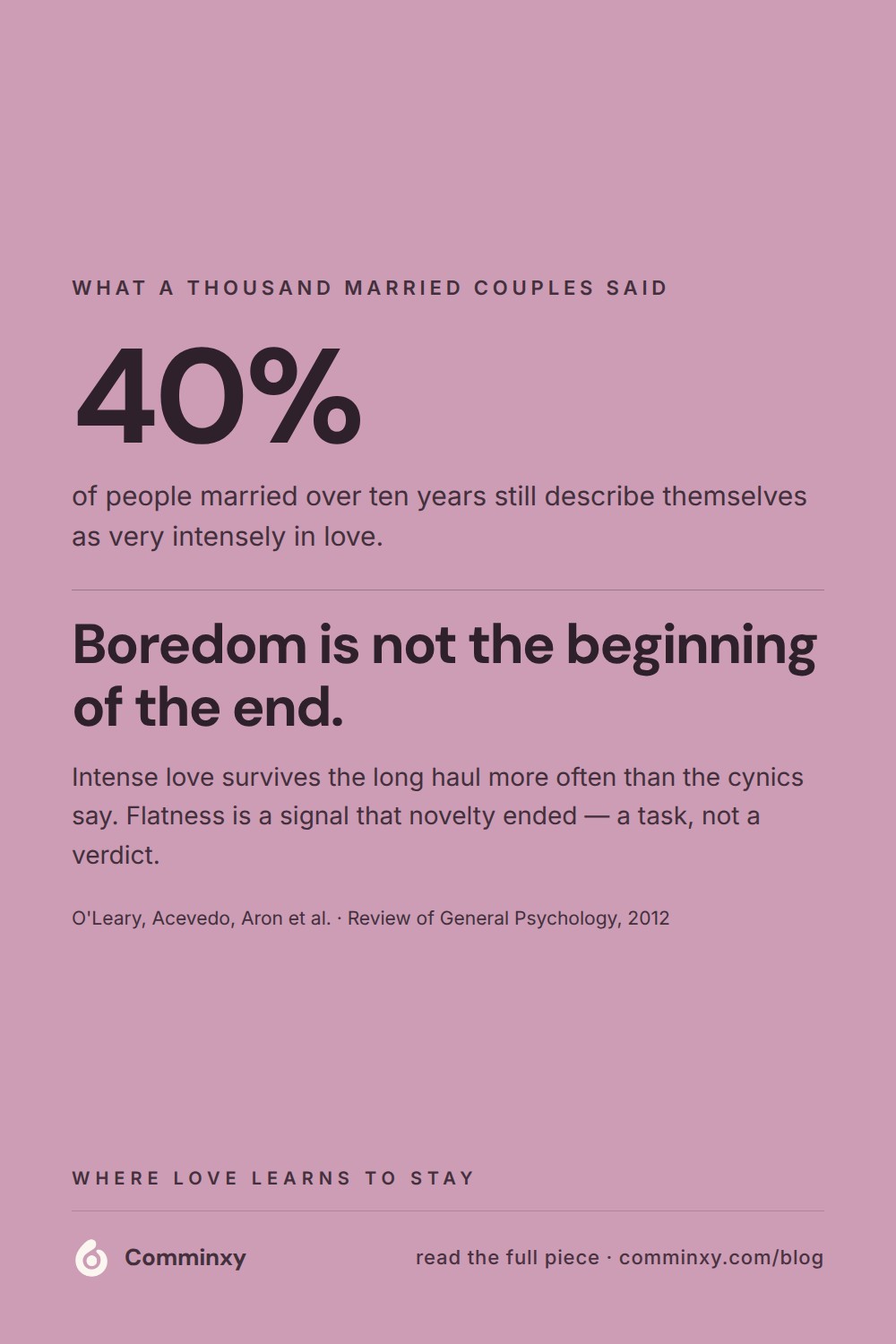
The research backs this up in a way that's almost comforting. In a study of more than a thousand married couples, O'Leary, Acevedo, Aron and colleagues found that 40% of people married over ten years still reported being "very intensely in love" (Review of General Psychology, 2012). Intense love survives the long haul more often than the cynics say. So if you feel both love and flatness at once, you're not contradicting yourself. You're describing something real.
Love is not the thing that went quiet. Something else did.
Why the air goes still
The thing that goes quiet is novelty. And the reason matters, because there's no villain in it.
Early on, a relationship expands you. You learn a new person, see your own life through their eyes, become slightly larger than you were. Then, slowly, you finish learning each other. You know the stories. You can predict the opinion before it's spoken. This isn't a failure. It's what closeness does. But it leaves a gap where the newness used to be, and that gap is where boredom settles.
What the research adds is that this matters more than we tend to think. Tsapelas, Aron and Orbuch followed married couples over nine years and found that boredom at year seven predicted lower satisfaction at year sixteen, while dissatisfaction at year seven did not predict boredom later (Psychological Science, 2009). Read that again slowly. The boredom came first. It wasn't a symptom of a relationship going bad. It was an early signal, arriving long before anyone would have said they were unhappy.
That's not a warning. It's permission. Permission to take the flatness seriously now, while you still feel love and not resentment, to treat it as information rather than failure. Boredom in a long relationship is a signal, not a sentence.
What actually brings the air back
The fix is smaller and stranger than you'd guess. It isn't a grand romantic overhaul.
It's newness. Shared, slightly unfamiliar newness.
Aron and his colleagues spent years testing this. Couples who did novel and challenging activities together, things that stretched them a little, that they had to figure out side by side, reported more satisfaction afterward than couples who did pleasant but familiar things (Journal of Neurophysiology). The key word is self-expanding. Not dinner at the usual place. Something that makes you slightly clumsy together, slightly more alive, slightly more you-two-against-the-unknown.
It doesn't have to be skydiving. It can be a cooking class where you both burn the sauce. A new walking route where you get a little lost. A topic neither of you knows anything about, learned together. The point isn't the activity. The point is becoming, for an hour, two people discovering something instead of two people maintaining something. That's where the old aliveness lives.
This is also why some couples drift even while doing everything "right." If you've felt that, close and kind and somehow further apart, it's worth understanding why couples who love each other still grow apart. It's rarely about effort. It's about what the effort goes toward.
The repair is in the noticing, together
Most people sit with boredom alone. They feel it, name it privately as a problem, and then say nothing, because what is there to say? "I love you but I'm bored" sounds like an accusation. So it stays unspoken, and unspoken, it curdles. The boredom you carry alone becomes distance. The boredom you name together becomes a project.
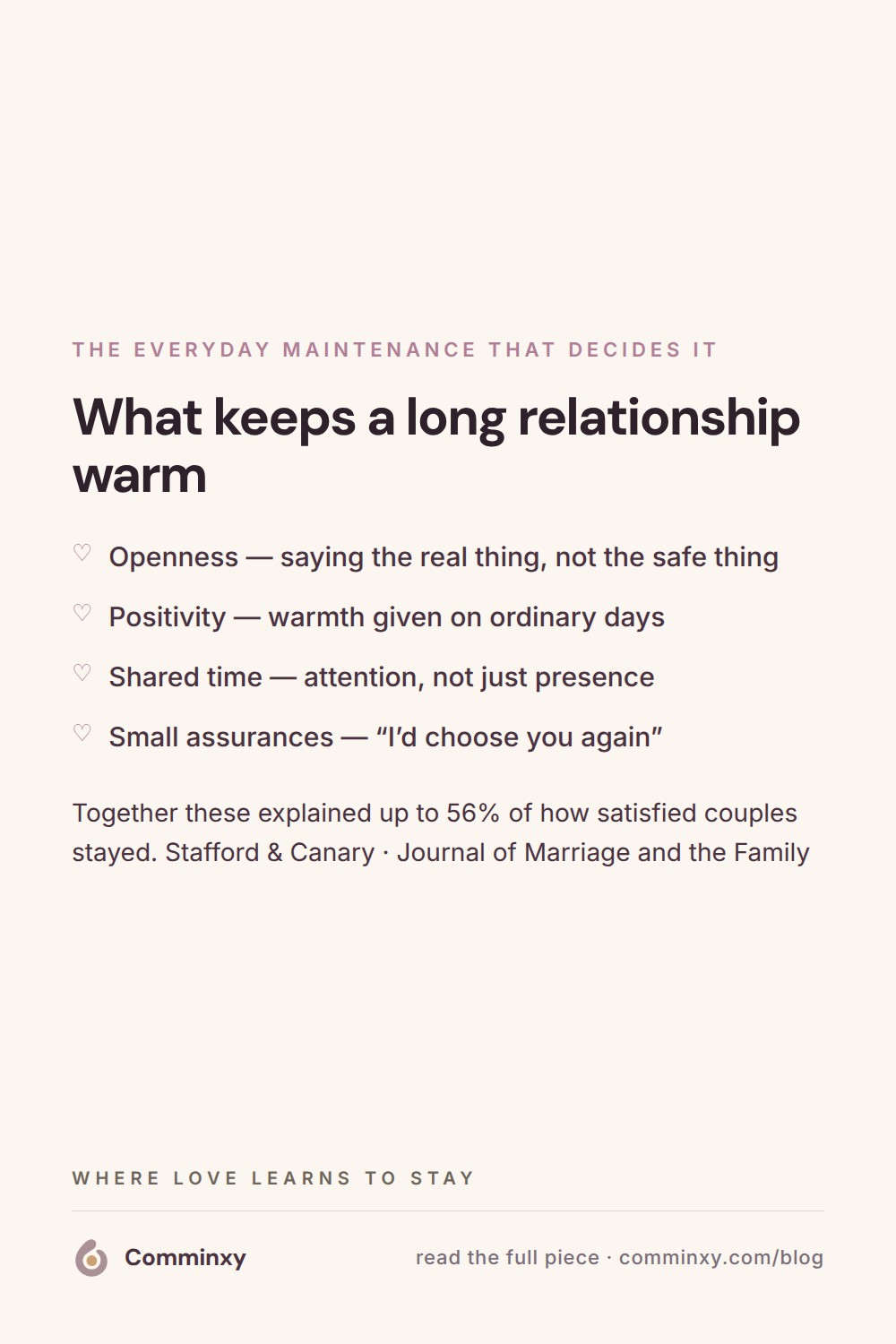
Stafford and Canary studied what actually keeps relationships warm over time and found that everyday maintenance, openness, positivity, shared time, small assurances, accounted for a large share of how satisfied couples stayed, explaining up to 56 percent of relational quality (Journal of Social and Personal Relationships, 1991). Openness is one of those pillars. And openness here doesn't mean a heavy talk. It means turning to him during the fine but flat evening and saying, "I miss being surprised by us. Not by you. By us." That sentence isn't a complaint. It's an invitation.
If saying it feels harder than it sounds, if every attempt to name something tender comes out wrong or lands wrong, that's its own thing worth tending, and there are gentler ways to have a calm conversation when you're both upset. The way in matters as much as the words.
What this doesn't mean
It doesn't mean the spark is gone for good. It doesn't mean you waited too long. The same research that shows boredom arriving early also shows, in study after study, that the slide is not fixed in advance. Newness can be added back. Air can move through a still room again.
And it doesn't mean something is wrong with the two of you for feeling it. Every long-loving couple meets this. The ones who come through aren't the ones who never got bored. They're the ones who noticed it together before it had a chance to become a story about each other.
So. The laundry, the bills, the tea neither of you really wanted. None of it has to mean love is leaving. It might just mean love has finished learning you, and is waiting, a little restlessly, for the next thing to learn together. That restlessness isn't the end of something. It's the part of you that still wants more with him. Comminxy was built to help partners catch these quiet signals and say the tender thing before it goes unspoken, because this is exactly where love learns to stay: not in the absence of flatness, but in two people deciding, again, to surprise each other.
Questions people ask
Is it normal to be bored in a long term relationship
Yes, it is completely normal and happens to most couples who stay together for years. Boredom usually means you have finished learning each other, not that love has gone. Research shows 40% of people married over ten years still report being very intensely in love while also experiencing flatness.
Does boredom mean my relationship is over
No, boredom does not mean your relationship is ending. It is an early signal that your relationship needs shared newness, not a sign that love is leaving. Couples who notice and address boredom together before resentment builds often come through it stronger.
What causes boredom in long relationships
Boredom happens when novelty fades after you finish learning each other deeply. Early on a relationship expands you, but over time you know the stories and can predict responses, which leaves a gap where newness used to be. This is a natural result of closeness, not a failure.
How do you fix boredom in a relationship
You fix it by doing novel and slightly challenging things together that make you both a little clumsy or uncertain. The key is shared activities that help you discover something new side by side, not just pleasant familiar routines. It can be as simple as getting lost on a new walk or learning something neither of you knows.
Keep the idea with you — pin it, or download the cards.



Comminxy helps you notice the quiet drift and name it before it becomes distance
Get Comminxy free →