What Couples Who Stayed Together Did Differently, According to the Research
You're standing at the pharmacy counter, waiting for a prescription you've picked up a hundred times before. The pharmacist is busy, the queue behind you is long, and your partner just sent a text that read "ok". Just that. No punctuation, no follow-up. And you're standing there inventing three different arguments he might be starting, when really he's probably just between meetings. But the story your mind tells in that gap, the one where "ok" means he's done with you, feels more real than what's probably true.
The couples who stayed together research from the University of North Carolina at Chapel Hill and elsewhere keeps arriving at a pattern. The relationships that lasted weren't the ones that never had that moment at the pharmacy counter. They were the ones where someone, at some point, chose the kinder story. Not because they were naive. Because they'd learned the meaner story cost them more than it was worth.
It was rarely about how much they loved each other
This part surprises people. We assume the couples who stay are simply the ones who feel the most. But when researchers actually traced what holds a relationship together, feeling in love was only one piece.
A meta-analysis of 52 independent samples by Le and Agnew, published in Personal Relationships, found that commitment was predicted by three things working together: how satisfied people felt, whether they believed they had good alternatives, and how much they had already invested. In plain terms, the couples who stayed felt their shared life was worth more than the version of themselves that walked away from it. That's not romance. That's a quiet, daily decision about where you've poured your years.
You don't have to feel fireworks every Tuesday to be building something real. You just have to keep noticing what you've built.
They didn't let a bad moment become the whole story
One bad exchange weighs more than several good ones. We are wired that way.
Baumeister and colleagues laid this out in their review published in the Review of General Psychology: across nearly every area of human experience, negative events hit harder and linger longer than positive ones of the same size. A sharp word at breakfast outlasts three warm ones at dinner. Not because your relationship is fragile. Because your brain is doing exactly what brains do.
The couples who stayed seemed to understand this without naming it. They didn't pretend the hard moment never happened. They just refused to let it become the headline. After a snap, after a cold silence, one of them would circle back, sometimes hours later, and say something small that put the moment back in proportion. If you want a closer look at how that recovery actually sounds, there's more in how to recover after saying something you can't take back.
The story they told about each other mattered more than the facts
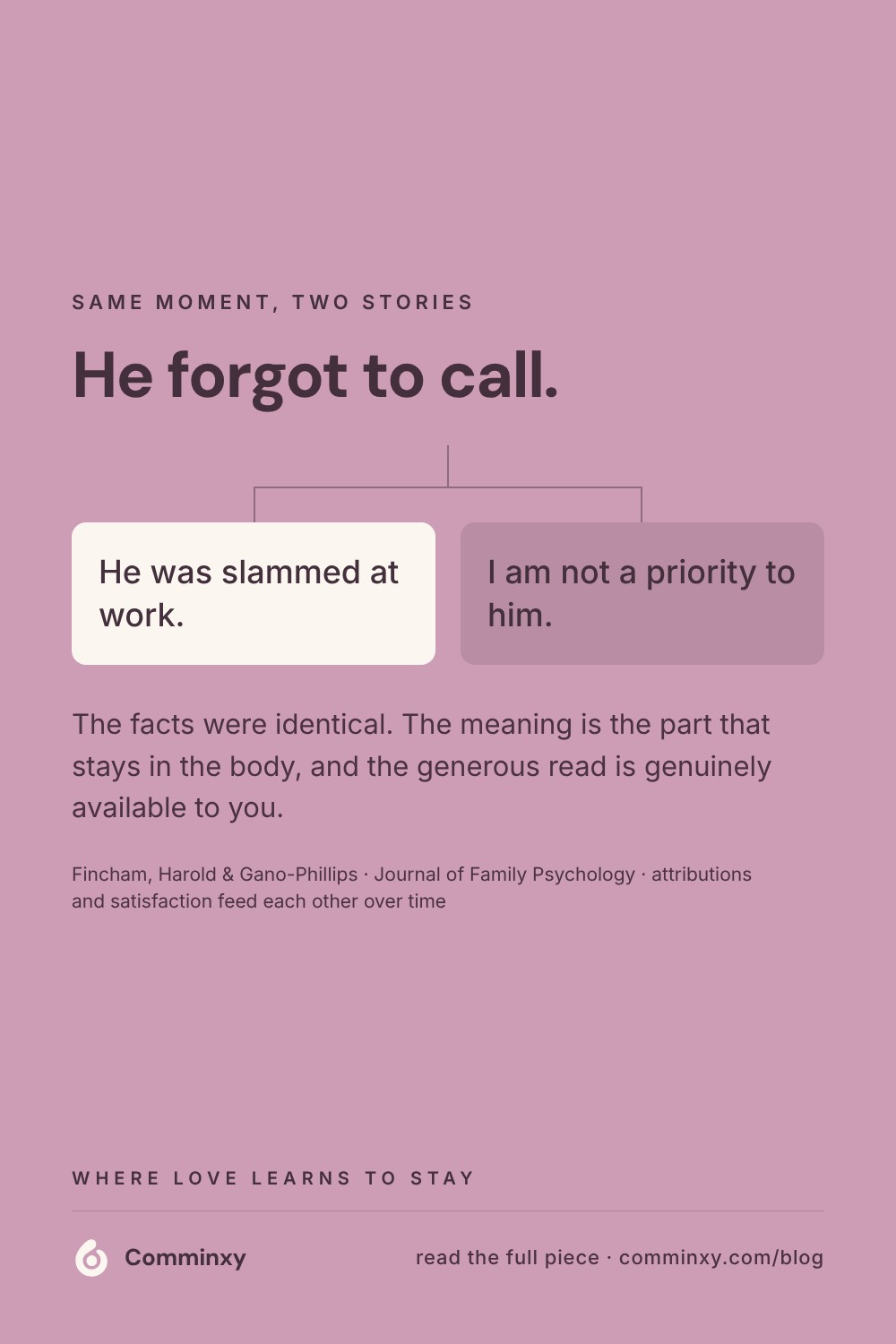
Two partners can live through the identical moment (he forgot to call) and walk away with completely different stories. One thinks, he was slammed at work. The other thinks, I'm not a priority to him. Same facts. Different meaning. And the meaning is what stays in the body.
Fincham, Harold, and Gano-Phillips followed couples across three waves of measurement, published in the Journal of Family Psychology, and found a reciprocal loop: the negative explanations partners assigned to each other and their satisfaction fed each other over time. When you start reading your partner's behavior as proof of something bad about them, satisfaction drops. And when satisfaction drops, you read more behavior as proof. It spins.
The couples who lasted weren't naive. They just gave each other the more generous read a little more often. Not because their partner had earned it every single time, but because they'd learned the cheaper interpretation cost them more than it was worth. This is also why so much trouble starts over text: the story fills in where the tone went missing, and there's more on that in why tone gets lost in text and how to add it back.
They kept doing things together that felt slightly new
That neutral quiet, the one where you're both home but barely present to each other, has a name in the research. And it's worth knowing.
Tsapelas, Aron, and Orbuch tracked couples over a nine-year span and found, in Psychological Science, that boredom at year seven predicted lower satisfaction nine years later. Not conflict. Boredom. The slow flattening of two people who already know all of each other's stories.
But the same line of research offered the way back. Couples who did novel, slightly challenging things together (anything that stretched them a little) felt closer afterward. It didn't have to be skydiving. A new route home. A meal neither of you knew how to cook. Something that put you back in the position of figuring something out side by side, instead of just managing the household together. The couples who stayed kept a small thread of new running through the familiar.
They tended the relationship before it needed rescuing
Most people only reach for repair after something breaks. The couples who stayed did something gentler. They maintained.
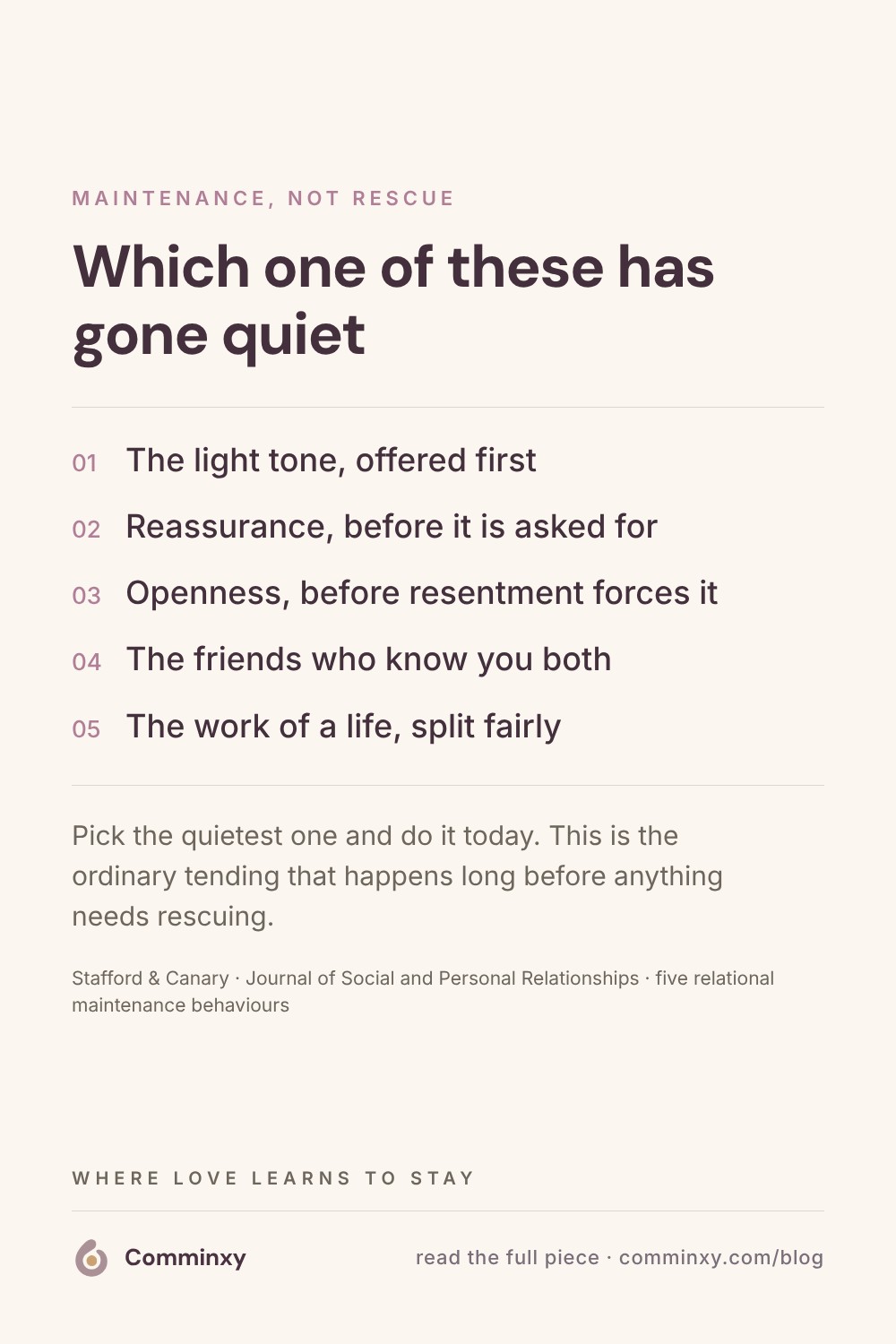
Stafford and Canary, in the Journal of Social and Personal Relationships, identified five ordinary maintenance behaviors that quietly held relationships together: positivity, reassurance, openness, leaning on shared friends, and simply splitting the work of a life fairly. None of it dramatic. All of it daily. The reassurance offered before anyone asked for it. The openness given before resentment forced it out.
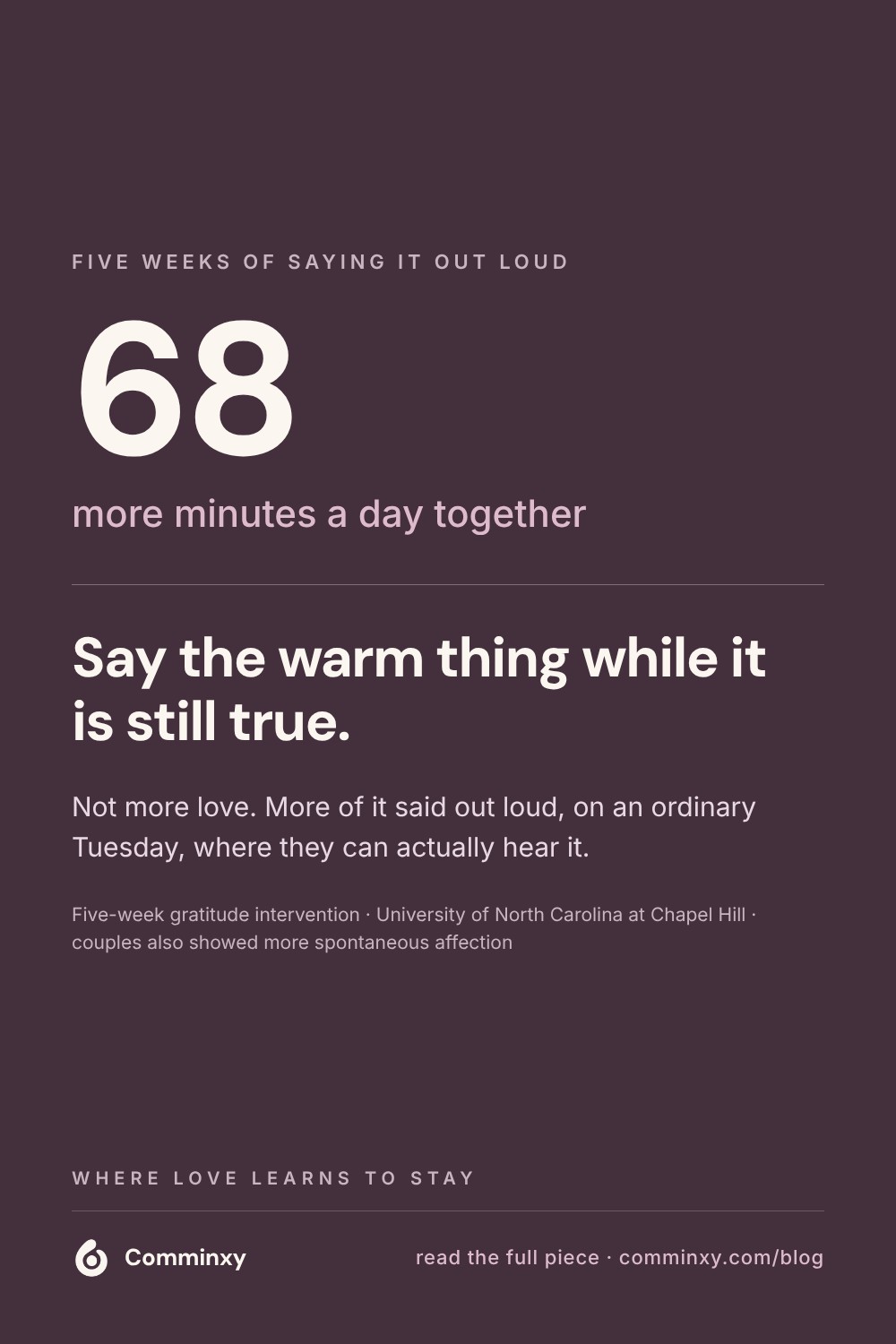
And there's evidence that even gratitude does heavier lifting than we assume. In a five-week intervention from the University of North Carolina at Chapel Hill, couples who practiced gratitude ended up spending an average of 68 minutes more together each day and showed more spontaneous affection than couples who didn't. Sixty-eight minutes. From noticing out loud what you already appreciated. The hardest part of staying together often turns out to be just remembering to say the warm thing while it's still true. When you both stay calm enough to keep saying it, even in tension, things hold. There's more on that in how to have a calm conversation when you're both upset.
The pharmacy counter was never the problem
So you're back at the counter. The text still says "ok". The story you're inventing is still louder than the one that's probably true. But that moment isn't a warning that something is dying. It's an invitation to choose the kinder read, to add one small new thing to the day, to say the warm thing before it goes unsaid too long.
The couples who stayed weren't blessed with easier love. They just kept doing the quiet, ordinary work of turning back toward each other. Not one heroic gesture, but a thousand small moments of staying. The work of a life.
Comminxy was built to sit in those moments with you, to help you find the warmer word, the gentler read, the way back, because that's where love learns to stay. You pocket your phone. The pharmacist calls your name. And when you get home, you'll say the small thing first.
Questions people ask
why do couples who stay together last longer than others
Couples who stay together tend to give each other generous interpretations of behavior, maintain the relationship before it breaks, and keep doing new things together to avoid boredom. They also make a daily decision that their shared life is worth more than walking away, which matters more than just feeling in love.
what does research say about what makes couples stay together
Research shows lasting couples are distinguished by commitment built on satisfaction, investment, and lack of better alternatives, not just love. They also refuse to let single bad moments define the relationship, practice ordinary maintenance like reassurance and openness, and do novel activities together to prevent boredom from eroding satisfaction.
how do you stop reading your partner's behavior as proof they don't care
You practice choosing the kinder story when the facts allow multiple interpretations, recognizing that the meaner story often costs you more than it's worth. Over time, negative interpretations and declining satisfaction feed each other in a loop, so interrupting that pattern by assigning more generous reads helps stop the spiral.
Keep the idea with you — pin it, or download the cards.


Comminxy helps you find the kinder read when the facts feel cold
Get Comminxy free →