How to Take a Break During an Argument Without Making It Worse
You know the moment. Your voice has gone tight. The words are coming faster than you can think them. Somewhere in the back of your mind a quieter voice says, stop, this is going somewhere bad, and instead of stopping, you say the next sharp thing anyway. Later, lying in bed, you'll wonder why you couldn't just walk away when you needed to.
Most of us were never taught how to take a break during an argument. We only know two moves: keep going until someone breaks, or leave the room and slam something on the way out. Both make it worse. But there's a third way, and it's quieter than you'd think.
The break that isn't really a break
Here's what usually happens. One of you says "I can't do this right now" and walks off. The other one is left standing in the kitchen, heart pounding, staring at the space where a person used to be. Nothing got paused. The argument just moved indoors, into two separate bodies, and kept running.
That's not a break. That's an exit. The difference matters, because a real break is something you do together, even when you're apart. An exit says I'm done with you. A break says I'm coming back. The words can be almost identical. What changes everything is whether the other person knows you're returning.
Why your body gets there before your words do
There's a reason the smart part of you goes offline mid-fight. When conflict escalates, your nervous system floods. Your heart rate climbs, stress hormones spike, and the part of your brain that hears nuance and finds the kind word simply stops being available. You are not being difficult. You are being human, in a body that thinks it's in danger.
Levenson and Gottman found in the Journal of Personality and Social Psychology (1983) that when partners' bodies become physiologically linked during conflict (both of them spiking at once), it predicts a decline in how satisfied they feel with the relationship over time. Read that slowly. The disagreement itself isn't what erodes things. It's the two flooded bodies feeding each other's alarm, faster and faster, until no one can hear anything.
This is exactly why walking away can be an act of love rather than abandonment. You're not refusing the conversation. You're refusing to keep having it while your body is convinced you're under attack. The trouble is that your partner's body is convinced of the same thing, so when you leave without a word, their alarm doesn't quiet. It gets louder.
What actually makes a break work
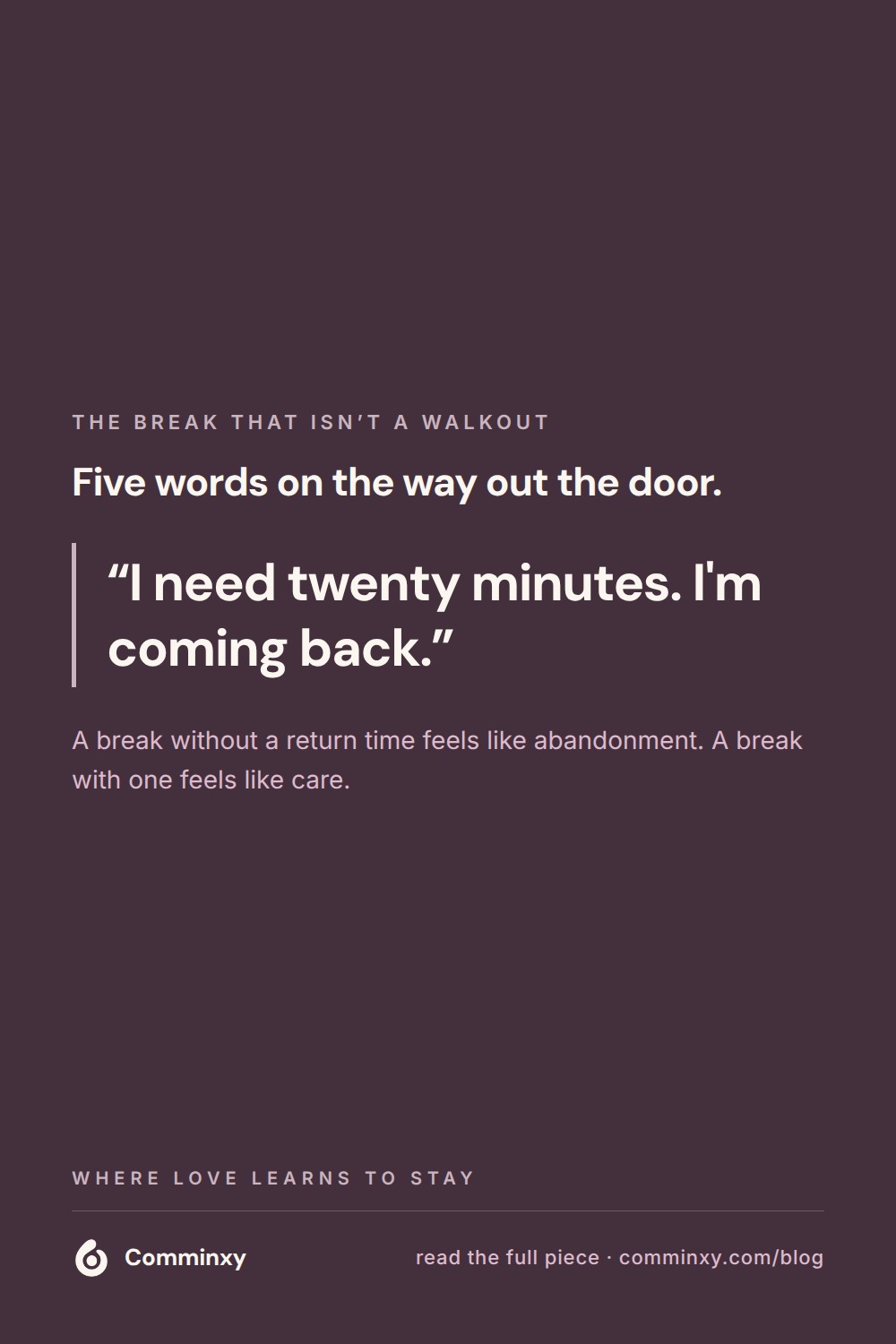
The thing that turns an exit into a real break is almost embarrassingly small. It's a sentence. Something like, I want to keep talking about this, but I'm too worked up to do it well right now. Give me twenty minutes and I'll come back.
Notice what that sentence does. It names that you're leaving. It names why. It promises a return, and (this is the part people forget) it gives a time. Without a time, a break feels like a punishment, an open-ended silence the other person has to wait out. With a time, it becomes a container. Your partner can exhale, because they know the conversation isn't being buried. It's being protected.
Then you actually take the time. Not to build your case. Not to rehearse the next round. The point of the break is to let your body come back down, and you can't do that while you're still prosecuting the argument in your head. Splash water on your face. Walk around the block. Do something boring with your hands. You're waiting for the moment when the other person stops feeling like an enemy and starts feeling like someone you love who is also having a hard night.
And when you come back, you come back. That's the promise. A break you don't return from isn't a break at all. Gottman and Krokoff found in the Journal of Consulting and Clinical Psychology (1989) that disagreement and anger, in themselves, don't harm a marriage over the long run, but defensiveness and withdrawal do. You're allowed to be angry. You're allowed to disagree loudly. What quietly corrodes things is the leaving that never comes back. So the break is only half the move. The return is the other half, and it's the more important one.
Coming back without picking it back up
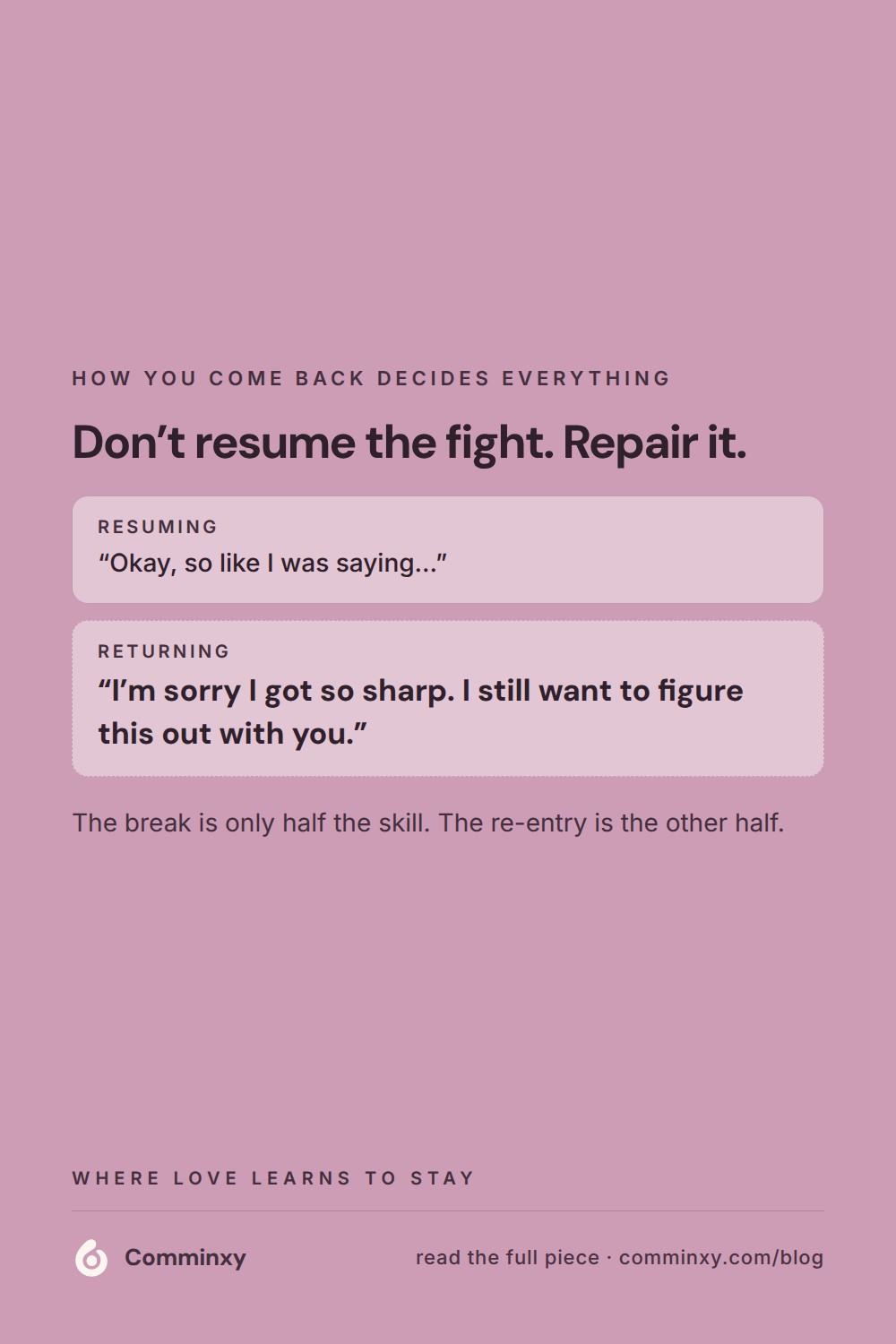
Returning is its own small skill. Most people come back and immediately reopen the wound (okay, so like I was saying), and within thirty seconds the flood is right back where it was. The return works better when it starts softer than the fight ended.
Something like, I'm sorry I got so sharp. I still want to figure this out with you. You don't have to have solved anything. You don't have to concede the point. You just have to signal that you came back as a partner, not a litigator. If you want more on how these re-entries shape whether a conversation heals or hardens, there's a fuller look at that in what emotional safety in a relationship actually looks like.
There's something quietly hopeful buried in the research here. Carstensen, Gottman, and Levenson watched long-married couples in Psychology and Aging (1995) and found that the ones who stayed close used small moments of humor and affection to soothe themselves right in the middle of hard conversations. Not big gestures. A wry look. A softened voice. A hand on a shoulder. These couples had learned to bring the temperature down without leaving the room at all. A good break is you buying yourself the time to become the kind of person who can do that.
The bigger thing a break protects
When you take a break the right way, you're not avoiding the fight. You're protecting the two of you from the version of yourselves that shows up when you're both flooded: the version that says things you'll spend the next week trying to unsay. If that sounds familiar, you may recognise yourself in why you keep saying things you regret to your partner over text, where the same flooding does its damage through a screen instead of across a room.
So think back to that moment in the kitchen: the pounding heart, the space where a person used to be. Imagine it differently. This time there's a sentence before the silence. I need twenty minutes. I'm coming back. And then, twenty minutes later, footsteps, and someone standing in the doorway a little softer than they left. That's not the end of the argument. It's the beginning of the two of you learning that a hard conversation doesn't have to become a wound.
That learning takes practice, and practice is easier with something in your corner, which is part of why Comminxy exists, quietly helping partners notice when to pause and how to find their way back to each other. Because the return is the whole thing. It's where love learns to stay.
Questions people ask
how long should you take a break during a fight
Twenty minutes is usually enough for your body to come back down from the physiological flood that happens during conflict. The specific length matters less than naming a time out loud so your partner isn't left waiting in an open-ended silence. When you return, start softer than the fight ended.
what do you say when you need space in an argument
Say something like 'I want to keep talking about this, but I'm too worked up to do it well right now, give me twenty minutes and I'll come back.' This names that you're leaving, explains why, and promises a return with a timeframe. Without those pieces, walking away feels like punishment instead of protection.
is it okay to walk away during an argument
Yes, walking away can be an act of love when your body is flooded and you can't access the part of your brain that hears nuance. The key is to tell your partner you're leaving, why you need the break, and when you'll return. Then actually come back at that time.
why does my partner leave in the middle of a fight
When conflict escalates, the nervous system floods with stress hormones and heart rate climbs, making the reasonable part of the brain go offline. Your partner isn't being difficult, their body thinks it's in danger. If they leave without explanation, though, that exit can make things worse instead of creating space to calm down.
Keep the idea with you — pin it, or download the cards.


Comminxy helps you notice when to pause and find your way back
Get Comminxy free →