What Is Emotional Intimacy, and Why Does It Decide Whether Love Stays
Two people can share a bed, a mortgage, a decade, and still not know what the other one is afraid of. You can know how they take their tea, which side of the car they will reach for, the exact face they make before they cry, and still feel, some nights, like you are living beside a locked room. That gap is what people mean when they ask what is emotional intimacy. It is the difference between knowing someone's habits and knowing their inner weather.
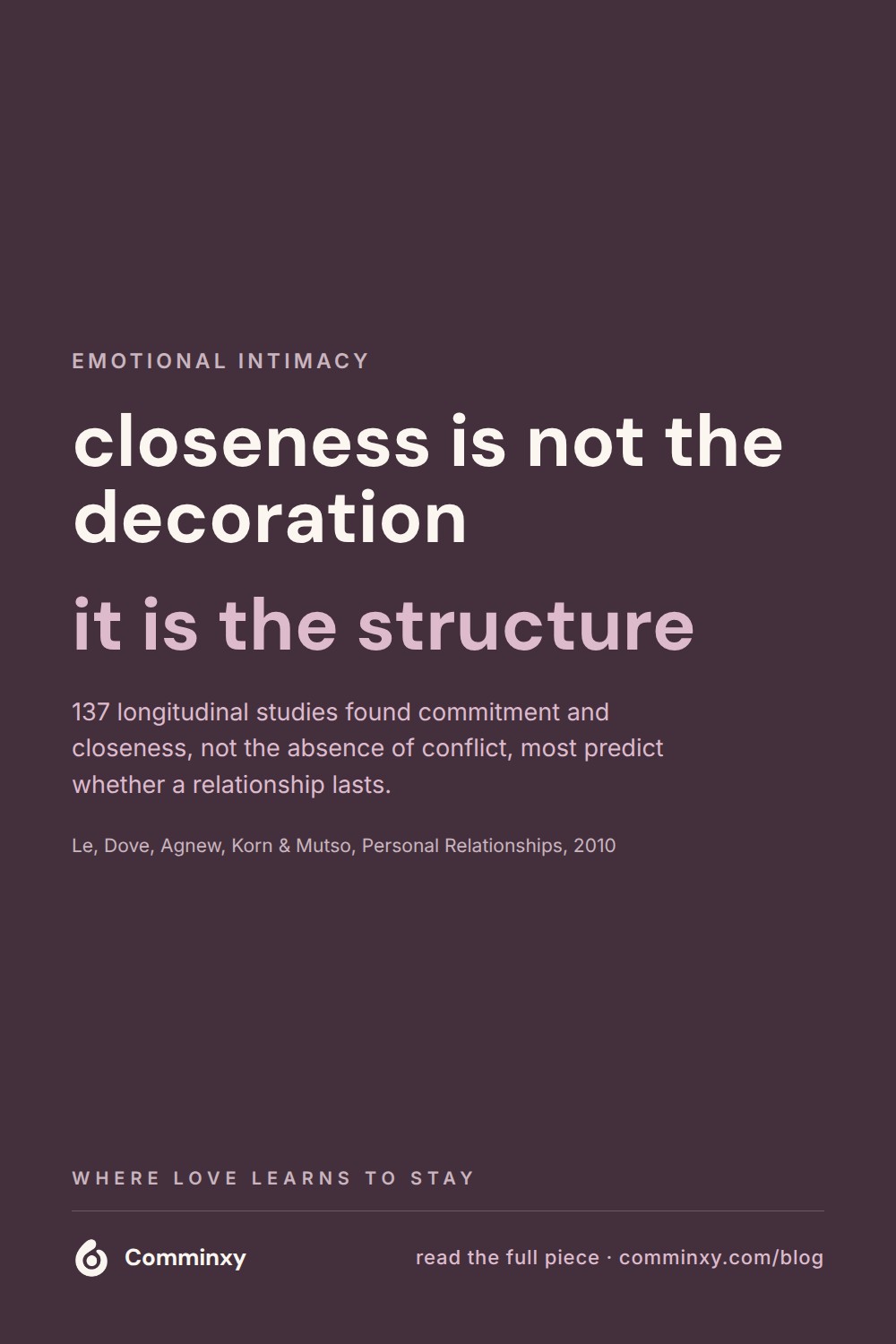
And it is more decisive than most of us were ever told. When researchers went looking for what actually keeps couples together over time, the loudest predictors were not chemistry or shared hobbies. A meta-analysis of 137 longitudinal studies spanning thirty years found that commitment, love, and the degree to which partners had folded each other into their sense of self were among the strongest forces holding a relationship together, and their absence among the strongest signs it would end (Le, Dove, Agnew, Korn, and Mutso, Personal Relationships, 2010). The thing that decides whether love stays is how much of each other you have actually let in.
Intimacy is not a mood you fall into. It is something two people build, turn by turn
There is a study that quietly changed how people think about this. Researchers asked couples to keep diaries of their daily interactions and rate how close they felt after each one. What they found was that intimacy was not a fixed temperature in the relationship. It was built, conversation by conversation, through a specific loop: one person reveals something real, the other responds in a way that says I heard you and I am still here, and the first person feels understood. That feeling of being understood, what the researchers called perceived partner responsiveness, was the hinge the whole thing turned on (Laurenceau, Barrett, and Pietromonaco, Journal of Personality and Social Psychology, 1998).
Which means intimacy is not a thing you have. It is a thing you do, and keep doing, in small unremarkable moments. Someone says the appointment went worse than they let on earlier. The other one puts down what they were holding and turns toward it. A closeness exists in that exchange that did not exist a minute before. It was made, right there, by two people.
And it can go unmade just as quietly. Not through cruelty. Through the thousand small moments where someone reaches out with something tender and the other, distracted, tired, defended, does not quite catch it. The disclosure stops coming. The room locks.
Why the room locks without anyone choosing it
Almost nobody decides to stop being known. What happens is smaller and sadder. You mention the thing that scared you, and it lands flat, or gets fixed instead of heard, or gets met with a story about their day instead. So the next time the tender thing rises in you, you let it pass. Easier that way. No sting.
Do that enough times and the disclosure muscle goes quiet. You are still talking. Logistics, the kids, the car, the weekend. But the inner weather stays private, and after a while you forget you ever reported it to anyone. This is often what people are feeling when they say they have grown apart. Not that the love left. That the disclosures stopped, and nobody noticed the exact day it happened.
If this is where you are, it is worth saying plainly: there is nothing wrong with you for closing. You closed because opening got no answer, and a person who stops reaching for a hand that keeps missing is not broken. They are learning.
The loop runs both ways, and it does not need to be done well
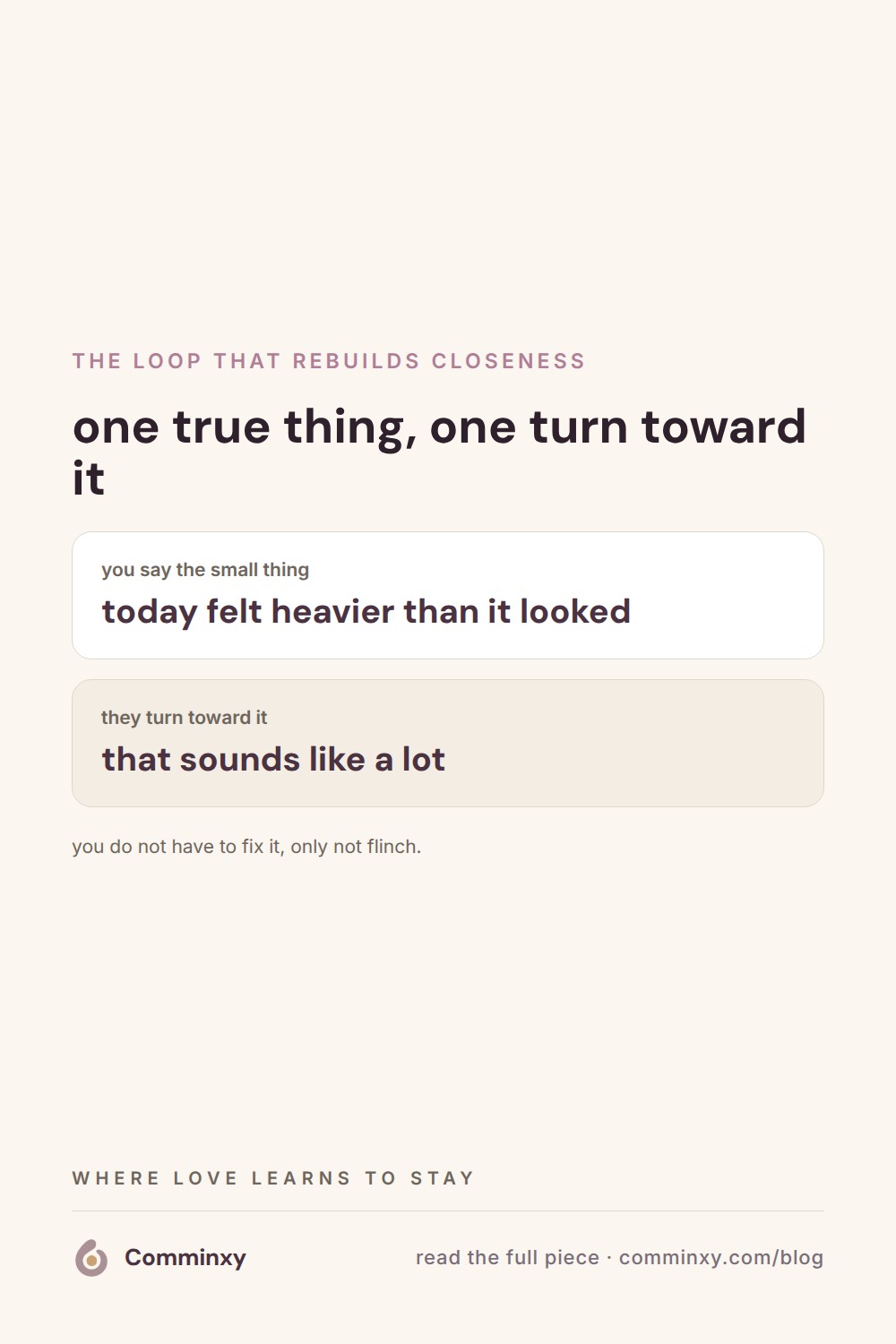
The hopeful part of that diary study is that the loop is simple enough to restart. It takes one disclosure and one response. Not a breakthrough. Not a weekend away. One true thing said, and one person on the other end who turns toward it instead of away.
The disclosure can be small and clumsy. "Today felt heavier than it looked." "The thing with your mum bothered me more than I said." You do not have to say it beautifully. The research found that what mattered was the responsiveness on the other side, the sense of being received, not the eloquence of the reveal. A person can stumble through the words and still be fully understood, because understanding lives in the listener as much as the speaker.
And if you are the listener, the turn is smaller than you fear. You do not have to solve what they hand you. You mostly have to not flinch, not fix, not change the subject. "That sounds like a lot" does more than any advice. Being understood, it turns out, matters more to most of us than being agreed with, and it certainly matters more than being handed a solution we did not ask for.
Why this is the thing worth protecting
It would be easy to treat emotional intimacy as a soft extra, the nice-to-have on top of the real business of running a life together. The long research does not read that way. When commitment and that sense of two lives folded into one thin out, the relationship loses the very things that were holding it (Le and colleagues, Personal Relationships, 2010). Closeness is not the decoration. It is the structure.
There is relief buried in that, if you look. It means the couples who stay are not luckier or better matched. They are the ones who kept the loop running, who kept saying the slightly vulnerable thing and kept turning toward it when it was said to them. That is a thing two ordinary, tired people can do. Badly, often. And it still counts.
Think again of that locked room, the sense of living beside someone you cannot quite reach. It does not open with a grand confession. It opens the way it closed, one small disclosure at a time, one moment of someone putting down what they were holding and saying, go on, I am listening. Comminxy exists to help you catch those moments, the reaches that are easy to miss when you are both worn out, so the turning-toward happens a little more often than it would on its own. The room was never locked for good. You both still have the key, and it is smaller than you think. It is just the next true thing, said out loud, to someone who stays to hear it.
Questions people ask
what does emotional intimacy actually mean
It means knowing and being known on the inside, not just knowing someone's habits and routines. It is the sense that you can share something real and be received rather than dismissed. It grows through small moments of opening up and being understood.
why do couples who still love each other feel distant
Often because the small vulnerable things stopped being shared, usually after they went unheard a few times. The love can still be there while the openness has quietly faded. Nobody notices the exact day it stops.
how do you rebuild emotional closeness after drifting apart
Start small with one honest thing said out loud to someone who stays to listen. You do not need a grand gesture or a perfect conversation. What matters most is one person turning toward the other instead of away.
is it my fault for shutting down in my relationship
Not necessarily, people usually close off because reaching out stopped getting a response. Pulling back is often a learned reaction, not a flaw. If the distance feels heavy or lasting, talking to a qualified therapist can help.
Keep the idea with you — pin it, or download the cards.



Notice the small reaches before they stop coming.
Get Comminxy free →