Why Couples Stop Talking — And the Quiet Way Back to Each Other
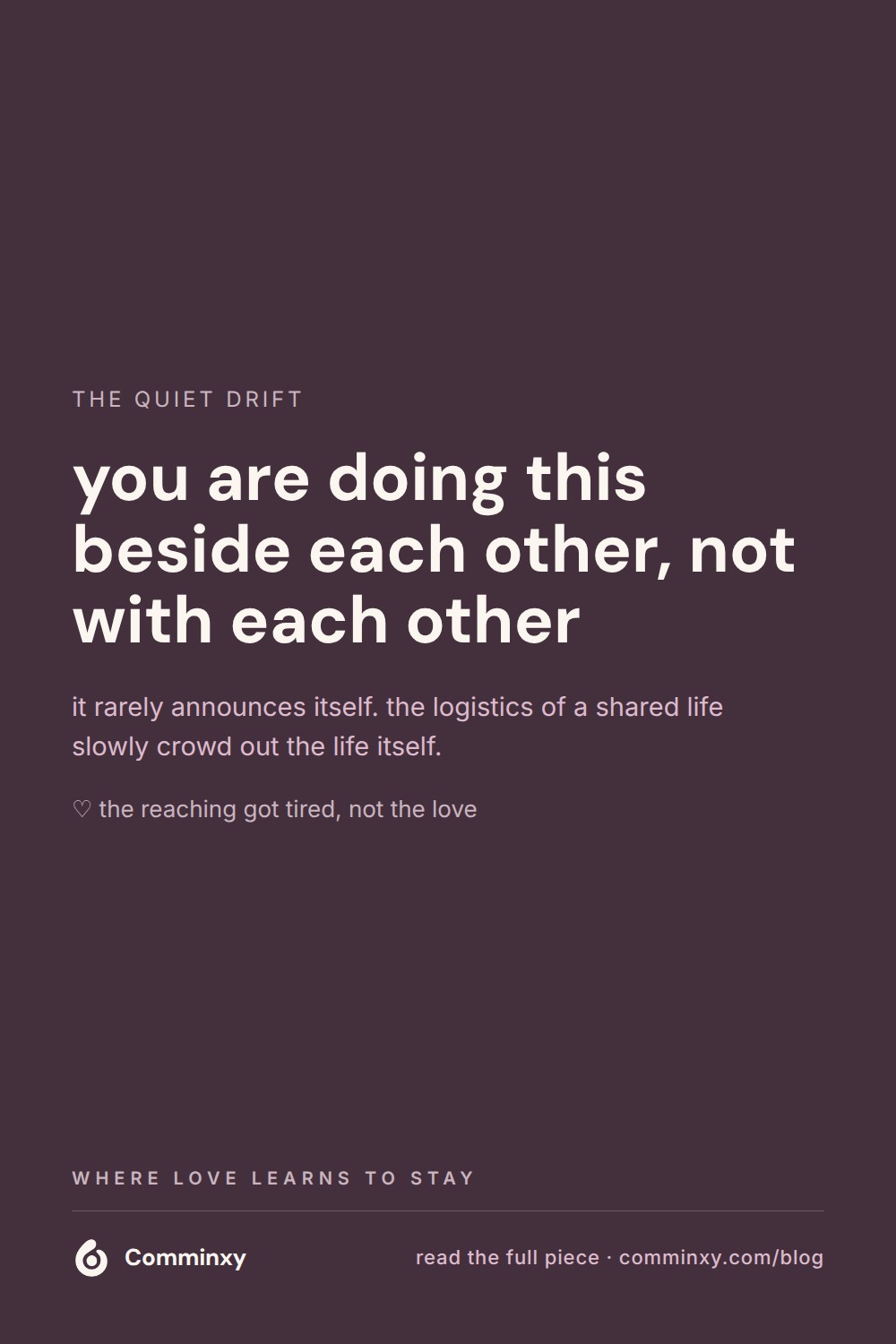
You used to narrate everything. The strange dream you had, the coworker who microwaved fish again, the song that came on in the pharmacy that you hadn't heard since you were seventeen. Now you're standing in the produce aisle together on a Sunday, reaching for the same bag of oranges you always get, and neither of you says anything. It isn't cold, exactly. It's just quiet. Efficient. You move through the list like two people who have done this a thousand times, because you have. And somewhere between the oranges and the checkout you notice a small ache you can't quite name: you are doing this beside each other, not with each other.
When couples stop talking, it rarely announces itself. There's no last conversation, no door slammed on words. There's just a slow drift toward the practical, the logistics of a shared life crowding out the life itself. You still talk. You talk about the dentist and the car and whose turn it is. What went missing was the other kind of talking, the useless, tender, unnecessary kind that was never about information at all.
The silence that grows where the words used to be
It helps to name this plainly, because the not-naming is part of how it grows. Conversation isn't really what went missing. What went missing was a certain kind of reaching: the little offerings you used to make without thinking, a half-formed thought handed across the room just to see what the other person did with it.
Those small offerings were doing quiet work. Each one carried a tiny question underneath the words. Are you still there? Do you still want to know me? When the answer came back warm often enough, you stopped needing to ask consciously at all. You just trusted it. Then the offerings slowed. Not from anger. From fatigue, from busyness, from a hundred moments where one of you was too tired to catch the thing the other tossed out, and after enough dropped catches you both stopped throwing, gently, without either of you ever deciding to.
Why the quiet arrives without anyone choosing it
There's a comforting thing buried in the research here. The couples who drift into silence are usually not the couples who fight the loudest. They're often the ones who learned to stop fighting altogether.
Tracking couples over many years, John Gottman and Robert Levenson found that divorce tends to arrive in two quite different shapes. Some marriages end early, around 5.6 years in on average, worn down by high conflict. Others end much later, and those are undone by withdrawal rather than shouting: emotional distance, a slow flattening, the quiet leaving of the room while both people are still in it (Gottman and Levenson, Journal of Family Psychology, 2000). Which makes silence less of a safe alternative to the fight, and more of a slower weather doing the same work.
That's strangely relieving to know while you're standing in the produce aisle. It means the quiet you're feeling isn't evidence that you've run out of things to say. The reaching got tired, and tired can be rekindled in a way that broken cannot.
What the drift is actually protecting
The drift almost always begins as a form of care, which is the part that makes it so hard to see. You stopped bringing up the thing that hurt because you didn't want a Sunday to curdle. You stopped mentioning the small worry because they already seemed stretched thin. You went quiet at exactly the moments when talking felt too risky, and every one of those was a kindness that slowly starved you both.
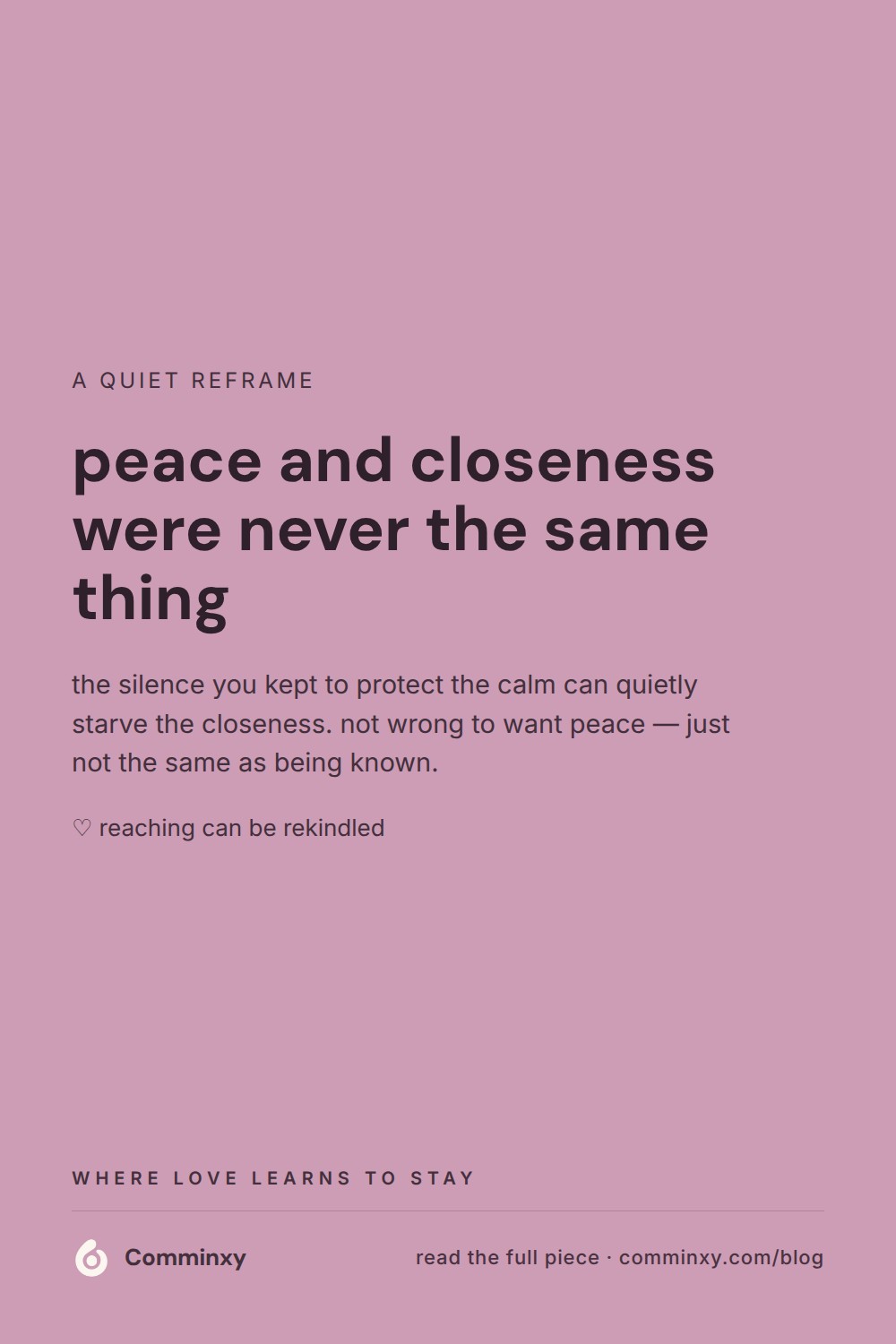
Gottman and Krokoff found something that runs against instinct. The couples who stay satisfied over the long run are often not the ones who avoid disagreement but the ones who let it happen, while withdrawal, going quiet to keep the peace, is what predicts the real deterioration over time (Journal of Consulting and Clinical Psychology, 1989). So the silence you chose in order to protect the relationship is quietly the thing wearing it down. You weren't wrong to want peace. Peace and closeness were simply never the same thing.
The way back is smaller than a conversation
People imagine the repair has to match the size of the distance. Some long, brave talk about Where We Are, staged after the kids are asleep, everything on the table. Sometimes that talk does come. It's almost never how the way back begins.
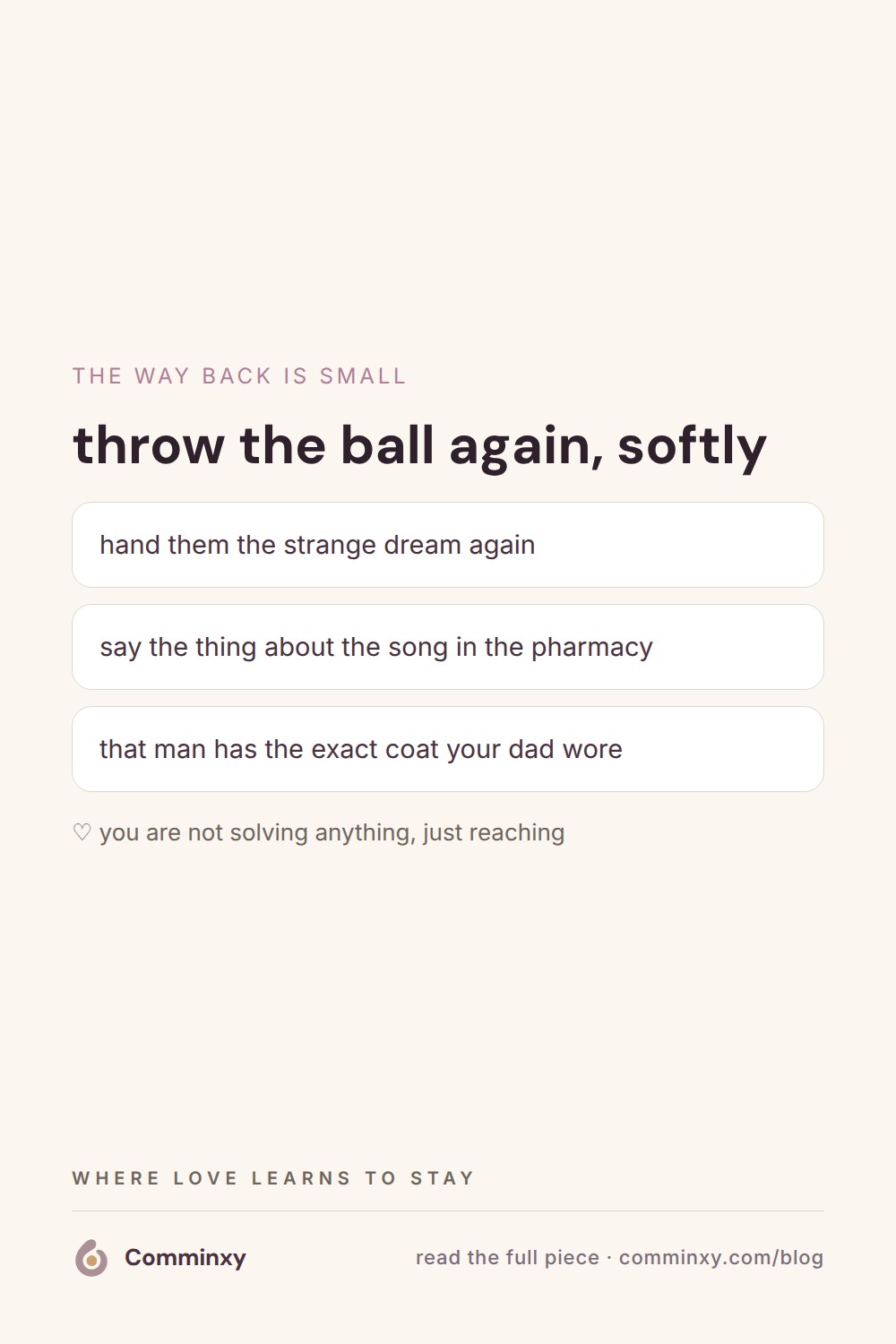
The way back begins with a single unnecessary offering. Handing them the strange dream again. Saying the thing about the song in the pharmacy. Telling them the small, pointless observation you'd normally swallow, that man over there has the exact coat your dad used to wear, and watching for one second to see whether they turn toward it. You aren't solving anything. You're throwing the ball again, softly, to find out whether the catching still lives in there. It usually does. It has been waiting.
The first few offerings will feel awkward. Stilted, too loud in all that quiet. Let them be awkward. That stiffness is the sound of two people relearning a language they used to speak fluently, and there's no version of relearning that skips it. If you want a gentler on-ramp back into the everyday kind of talking, there's more in how to communicate better with your partner, less technique than small ways of turning back toward each other.
What stays possible, even now
Couples decades into a marriage find their way back from quiets far deeper than this one. Following long-married couples for Psychology and Aging, Carstensen, Gottman and Levenson noticed that the ones who stayed close weren't the ones who never hit friction. They kept small warmth alive inside it, a bit of humour, a bit of affection, right there in the middle of the hard moments. That warmth doesn't require a breakthrough. It requires a beginning.
And some Sundays you'll say nothing at all. You'll mean to, you'll have the small thing ready, and it will sit in your mouth all the way to the car park. That isn't the drift winning. It's one quiet Sunday, and there's another one next week.
So on one of them, in the produce aisle, when you reach for the same oranges you always get, say the small thing. Not the important thing. The pointless, tender one. Watch them turn. Comminxy was built for exactly these small returnings, not to hand you a script but to help you notice the openings a little sooner. The grand conversation can wait. Someone is standing next to you by the oranges, and they have been hoping you'd say something useless to them for a while now.
Questions people ask
Why have my partner and I stopped talking?
Most often because the practical crowded out the tender rather than because anything went wrong. Couples keep talking about the dentist and the car long after they stop handing each other the small pointless things. The drift is usually fatigue, not a verdict.
Is silence in a relationship a bad sign?
It depends on whether it is companionable or avoidant. Quiet that comes from ease is fine. Quiet chosen to keep the peace is the kind the research links to slow deterioration, because peace and closeness are not the same thing.
How do we start talking again after months of silence?
Start much smaller than a conversation about the relationship. Say one unnecessary thing, a dream, an observation, something you would normally swallow, and see if they turn toward it. The first few attempts feel stilted for everyone.
Should we have a big talk about the distance between us?
Eventually that talk can help, but it is rarely how the way back begins. A serious conversation asks both people to be brave at the same moment. A small offering only asks one person to try something low stakes, which is why it usually works first.
Keep the idea with you — pin it, or download the cards.


The small useless sentence is the one worth saying tonight.
Get Comminxy free →