How to Rebuild Trust in a Relationship When It Feels Broken Beyond Repair
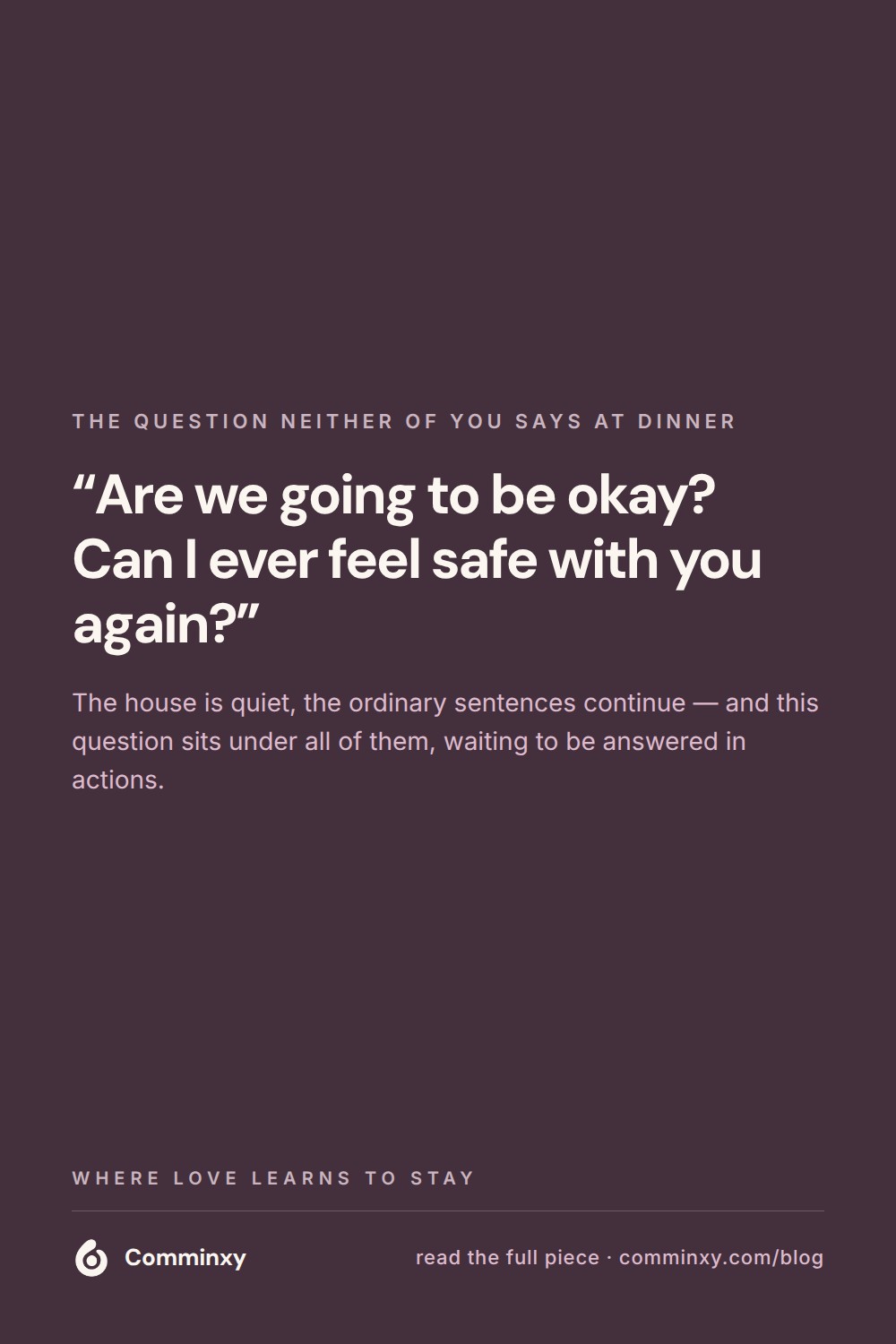
There is a particular kind of quiet that settles into a home after trust has broken. You are both still there. You pass each other in the kitchen. You say the ordinary things: did you eat, what time is your meeting, the bins go out tonight. But underneath every unremarkable sentence there is a second conversation happening, one neither of you is saying out loud. Are we going to be okay. Can I ever feel safe with you again. If you are lying awake tonight wondering how you rebuild trust in a relationship that feels shattered past any repair, the ache you are carrying is not proof that it's over. It is proof that you are still here, still trying to understand.
Stay in that for a moment.
The betrayal is rarely the thing that lingers longest
When trust breaks (through a lie, an affair, a hidden thing that surfaced, a promise that wasn't kept) the event itself is what everyone talks about. But what lingers is smaller and quieter than that. It is the ordinary moment afterward that carries the wound.
It's the phone lighting up on the table and both of you pretending not to notice the flinch. It's the second of hesitation before answering "who was that?" It's lying in the dark next to someone you have loved for years and feeling, for the first time, like you don't quite know the shape of them anymore. The betrayal happened once. The aftermath happens a hundred times a day, in glances and pauses and the small held breaths of a life that used to feel automatic and now feels like something you're both learning to do by hand.
Why the ground gives way (and why that isn't a character flaw)
Trust was never really about believing your partner would never hurt you. It was about not having to think about it at all. You didn't decide to trust them each morning. You simply lived, the way you don't decide to trust the floor when you get out of bed. Betrayal doesn't just break a promise. It removes the floor. Suddenly you are aware of every step, calculating, bracing. That exhaustion you feel? It is the sheer effort of walking on a surface that used to hold you without asking.
And so the person who was hurt becomes vigilant, and the person who caused the hurt often becomes defensive. Not because either of them is cruel, but because both are frightened. This is where so many couples quietly slip into the patterns that do more lasting damage than the original wound, the cycles of criticism and withdrawal described in the four communication patterns that destroy relationships. The betrayal is a wound. What happens next is what decides whether it heals or scars over hard.
Trust doesn't return through promises (it returns through evidence)
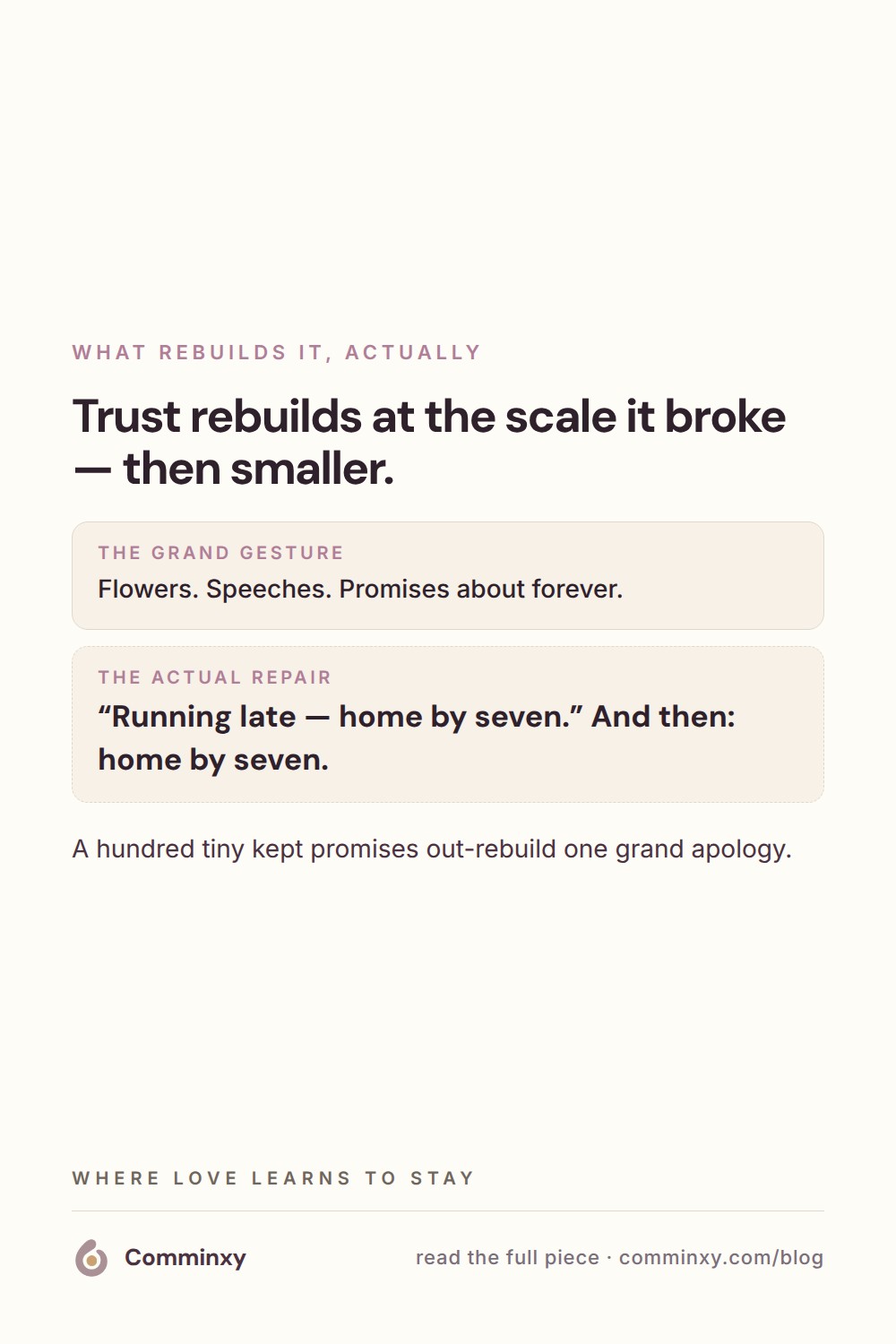
You cannot talk your way back into trust. No amount of "I'm so sorry, it will never happen again" rebuilds it, no matter how sincerely it's meant. Because trust was never made of words. It was made of a thousand small moments where reality matched expectation.
So it has to be rebuilt the same way. Not in one grand gesture of atonement, but in the accumulation of ordinary, boring, reliable moments. The text that says running late, home by seven and then home by seven. The question answered before it has to be asked. The small openness offered without being demanded. Trust comes back the way it left: quietly, incrementally, in the unglamorous evidence of a partner who is exactly where they said they would be. This is slow work, and the slowness is not a failure. The slowness is the medicine.
What repair actually asks of both people
Repair after broken trust is strange, because it asks something difficult of each person, and the two things are not the same.
The one who was hurt is asked, eventually, to risk again. To let a moment of reliability actually count, rather than filing it away as suspicious. And the one who caused the hurt is asked to stay soft under scrutiny they may feel is unfair, to keep showing up warmly even when the warmth isn't yet returned, to understand that their partner's questions are not attacks but the sound of someone trying to find the floor again.
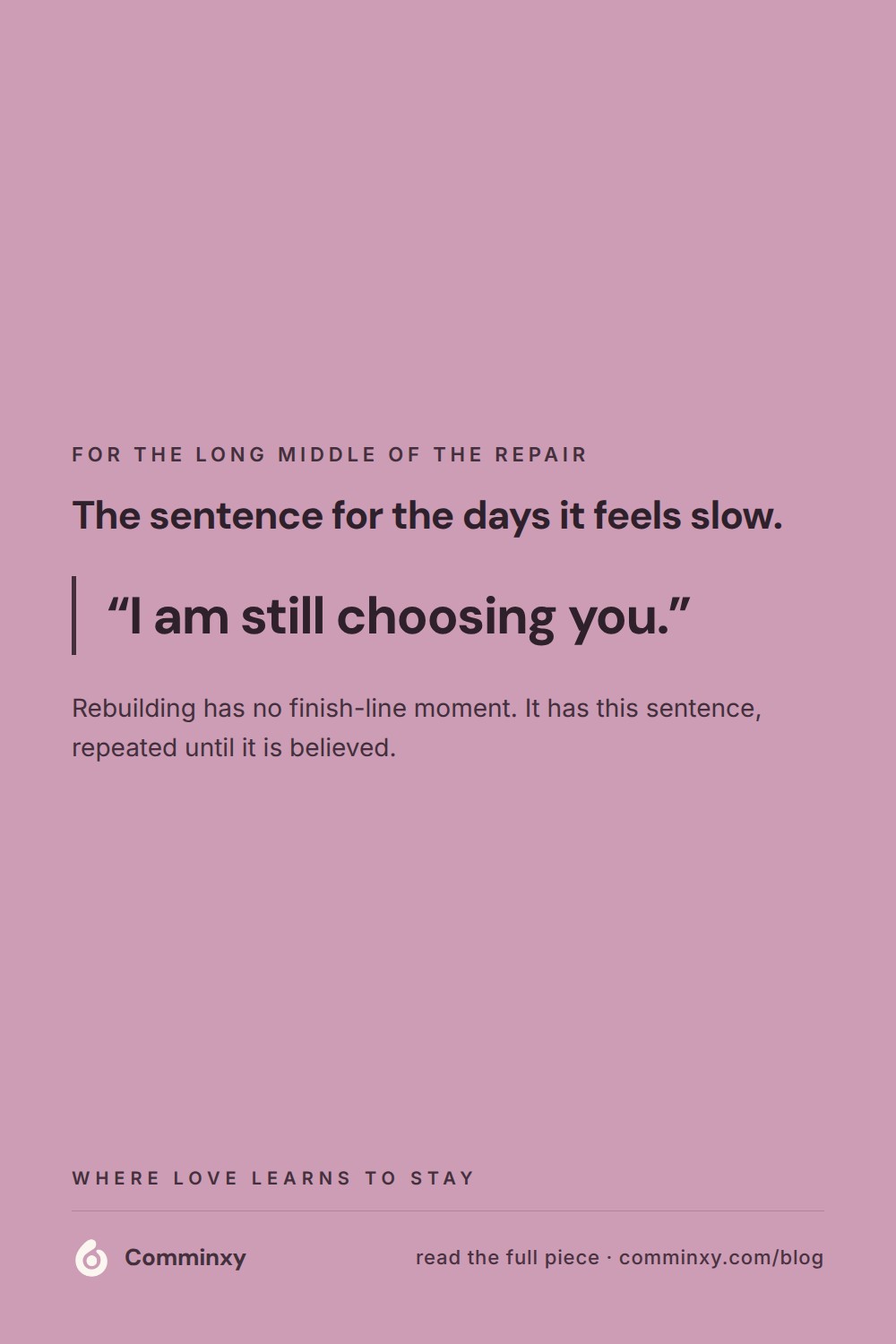
What makes this bearable is emotional safety: the sense that the truth, even a hard truth, can be spoken without the whole thing collapsing. Researchers De Netto, Quek, and Golden, in a 2021 study published in Frontiers in Psychology, found that the way partners respond to each other's good news (with genuine, active warmth rather than distraction or flatness) has the strongest influence on relationship satisfaction of any response style they measured. It's a small thing, turning toward someone when they share something. But after trust breaks, these small turnings toward each other are how you signal, wordlessly, I am still choosing you. If you want to understand what that safety looks like in daily life, there is more about what emotional safety in a relationship actually looks like.
A truer kind of trust than the one you had
Not every relationship survives this, and whether yours should is not a question anyone else can answer. That is not the question in front of you tonight. The question is only whether a way back exists.
It does. Not to the trust you had before, but to something that surprises many of the couples who reach it. The trust that grows after a rupture is often sturdier than the innocent kind that came before, because it isn't built on the assumption that nothing bad can happen. It's built on the lived knowledge that something bad did happen, and you found your way through it anyway. That is a floor that has been tested. Some couples say, years later, that they know each other more honestly now than they ever did in the easy years.
So come back to that quiet house, that kitchen where you pass each other saying ordinary things. What if the ordinary things are not the silence of an ending, but the first small evidence of a beginning? The earliest, most unglamorous proof that you are both still choosing to be here. Rebuilding trust is nothing more than a long series of these unremarkable moments, tended patiently. If it helps to have something alongside you as you find your words for the hard conversations, that's what a companion like Comminxy is for: not to fix what happened, but to help love find its footing again, and, in time, learn how to stay.
Questions people ask
how long does it take to rebuild trust after cheating
There is no set timeline because trust rebuilds through the accumulation of small reliable moments, not elapsed time. Some couples feel steady again within months, others need a year or longer depending on the depth of hurt and consistency of repair. The slowness itself is part of the healing, not a sign that it is failing.
can a relationship go back to normal after trust is broken
It does not usually go back to what it was before, but it can grow into something different and often more honest. The trust that forms after a rupture is based on tested evidence rather than assumption, which many couples find steadier than the innocent trust they had early on. Normal changes, but that does not mean worse.
why do I still feel anxious even when my partner is doing everything right
Because trust was never built from words or promises but from a thousand unconscious moments where expectation matched reality, and betrayal removed that automatic sense of safety. Your vigilance is not a character flaw but the natural result of learning the floor can give way. It takes time for your nervous system to believe the ground is solid again.
should I stay in a relationship after trust is broken
That is a question only you can answer, and not one anyone else should decide for you. A way back does exist for many couples, but not every relationship should or will survive, and choosing to leave is sometimes the wiser and braver choice. What matters most is whether both people are willing to do the patient, unglamorous work repair actually requires.
Keep the idea with you — pin it, or download the cards.


Comminxy helps you find your words when trust feels too fragile to speak
Get Comminxy free →