How to Feel Emotionally Close to Your Partner Again When the Distance Feels Quiet
You said goodnight the same way you have said it a thousand times. A soft word, a turn toward your own side of the bed, the click of a lamp. Nothing was wrong. There was no fight to point to, no cold silence you could name. And yet, lying there in the dark, you felt it — that quiet ache of missing someone who is close enough to touch. If you have been wondering how to feel emotionally close to your partner again when nothing has visibly broken, it might help to know that this particular kind of distance is one of the most common, and one of the most misunderstood.
The distance that arrives without a doorway
Most people expect distance to come with a story attached — a betrayal, a blowup, a slow-burning resentment. So when it arrives quietly, without any of those, it can be disorienting. You keep waiting for the reason to reveal itself, and it never does. You share a home, a bed, a calendar. You laugh at the same things. And still, somewhere underneath all that functioning, you feel like you are living beside your partner rather than with them.
Here is the reframe worth sitting with: the distance you are feeling is usually not a sign that something went wrong. It is a sign that something stopped happening. Those are very different problems, and the second one is far kinder than it feels at midnight.
Why closeness fades when nothing is broken
We tend to think of connection as a state — something you either have or you don't, like the weather. But the research points somewhere more surprising. John Gottman and Robert Levenson, studying couples in their lab, found that satisfied partners made up to 100 small overtures for attention in a ten-minute period, while distressed couples managed only 65 (Journal of Personality and Social Psychology). Gottman called these overtures "bids" — a glance toward the window, a half-finished thought said aloud, a hand resting a little too long on the counter.
What strikes me about that number is not the size of the gap. It is how ordinary the missing pieces are. Nobody withheld love. Nobody slammed a door. Someone simply mentioned something small, and the other person, tired or preoccupied or scrolling, didn't turn toward it. Do it once and it means nothing. Do it a thousand times and you get exactly the feeling you had tonight — two people who love each other, quietly out of reach. The distance wasn't built out of one wound. It accumulated out of a hundred unremarkable moments where nobody was even looking.
The moment you keep letting pass
Picture this: your partner walks into the kitchen and says, "Traffic was insane today." It is not a fascinating sentence. There is nothing in it that demands a response. And that is precisely why it matters. That throwaway line is a bid — a small hand held out, testing whether anyone is home.
Most of us answer these moments with our bodies half-turned. "Mm." Eyes still on the phone. It doesn't feel like rejection because it isn't meant as one. But the person offering the bid registers something anyway — not a rejection, exactly, but an absence. And when those absences stack up, the mind draws a quiet conclusion: my small self isn't very interesting to you anymore. That belief, more than any argument, is what makes a bed feel wide.
The reassuring part is that these moments arrive constantly. You are not waiting for one grand opportunity to reconnect. You are surrounded by dozens of tiny ones every single day, most of which you have been walking past without noticing.
The way back is smaller than you think
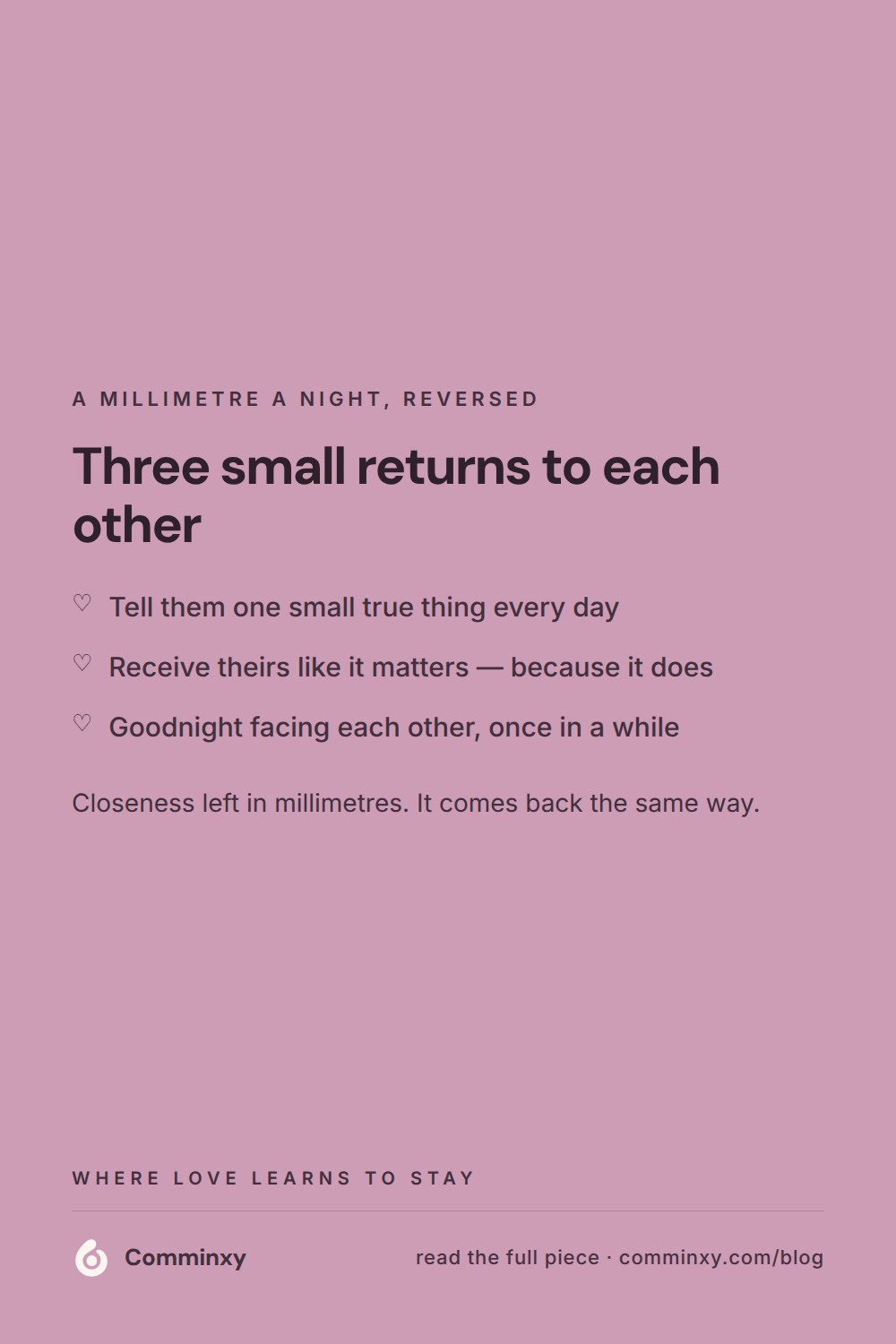
When people feel this kind of distance, they often assume the repair has to match the scale of the feeling — a weekend away, a long overdue talk, some dramatic reopening of the heart. But if closeness eroded through missed small moments, it tends to return through caught ones.
The next time your partner says something forgettable, try turning your whole body toward it. Put the phone face down. Ask the second question — not "how was traffic" but "what was going through your head while you sat there?" You are not solving anything. You are simply signaling: I'm still here, and your small self is still interesting to me. Brooke Feeney's work found that responsive, non-intrusive support of a partner's ordinary goals and curiosities increased their happiness and self-esteem (Journal of Personality and Social Psychology). Responsiveness, it turns out, is less about grand gestures and more about being reachable in the unremarkable moments.
If words feel hard to find at first, this is often where couples get quietly stuck — not from lack of love, but from not knowing how to reopen a channel that went silent. It can help to read a little about how to communicate better with your partner when the usual rhythm has faded, and to remember that turning toward someone is a skill, not a verdict on how much you feel.
What repair actually feels like
Repair here rarely looks like a breakthrough. It looks like your partner mentioning the traffic, and you — for once — looking up. It looks like a slightly longer pause before you both turn to your own sides of the bed. Nobody announces that the distance is closing. You just notice, some ordinary evening, that you laughed at something together and the laugh landed somewhere deeper than usual.
This is why the quiet kind of distance, painful as it is at midnight, is often the most forgiving to mend. There is no rubble to clear, no trust to rebuild from scratch. There is only a habit of not-quite-noticing that can be gently replaced with a habit of turning toward.
So the next time you say goodnight the way you have a thousand times — the soft word, the turn, the click of the lamp — see if you can add one small thing before the light goes out. A question you didn't ask. A hand that stays a moment longer. That is where the whole thing quietly begins again. Comminxy exists to help you notice those small openings as they happen, so the reaching-toward becomes a rhythm rather than an afterthought. Because closeness was never something you lost. It was something you stopped catching — and it is waiting, patiently, to be caught again.
Questions people ask
Why do I feel distant from my partner when nothing is wrong?
Because distance does not always arrive with a reason attached. More often it builds from small overtures that stopped being answered. That is a different problem from something being broken, and a gentler one.
What is a bid for connection?
A bid is any small overture for attention. A glance toward the window, a half-finished thought said aloud, a comment about the traffic. Researchers counted around a hundred of them in ten minutes among satisfied couples, and sixty five among distressed ones.
How do you rebuild emotional closeness with your partner?
Start by turning toward the unremarkable moments rather than planning a serious conversation. When they say something that does not seem to require a response, respond anyway. That is where the closeness actually lives.
Can emotional distance in a relationship be fixed?
In most cases yes, and usually more easily than it feels at midnight. Distance built from a hundred small misses can be closed by a hundred small turns toward each other. It rarely takes a dramatic conversation.
Keep the idea with you — pin it, or download the cards.




Turning toward the boring sentence is where closeness comes back.
Get Comminxy free →