The Quiet Cost of a Hard Day: What Stress Spillover Relationship Research Reveals About Love
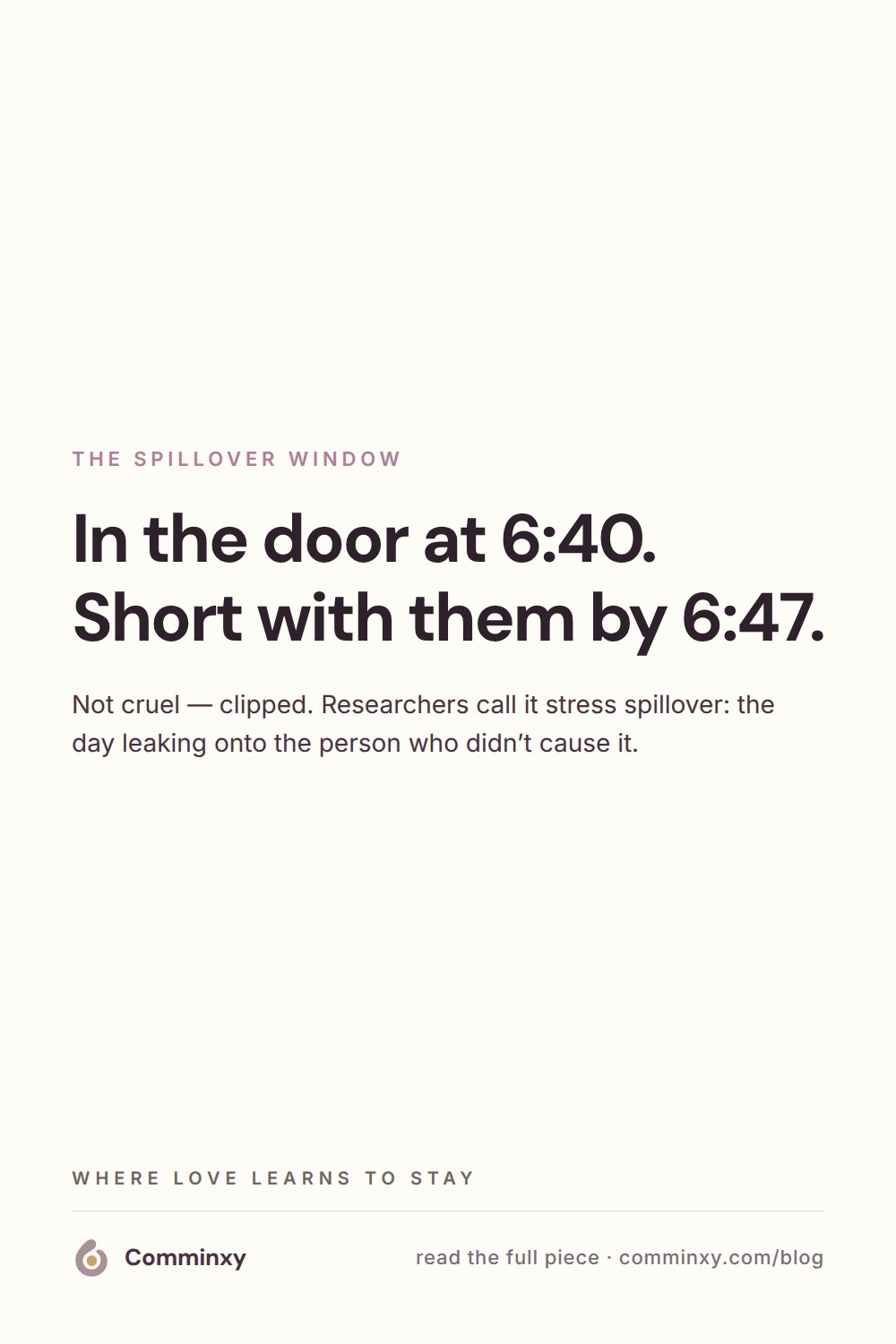
You walked in the door at 6:40, and by 6:47 you'd said something short to the person you love most. Not cruel, just clipped. A sigh at the wrong moment, an answer that came out flatter than you meant it, a flinch when they asked how your day was. The strange part is that you weren't even upset with them. You were upset about the email you never sent, the meeting that ran long, the thing your boss said in that tone. But your partner is the one standing in the kitchen, so your partner is the one who caught it.
If you've felt that, the quiet guilt of being shorter at home than the day actually earned, you're not doing anything wrong. You're doing something profoundly human. What you're feeling has a name in the research world, and understanding it changes how you see those clipped evenings. This is what stress spillover relationship research has been trying to tell us for years: the day doesn't end at the door. It walks in with you.
The day you had becomes the night you have
Think about the last time you snapped over something small. The dishwasher left half-loaded, a question repeated twice. In the moment it felt like it was about the dishwasher. It almost never is.
Stress works like water finding the lowest point. When you spend all day holding it together at work, keeping your voice even for people who haven't earned your patience, you arrive home already spent. Home is the one place you feel safe enough to stop performing. So the tension you swallowed everywhere else finally leaks out, usually onto the person who feels safest to leak onto. That's not a flaw in your love. It's almost a backhanded compliment. You let your guard down with them precisely because they're the one place your guard is allowed to fall.
Why the ones we love catch what the world hands us
All day you regulate yourself for people who don't matter as much. Then you come home to the one person who matters most, and you have nothing left to regulate with. The stranger at the checkout gets your patience. Your partner gets your exhaustion.
Stress doesn't just make us shorter. It makes us worse listeners, quicker to assume the harsh interpretation. A neutral "did you call the plumber?" lands as an accusation. A tired silence gets read as coldness. Neither of you is inventing the friction, but neither of you is quite the author of it either. The day wrote most of it before either of you got home.
This is why the same evening can go two completely different ways depending on nothing more than how the two of you arrive. It's rarely the topic that decides the night. It's the state you're both in when the topic comes up.
The small thing that decides how the stress lands
For years we assumed the couples who survived stress best were the ones who fought least, or who had less stress to begin with. The research tells a different story.
What matters enormously is what happens in the good moments, the small ones. When your partner comes home with even a flicker of something to share, how you respond to that flicker predicts more than you'd think. De Netto, Quek, and Golden, writing in Frontiers in Psychology in 2021, found that active-constructive responses (genuinely turning toward your partner's good news with interest rather than a distracted "that's nice") exert the strongest influence on relationship satisfaction of all the ways a couple can respond to each other.
Sit with what that means on a hard day. When you're depleted, the first casualty is usually not your kindness during conflict. It's your enthusiasm during the ordinary. You stop looking up when they talk. You give the flat "mm-hm." And that small withdrawal, repeated across enough tired evenings, does quieter damage than any argument. The good news is that it's also the easiest thing to protect. Turning toward someone for ten seconds costs almost nothing, even a spent, drained, end-of-day version of you can usually manage ten seconds.
What the way back actually looks like
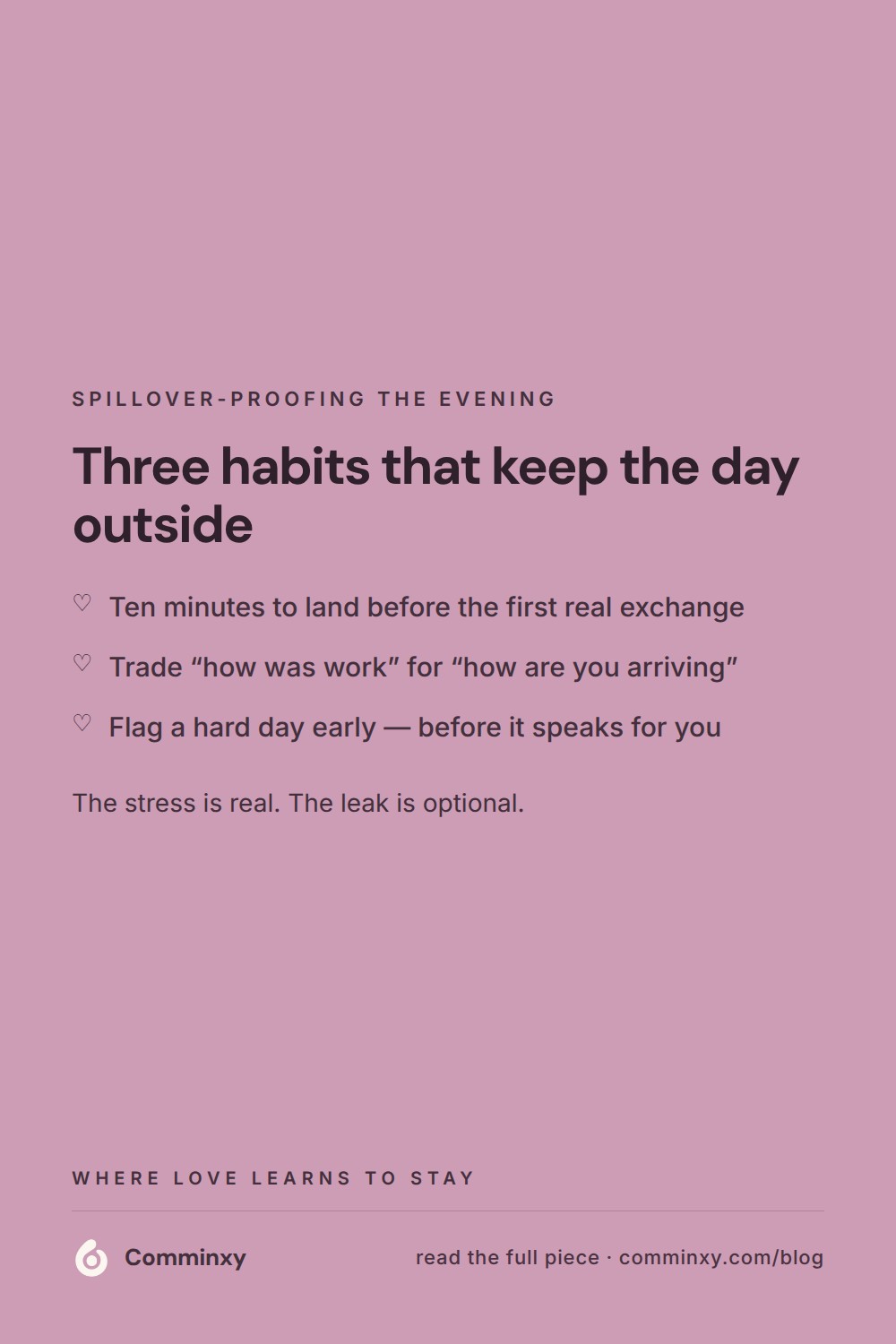
The repair here is smaller and gentler than you'd imagine, because the problem was never really malice. It was depletion. So the way back isn't a grand apology. It's naming the leak out loud.
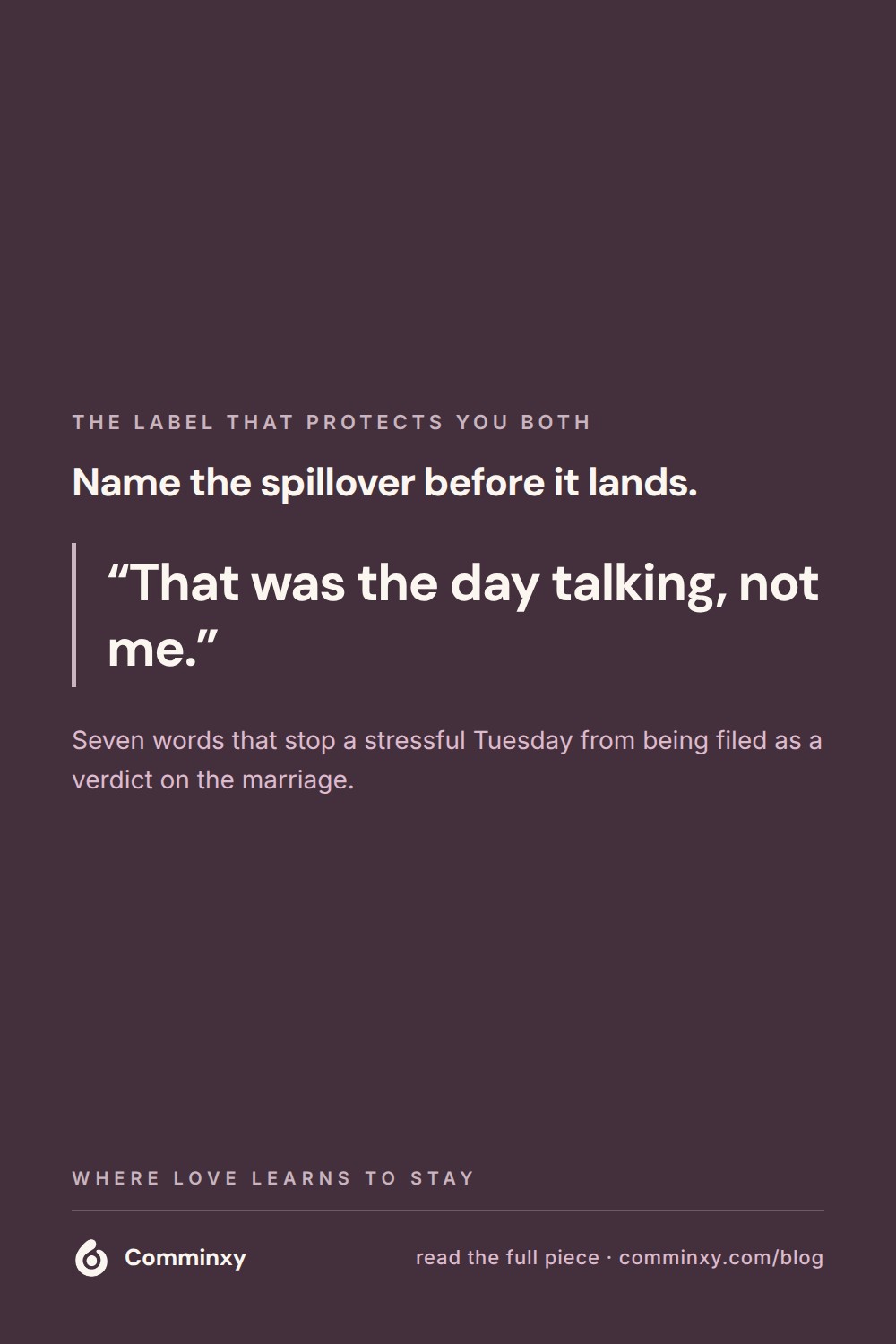
"I'm short tonight and it's not you, today was a lot." That single sentence does something remarkable. It tells your partner that the flatness in your voice has a source, and that source isn't them. It converts a mystery into weather, something passing through, not something that lives in the relationship. Most of the pain of stress spillover comes not from the sharpness itself but from the story the other person tells about it. When you name the day, you hand them a kinder story to hold.
It helps, too, to notice that text is where spillover does its worst work. A curt message fired off between meetings can wound in a way you'd never intend face to face. If that's a familiar ache, there's a whole piece worth reading on why you keep saying things you regret to your partner over text. And underneath all of this sits the deeper foundation: the sense that home is a place you can arrive frayed and still be met gently. That's the quiet architecture of emotional safety in a relationship, and it's what lets a hard day stay a hard day instead of becoming a hard week.
The evening doesn't have to keep the day's shape
None of this means you'll always catch it in time. Some nights the stress will beat you to the punch, and you'll hear yourself being short before you've decided to be. That's not failure. That's being a person who feels things. The couples who last aren't the ones who never bring the day home. They're the ones who learn to say, eventually, that was the day talking, not me.
So go back to that kitchen at 6:47. The clipped answer, the sigh, the flinch. Now imagine the version where, a few minutes later, one of you softens and says the day was heavy and it spilled. The whole evening changes shape. Nothing about the day got better, but the night stopped inheriting it. That's the small mercy hidden inside all of this: stress spills, but it doesn't have to settle. Comminxy exists to help you notice the leak a little sooner and find the words to name it, so the hard days pass through your relationship instead of pooling inside it, because this is, in the end, where love learns to stay.
Questions people ask
Why am I meaner to my partner after a bad day at work
You've spent all day regulating your emotions for people who matter less, so you arrive home already depleted. Home feels safe enough to finally stop performing, which means your partner often catches the stress you held back everywhere else. It's not a flaw in your love, it's actually because you feel safest with them.
How do you stop work stress from affecting your relationship
Name the spillover out loud as soon as you notice it, even just saying 'I'm short tonight and it's not you, today was a lot.' This tells your partner the flatness in your voice has a source outside the relationship. The repair is usually smaller than you think because the problem was depletion, not malice.
Why does my partner get quiet when they're stressed
When someone is depleted from stress, the first thing that disappears isn't kindness during conflict but enthusiasm during ordinary moments. They stop looking up when you talk, give flat responses, and withdraw not out of coldness but because they have nothing left to give. It's exhaustion mistaken for distance.
What is stress spillover in relationships
Stress spillover is when the tension and difficulty from one part of your life (like work) leaks into your relationship, usually making you shorter, less patient, or more withdrawn with your partner. The stress doesn't end when you leave work, it walks in the door with you and often lands on the person closest to you.
Keep the idea with you — pin it, or download the cards.


Comminxy helps you name the spill before it settles into something harder
Get Comminxy free →