The Science of Relationships: What Makes Love Last When Everything Else Fades
You are lying in bed beside someone you have known for years, and the thought arrives quietly: when did we stop reaching for each other? Not in anger, not even in disappointment. Just a question you cannot quite shake. The science of relationships, what makes love last when the early urgency settles into something less loud, has studied this moment closely. What it has found does not demand that you feel more than you do. It asks something smaller, and more possible, than that.
The feeling that arrives in the middle of a long relationship, the one that makes you wonder if the love has thinned or only changed shape, is one of the most common experiences there is. You are not the first person to lie awake beside someone you still care for and wonder whether care is enough. The question itself does not mean something has broken. Often, it means you are standing in the middle of something that can still move.
The thing that keeps people is rarely the thing they think it is
Most of us grow up believing that love is what holds a relationship together. That if the feeling is strong enough, it will carry us. So when the feeling flickers, and it will flicker, we panic a little, as though the flickering means something is broken.
But when Le and Agnew, Personal Relationships, 2003, pulled together fifty-two separate studies on why people stay committed, they found that satisfaction alone did not predict who stayed. Commitment was built from something wider: how happy you are, yes, but also how much you have quietly built together, and whether the alternatives feel real or imaginary. Love was part of it. But love was never the whole floor you were standing on.
There is something tender in that. It means that on the nights the feeling goes thin, you are not standing on nothing. You are standing on years, on a shared history, on all the small investments neither of you kept score of. The floor is wider than the feeling.
Why the air goes still, and why it is not a verdict
The stillness that arrives in a long relationship gets misread constantly. We treat it as evidence: proof that the love has faded, that we chose wrong, that something in us or them has gone missing.
But here is what the stillness usually is. Familiarity doing exactly what familiarity does. The two of you have learned each other so well that there is very little left to discover in the ordinary run of a day. The nervous system relaxes. And a relaxed nervous system, for all its comfort, does not feel like falling in love. It feels like nothing much at all.
This is the quiet ache underneath so many couples who still love each other and yet feel themselves drifting. Nothing went wrong. The very success of learning each other created the flatness. And once you see that, the flatness stops feeling like a sentence and starts feeling like a stage, one that can move again.
Intense love does not have an expiry date
There is a myth worth setting down gently, because it costs people a great deal: that intense, alive love has an expiry date, that after ten years the best you can hope for is fondness and logistics.
When O'Leary, Acevedo, Aron and their colleagues studied people married more than a decade, published in the Review of General Psychology in 2012, they found that forty percent of them reported being very intensely in love with their partner. Not remembering it. Not settling near it. Still inside it, years on.
Sit with that for a moment, because it changes the question entirely. The question was never whether this can last. Plenty of people are living proof that it can. The question is quieter: what were those couples doing that let the aliveness survive the familiarity? And the answer turns out to be something ordinary enough that any of us could reach for it.
The way back is smaller than you think
When Aron and his colleagues looked at what reawakened long relationships, the finding was almost disappointingly humble. Couples who did novel, slightly challenging things together (anything that pulled them a little outside the worn grooves of their routine) reported feeling more alive in their relationship afterward. Self-expanding, they called it, in the Journal of Personality and Social Psychology. Growing yourself, together, so that the other person becomes bound up in the feeling of becoming more.
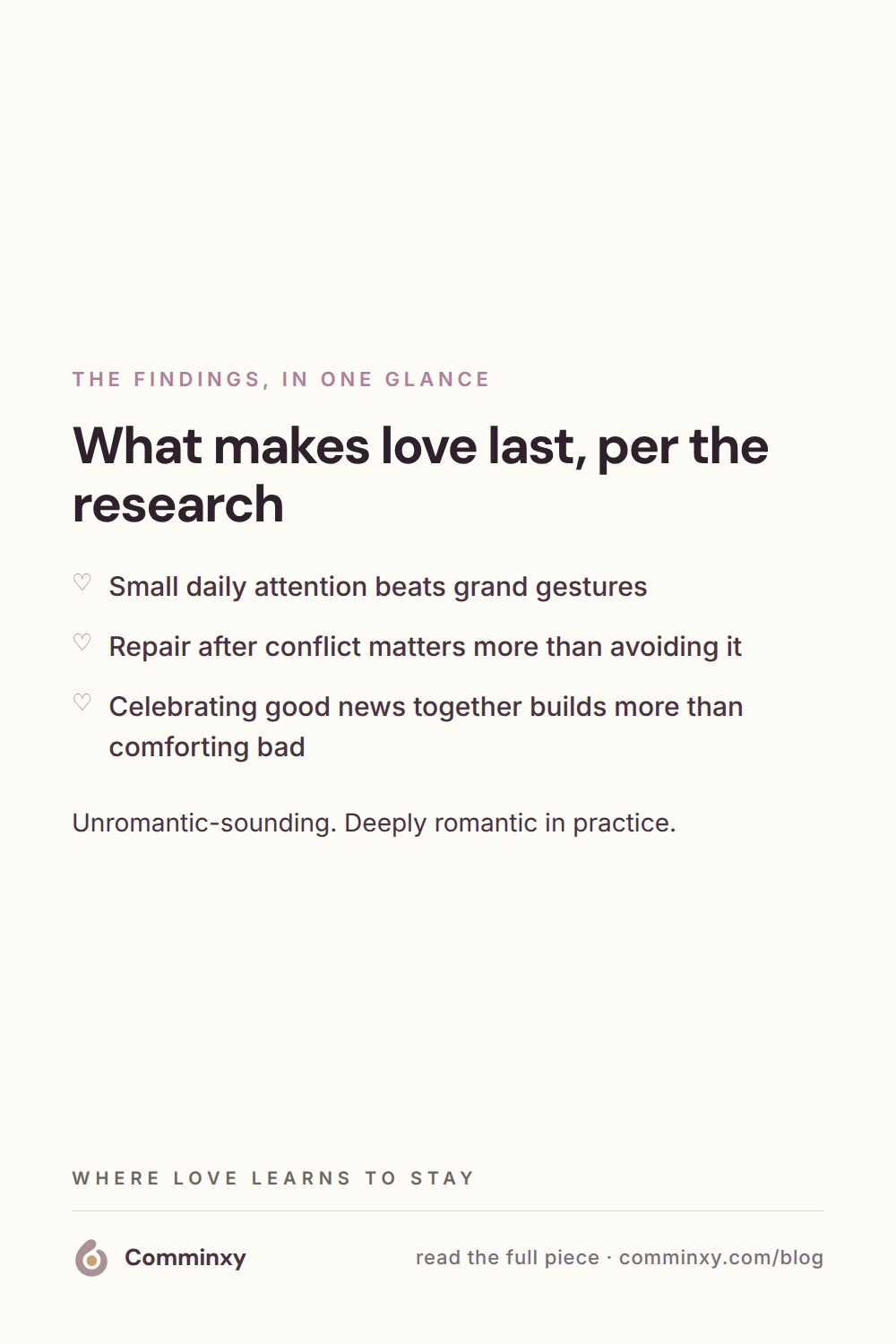
Grand gestures are not required. It is the two of you being slightly unpracticed at something in the same room. A little clumsy together. A little new. That is where the old spark tends to hide, not in recovering the past, but in reaching, side by side, for something neither of you has done yet.
And there is a second, even quieter thread. Lambert and Fincham, Journal of Personality and Social Psychology, 2011, found that expressing gratitude to a partner does something surprising. It changes how you see them, and in doing so it makes it easier to speak openly about the relationship at all. Saying thank you, and meaning it, is not just a nicety. It quietly reopens the door to talking. If you have ever found it hard to say the real thing to your partner, gratitude is often the small key that turns first.
What repair actually feels like from the inside
None of this asks you to manufacture a feeling you do not have. That never works, and you would feel the falseness of it immediately. Repair does not require performance. It requires noticing: noticing that the stillness is not the end of something but the middle of it, noticing your partner freshly across a room you have shared a thousand times.
The couples who stay in love are not gifted with a rarer heart. They are, mostly, people who kept turning toward each other after the newness wore off, who let gratitude interrupt their assumptions, who agreed to be beginners together now and then. It is undramatic work. It is also, quietly, everything.
So the next time you are both moving through an ordinary evening and the question comes (is this it? is this what we're going to be now?), you might hold it a little more gently. The flatness is not a verdict. The love has not gone anywhere. It has simply gone quiet, the way anything does when it feels safe. And love that has gone quiet can be spoken to again. That is really all Comminxy was built to help with: noticing the small moments where love is still reaching for you, so it has somewhere to stay. Where love learns to stay is not a place you arrive at. It is a thing you keep choosing, in the kitchen, on the ordinary nights, again and again.
Questions people ask
why does my relationship feel boring after years together
The stillness usually comes from familiarity doing what it does: your nervous system has relaxed because you know each other so well, and a relaxed system does not feel like falling in love even when love is still there. The flatness is not a verdict, it is a stage that happens when two people have successfully learned each other. Nothing has gone wrong, and the stage can move again.
can you stay in love after 10 years of marriage
Yes, research shows that forty percent of people married more than a decade report being very intensely in love with their partner, not just remembering it or settling near it. Intense love does not have an expiry date. The couples who stay in love tend to do novel things together and express gratitude, which keeps the relationship feeling alive even as familiarity deepens.
how do you bring back the spark in a long term relationship
Doing novel, slightly challenging things together (anything that pulls you both outside your routine) tends to reawaken long relationships because it makes you beginners together again. Expressing real gratitude to your partner also helps because it changes how you see them and makes it easier to talk openly. Neither requires grand gestures, just small shared newness and noticing each other again.
Keep the idea with you — pin it, or download the cards.


Comminxy helps you notice the small moments where love is still reaching for you
Get Comminxy free →