Attachment Theory and Relationship Patterns: Why You Love the Way You Do
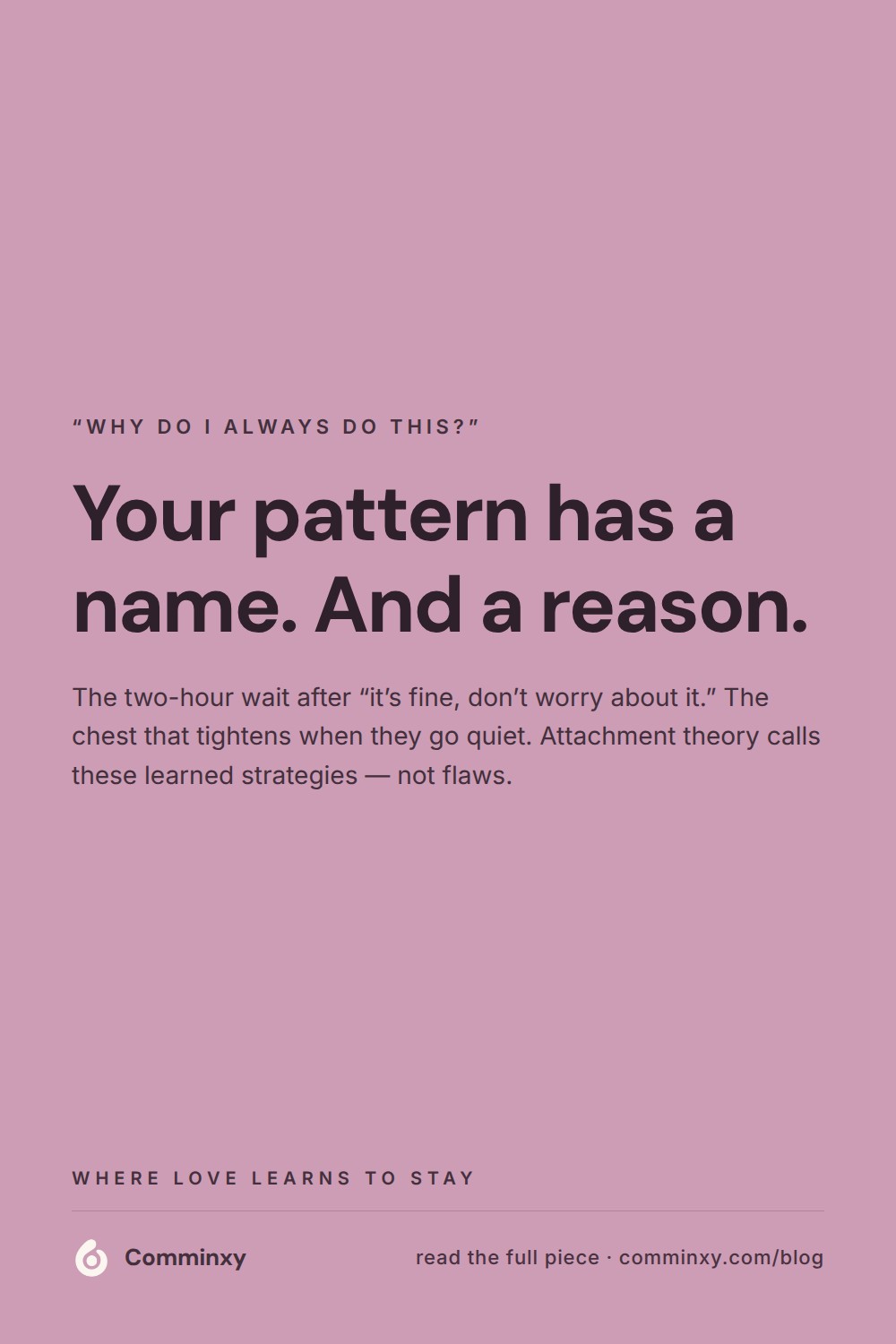
You said something small, something you meant to sound reassuring, and then spent the next two hours quietly waiting for them to notice you were not fine at all. Or it went the other way. They got quiet, and something in your chest tightened, and before you knew it you were following them from room to room, needing them to say the thing that would make the knot loosen. You have probably watched yourself do this and thought: why do I always do this?
The honest answer is that you learned to love a particular way, long before you met the person sleeping next to you. Attachment theory relationship patterns are the closest thing we have to a map of those reflexes, the ones that show up not when things are calm, but the moment you feel a little bit alone.
The move you make when you feel the distance open
Think about the last time you felt your partner pull back. A shorter reply than usual, a turned shoulder, a "nothing" that clearly was not nothing. Watch what you did next.
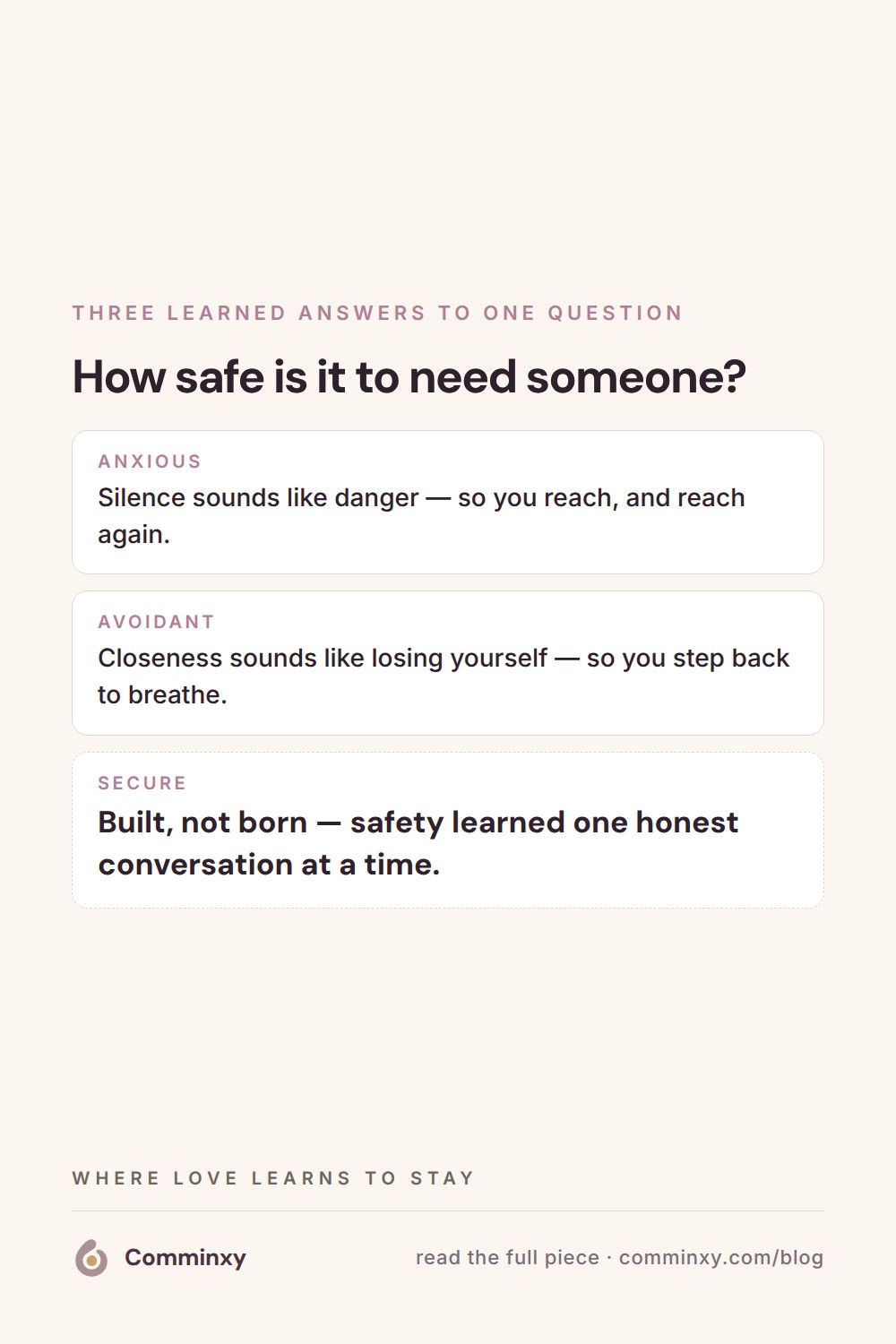
Some of us lean in hard. We text again. We ask if they are mad. We need to close the gap right now, because the gap feels like a threat to everything. Others of us do the opposite. We go smooth and self-contained. We say we are fine. We find something urgent to do, and we feel oddly relieved to have a reason not to talk.
Neither of these is a character flaw. They are strategies, old and well-practised ones. One person's nervous system learned that closeness returns if you reach loudly enough. The other learned that reaching only makes things worse, so it is safer to need less out loud. You did not choose these. You inherited them from a hundred small moments of being very young and figuring out how to stay close to the people you loved.
Why the two of you keep landing in the same argument
The two strategies tend to find each other. The one who reaches often ends up with the one who retreats, and then they do a slow, painful dance. One reaches harder because the other pulled away. The other pulls away harder because the reaching feels like pressure. Around and around, until you are both exhausted and neither of you can remember what the fight was even about.
You have probably had the thought, in the middle of it, that you are on completely different planets. You are not. You are both doing the exact same thing, trying to feel safe, in two languages that happen to cancel each other out. The reacher hears the silence as you do not care. The retreater hears the pursuit as you are too much and I have failed. Both are frightened. Both look, from the outside, like they do not want to be there. If you have ever watched your partner go blank mid-conversation and felt the ground drop out, there is more on that in what to do when your partner shuts down during a conversation. It is almost never the rejection it feels like.
What actually keeps people in (and it is not only the love)
We tend to assume that what holds a relationship together is how much you love each other. But there is a large body of work that complicates that in a useful way. In a meta-analysis of 137 longitudinal studies spanning thirty years, Le, Dove, Agnew, Korn and Mutso (Personal Relationships, 2010) found that whether couples stayed or split was predicted less by love alone and more by things like commitment, dependence, and something researchers call inclusion of the other in the self. That last one means the degree to which your sense of "me" has quietly grown to include "us".
Sit with that for a second, because it says something gentle about your patterns. When you chase, you may be trying to protect that shared self, the "us" you have woven your life around. When you retreat, you may be protecting the "me" you are afraid of losing inside it. You are both guarding something real. The fight is not proof that the bond is broken. It is often proof of how much of yourself is tangled up in it.
The small moment where the pattern loosens
Patterns do not change with a grand conversation. They change in a single, ordinary sentence, said a half-second later than usual. The reacher, instead of sending the third text, says: "I noticed I am spinning a little. I think I just need to know we are okay." The retreater, instead of disappearing, says: "I am not going anywhere, I just need a minute before I can talk." Neither of those fixes anything. What they do is name the fear underneath the behaviour, so your partner is no longer guessing at a stranger.
This is where so much of the damage actually happens. Not in the pattern itself, but in the words we grab for while we are inside it. If you have ever sent a message you would give anything to unsend, you already know how fast the retreat-and-chase can turn into something sharper; why you keep saying things you regret to your partner over text sits right in the middle of this. The repair is rarely in a perfect sentence. It is in catching yourself one beat sooner, and telling the truth about what you are afraid of instead of acting it out.
You are not stuck with the way you learned to love
The most hopeful thing about attachment patterns is that they were learned in relationship, which means they can soften in relationship too. A partner who stays steady when you reach, or who gently stays present when you would normally vanish, is slowly teaching your nervous system something new. Not overnight. But over enough small moments, the old reflex loosens its grip. People move toward what researchers call earned security, one un-dramatic repair at a time.
So think back to that reassuring sentence, and the two hours of waiting. You were not being difficult, and neither were they. You were both very young, for a moment, doing the only thing you ever learned to do when the distance opened up. Now you can see the pattern from the outside. You can catch each other's hand inside it. If it helps to have something in your corner while you learn that, Comminxy was built to sit quietly beside couples in exactly these moments, helping you hear the fear underneath the words before it turns into the same old dance.
Questions people ask
why do I push my partner away when they get close
You likely learned early on that needing someone out loud made things worse, so your nervous system now protects you by retreating when closeness feels overwhelming. This is not a character flaw but a survival strategy from childhood. It can soften over time with a partner who stays gently present instead of chasing harder.
why does my partner shut down when we argue
Shutdown is usually a nervous system response to feeling flooded or trapped, not a sign they do not care. They are trying to protect themselves the only way they learned how. Asking them to name what they are afraid of, rather than demanding they stay and talk, often helps more than pressure.
how do you break anxious avoidant cycle
The cycle loosens when one person catches themselves mid-pattern and names the fear instead of acting it out, like saying 'I am spinning and need to know we are okay' instead of sending another text. It is not fixed in one conversation but in many small moments of telling the truth about what you are afraid of.
can your attachment style change in a relationship
Yes, attachment patterns can soften when a partner responds differently than the people who taught you those patterns in the first place. Researchers call this earned security, and it happens gradually through repeated small repairs, not overnight.
Keep the idea with you — pin it, or download the cards.



Comminxy helps you hear the fear before it becomes the fight
Get Comminxy free →