How to Have a Real Conversation in a World of Quick Replies
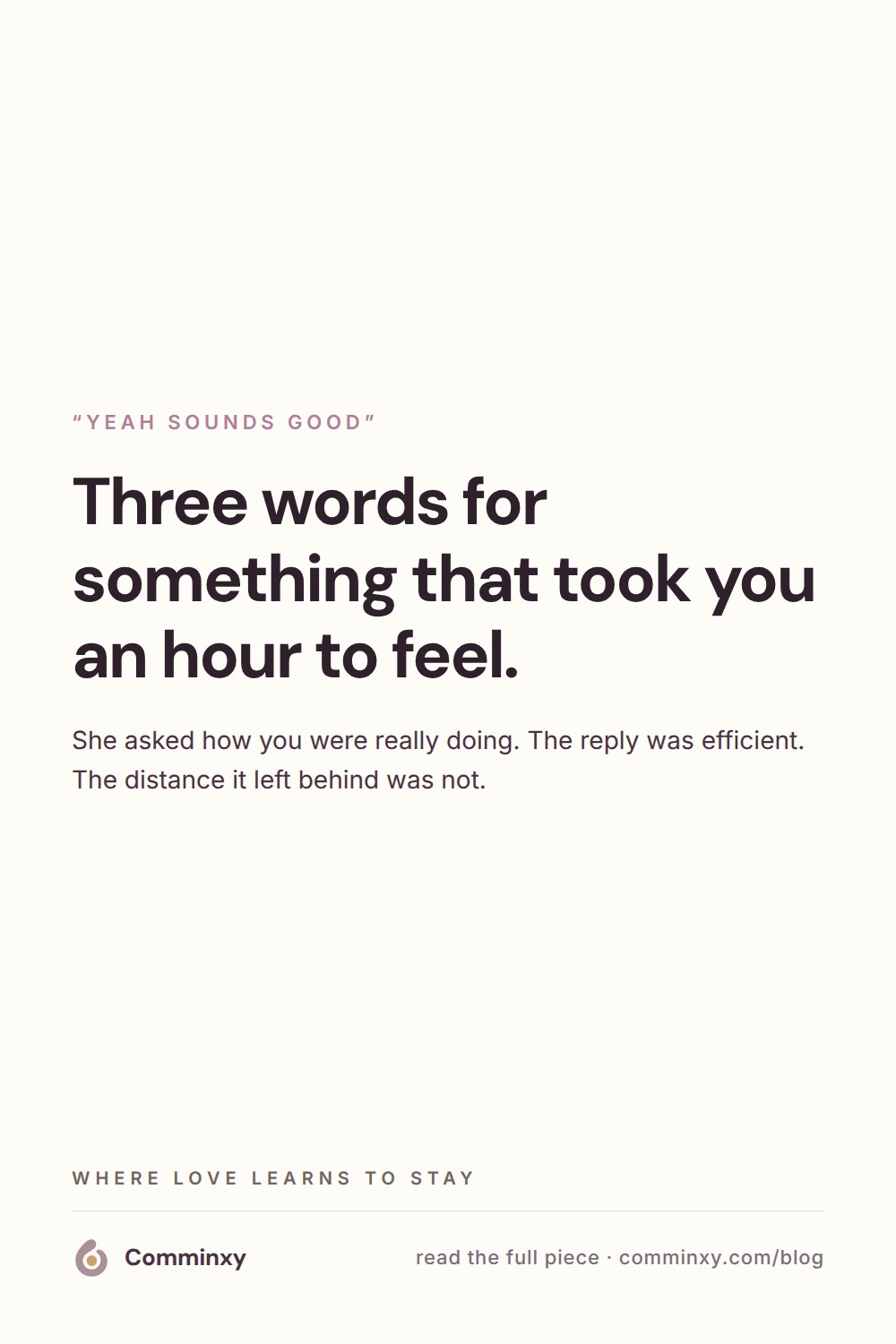
You typed "yeah sounds good" and hit send. Then you looked at it. Three words for something that took you an hour to feel. She'd asked how you were doing, really doing, and you'd handed her a reply you could have sent to a coworker. You weren't lying. You just answered fast, the way we all answer now, and the honest thing you meant to say stayed inside you, unsaid.
This is the quiet cost of a world built for quick replies. We've gotten very good at responding and very out of practice at conversing. A real conversation and a quick reply are not the same thing wearing different clothes. They run on different fuel. One wants to close the loop. The other wants to open it.
The reply that ends the thing you wanted to begin
Watch what a quick reply actually does. It resolves. "Got it." "All good." "Fine." Each one is a small door closing, and closing doors feels efficient. Our phones train us for it a hundred times a day: clear the notification, answer the message, mark it read.
But the moments that matter between two people don't want to be cleared. When your partner says "I've been feeling kind of alone lately," that isn't a task. It's a door swinging open. And if you answer it the way you answer everything else, fast, tidy, resolved, you shut the door they just worked up the courage to open. Not out of coldness. Out of habit.
Why the opening carries all the weight
In newlywed couples, the outcome of a fifteen-minute conflict conversation can be predicted from its first three minutes. 96% of the time. That's what Carrère and Gottman found when they studied how early moments shape entire exchanges.
Not the middle. Not the resolution. The beginning. How the first few sentences land, soft or sharp, curious or defended, mostly decides where the whole thing goes.
Now think about what a quick reply does to a beginning. It rushes it. It answers before understanding. It treats the opening as something to get past rather than something to step into carefully. The very moment that holds the most weight is the moment our reflexes are worst equipped to handle. This is close to what happens when we say things we regret over text. The medium moves faster than the heart, and we send the reflex instead of the truth.
It isn't that you don't care
When you fire off "yeah sounds good," it isn't because your partner doesn't matter to you. It's because your attention has been chopped into a thousand small responses all day, and by the time they reach you, you're operating on the same setting you've used since 9am.
A real conversation needs a different setting entirely. It needs you to slow down enough to be curious instead of correct. To ask a second question instead of offering a first answer. That gear is still in you. It just doesn't come on automatically anymore, because nothing else in your day asks for it.
Couples don't usually drift apart in one dramatic silence. They drift in the accumulation of a thousand quick replies that were technically fine and quietly hollow. It's one of the ways people who still love each other slowly grow apart, not through fights, but through conversations that kept ending before they began.
What a real conversation actually looks like
Less than you'd think. A real conversation isn't a summit. It doesn't require candles or a scheduled Sunday afternoon. It requires one small refusal: the refusal to close the door too fast.
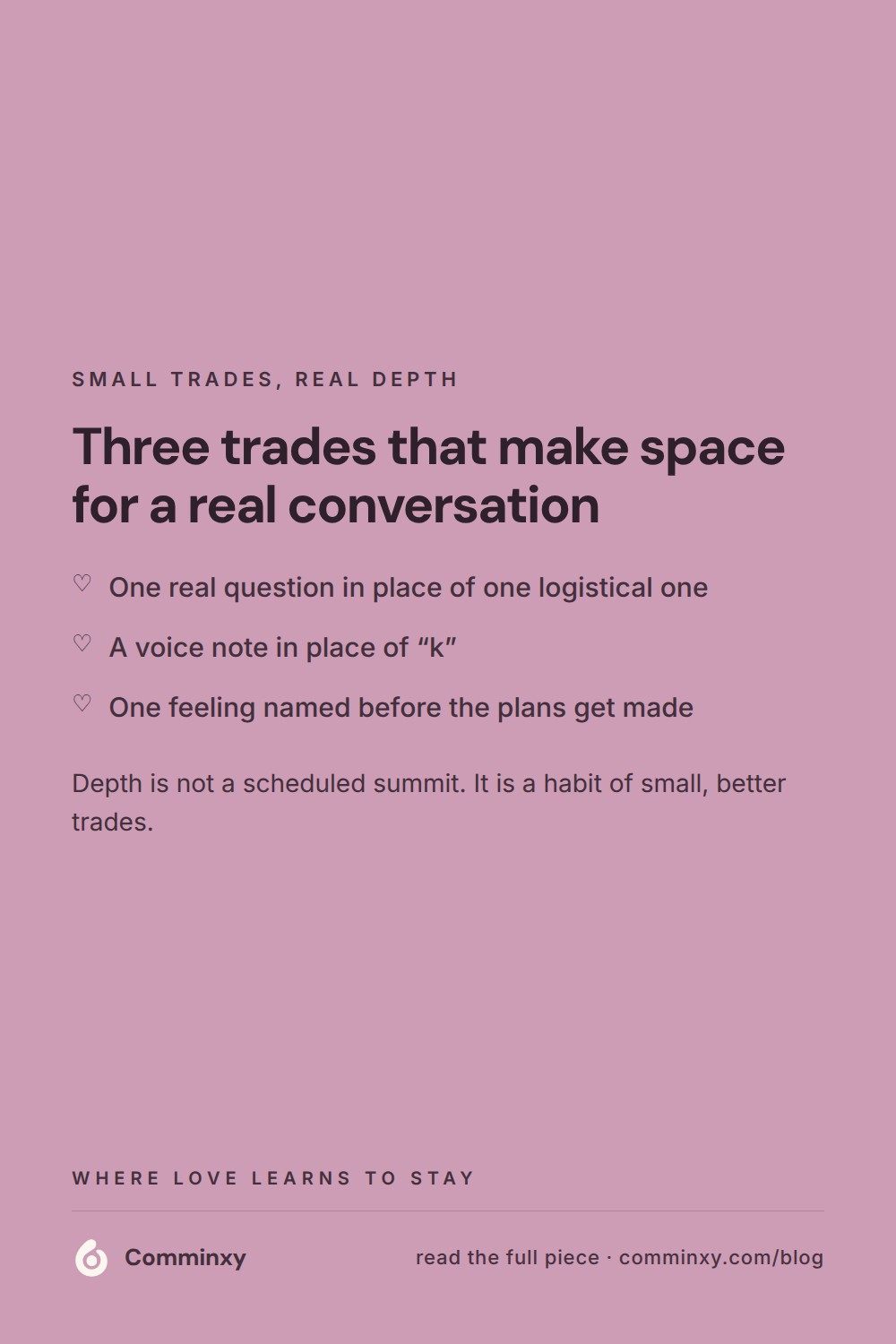
It looks like your partner saying "work was a lot today," and you not saying "at least it's Friday." It looks like saying "a lot how?" and then going quiet long enough for them to find the real answer. It looks like resisting the pull to fix, to reassure, to move on. Staying in the open a few seconds longer than is comfortable. That's most of it.
Sometimes it looks like putting the phone face-down and saying the thing out loud instead of typing it. Not because typing is wrong, but because your voice carries what three words on a screen never can. The other person hears your hesitation, your warmth, the pause where you're choosing your words. Those are the parts a quick reply strips away.
The way back is smaller and closer than you fear
If you're reading this thinking your conversations have been running on reflex for a long time now, the way back doesn't require a confrontation. It requires a single door left open on purpose.
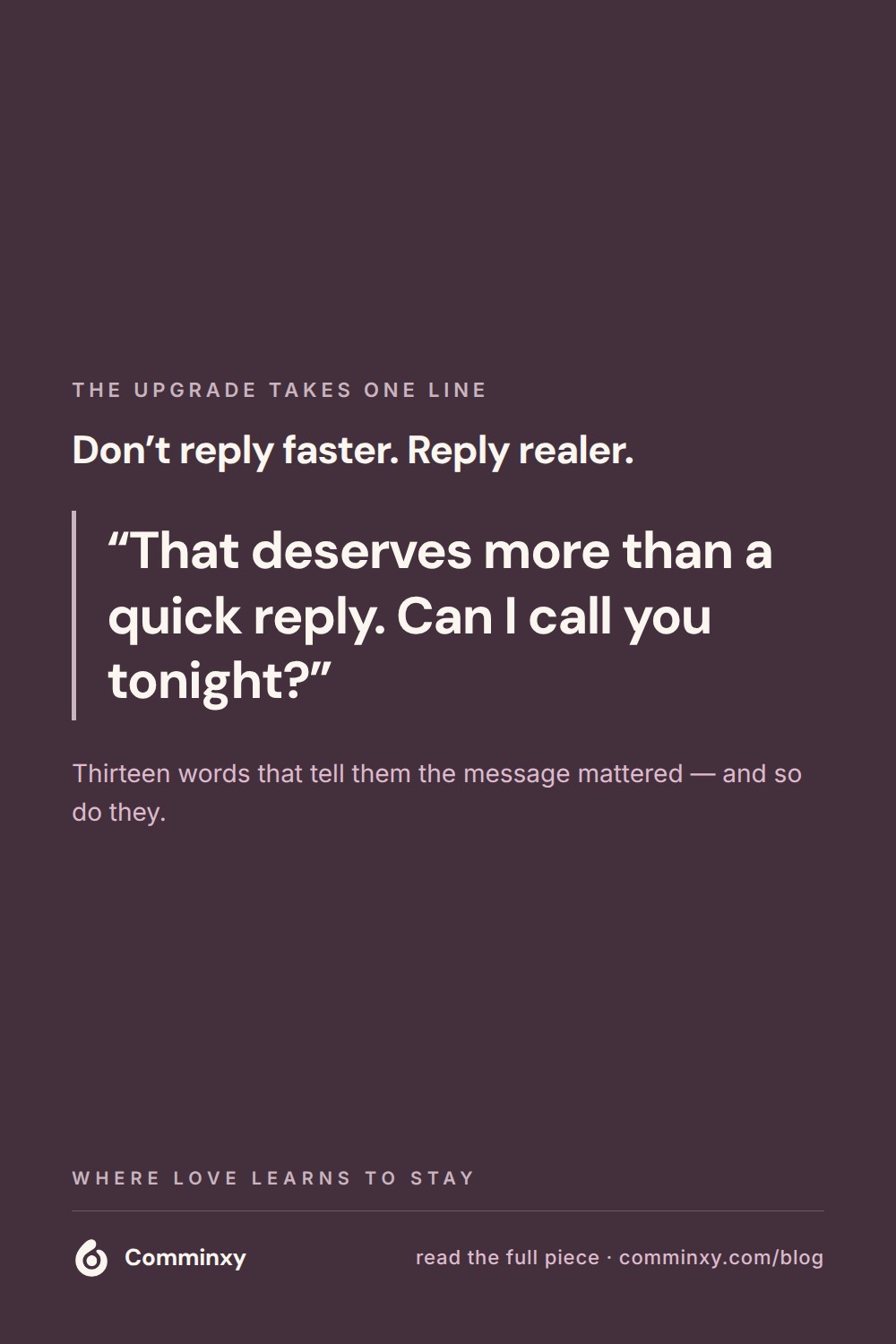
Next time your partner opens something (and they will, they always do, in small offerings we usually miss) try not to resolve it. Try to follow it. "Tell me more." "What was that like?" "I'm listening, I'm not going anywhere." Those aren't clever. They're just the opposite of a quick reply. They keep the loop open instead of closing it.
This is a large part of what emotional safety is built from. Not grand reassurance, but the repeated experience of being met slowly instead of answered fast. You don't build it in a night. You build it one un-rushed moment at a time, and every one of them counts more than you'd guess.
The door is still open
Think back to "yeah sounds good." The hour of feeling behind three flat words. You didn't fail there. You just answered on the wrong setting, the way the whole world has trained you to. And the good news is that door isn't gone. It's still there, tonight, when they say something small and you get the choice again: close it, or step through.
Comminxy exists for exactly that moment, the one right before the reflex fires, helping you notice when a door is opening so you can stay in the conversation a little longer instead of ending it. Not to fix anything. Just to help you catch the moments worth slowing down for, so the person across from you feels heard instead of answered. That's usually where love learns to stay. Not in the grand talks, but in the small ones we finally stop rushing.
Questions people ask
why do i always give short answers when my partner tries to talk
You are probably still on the same mental setting you have used all day to clear notifications and respond quickly. Real conversations need a different gear that does not turn on automatically anymore because nothing else asks for it. It is habit, not a lack of care.
how do you have a real conversation with your partner
Stay in the open a few seconds longer than feels comfortable instead of rushing to close the loop. Ask a second question like 'tell me more' or 'what was that like' rather than offering a quick reassurance or solution. Put the phone down and use your voice so the other person hears your hesitation and warmth, not just three flat words.
what is the difference between a quick reply and a real conversation
A quick reply wants to close the loop and resolve the exchange, while a real conversation wants to open it and follow where it leads. One clears the notification, the other steps through the door the other person just opened. They run on completely different fuel.
Keep the idea with you — pin it, or download the cards.


Comminxy helps you notice when a door is opening so you can step through instead of closing it
Get Comminxy free →