What Holding Hands Stress Research Reveals About Calming Each Other Down
The nurse says the results will take a couple of hours. You both nod like this is manageable, like two hours is nothing, and then you sit down in the plastic chairs bolted to the floor and the waiting starts to fill the room. Your partner's leg is going. That small bounce they do when their whole body is holding something they cannot say. You reach over without deciding to, and you put your hand on theirs, and the bounce slows. Not stops. Slows. Neither of you looks up.
Most of what we know about holding hands stress research began with a moment not so different from that one. Two people, one of them frightened, and a hand that did something a word could not. If you have ever reached for someone in a hard room and felt them settle a fraction under your palm, you already know the finding in your body. The science only tells you what your body was doing.
The hand that gets there before the words
There is a kind of fear that language arrives too late for. You are in it before you can name it. The letter, the phone call, the scan, the closed door of an office where someone is about to tell you something. In those moments the mind is not looking for an explanation. It is looking for a signal that it is not alone in the thing.
A hand is often the fastest signal we have. It travels before the sentence forms. And it says the one thing the frightened part of a person most needs to hear, which is not it will be fine, because nobody knows that. It says I am here in it with you. That is a smaller promise. It is also one you can actually keep.
What the brain does when you are held
Something quieter happens under the surface than either of you can feel. When a person is under threat, the parts of the brain that run the alarm light up, the same machinery that readies the body to cope alone. Being touched by someone safe turns some of that machinery down.
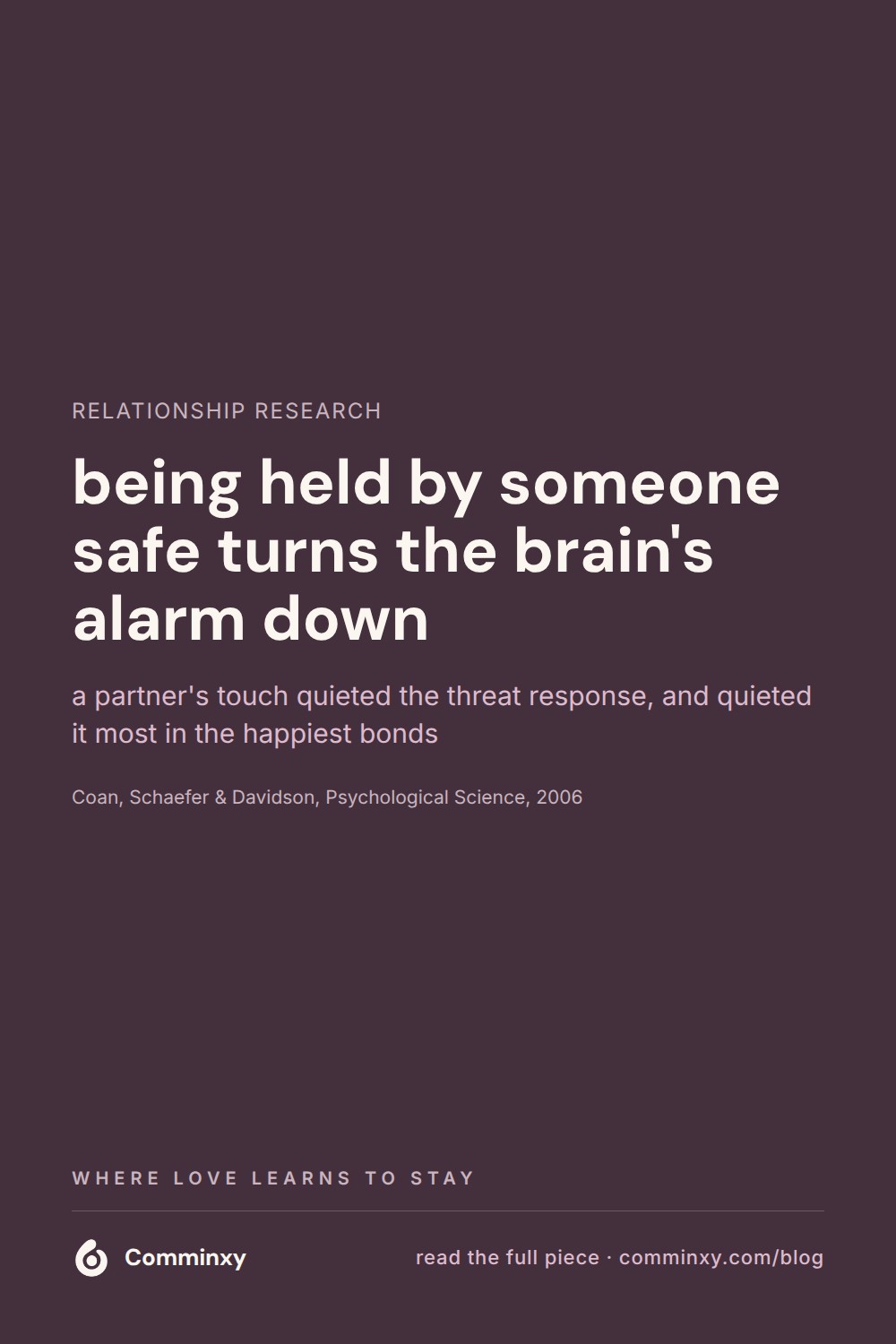
In one study, married women were told to expect a mild electric shock while their brain activity was watched. When a woman held her husband's hand, the threat response in her brain quieted, and it quieted most for the women who reported the happiest marriages (Coan, Schaefer & Davidson, Psychological Science, 2006). The stranger's hand helped a little. The husband's hand helped more. The good marriage helped most of all.
Read gently, that finding is saying something ordinary and enormous at once. A safe hand does not just comfort the mind. It changes how much of the fear the body has to carry by itself. Some of the load that was yours alone becomes shared, at the level of the nervous system, before either of you has understood anything.
Why it sometimes doesn't work
You may have reached for a hand and felt it stay stiff in yours. You may have been the stiff one. This is worth sitting with honestly, because the same research points at it. The hand helped most where the bond was already trusted. Where things have been strained, a hand can land as pressure rather than relief. The body has learned to brace against this person, even a little, and it does not switch that off on request.
That does not mean the reaching was wrong. It means the hand is telling the truth about where the two of you are. If it did not soften the way you hoped, the ache you felt was real, and it was information, not failure.
Some couples find that the words have stopped moving between them long before the hands do. If that sounds like the room you are in, the quiet that grows when couples stop talking is worth understanding on its own terms, because touch and speech tend to go cold together, and warm back up together too.
The small repair of reaching anyway
There is a way back, and it is less dramatic than you would expect. It is not a conversation. It is the willingness to keep offering the hand even when you are not sure it will be taken.
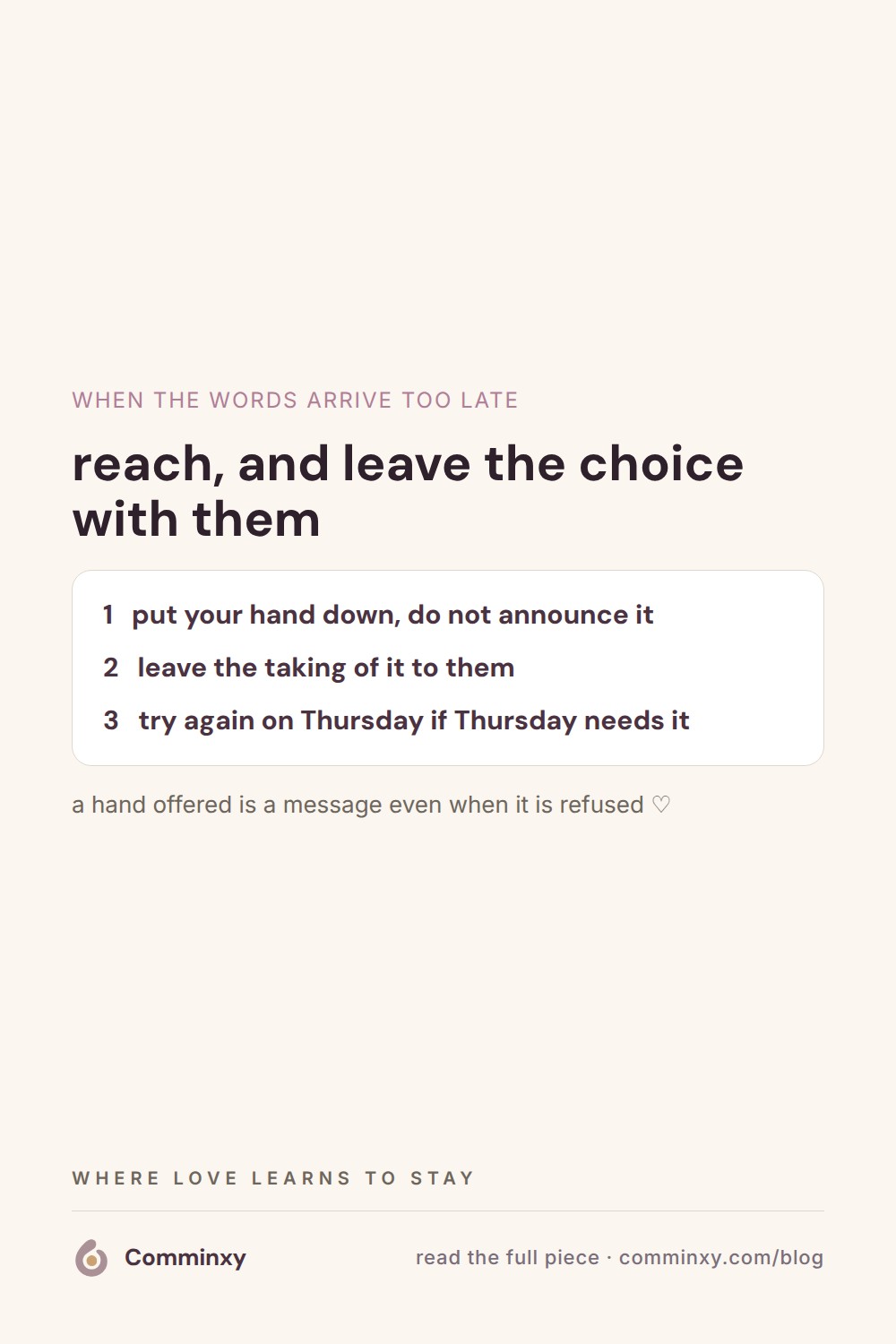
A hand offered is a message even when it is refused. It says the door is open on your side. You do not have to explain it or make it a moment. In the waiting room, you did not announce anything. You just put your hand down and left it there, and left the choice with them. That leaving of the choice is part of what makes it safe. Nobody softens on command.
If tonight the reach is not landing in person, it can still land in smaller ways. A message that says thinking about you in that meeting is a hand across a distance. Getting the tone of those messages right when things are tender is its own skill, and one worth learning gently rather than the hard way. The instinct underneath is the same. Reach. Leave the choice. Try again on Thursday if Thursday needs it.
What changes when this becomes ordinary
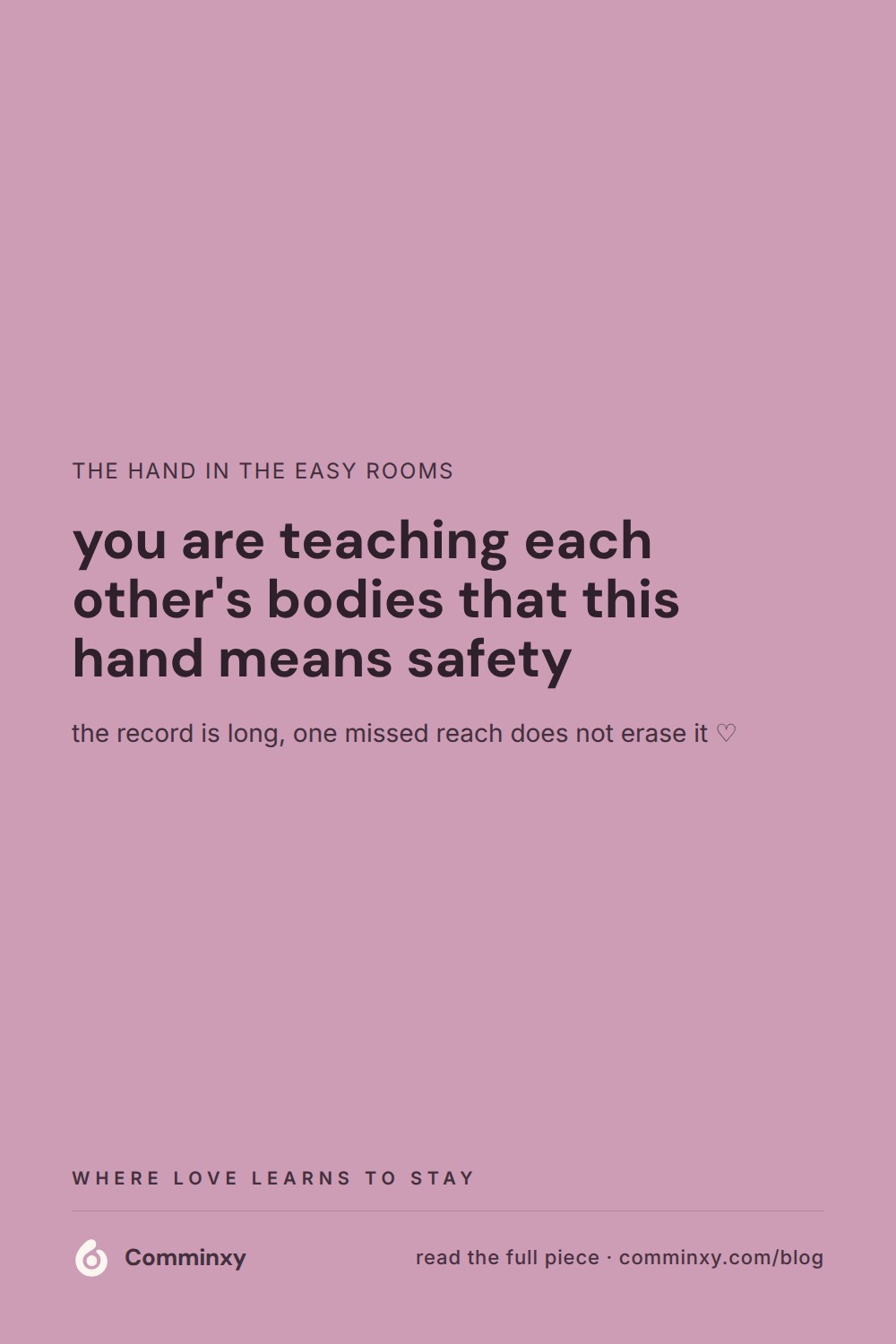
The couples for whom a hand does the most work are not the ones having their best day. They are the ones who have reached for each other on a thousand unremarkable ones. The hand in the hard room works because of all the hands in the easy rooms that came before it. The nervous system is keeping a quiet record of whether this person shows up, and it consults that record faster than thought.
So the thing that helps is not a grand gesture saved for the crisis. It is the hand on the small stuff. The bad news that is only medium bad. The dentist, the difficult call to a parent, the results that were probably nothing. Each of those is a deposit. You are teaching each other's bodies, over years, that this hand means safety. Then when the truly frightening room arrives, the message is already fluent between you.
You will forget this. You will sit beside them stewing in your own worry and not think to reach, or you will reach and get it wrong, and there will be nights the hand stays where it is. That is not evidence of anything except that you are a tired human being. The record is long. One missed reach does not erase it.
Comminxy exists for the space between the reaching, for helping two people find their way back to each other when the words have run out and the hands have gone quiet, because that is where love learns to stay. Back in the waiting room, the door opens and a name is called, and you both stand. Whatever the news is, your hand was on theirs when it came. That part, at least, they will remember with their whole body.
Questions people ask
does holding hands actually reduce stress or is it just in your head
It is a real physical effect, not just a feeling. Research using brain scans found that holding a trusted partner's hand quieted the brain's threat response during a stressful task. The closer and happier the bond, the stronger the calming effect.
why does my partner pull away when I try to hold their hand during a hard moment
Touch tends to soothe most when the bond feels safe, and it can feel like pressure when things have been tense. Their body may be bracing out of habit rather than rejecting you. Keep offering gently without demanding they take it.
how do you comfort someone who is really scared without saying the wrong thing
Sometimes presence works better than words when someone is frightened. A hand on theirs can signal that they are not alone in it, which is often what a scared person needs most. Leave the choice to accept it with them.
can a text message really be as comforting as being there in person
A short message can carry real reassurance when you cannot be present, though it works differently than touch. Something simple like thinking of you shows you are reaching across the distance. Getting the tone right matters more than the length.
Keep the idea with you — pin it, or download the cards.


For the moments when the words run out and the hands go quiet.
Get Comminxy free →