The First Three Minutes: What Conversation Research Reveals About Your Relationship
You already know how a conversation is going to go before either of you has said anything real. It's in the way they put their cup down. The particular flatness of "we need to talk." The three seconds of silence that arrive before the first word, where your whole body braces for something. And most of the time, you're right. The ending you sensed in that opening moment is the ending you get.
That instinct isn't paranoia. When researchers looked closely at what shapes a difficult conversation between partners, one of the most striking findings in all of first three minutes conversation research was this: the way it begins tends to decide the way it ends. Not because you're doomed, but because those opening seconds set a tone that both of you then live inside for the rest of the exchange.
The whole argument is often decided before it starts
We tend to imagine that a conversation is won or lost somewhere in the middle. In the sharp comeback, the point we forgot to make, the thing we wish we'd said instead. So we replay the middle afterward, editing our lines. But that may be looking in the wrong place entirely.
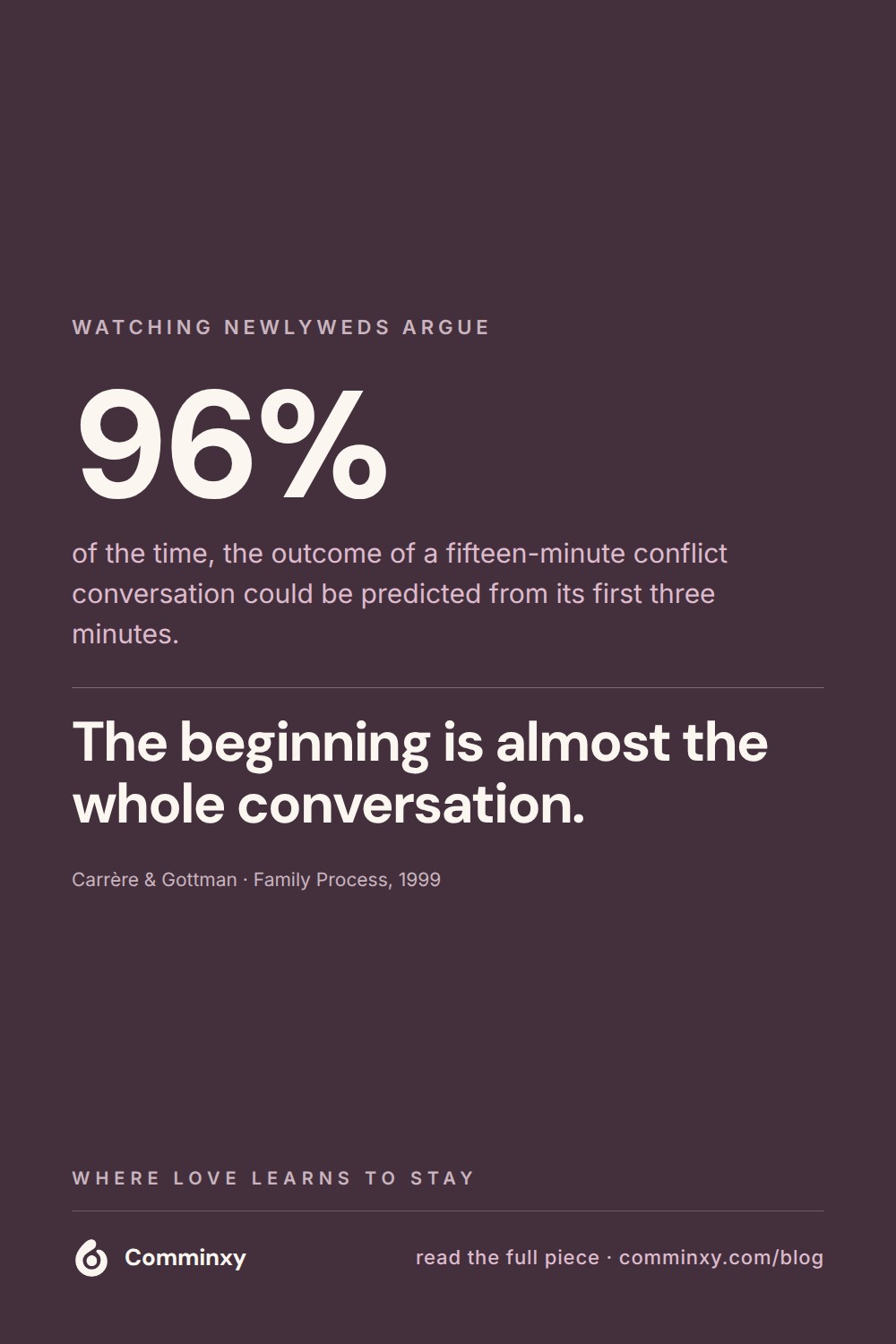
John Gottman and Sybil Carrère, watching newlywed couples talk through a disagreement, found that they could predict marital stability or divorce over six years from the first three minutes of a fifteen-minute conflict conversation, accurately about 96% of the time (Carrère & Gottman, Family Process, 1999). Read that again, because it's easy to skim past. Not the whole fight. The opening. Whatever happened in those first three minutes tended to be the emotional weather of the next twelve, and, remarkably, a signal of the years to come.
What that means for you, lying awake reworking a conversation from last week, is gentler than it sounds. You may not have lost it in the middle at all. You may have both walked in already carrying the ending.
Why the opening carries so much weight
We usually treat "how you start" as a matter of tone. Say it nicely, don't come in hot. But the reason the opening matters isn't politeness. It's that the first few seconds tell your partner's nervous system what kind of moment this is about to be. A harsh start-up (an accusation, a sigh loaded with history, a "you always") lands not as information but as a threat. And a threatened person cannot listen. They can only defend.
So the conversation you meant to have quietly becomes a different conversation, one where both of you are protecting yourselves from each other. Neither of you chose that. It happened in the space of a breath, before either of you had a chance to be your better self. If you've ever wondered why a talk about the dishes somehow ended up being about your whole relationship, this is part of the answer.
It's also why the same argument keeps arriving in the same shape. The opening move triggers the familiar defence, which triggers the familiar counter-move, and you're both back on the well-worn track. If you want to see how those tracks get laid down over time, this is close to what researchers describe when they map the communication patterns that quietly wear a relationship down.
The softened start is not about being nicer
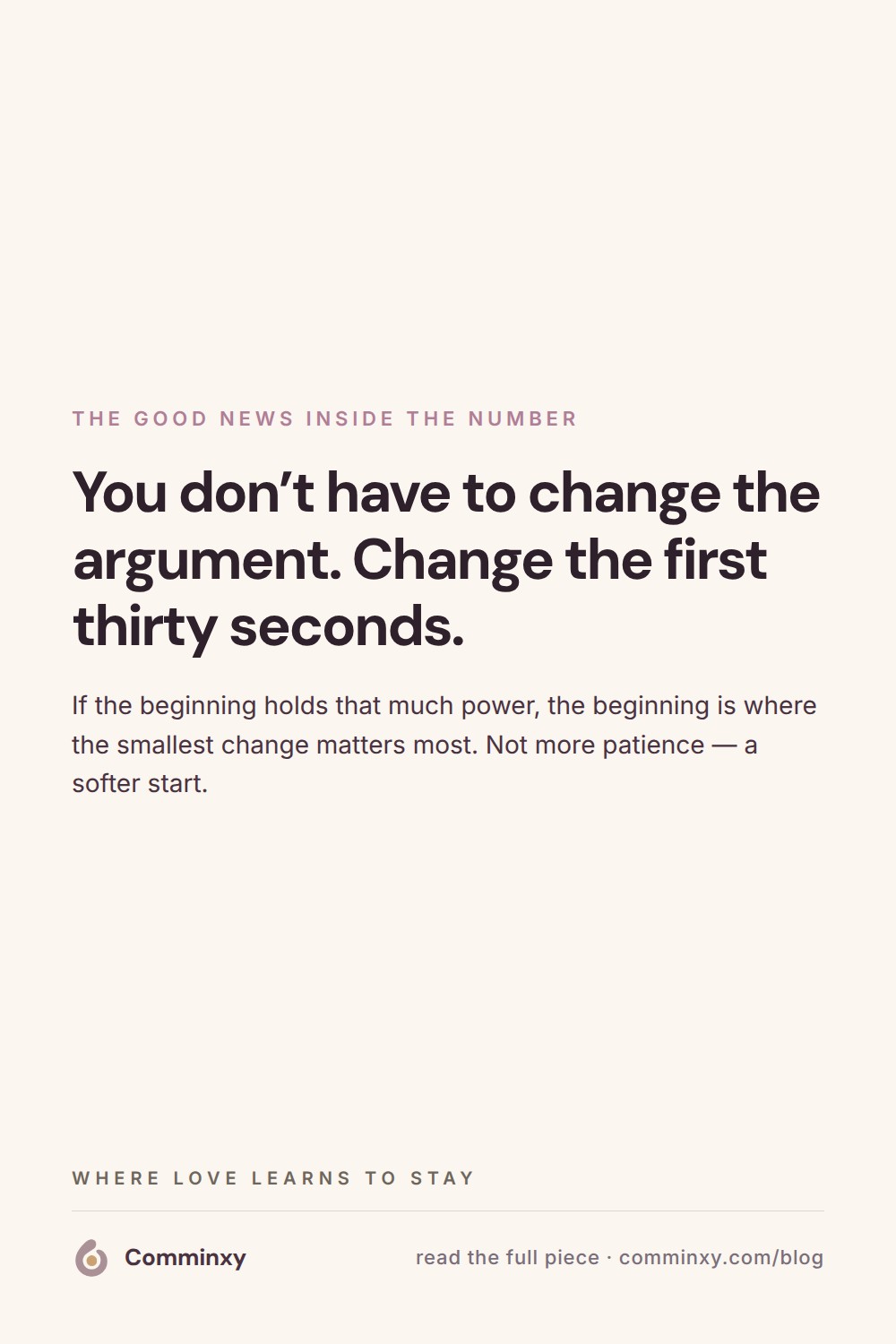
The good news buried inside that 96% is this: if the beginning holds so much power, then the beginning is also where the smallest change matters most. You don't have to become a more patient person or resolve the whole issue. You have to change the first thirty seconds.
A soft start isn't sugarcoating. It's leading with what's true about you rather than what's wrong with them. "I've been feeling far from you this week" opens a door. "You never make time for me" slams one, even when both sentences come from the exact same ache. The difference isn't manners. It's whether your partner hears a person reaching for them or an opponent lining up a case.
What surprises people is how little the words themselves matter compared to the moment before them. A softened start often begins in your own body. A slower breath, an unclenching, a decision made privately not to lead with the sharpest thing you're holding. Your partner feels that shift before you've finished your first sentence.
What the way back looks like when the start goes wrong
But you won't always catch it in time. Some nights the harsh start-up is already out of your mouth before you knew it was coming, and you can feel the whole thing tilting toward the ending you didn't want. The opening predicts a lot, but it doesn't seal anything shut.
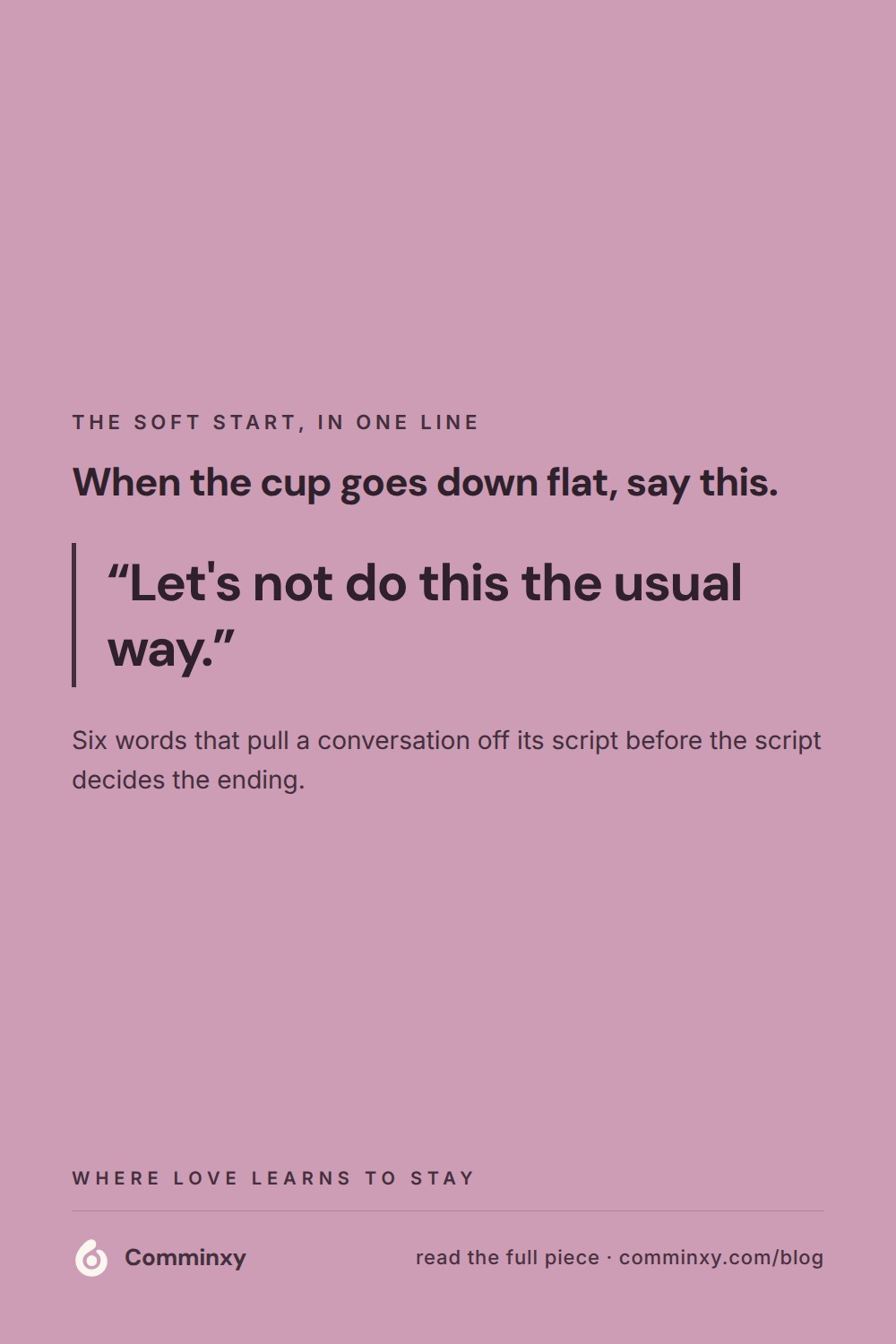
Because there is a second door. It's called a repair attempt, the small, sometimes clumsy gesture that says lets not do this the usual way. A hand reaching across the table. "Wait, can we start over?" A little joke that isn't quite a joke. Even a plain, tired "I'm scared we're going to fight and I don't want to." What these moments do is reset the opening, right there in the middle. They give the two of you a chance to walk in again, this time without the armour.
The couples who last aren't the ones who never start badly. They're the ones who let each other start over. That capacity to reset, to offer and accept the small olive branch mid-storm, is the living texture of emotional safety between two people, the felt sense that a bad beginning doesn't have to become a bad ending.
The first three minutes of a conversation belong to both of you
Notice what this quietly undoes. If the opening decides so much, then the opening is not a test one of you passes or fails. It's a moment the two of you build together, the one who begins, and the one who chooses how to receive that beginning. A soft start met with a slammed door goes nowhere. A rough start met with grace can turn into the closest conversation you've had in months.
So think back to that moment. The cup set down, the "we need to talk," the three seconds of braced silence. You've read that opening as a verdict for a long time. But it was never a verdict. It was an invitation, offered in the only way either of you knew how in that instant. And invitations can be answered differently than they're sent.
That's the small, hopeful thing to carry to bed tonight. You don't need to win the middle. You only need to soften the start, or offer the reset when the start goes wrong, and let yourselves begin again. Tools like Comminxy exist to sit beside you in exactly those first fragile seconds, helping you notice the tone before it hardens and reach for the gentler door. Because this is where love learns to stay: not in the arguments you avoid, but in the beginnings you're willing to try one more time.
Questions people ask
how do the first three minutes of a conversation affect the outcome
The first three minutes set the emotional tone that usually continues through the entire conversation. Research found that those opening minutes predicted relationship outcomes over six years with 96% accuracy. A harsh start triggers defensiveness while a soft start opens the door to actual listening.
what is a harsh startup in a relationship
A harsh startup is beginning a conversation with accusation, criticism, or loaded sighs that land as a threat rather than an invitation. It includes phrases like 'you always' or 'you never' that put your partner immediately on the defensive. The problem is not rudeness but that it tells their nervous system to protect rather than listen.
what is a repair attempt in a relationship argument
A repair attempt is a small gesture during conflict that tries to reset the tone and avoid the usual destructive pattern. It can be asking to start over, reaching your hand across the table, making a gentle joke, or simply saying you are scared of fighting. These moments give both people a chance to walk back in without armor.
how do you start a difficult conversation with your partner
Start by saying what is true about you rather than what is wrong with them. 'I have been feeling far from you' opens a door while 'you never make time for me' closes one, even when both come from the same hurt. The shift often begins in your body with a slower breath before you speak.
Keep the idea with you — pin it, or download the cards.


Comminxy helps you notice the tone in those first fragile seconds before it hardens
Get Comminxy free →