Contempt in Relationships: Why Gottman Calls It the Number One Love Killer
Your partner is standing at the bedroom doorway, half dressed for work, holding a shirt you said you'd iron three days ago. They don't say anything. They just hold it up, let their eyes rest on you for one long second, then drop the shirt on the chair and walk out. No words. But you heard it anyway: the quiet disgust, the judgment that somehow you always manage to let them down, the certainty that they're carrying more than their share and you're too careless to notice.
That wordless moment has a name. In the research on contempt in relationships, Gottman identified it as the single most corrosive thing two people can do to each other. Once you learn to recognise it, you start to see why it leaves a mark that ordinary anger never does.
The thing that lands harder than the argument
Most of us brace for the loud stuff. The raised voice, the slammed door, the sentence that goes too far. But if you think back to the moments that actually stayed with you, the ones you replayed at two in the morning, they often weren't the loudest ones.
They were quieter.
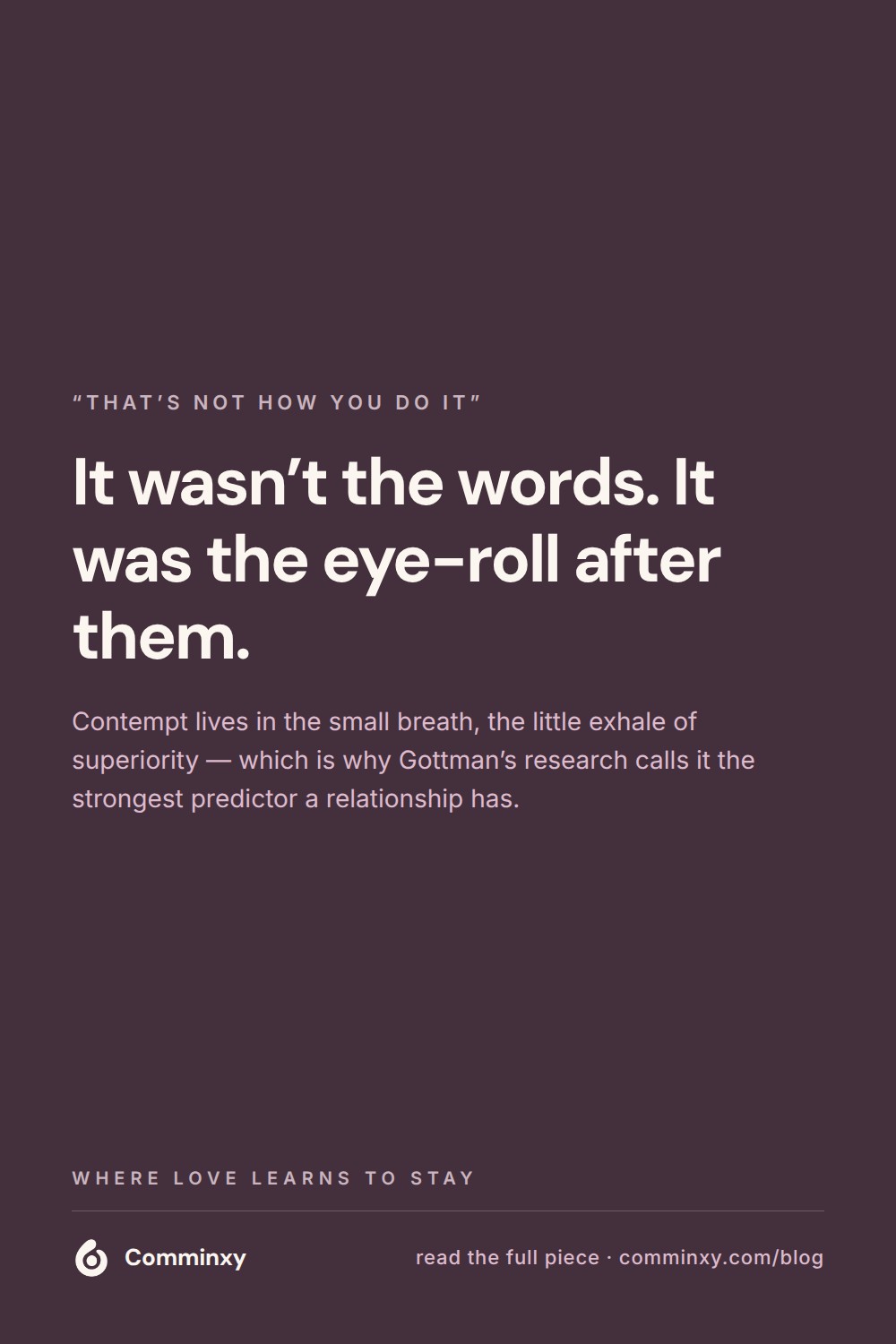
A tone. An eye-roll. A "wow, okay" said flatly, with a little laugh underneath it that told you exactly how far you'd fallen in their estimation. Contempt is the moment one person stops standing beside the other and starts standing above them. Not "I'm angry at you." Something colder: "I'm better than you." The eye-roll, the mockery, the sarcasm sharpened to a point, the mimicking of your voice back at you. It communicates disgust, and disgust is a very particular feeling to receive from someone whose warmth you were counting on.
Why Gottman calls it the number one predictor
When John Gottman and Robert Levenson watched couples argue in their lab and then followed those couples for years, they found that four particular behaviours during conflict (criticism, defensiveness, contempt, and stonewalling) predicted divorce with striking accuracy (Gottman & Levenson, Journal of Personality and Social Psychology, 1992). Of the four, contempt stood out. It was the strongest single sign that a relationship was in trouble.
Sit with why that might be. Anger, even ugly anger, usually means I still expect something from you. I'm still in this. Contempt has already decided. It looks at your partner and, in that flick of the eyes, files them under a lower category of person. That's why it lands so cold: underneath the sarcasm is a quiet verdict, and some part of you hears the verdict even when you can't name it. If you want to see how contempt sits alongside its three cousins, we've written more about the four communication patterns that destroy relationships.
Where it actually comes from
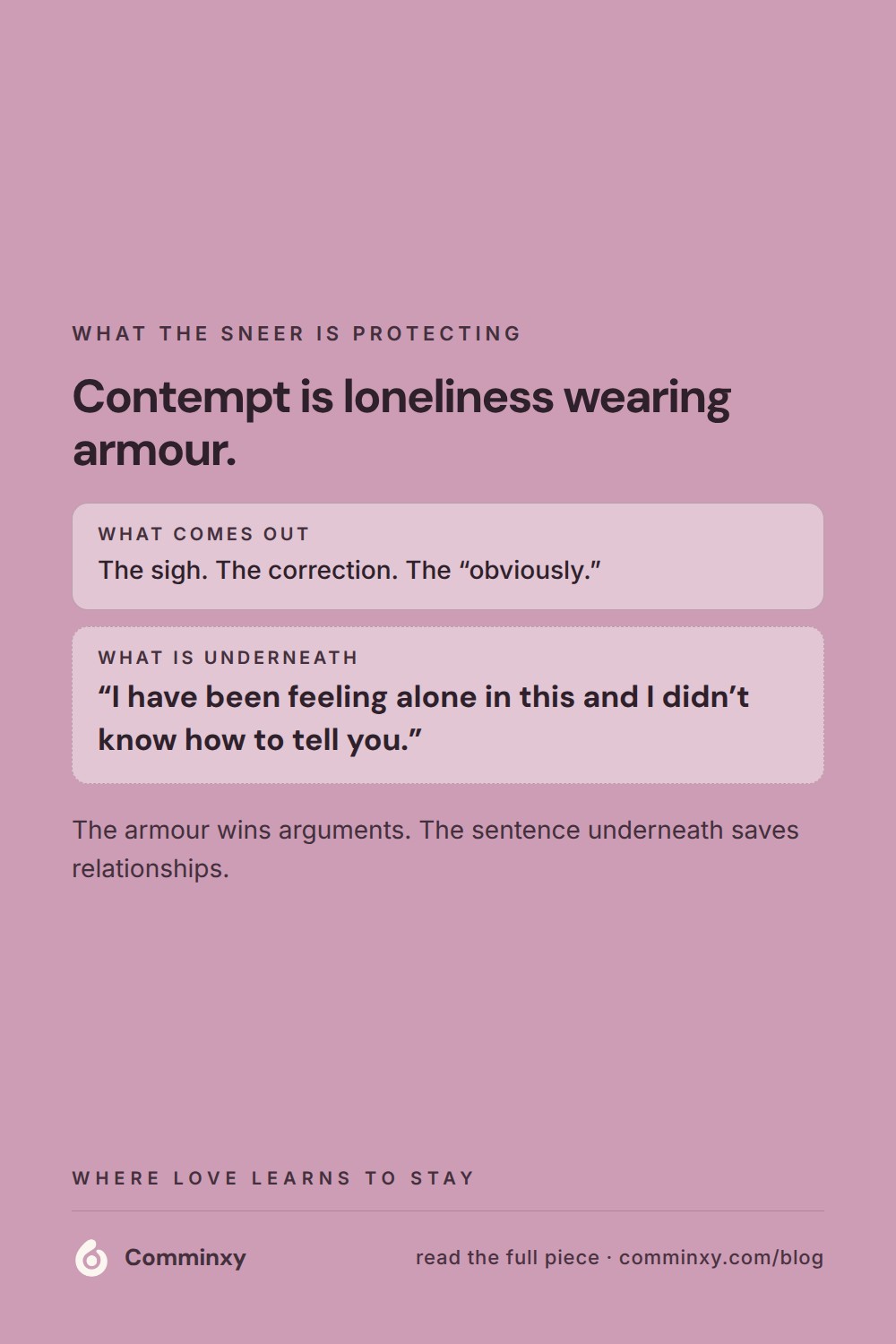
Almost nobody sets out to be contemptuous. The person doing the eye-rolling isn't a cruel person who woke up wanting to wound. Usually they're someone who has been quietly keeping score: of the times they felt unappreciated, unheard, taken for granted. The ledger has grown long enough that they've stopped seeing their partner clearly. Contempt is what long-unspoken resentment turns into when it's had nowhere to go.
That's the part that's strangely hopeful. Contempt isn't a personality. It's a build-up. It's what happens when admiration erodes one un-repaired moment at a time, until affection curdles into a running commentary in someone's head. A build-up, unlike a character flaw, has a source you can go looking for. When someone rolls their eyes, there's almost always a sentence underneath it they never got to say plainly. Something like I've been feeling alone in this and I didn't know how to tell you.
What the way back actually looks like
You don't undo contempt by policing tone. You undo it by rebuilding the thing contempt replaced: the sense that you're on the same side, looking at the problem together rather than at each other.
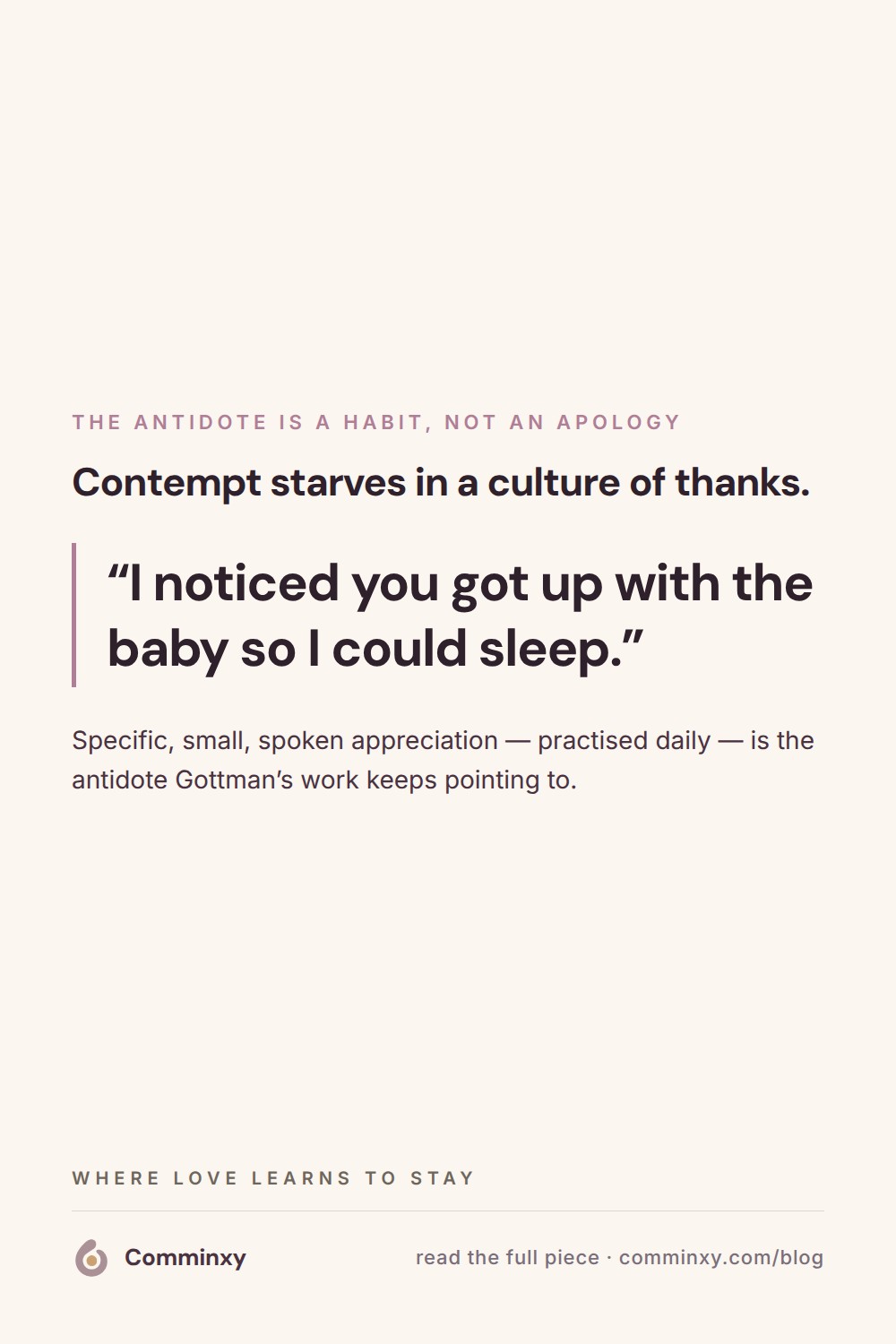
Gottman's own antidote to contempt wasn't a communication trick. It was a slow return to noticing what's good in the person in front of you, out loud, and often. Not grand declarations. The small ones. Thank you for handling the thing with your mum, I know that wasn't easy. I noticed you got up with the baby so I could sleep. These sound almost too minor to matter, but they're doing something structural: they refill the account that contempt drains. Every genuine word of appreciation is a quiet correction to the story that this person is beneath you, because you can't roll your eyes at someone you've just, honestly, thanked.
It also helps to name the feeling underneath the sarcasm instead of firing the sarcasm. "I felt invisible when you didn't ask about my day" says the same thing an eye-roll says, but it says it as an equal, reaching across, rather than as a judge passing sentence. It's harder. It's more exposing. It's also the only version that gives your partner something to move toward. If saying the tender thing plainly feels almost impossible, you're not unusual, and what emotional safety in a relationship actually looks like is really the ground all of this grows from.
A quieter kind of hope
What research on lasting couples keeps finding is that they aren't the ones who never wound each other. They're the ones who don't let a bad moment become the whole story. Contempt is not a life sentence handed down on your relationship. It's a signal. Resentment that got no outlet, admiration that went unspoken, two people who drifted into standing across from each other instead of beside each other. Every one of those things can move.
So go back to the shirt on the chair. The next time that little breath escapes, theirs or, honestly, yours, try to hear it not as proof of contempt but as proof of something older and softer underneath it: someone who once looked at this person with real admiration, and misses feeling that way. That ache is not the end of love. It's love asking to be tended again. Comminxy exists to sit in those small, charged moments with you, helping you hear what's underneath the tone before it hardens into a verdict, because this is exactly where love learns to stay.
Questions people ask
What does contempt look like in a relationship
Contempt shows up as eye-rolling, mocking tone, sarcasm, mimicking your partner's voice, or a look of disgust that communicates they are beneath you. It is colder than anger because it carries a judgment that you are better than them rather than just upset with them. The key marker is that it places one person above the other instead of on the same level.
Why is contempt the biggest predictor of divorce according to Gottman
Contempt communicates disgust and superiority, meaning one partner has already decided the other is a lower category of person. Anger still expects something from your partner, but contempt has stopped expecting and started judging. Gottman's research found it was the strongest single sign a relationship would end because it erodes the fundamental respect couples need to stay together.
How do you fix contempt in a relationship
You rebuild contempt by returning to small, genuine expressions of appreciation and noticing what is good in your partner out loud. Instead of sarcasm or eye-rolling, name the vulnerable feeling underneath, like saying you felt invisible rather than rolling your eyes. This refills the respect and admiration that contempt drained and helps partners stand beside each other again instead of above or below.
Can a relationship recover from contempt
Yes, because contempt is a build-up of unspoken resentment, not a permanent character flaw or a life sentence on the relationship. It signals that admiration eroded over time through un-repaired moments, and those things can be rebuilt. Recovery requires both people to return to seeing each other as equals and tending to appreciation again.
Keep the idea with you — pin it, or download the cards.


Comminxy helps you hear what sits underneath contempt before it becomes the whole story
Get Comminxy free →