What Conflict Reappraisal Research Reveals About Making Love Last
There is a particular kind of ache that arrives after an argument, often before either of you has left the room. Not the heat of the disagreement itself, but something quieter: the slow realisation that you are both better than the ten minutes you just spent together, and you cannot quite understand why those ten minutes keep happening anyway.
What conflict reappraisal research quietly suggests is something worth holding onto: the fight itself may matter far less than the story you tell yourself about it afterward.
The story arrives faster than the facts
Two people have a hard conversation. Nothing catastrophic. A forgotten plan, a tone, a silence held a beat too long. And then, in the space of about four seconds, one of them decides what it meant. He doesn't listen. She's always keeping score. He did that on purpose.
The deciding is so fast it doesn't feel like deciding. It feels like simply seeing clearly.
But Fincham and Bradbury, in the Journal of Personality and Social Psychology, found something worth sitting with: when partners judge each other's behaviour as intentional, selfish, and blameworthy, that judgment predicts more hostility and more of that back-and-forth escalation where each person answers a jab with a jab. It is not the forgotten plan that sets the next twenty minutes on fire. It is the private verdict (he meant it) that gets reached before the other person has even finished their sentence.
The verdict feels like truth. Most of the time, it is just the fastest available story.
Why we reach for the worst version
When we love someone and they hurt us, even in a small way, the mind goes looking for meaning. And meaning, when we are hurt, tends to organise itself around threat. Not maybe he was tired, but maybe he doesn't care.
The trouble is that once the story is written, everything they do afterward gets read as evidence for it. The clipped answer. The turning away. It all slots neatly into the case you have already begun building. This is how two people who genuinely love each other can find themselves, night after night, in the same argument that never seems to be about the thing it is about. If that pattern feels familiar, you might recognise yourself in why couples who love each other still grow apart. It is not a shortage of love. It is an accumulation of stories left unexamined.
The disagreement itself is not the danger. Gottman and Krokoff, writing in the Journal of Consulting and Clinical Psychology, found that anger and disagreement do not harm a relationship over the long run. What corrodes things is defensiveness and withdrawal: the turning away, not the turning toward in frustration. So the goal was never to stop fighting. It was something quieter.
The small shift that changes the whole trajectory
Finkel and his colleagues, in Psychological Science, asked couples to do one small thing three times over the course of a year. Not to fight less. Not to communicate more. Just, after a disagreement, to write for a few minutes about the conflict from the perspective of a neutral third party who wants the best for both of them. Someone standing in the doorway, seeing two people who love each other having a hard moment.
The total time spent doing this over the whole year was twenty-one minutes.
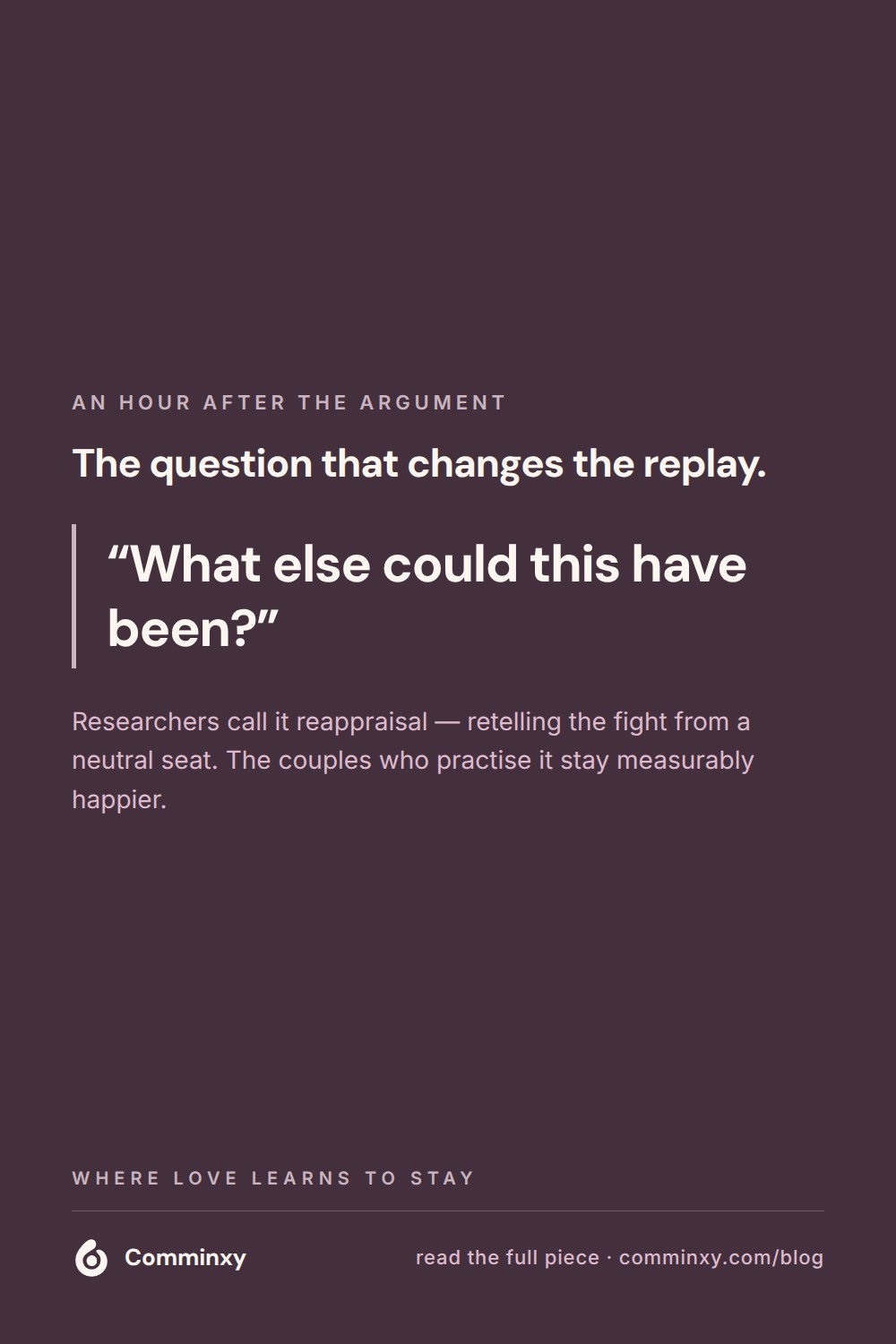
And in those twenty-one minutes, the couples completely stopped the slow decline in marital satisfaction that the other couples experienced. The relationships were not rescued by grand gestures or breakthroughs. They were protected by a few minutes of stepping outside the four-second verdict and asking a softer question: what else could this have been?
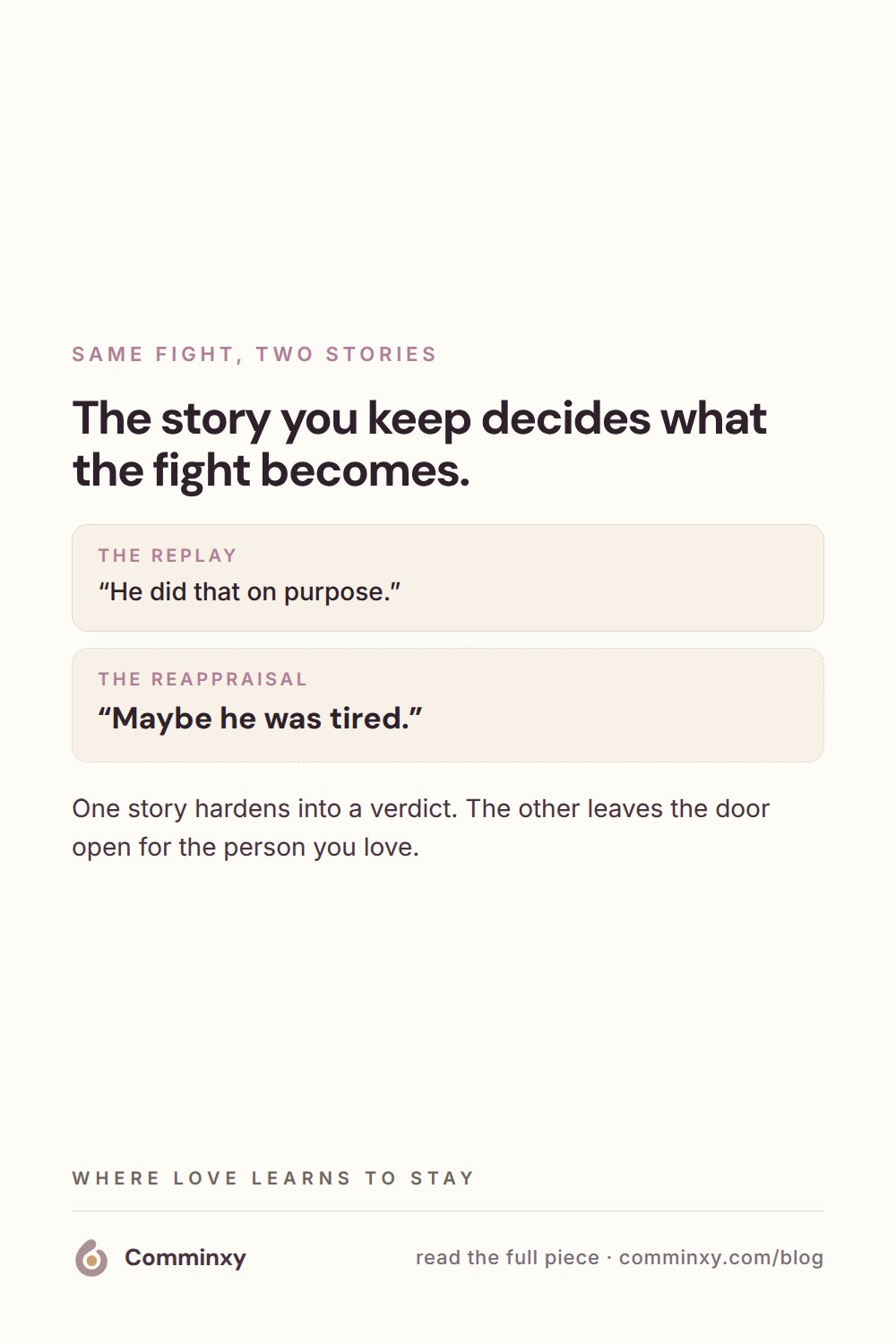
Not he did that on purpose, but he came home carrying a day I didn't see. Not she doesn't care, but she was scared I'd stopped noticing her.
That is conflict reappraisal. It is not pretending the hurt did not happen. It is refusing to let the fastest, most frightening story be the only one you get to keep.
What the way back actually looks like
An hour after the argument, you will not feel like being generous. The verdict will feel earned. And it might partly be.
The reappraisal is not about deciding you were wrong. It is about widening the frame enough to hold two things at once: that you were hurt, and that the person who hurt you was probably not the villain your four-second story cast them as. You can hold both. Most repair lives in that both.
Sometimes the widening happens in your own head, on a slow walk. Sometimes it happens when you go back to your partner the next morning and say the harder, truer sentence: I think I decided you didn't care, and I'm not sure that was fair. That single admission does more than an hour of defending your case. If saying the true thing without it turning into another fight feels impossible right now, there is a gentler map for it in how to communicate better with your partner.
What the research is really telling us is oddly hopeful. You do not have to become more patient, more articulate, more evolved. You just have to interrupt the story once, before it hardens into fact.
What you're really protecting
The ache you feel after an argument, the sense that the two of you are better than that disagreement, is not naive. It is accurate.
The better version of you both is real. It has just been temporarily buried under a story that arrived too fast to be trusted. And the extraordinary, almost gentle finding buried in the conflict reappraisal research is that you do not have to dig it out with force. You have to loosen the story by a few degrees. A neutral doorway. A softer question. Twenty-one minutes, spread across a whole year of ordinary Tuesdays.
This is the quiet work that Comminxy was built to sit beside: not to referee your conflicts or hand you a verdict, but to help you catch the story before it sets, and find the truer one underneath. That is usually where love learns to stay. Not in the absence of hard nights, but in the small, repeated grace of not letting one of them become the whole story.
Questions people ask
why do couples keep having the same argument
Couples repeat the same argument because they reach a fast verdict about what their partner's behaviour meant, then read everything afterward as evidence for that story. The argument is rarely about the surface issue but about unexamined stories that have accumulated over time. Breaking the pattern requires catching and loosening those stories before they harden into fact.
does arguing mean your relationship is failing
No, arguing does not mean your relationship is failing. Research shows anger and disagreement do not harm relationships long term. What corrodes things is defensiveness and withdrawal, the turning away rather than turning toward each other even in frustration.
what is conflict reappraisal
Conflict reappraisal is stepping back after a disagreement to consider the conflict from a neutral perspective, asking what else it could have been beyond your first fast judgment. It is not pretending the hurt did not happen but refusing to let the most frightening story be the only one you keep. This practice takes only minutes but protects relationship satisfaction over time.
how do you stop making your partner the villain after a fight
Write for a few minutes about the disagreement from the perspective of someone neutral who wants the best for both of you. Ask softer questions like whether your partner came home carrying a day you did not see, rather than deciding they hurt you on purpose. This interrupts the four-second verdict before it becomes the only truth you hold.
Keep the idea with you — pin it, or download the cards.



Comminxy helps you catch the story before it sets and find the truer one
Get Comminxy free →