The Small Bids for Connection Gottman Says Can Make or Break Your Love
The question underneath this whole article is small and it might be the most important one in your relationship. It goes something like this: how many times a day is my partner reaching for me, and how many of those do I miss?
Not the big reaches. Not the anniversary, not the hard talk on the sofa at midnight. The tiny ones. The comment about the neighbour's new fence. The half-laugh at something on their screen they turn to show you. The "look at this dog" while you are hunting for your keys by the front door. These are what the researcher John Gottman named bids for connection, and the honest answer to how many you miss is: more than you think, and it matters more than it looks like it should.
What a bid actually is, in real life
A bid is any small attempt to get your attention, your affection, or just your acknowledgement. It rarely announces itself. Your partner does not walk in and say, "I need to feel connected to you now." They say the recycling truck came early. They read a headline out loud. They sigh at their phone and wait half a second to see if you ask what is wrong.
Underneath the fence and the dog and the headline is the same quiet question, asked over and over across a life together. Are you there? Are you with me?
You can answer a bid in three ways. You can turn toward it, even clumsily, even with just a "huh, early." You can turn away, keep reading, say nothing. Or you can turn against it, snap that you are busy. Most missed bids are not the third kind. They are the second, and the second is so gentle it barely registers as anything at all. That is exactly what makes it dangerous.
Why missing them is so easy, and so quiet
A bid missed does not feel like rejection to the person who missed it. It feels like nothing. You were mid-thought, mid-email, mid-worry about the thing at work. You genuinely did not hear it. There was no cruelty in it, and you would be hurt to be told you had done anything at all.
But the person who made the bid felt something land, or not land. Not a wound exactly. A tiny recalibration. Not now. Not that. Maybe later. One of those on its own is nothing. Ten thousand of them is a marriage where two people are technically kind to each other and quietly, bafflingly alone.
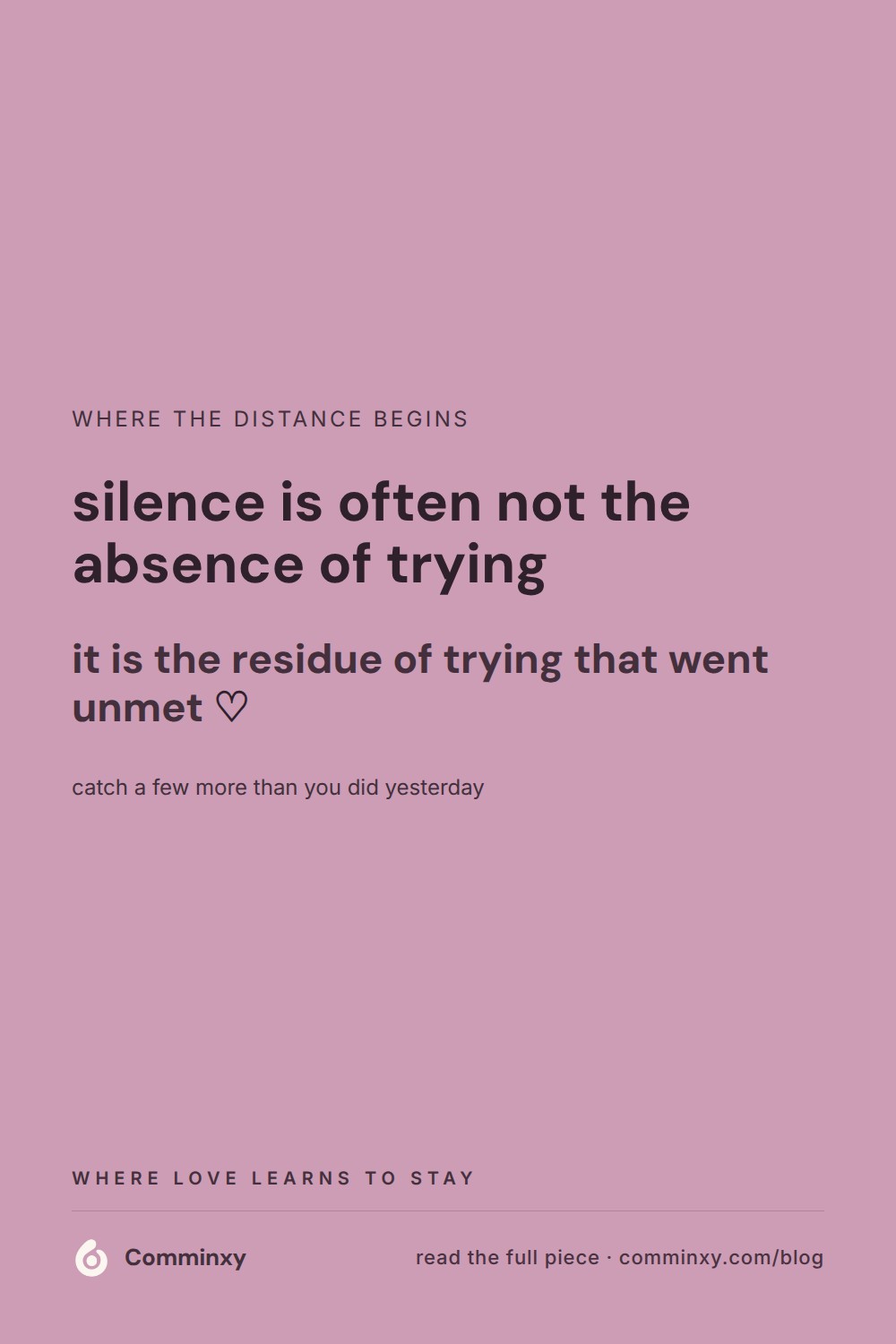
This is part of why couples stop talking without ever deciding to. Nobody stopped bidding out of spite. They just made a hundred small offers, got a distracted response to most of them, and slowly, sensibly, stopped offering. Silence is often not the absence of trying. It is the residue of trying that went unmet.
What the research can and cannot tell you
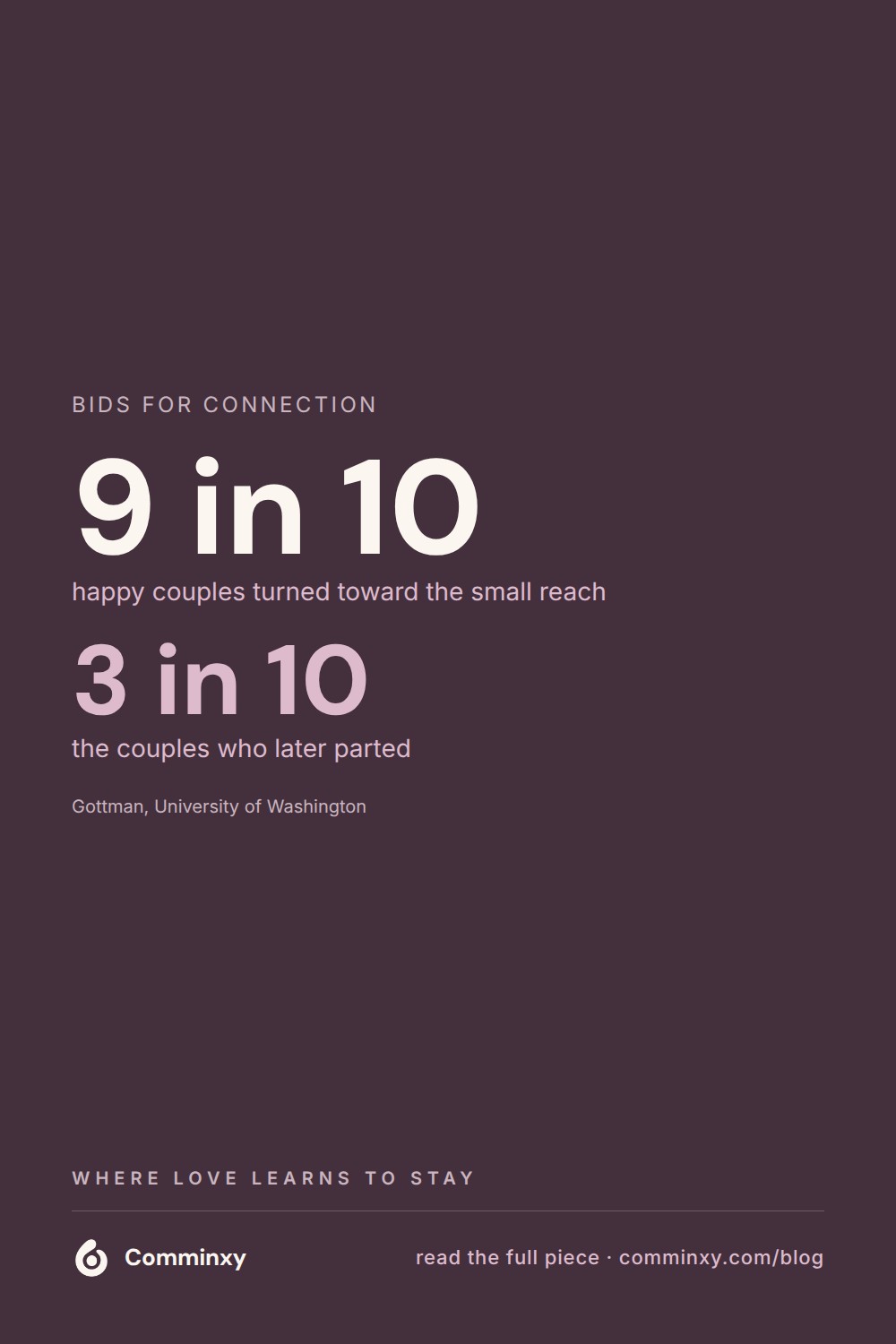
The finding that made this idea famous is worth sitting with, because of how large the gap turned out to be. Gottman brought newlywed couples into an observation apartment and watched how they responded to each other's small bids. Then he checked back years later. The couples who had stayed together and were happy had turned toward each other's bids about eight or nine times out of ten. The couples who had divorced had done so only about three times out of ten (Gottman, University of Washington).
Sit with that difference. Not a chasm in personality. A gap in how often two people noticed the small reaches and reached back.
Now the honest part, the part these articles are supposed to keep. The research does not prove that turning toward bids caused those marriages to last. When couples divorce, they tend to point to bigger, sharper reasons. In one large study, seventy-five percent of formerly married people named a lack of commitment as a major cause, and nearly sixty percent named conflict (Scott, Rhoades, Stanley, Allen, and Markman, Journal of Family Psychology). Nobody stands in a lawyer's office and says, "He never asked about the dog." So it would be dishonest to promise you that catching bids will hold a relationship together on its own. It will not carry a marriage through betrayal or a slow loss of commitment.
What the bids research suggests is quieter and more true to daily life. The missed bid is often where the distance begins, long before it has a name a court would recognise. The small turning away is the first draft of the big one. Catch it early enough and it stays small.
The way back is smaller than the miss
Here is the relief in it. You do not have to become a person who catches every bid. That person does not exist. You will miss one tonight while reading this. You will miss three tomorrow because your mother is unwell or the boiler broke or you are simply tired in the way that eats attention.
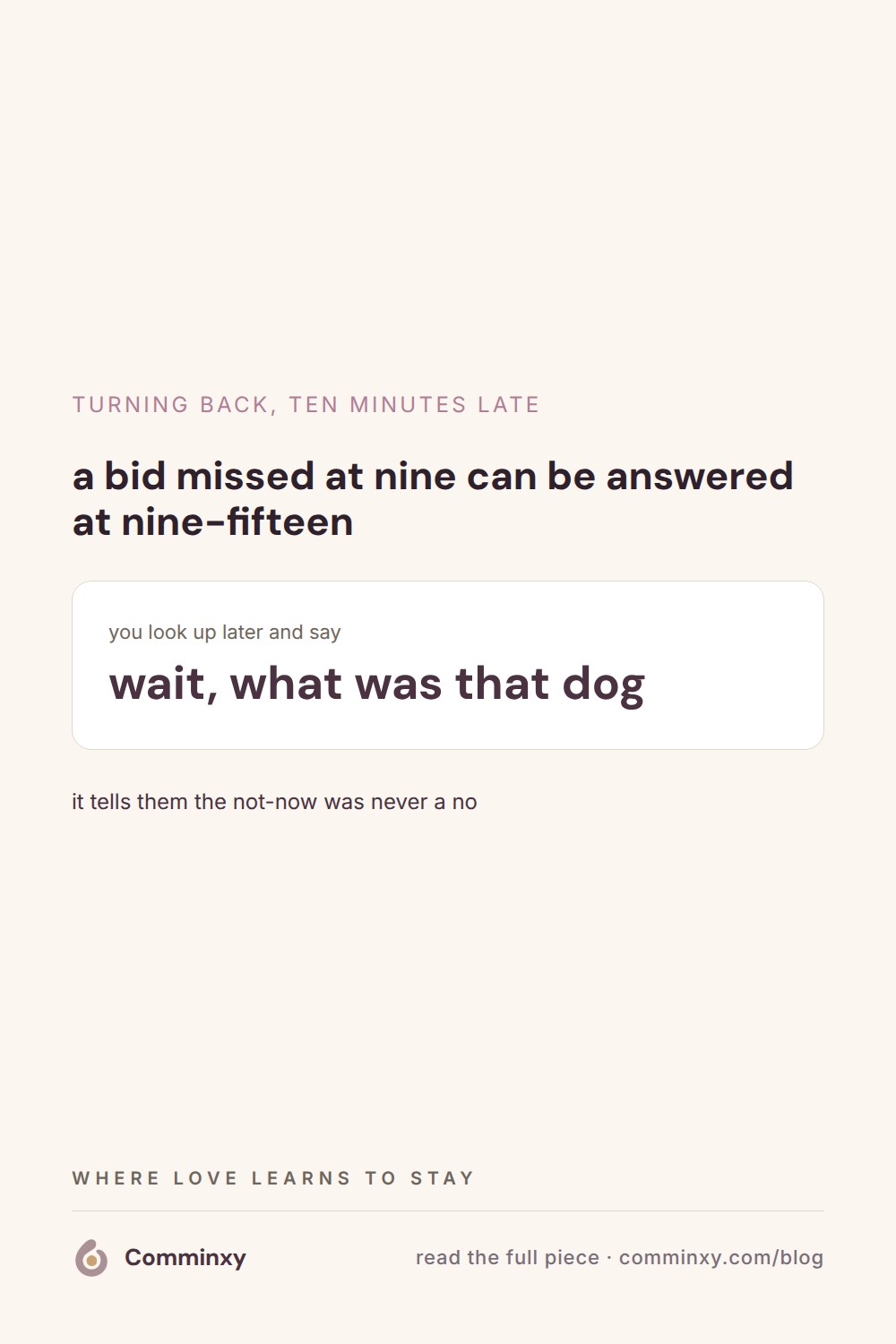
What the couples who stay seem to do is not perfection. It is repair. A bid missed at nine can be answered at nine-fifteen. You look up ten minutes later and say, "Wait, what was that dog?" It sounds too small to matter. It is not. Turning back late still reaches the person. It tells them the not-now was never a no.
And you can widen your own aperture a little. Once you know that the fence comment and the headline are bids, you start hearing them as what they are: your partner, standing there, asking if you are with them. The comment stops being noise. It becomes an invitation with your name on it.
If you want a gentler way in, so much of this is really about how the two of you notice each other in the ordinary hours, not the dramatic ones.
So, back to the one question. How many bids do you miss each day? You will never know the number, and you do not need to. You only need to catch a few more than you did yesterday, and to turn back when you notice you missed one. That is the whole of it. A relationship is not saved in a single conversation. It is kept alive in ten thousand small "look at this dog" moments where one person turns their face toward the other. Comminxy exists to help you hear those quiet reaches a little sooner, because that is where love learns to stay: not in the grand gestures, but in the countless times you looked up.
Questions people ask
what are bids for connection in a relationship
They are small everyday attempts to get your partner's attention, affection, or acknowledgement. Things like sharing a headline, pointing at something funny, or sighing to see if you ask what is wrong. Underneath each one is a quiet question about whether you are present with them.
how did gottman study bids for connection
He observed newlywed couples in a research apartment and watched how they responded to each other's small bids. Years later he checked back to see who was still together and happy. The couples who stayed happy had turned toward each other's bids far more often than those who divorced.
does ignoring bids for connection cause divorce
The research shows a strong link but does not prove that missed bids alone cause divorce. Bigger factors like lack of commitment and ongoing conflict are what people usually name. Missed bids tend to be where distance quietly begins rather than the final cause.
what do i do if i keep missing my partner's bids
You do not need to catch every one, since nobody can. Focus on repair by turning back a little later, such as asking about the thing you missed ten minutes ago. Learning to hear ordinary comments as invitations helps you catch a few more over time.
Keep the idea with you — pin it, or download the cards.


Start by noticing the small reaches you usually miss.
Get Comminxy free →