How Attachment Styles Shape Communication in Relationships (and How to Speak So Love Stays)
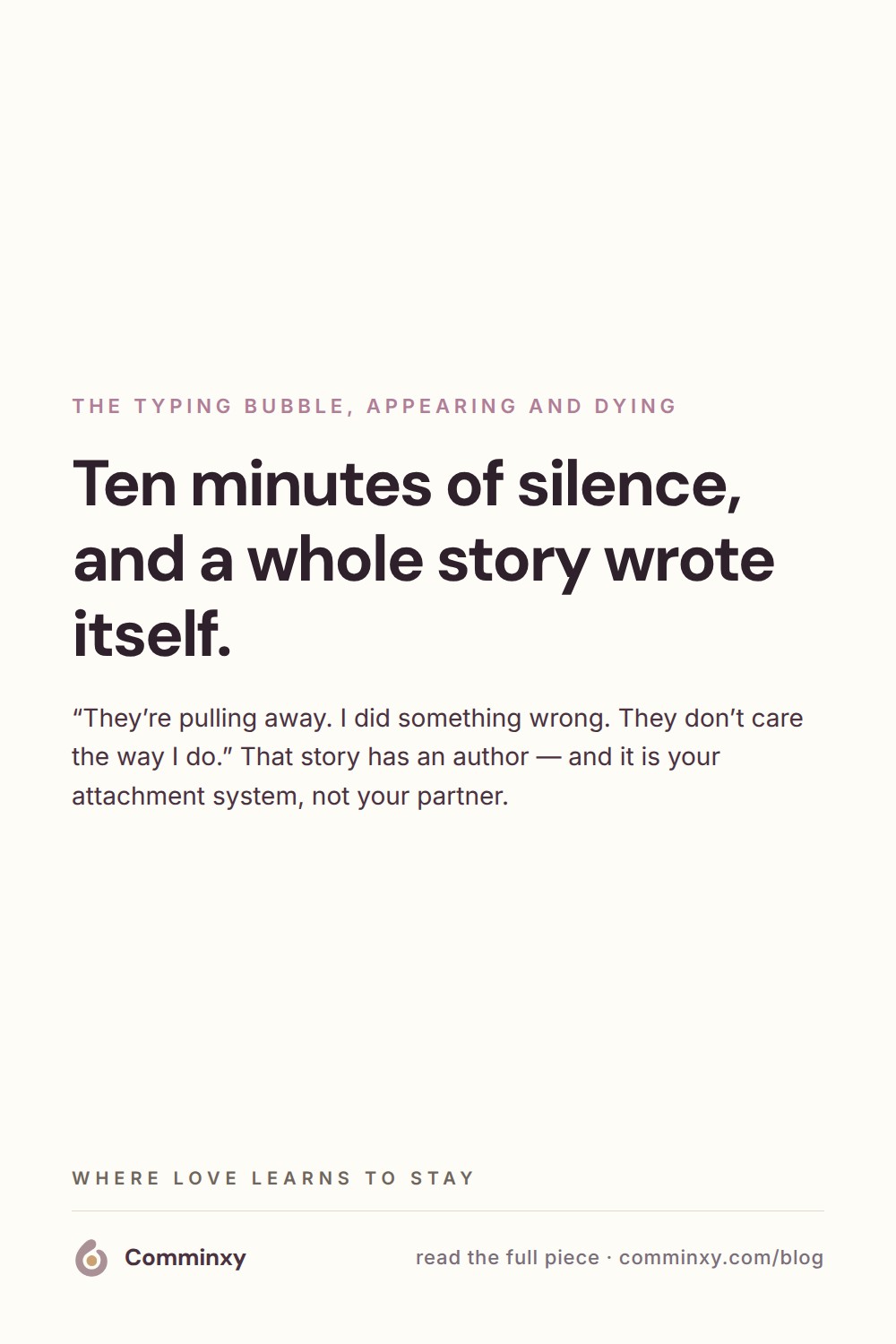
You send a text. Three words, nothing dramatic. Then you watch the screen. The little bubble appears, disappears, appears again. Five minutes pass. Ten. Somewhere in that silence, a story starts writing itself in your chest: they're pulling away, I did something wrong, they don't care the way I do. Meanwhile, across town, your partner has put the phone face-down and gone quiet, not because they've stopped caring, but because the conversation started to feel like too much and going still felt like the only way to breathe.
Neither of you is doing anything wrong. You're just meeting the same moment from two different starting points. That's what attachment styles do inside communication. In relationships, they quietly shape not just what we say, but how fast we panic, how long we stay, and how we read a silence that means nothing.
The reflex arrives before the words do
Watch yourself in the first half-second of tension. Before you've decided anything, your body has already moved.
One person leans in: texts again, asks "are we okay?", needs the connection restored right now. The other pulls back: goes vague, gets busy, needs space before they can even find the words. These aren't personality flaws. They're old strategies, learned long before this relationship, for what to do when closeness starts to feel uncertain. One learned that the way to stay safe is to hold on tighter. The other learned that the way to stay safe is to step back and self-manage. Both are trying to protect the bond. They just reach for opposite tools.
Why the same fight keeps circling back
The two reflexes feed each other. The one who reaches out reaches harder when the other goes quiet. The one who goes quiet goes quieter when the other reaches harder. Each move confirms the other person's worst fear. She texts more, he withdraws more, she reads the withdrawal as abandonment, he reads the texts as pressure, and around it goes, faster each time.
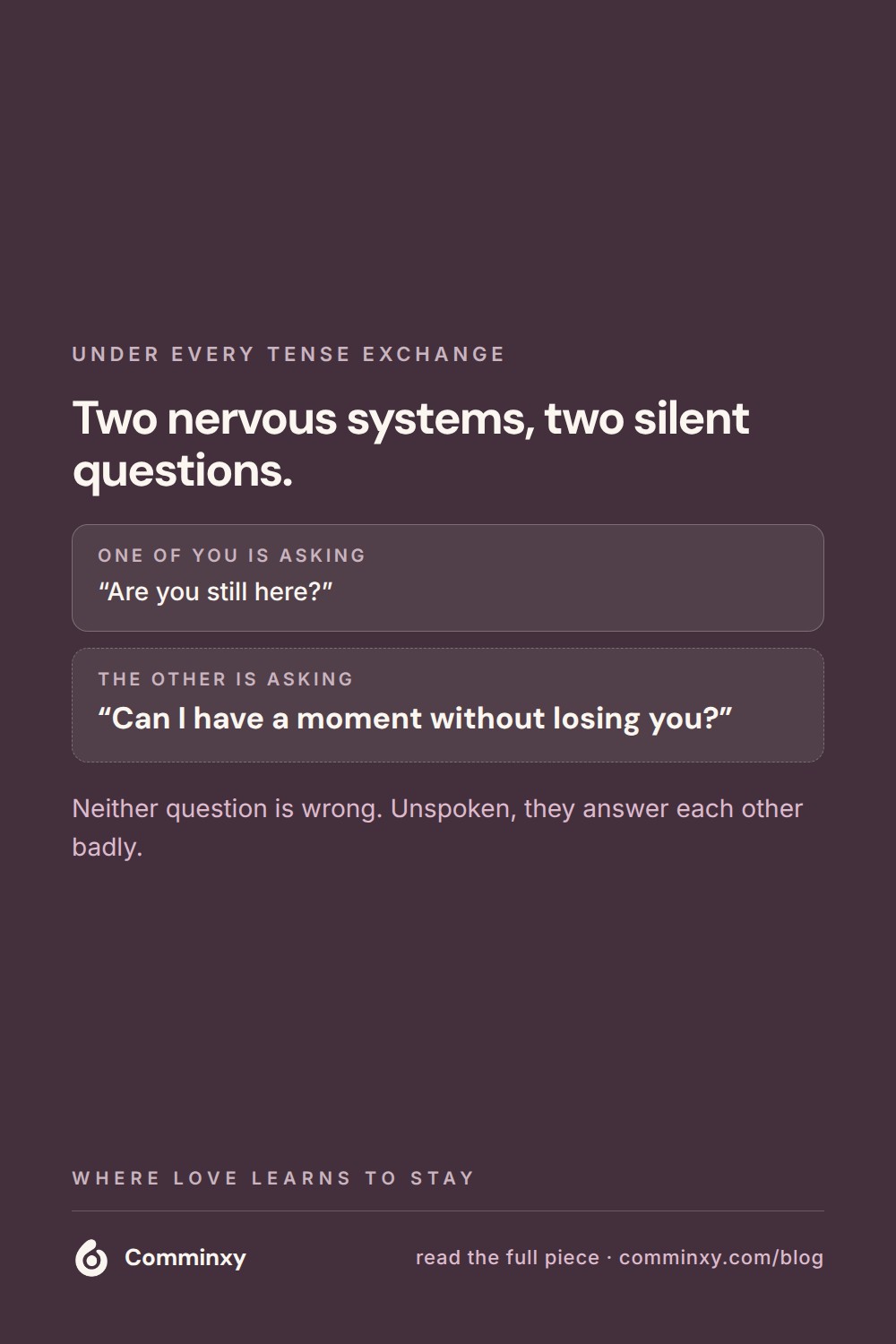
What makes this so hard to see is that the argument on the surface is almost never the real one. You think you're fighting about the dishes, or the tone of a message, or who forgot to call. Underneath, one of you is asking are you still here? and the other is asking can I have a moment without losing you? The content changes. The question underneath rarely does.
If you've noticed yourselves landing in the same place no matter where you started, you're not stuck. You're caught in a loop, and loops can be interrupted.
The story you tell about the silence
The gap between what your partner did and what you decided it meant: that's where most of the damage lives. And it turns out the story matters more than the moment.
Fincham, Harold, and Gano-Phillips, tracking couples across three points in time in the Journal of Family Psychology, found something that should change how you read a quiet partner: negative attributions and relationship satisfaction feed each other in a loop, each one deepening the other over time. When you decide the silence means he doesn't care, that interpretation doesn't just sit there. It shapes how you speak next, which shapes how he responds, which hardens the belief. The story becomes the weather.
This is where how attachment styles shape communication in relationships does its quietest work. The anxious reach reads a delay as rejection. The avoidant pull reads a question as an accusation. Neither reading is the truth of the moment. It's the fear filling in the blank. Once you can see that the story arrived before the facts did, you get a small, real choice: you can hold the interpretation a little more loosely.
What changes when one person moves differently
You don't need both people to change at once. That's the relief hidden in all of this. The loop is built from moves and countermoves, and it only takes one different move to loosen it.
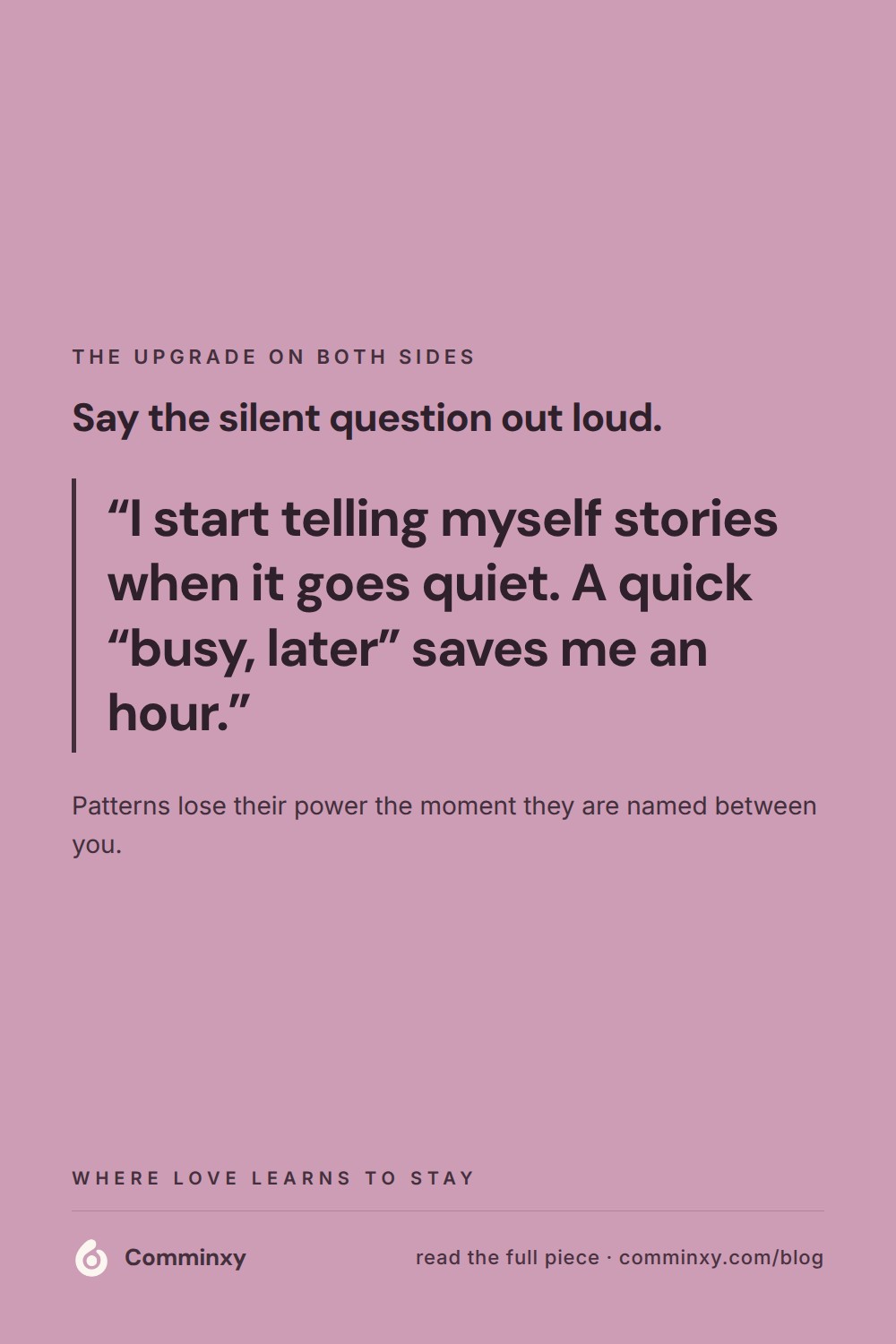
If you're the one who reaches, the different move is saying the fear out loud instead of chasing it sideways. Not "why didn't you text back" but "when it goes quiet, I start to spiral. It's not you, it's the quiet." If you're the one who pulls back, the different move is leaving a small light on before you go: "I need a bit of space, I'm not going anywhere, I'll come find you." A single sentence that says I'm still here can stop the other person's story before it writes its worst ending.
This is a lot of what emotional safety in a relationship actually is. Not the absence of fear, but the presence of a signal that the bond will hold.
Some of the hardest versions of this happen over text, where tone vanishes and the pauses feel enormous. If you've ever fired off something you regretted the second it sent, there's more on why that happens to almost everyone. It isn't a character defect. It's a nervous system reacting faster than a thumb can catch it.
The bond was never as fragile as the moment felt
Attachment styles aren't sentences. They're starting points. The reach and the pull are both, at heart, the same wish: to stay close and stay safe at the same time. When you can name your own reflex, and start to recognise your partner's, the whole thing stops feeling like a battle of wills and starts feeling like two people fumbling toward each other in the dark, using the only tools they were handed.
The repair is smaller than the wound suggests. It's rarely a long conversation. It's usually one honest sentence at the right moment. If you want a gentler map of how to build those moments, this is a good place to start.
So the next time the three dots appear and disappear, and the old story starts writing itself in your chest, see if you can notice it happening before you believe it. That noticing is the whole opening. Comminxy exists to sit in that small gap with you, to help you catch the reflex before it becomes the fight, so the next thing you say brings you closer instead of confirming the fear. The bubble on the screen was never the truth of the two of you. It was just a pause. And it's often in learning to survive the pauses that love learns to stay.
Questions people ask
why does my partner shut down when I try to talk
Shutting down is often a learned way to self-manage when closeness starts to feel overwhelming or uncertain. It is not a lack of care, it is a reflex to create breathing room when the nervous system feels flooded. The withdrawal is usually about needing space to regulate, not about rejecting you.
how do I stop being so anxious when my partner goes quiet
Notice the story your mind is writing about the silence before you believe it as fact. The gap between what happened and what you decide it means is where most of the spiral lives. Naming the fear out loud instead of chasing reassurance sideways can help interrupt the loop.
can attachment style affect texting in a relationship
Yes, attachment styles show up strongly in texting because tone disappears and pauses feel enormous. One person may read a delay as rejection and reach harder, while the other reads frequent messages as pressure and pulls back. The same loop that happens face to face often speeds up over text.
do both people need to change for communication to improve
No, it only takes one person to move differently because the loop is built from moves and countermoves. If one person names their fear plainly or signals they are still present before withdrawing, it can stop the other person from spiraling into their worst interpretation.
Keep the idea with you — pin it, or download the cards.


Comminxy helps you catch the reflex before it writes the story
Get Comminxy free →