What Is Phubbing in a Relationship and Why It Quietly Erodes Love
You were partway through telling them about the phone call with the pharmacy, the one where the prescription still hadn't gone through and you'd had to explain the whole thing twice, when you noticed the light. Not their face. The pale glow washing up from their lap, catching the underside of their chin. They said "mm" at the right moment. They even nodded. But the thumb kept moving, and you felt the sentence you were saying go quiet in your own mouth, like there was no longer anywhere for it to land.
That small act has a name now. Phubbing, a blend of phone and snubbing, and if you have ever wondered what phubbing does to a relationship, you have probably already felt the answer before you had the word for it. It is the moment your partner is technically present and somehow not in the room with you. Nobody meant it. That is almost the worst part.
The same moment, told two ways
Stand in that kitchen from two sides and you get two true stories.
From where you were standing, mid-sentence, it felt like being set down. You had carried this small annoyance around all afternoon, waiting for the person who is supposed to want to hear it, and in the moment you finally handed it over, their attention slid somewhere brighter. You did not want a solution to the pharmacy. You wanted to be met. Instead you got a nod aimed at a screen.
From where they were sitting, it was a work message that came in at exactly the wrong second, or a photo their sister sent, or nothing important at all, just the reflex of a thumb that has learned to move on its own. They heard you. They would swear they heard you. They did not feel themselves leave, because leaving through a phone does not feel like leaving. It feels like staying in the same chair.
Both of these are honest. Neither one is the villain. What makes phubbing quietly corrosive is that the person doing it rarely notices, and the person on the receiving end almost always does.
Why such a small thing costs so much
A dropped glance seems too minor to matter. It lasts three seconds. You do not fight about it. You just feel, faintly, a little less wanted, and then you fold that feeling up and put it away and start the next sentence with a bit less warmth than the last one.
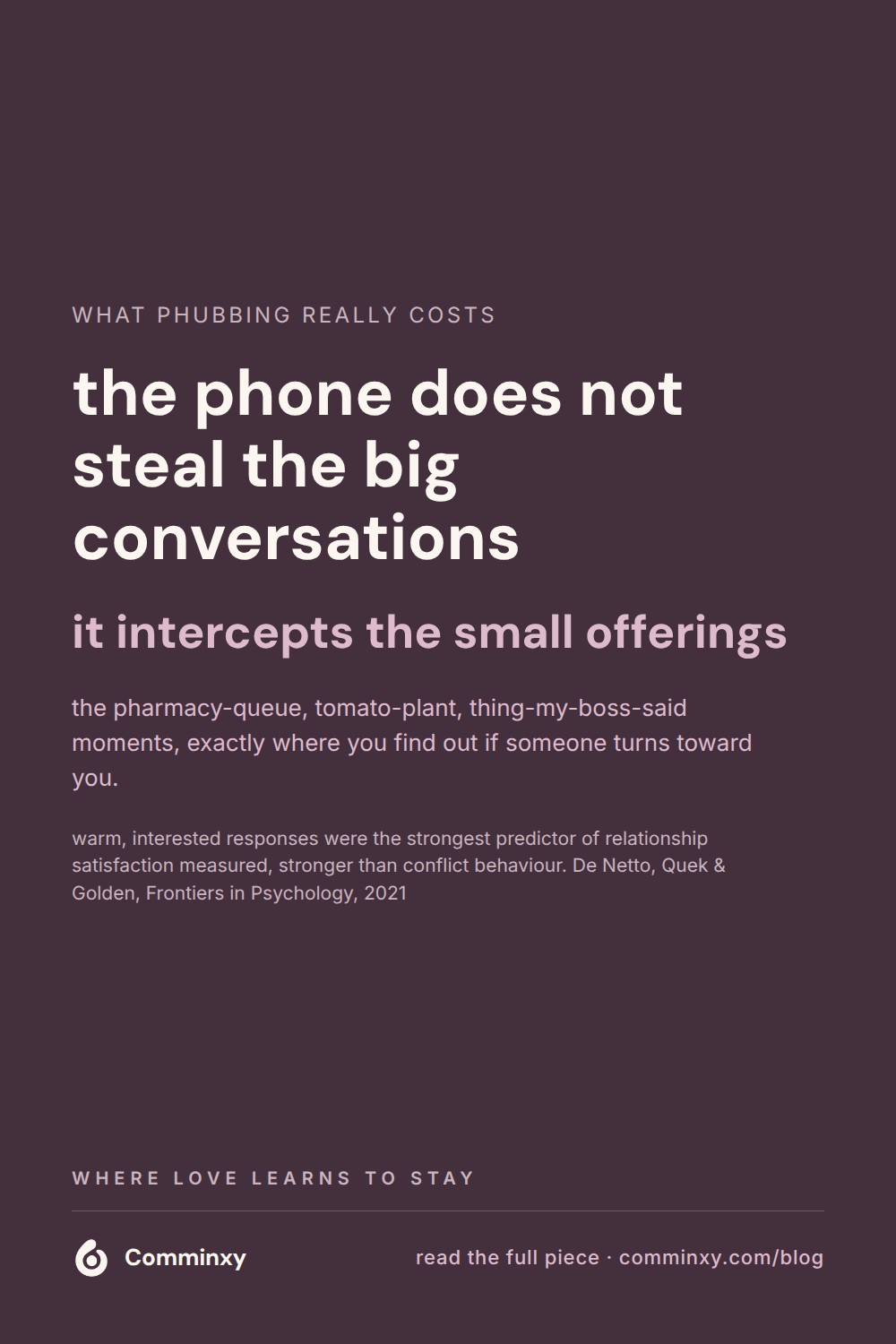
What you are actually reaching for in that moment has a name in the research. When you tell your partner something, even something as ordinary as the pharmacy, you are offering a piece of good or bad news and waiting to see what they do with it. Psychologists call the warm, interested version of that response active-constructive: they turn toward you, ask a follow-up, let it matter. In a study of couples, the sense that a partner responds this way when you share something turned out to be the single strongest predictor of relationship satisfaction they measured, stronger than how the partner behaved during conflict (De Netto, Quek, and Golden, Frontiers in Psychology, 2021).
Sit with what that means for the light on the chin. The phone does not usually steal the big conversations. It intercepts the small offerings, the tomato-plant, pharmacy-queue, thing-my-boss-said offerings, exactly the ones where you find out whether the person turns toward you or away. Miss enough of them and nothing dramatic happens. The account just slowly runs low, one unanswered small thing at a time.
If this is starting to sound familiar, you might recognise it in the way couples quietly stop telling each other things. Not from a fight. From a hundred sentences that stopped feeling worth finishing.
The part where you are the one holding the phone
It would be easy to write this as though there is a phubber and a phubbed, and you are always the one being left. You are not. Some nights you are the light on the chin.
You are tired. The message came in and your hand answered it before your attention did. You genuinely believe you were listening, and in a shallow way you were, enough to nod, enough to catch the shape of what they said. And now they have gone a little flat and you cannot quite work out what you did, because from the inside it did not feel like doing anything at all.
This is worth saying plainly, because the shame around it is real and mostly misplaced. Reaching for a phone mid-conversation is not a character flaw. It is a reflex built by machines designed, with enormous care, to pull exactly that reflex out of you. You did not fail at loving them. You lost a three-second contest against an entire industry, the way almost everyone does, most days.
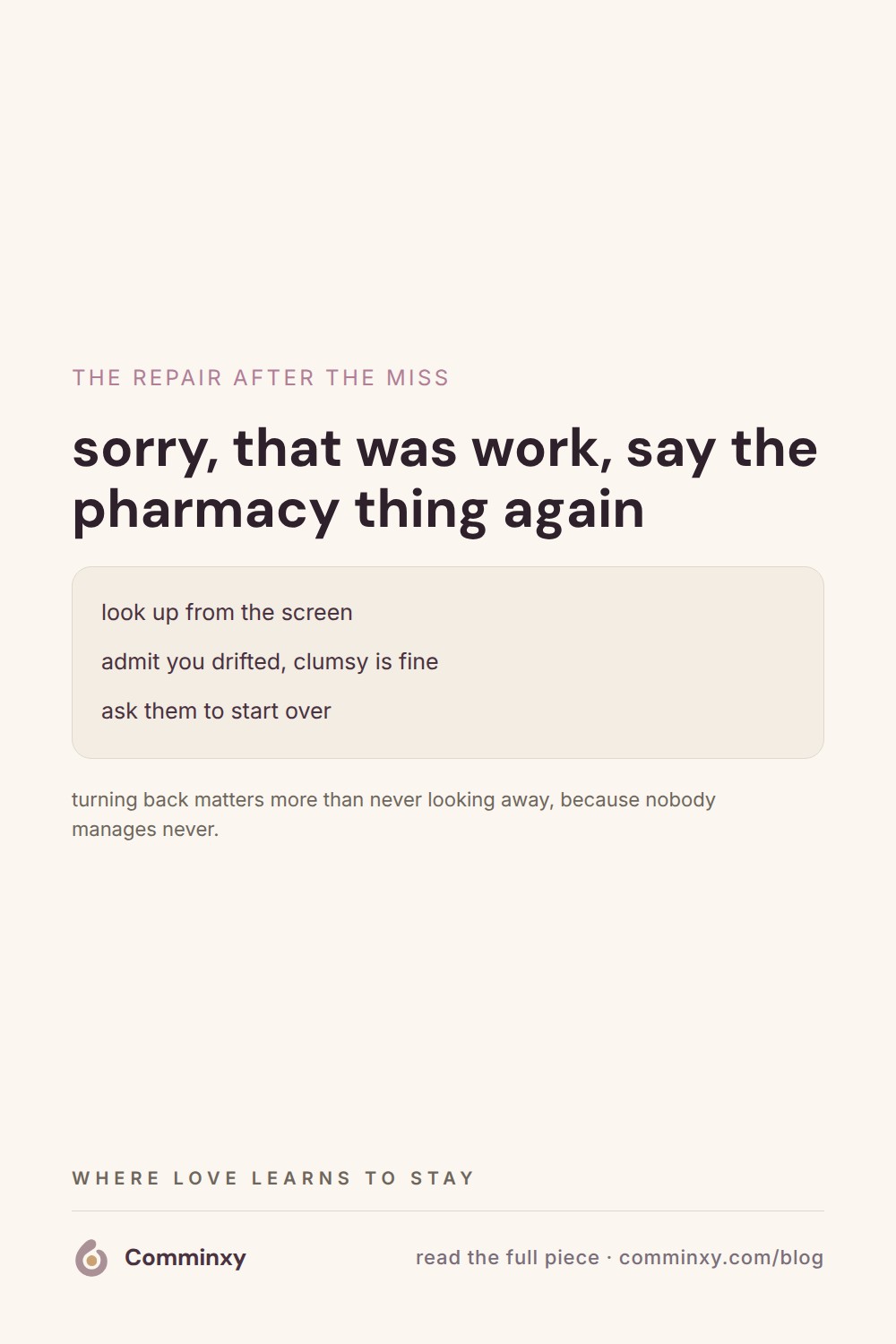
The repair is not a rule about phones at dinner, though you can make one if it helps. It is smaller and it happens after the miss. You look up. You say something like, sorry, that was work, say the pharmacy thing again, I want to hear it. Clumsy is fine. Late is fine. What you are doing when you ask them to start over is turning back toward the small offering you nearly dropped, and telling them it was worth catching. That turn matters more than never having looked away, because nobody manages never.
What stays after the glance goes back up
Here is what the two-sided nature of this actually gives you. If you have been on the receiving end, it helps to know the other person genuinely did not feel themselves leave, that their nod was not a lie, that the flatness you sensed was real but the intent to hurt you was not there. And if you have been the one on the phone, it helps to know the small deflation you noticed afterward was not you imagining things or being needy. They did feel put down. Both readings can be true in the same kitchen, and holding both is what keeps this from calcifying into a story about who does not care.
Most of what a relationship is made of is not the big talks. It is whether the ordinary sentence gets caught. That is repairable at any hour, in any kitchen, with the least graceful sentence you own.
Comminxy exists for the moment right after the glance goes back up, when you want to turn toward the person and are not sure how to say so without making it heavier than it is. Not to police anyone's phone. Just to help the small offering get caught the next time, and the time after that. Because love does not stay in the grand gestures. It stays in whether, when you told them about the pharmacy, someone finally looked up.
Questions people ask
what does phubbing mean in a relationship
Phubbing is when your partner pays attention to their phone instead of you during a moment together. The word blends phone and snubbing. It often happens without the person realising, yet the one being ignored usually feels it clearly.
why does it bother me so much when my partner looks at their phone while i talk
It bothers you because you were offering something small and hoping to be met, and their attention went elsewhere instead. These little moments are where you find out whether someone turns toward you. Missing enough of them slowly leaves you feeling less wanted.
is phubbing a sign my partner doesnt care
Not usually. Reaching for a phone mid-conversation is often a reflex rather than a statement about your relationship. The person genuinely may not feel themselves check out, even though the effect on you is real.
how do i fix phubbing without turning it into a big fight
You can repair it in the moment after it happens rather than making a strict rule. Look up, admit you drifted, and ask them to tell you again. A clumsy attempt to turn back matters more than never looking away.
Keep the idea with you — pin it, or download the cards.



Help the small everyday sentence get caught next time
Get Comminxy free →