How to Communicate in a Long Distance Relationship When Miles Feel Louder Than Words
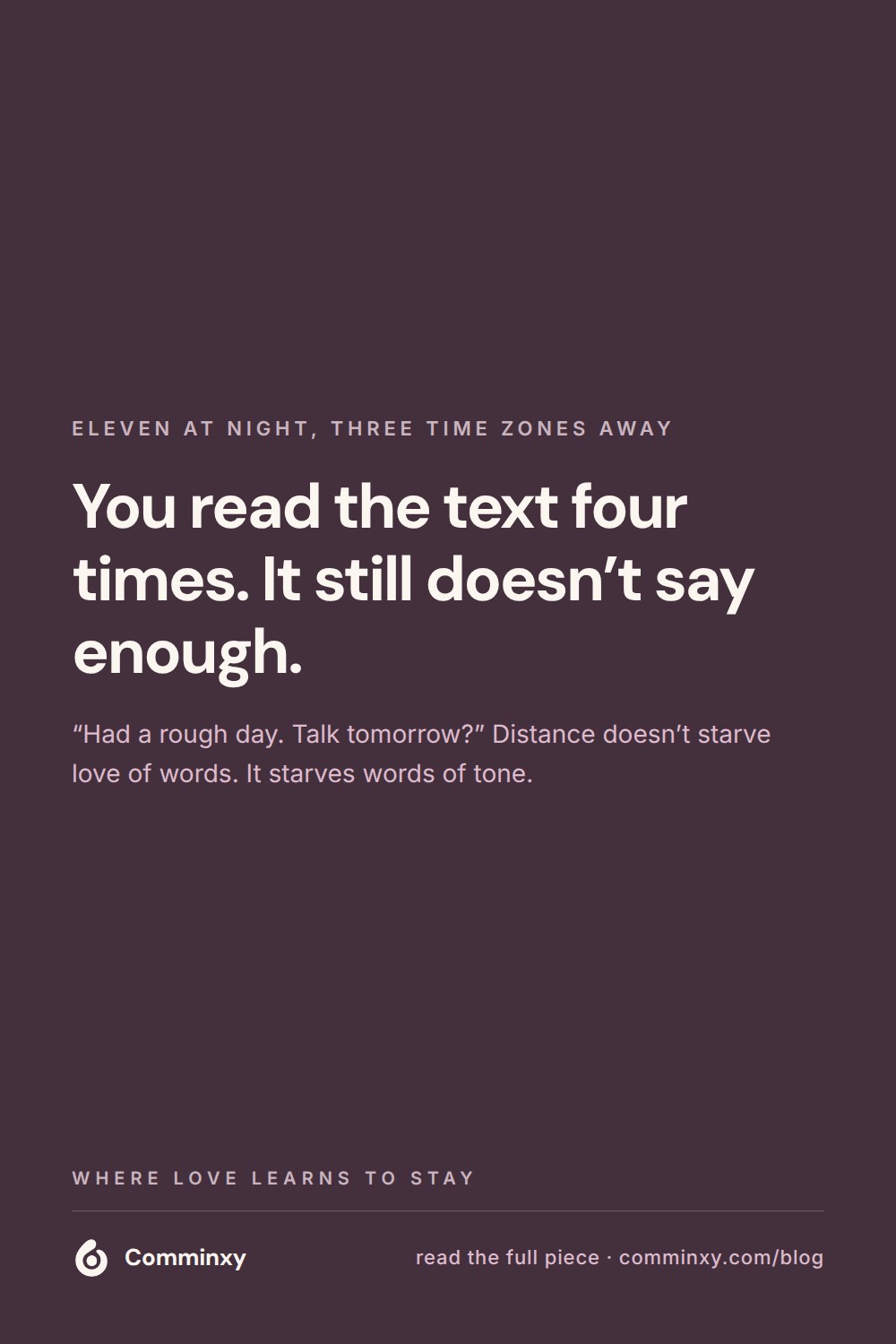
It is eleven at night where you are, and you are staring at a text that just came in from three time zones away. "Had a rough day. Talk tomorrow?" You read it four times. You want to know what happened. You want to say something warm. But there is a strange heaviness in your chest, because you can feel the distance not just in the miles but in the words themselves, how thin they are, how much they leave out. You type something, delete it, type something else. And then you lie there wondering whether the two of you are drifting or whether this is just what love sounds like when it has to travel.
Learning how to communicate in a long distance relationship is rarely about finding the right words. It is about something subtler: the way absence changes what a word has to carry, and how easily the two of you can be doing everything right and still feel far away.
When the words start carrying more than they were built to carry
Distance does not just take away touch and shared meals and the small glances across a room. It takes away all the tiny, wordless ways you used to reassure each other. When you are together, a hand on the shoulder can say I am still here without either of you noticing. From far away, that same reassurance has to become a sentence. And a sentence can be misread.
So "Talk tomorrow?" might mean I am exhausted and I want to tell you properly, not in fragments. Or it might land in your body as I am pulling away. The message has not changed. What has changed is that there is no glance, no tone, no warmth of a shared kitchen to hold it steady. You can read more about why that happens in why you keep saying things you regret to your partner over text, but the short version is that distance asks language to do a job it was never designed to do alone.
Why quietly keeping in touch stops being enough
Most long distance couples are astonishingly good at logistics. They text through the day. They schedule the calls. They send the goodnight message like clockwork. And yet many of them describe the same odd ache: that they are in constant contact and somehow still lonely.
This is the part worth sitting with, because it reframes the whole problem. You might assume that the fix for distance is more communication. But there is a finding from Stafford and Canary, published in the Journal of Marriage and the Family, that quietly challenges that assumption. Their research on relational maintenance found that it is not the sheer volume of contact that keeps couples close. It is specific behaviours, like openness and shared assurances, that together explained up to 56% of relationship satisfaction. In other words, ten forwarded memes and a "how was your day" are not the same as one moment where you actually let each other in.
So the loneliness you feel is not evidence that you are doing too little. It is often a sign that the contact has become maintenance instead of meeting, the relationship equivalent of keeping the lights on in a house nobody is living in. And that is a gentler thing to notice about yourselves than "we are growing apart."
The three minutes you do not think about
There is a moment in every long distance call that decides how the whole thing will go, and it happens before you have said anything real. It is the opening. You pick up, and one of you is tired, or distracted, or braced for disappointment, and the tone of those first exchanges quietly sets the temperature for everything after.
Carrère and Gottman found something remarkable about this, published in Family Process: in studying how couples begin a difficult conversation, they could predict the outcome of a fifteen-minute discussion from its first three minutes with 96% accuracy. How a conversation starts shapes almost everything that follows. Now imagine what that means across distance, where you do not get the softening of a shared space, where the call itself is often the only window you have. The way you say hello may be doing more work than the entire conversation after it.
This is not a reason to perform cheerfulness you do not feel. It is an invitation to notice that the first moments are fragile, and to offer each other a little grace right at the start: a real "I have missed you" instead of a defensive "you never called back." If the harder patterns feel familiar, the four communication patterns that destroy relationships shows how they take root, and how they loosen.
The way back is smaller and stranger than you would guess
When couples ask how to close the distance, they usually expect the answer to be about talking better. Sometimes it is not about talking at all. There is a body of work from Aron and colleagues, published in the Journal of Personality and Social Psychology, showing that doing novel and challenging things together (what they called self-expanding activities) reinvigorates a relationship in ways ordinary contact does not.
Across distance, this looks unexpectedly ordinary. Watching the same film at the same time and reacting in real time. Reading the same book a chapter ahead of each other. Cooking the same recipe badly in two different kitchens. It sounds almost too simple to matter. But what it does is give you something to build together rather than something to merely report on. You stop updating each other on separate lives and start having a shared one again, even from far apart.
And when you inevitably misfire (send the flat text, snap on a bad night, go quiet when you meant to reach out), repair across distance is less about the perfect apology and more about the return. Coming back and saying that came out wrong, here is what I actually meant. The willingness to circle back is, in the long run, more protective than never stumbling at all.
What the miles cannot reach
It helps to know that distance is not a sentence. In research published in Review of General Psychology, 40% of people married more than ten years reported still being "very intensely in love." Closeness, it turns out, is not primarily a matter of proximity. It is a matter of how seen each of you feels, and that can survive a great many miles when the two of you tend to it.
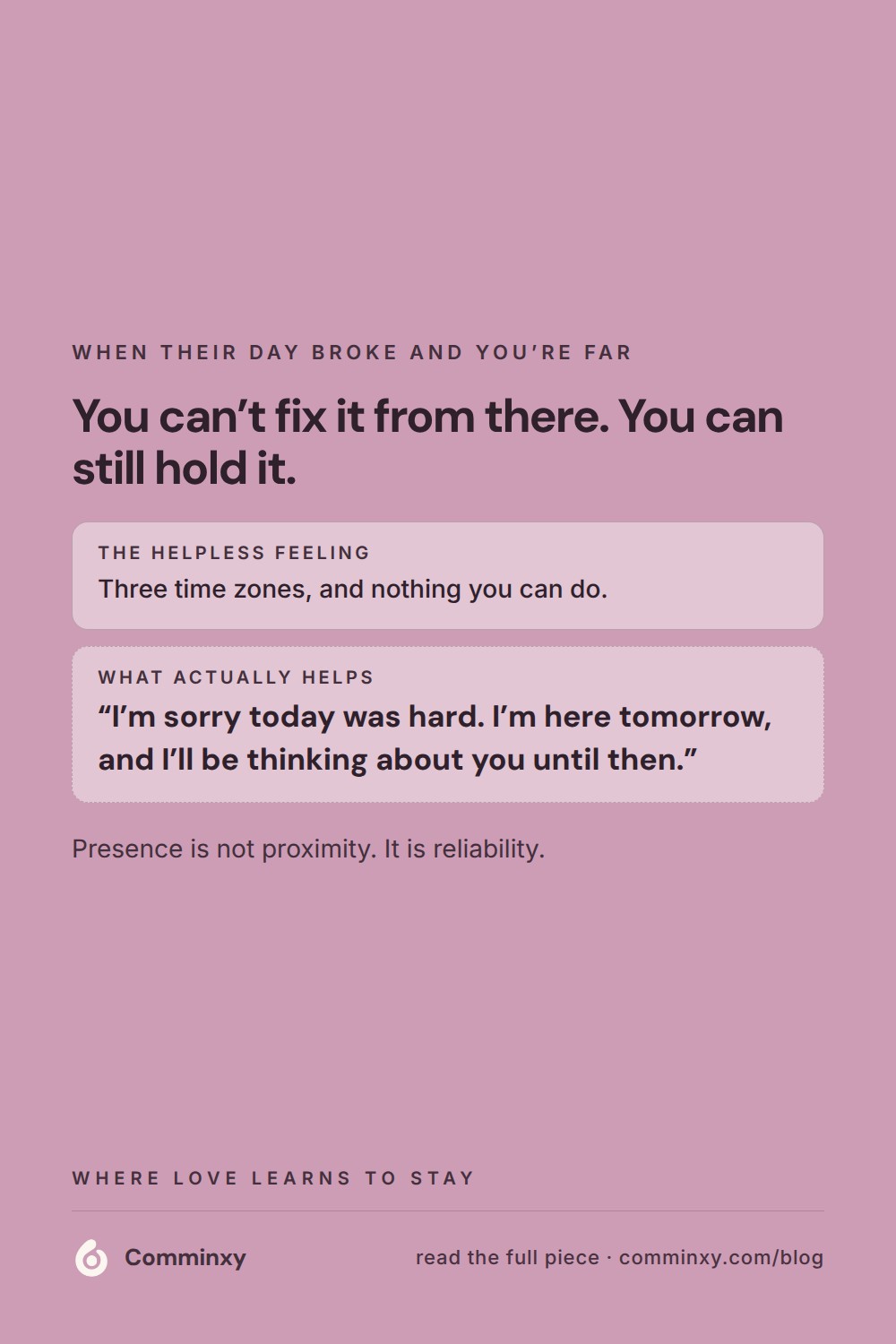
So go back to that text glowing on your screen at eleven at night. "Had a rough day. Talk tomorrow?" Maybe tonight you do not try to fix the distance. Maybe you just type, I am sorry today was hard. I am here tomorrow, and I will be thinking about you until then. Something that reaches across the gap without demanding the gap close. Tools like Comminxy exist for exactly these in-between moments, to help the two of you hear what the other actually meant when the miles make it hard. Because distance may stretch the words thin, but it was never the words that held you together. It was the reaching. And the reaching can travel anywhere.
Questions people ask
how often should long distance couples talk
There is no magic number, because frequency matters less than openness. Ten surface-level check-ins will leave you lonelier than one conversation where you actually let each other in. Focus on quality of contact, not just keeping a streak alive.
why does my long distance partner take forever to reply
Delayed replies across distance often mean someone is overwhelmed or unsure how to respond properly, not that they care less. Without tone or presence to soften a message, people hesitate because they know a text has to carry more weight than it would in person.
what to talk about in a long distance relationship when you run out of things to say
Stop only updating each other on separate days and start doing something together instead. Watch the same show, read the same book, cook the same recipe at the same time. Shared experience gives you something to build, not just report.
Keep the idea with you — pin it, or download the cards.



Comminxy helps you hear what they meant when the miles make it hard
Get Comminxy free →