You Went to Bed Angry After a Fight. Now What?
There is a piece of folk wisdom nearly everyone has absorbed, usually from someone who meant well. Never go to bed angry. It gets passed down at weddings and printed on tea towels, and by the time you are lying in the dark on your own side of the mattress, having gone to bed angry after a fight, it has curdled into something else. Proof that you have already done it wrong.
So it may help to know that the researchers who have studied conflict most closely do not say what the tea towel says.
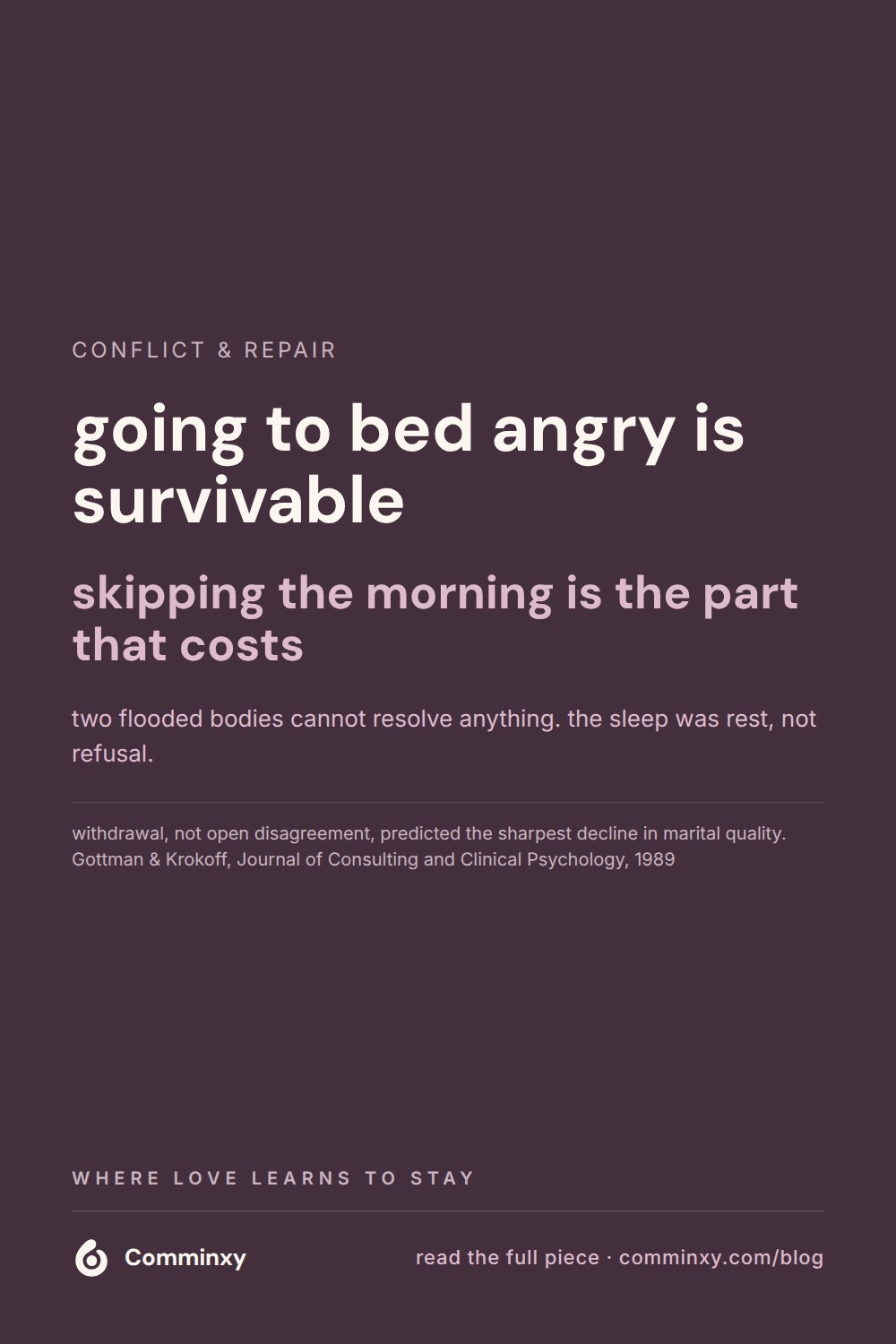
What they found is quieter and stranger. Some of the couples who fought openly, who let a disagreement stay unfinished for the night, did better over time than the ones who smoothed everything over before sleep. In one long study following couples across years, it was withdrawal, not active disagreement, that predicted the sharpest decline in marital quality. Active conflict sometimes preceded couples growing more satisfied, not less (Gottman and Krokoff, Journal of Consulting and Clinical Psychology, 1989).
Read that again slowly, because tonight it matters. The fight is not the failure. The fight might even be the thing keeping you both in the room.
Why the anger followed you into the dark
When a fight escalates, something happens in the body long before it happens in the conversation. The heart rate climbs. The chest tightens. Somewhere past a certain point, the part of you that can hear the other person as anything but a threat simply switches off.
Researchers watching couples argue could see this in the numbers, the autonomic nervous system flooding, and they could see what it did. Once a person is that physiologically overwhelmed, they stop taking in new information. They defend. They repeat themselves louder. They go cold (Gottman and Levenson, Journal of Personality and Social Psychology, 1992).
You did not go to bed angry because you are immature or because you love badly. You went to bed angry because two flooded bodies cannot resolve anything, and some part of each of you knew it. Sleep, in that light, was not avoidance. It was the only door out of a room that had no more oxygen in it.
That is worth sitting with before the sun comes up and the guilt arrives. You were not refusing to fix it. You were too flooded to.
The lie the morning tells
Overnight, the body settles. The flooding drains away. And this is where a particular kind of trouble waits, because a calm body can convince you the whole thing has passed.
It is tempting to wake, notice you both feel steadier, and quietly agree without a word that it is over. Nothing was said. Nothing needs to be. You reach for the ordinary things, the coffee, the shoes by the door, and you let the calm stand in for repair.
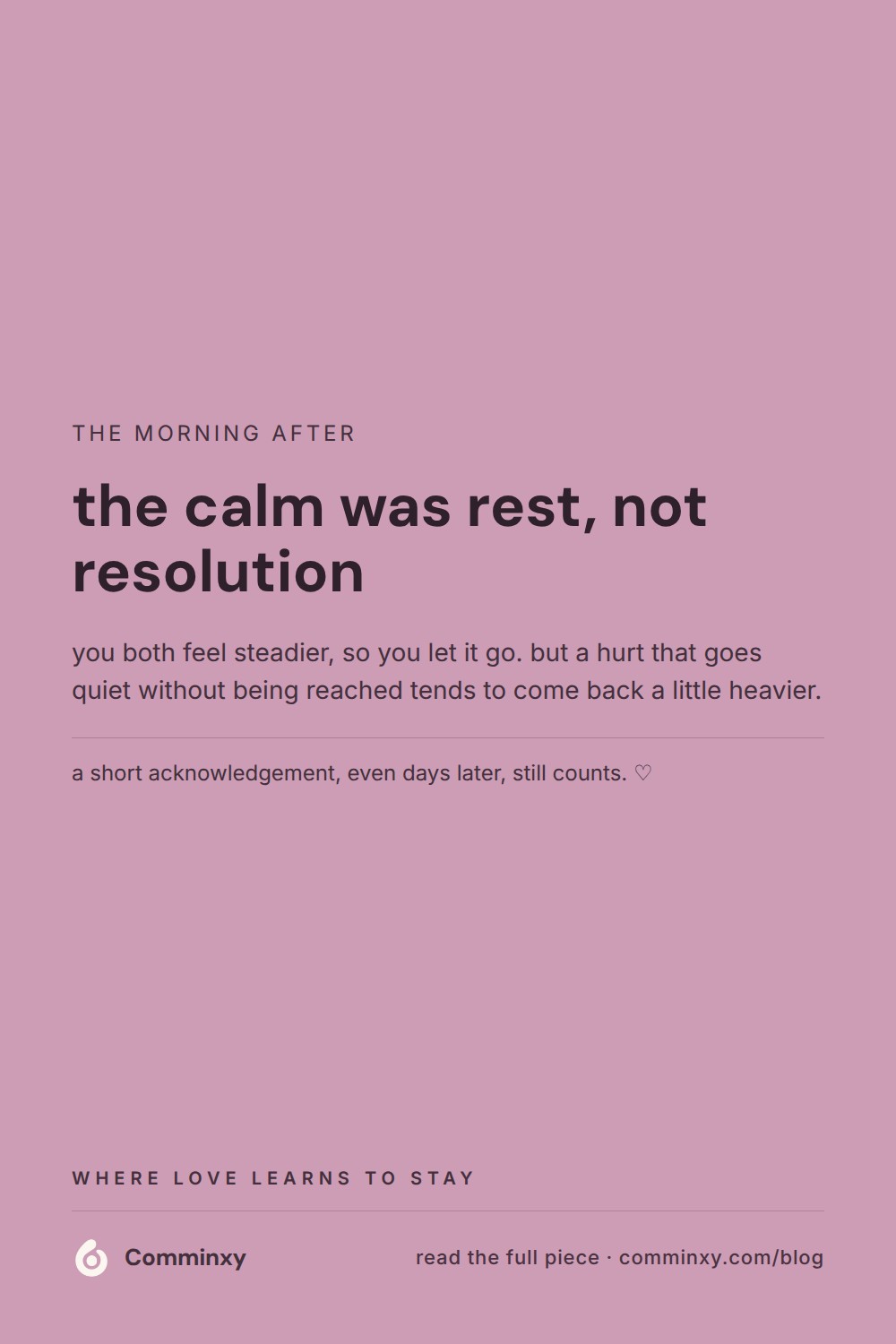
The problem is that calm and resolution are not the same. The hurt underneath did not evaporate in the night. It went quiet. And a hurt that goes quiet without being reached tends to come back the next time, a little heavier, carrying the last one on its back.
This is the slower, colder way relationships come apart, and it looks nothing like the shouting people fear. Later separations tend to grow not out of high conflict but out of emotional withdrawal, out of the steady loss of warmth between two people who stopped reaching for each other (Gottman and Levenson, Journal of Family Psychology, 2000). The couples who went to bed angry and then talked in the morning were often in less danger than the ones who went to bed angry and then simply moved on.
Going to bed angry, it turns out, is survivable. Skipping the morning is the part that costs.
What reaching back can look like when you barely want to
Nobody wakes up from a fight fluent. The words are clumsy. Part of you is still faintly annoyed and would rather be right than close. You do not have to feel warm to begin. You only have to make one small move toward, instead of one more move away.
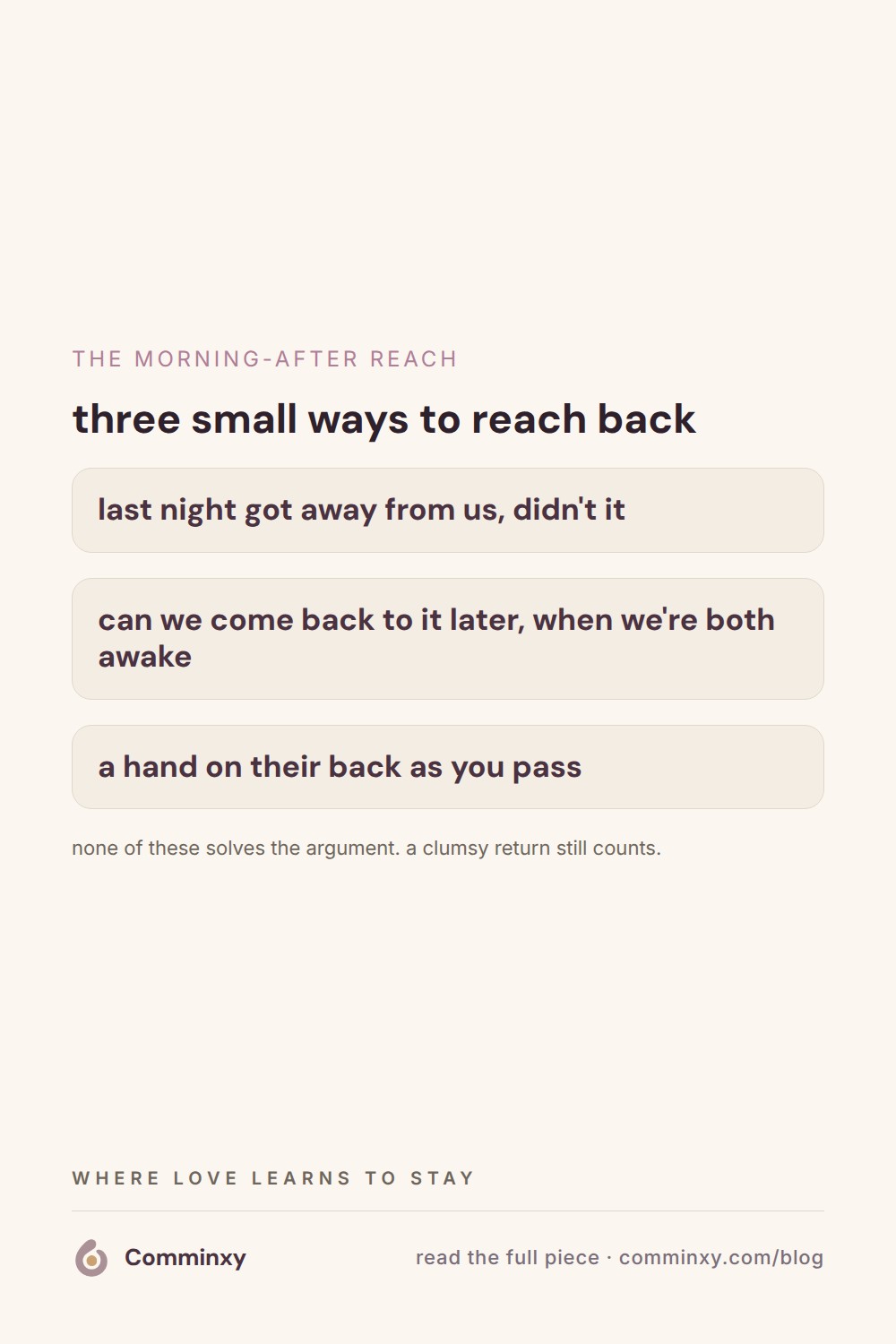
It can be almost nothing. Standing in the kitchen and saying, last night got away from us, didn't it. Not an apology, not a verdict on who was worse. Just an acknowledgement, out loud, that the two of you were in something together and it went sideways.
Or a hand on their back as you pass. Or, I hated how last night ended. Can we come back to it later, when we're both awake properly. That last one does a real thing, because it names the wound and buys time without pretending the wound is not there.
None of these solves the argument. They are not meant to. They send a smaller, more important signal underneath it: we are still on the same side. The fight was real, and so is this. If you want more on the shape of that first move, there is the way couples slowly stop talking, and how the talking starts again.
And you will do this imperfectly. You will reach back with something half-sour in your voice, or you will not manage it until Thursday. A clumsy return counts. It often counts more than a smooth one, because the other person can feel that it cost you something.
Why the story you tell yourself about the fight matters more than the fight
Here is something that changes how the whole night reads. What predicts where a couple ends up is often not the number of fights, but the story each person tells about them afterward.
In one study, couples wrote for a total of twenty-one minutes across a whole year, revisiting their worst recent conflict from the perspective of a neutral, caring outsider. Just that. And it was enough to stop the slow slide in satisfaction that most couples drift into over time. The fights kept happening. The story around them shifted, and the shift held (Finkel, Slotter, Luchies, Walton and Gross, Psychological Science, 2013).
So the question that matters this morning is not who won. It is which story you are quietly telling yourself about last night. They always do this. We can never talk about anything. Or, we were both tired, both scared of something, and it came out badly.
Both stories can be built from the exact same fight. One of them keeps a door open. The other slowly seals it shut, brick by brick, without either of you deciding to.
Where this leaves you tonight
You went to bed angry, and you woke up believing that meant something had already broken. It did not. The dark you lay in was two overwhelmed bodies doing the only thing they could, which was to stop, and rest, and try again with clearer heads.
What is still ahead of you is the small, undramatic reach. The sentence in the kitchen. The hand on the back. The choice, made quietly, to tell yourself the more generous true story of what happened rather than the harsher one. None of it has to be graceful. It only has to be toward.
Comminxy exists for exactly this stretch, the morning after, when you want to come back but the words are still tangled and the last thing you want is to reopen the wound the wrong way. Not to script you. Just to help you find the reach when the reaching is hard. Because a night of anger is not where love ends. It is one of the ordinary places where love learns to stay.
Questions people ask
is it bad to go to bed angry after a fight
No, going to bed angry is not the failure many people fear. When both people are too overwhelmed to think clearly, stopping and resting can be the healthier choice. What matters more is whether you come back to it afterward.
we didnt talk in the morning and now we act like the fight never happened is that ok
Feeling calm again is not the same as having actually resolved things. The hurt underneath often goes quiet rather than disappearing, and it tends to return heavier next time. A short acknowledgement, even days later, still counts.
how do i bring up a fight the next morning without starting it again
Start small and aim to acknowledge rather than relitigate who was right. Something as simple as saying last night got away from us, or asking to talk later when you are both properly awake, signals you are still on the same side. You do not have to feel warm to begin.
why does my partner shut down and go silent during arguments
Silence during a fight is often a sign of being physiologically overwhelmed rather than not caring. Past a certain point the body floods and a person stops taking in new information. If this pattern is constant and painful, talking with a couples therapist can help.
Keep the idea with you — pin it, or download the cards.


For the morning after, when you want to reach but the words are tangled
Get Comminxy free →