Venting vs Attacking Your Partner: The Subtle Line That Decides How Conflicts End
You didn't mean for it to come out that way. You'd had a long day, the dishes were still in the sink, and something small tipped you over. You started to speak, and somewhere between the first word and the last, a complaint about the dishes became a verdict about who your partner is. You felt it happen. You saw their face change. And a part of you thought, quietly, that isn't what I meant to say.
There is a subtle line between venting and attacking your partner, and most of us cross it without noticing. We think we're releasing pressure. Somewhere in the release, the words turn and point at the person instead of the feeling. Learning where that turn happens is one of the quietest ways to change how your conflicts end.
What venting is actually trying to do
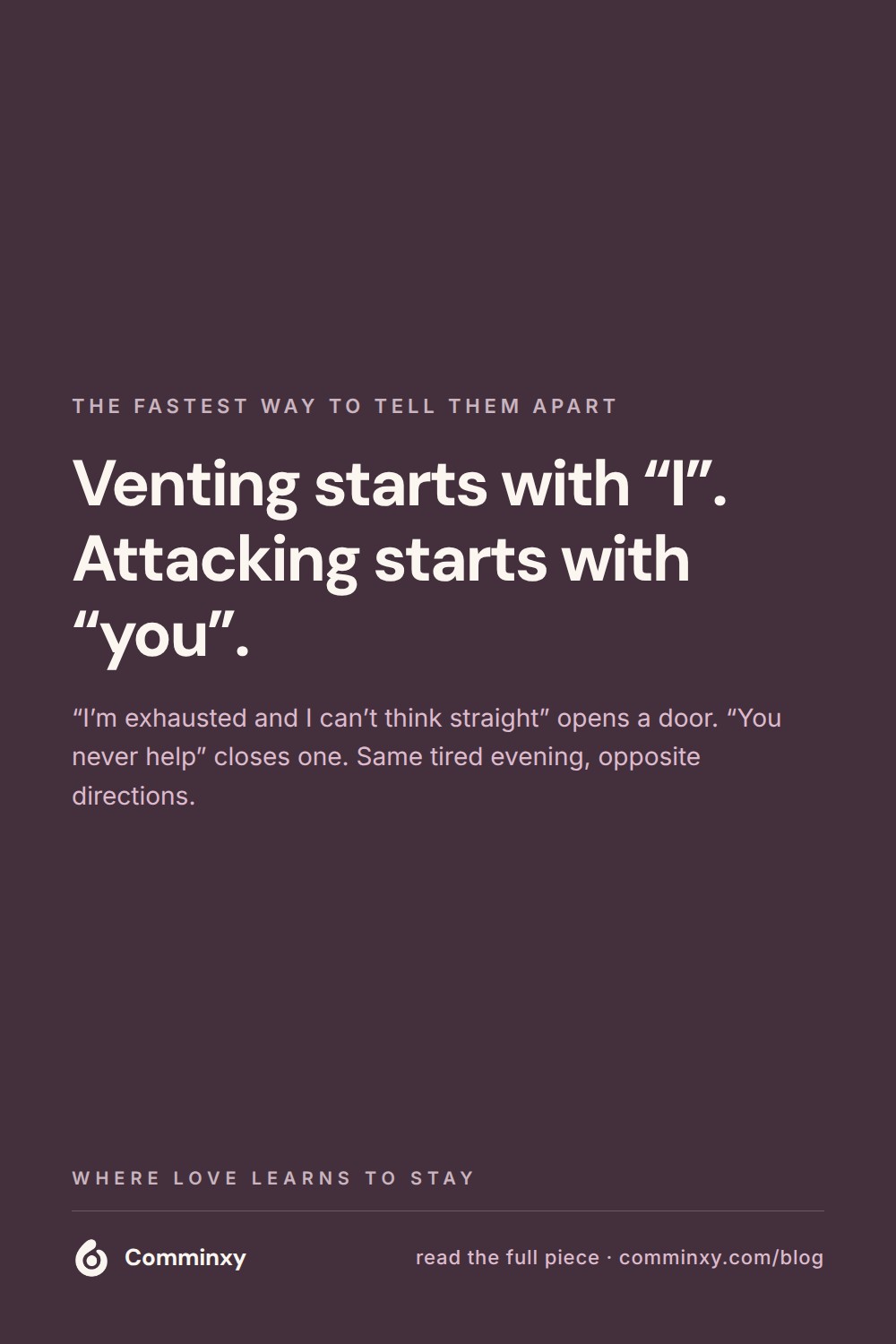
Venting is a bid for company. You have something heavy inside you and you want another person to hold one end of it. I'm so behind at work I can't think straight. I felt invisible at that dinner. I'm exhausted and I don't know why. Open hands, all of them. Here is what it's like to be me right now.
Attacking closes the hand and throws. You never help. You always do this. You're just like your mother. The difference is small and reliable: venting stays with the feeling, attacking travels to the person.
Almost nobody makes that move on purpose. You slide. The frustration is real, the words are close at hand, and the sentence that arrives fastest is usually the one built to land hardest.
Why the slide happens, and why it isn't a character flaw
When you're flooded, heart quickening, chest tight, a kind of static rising behind your eyes, your body stops working in your favour. Watching couples over years for the Journal of Personality and Social Psychology, Gottman and Levenson found that it was physiological arousal, not personality, that separated the couples who stayed steady from the ones who slowly came apart. The criticism and contempt they named as corrosive don't show up because someone is cruel. They show up because a body in alarm reaches for defence, and attack is defence wearing a different coat.
So the sentence you regret was closer to an alarm going off than to a verdict being passed. It came out of your mouth. It was never a report on what you think of the person you live with.
That's worth sitting with for a moment, because most people carry sentences like that around as evidence of something rotten in them. Usually they're evidence of a frightened body and a mouth that got there first.
If you've noticed this happens most over text, where there's no face to soften you and no tone to catch you, you're not imagining it. There's a reason the words we regret most often arrive over text, and it has everything to do with how little the medium gives the frightened part of us to hold onto.
What it sounds like when venting stays venting
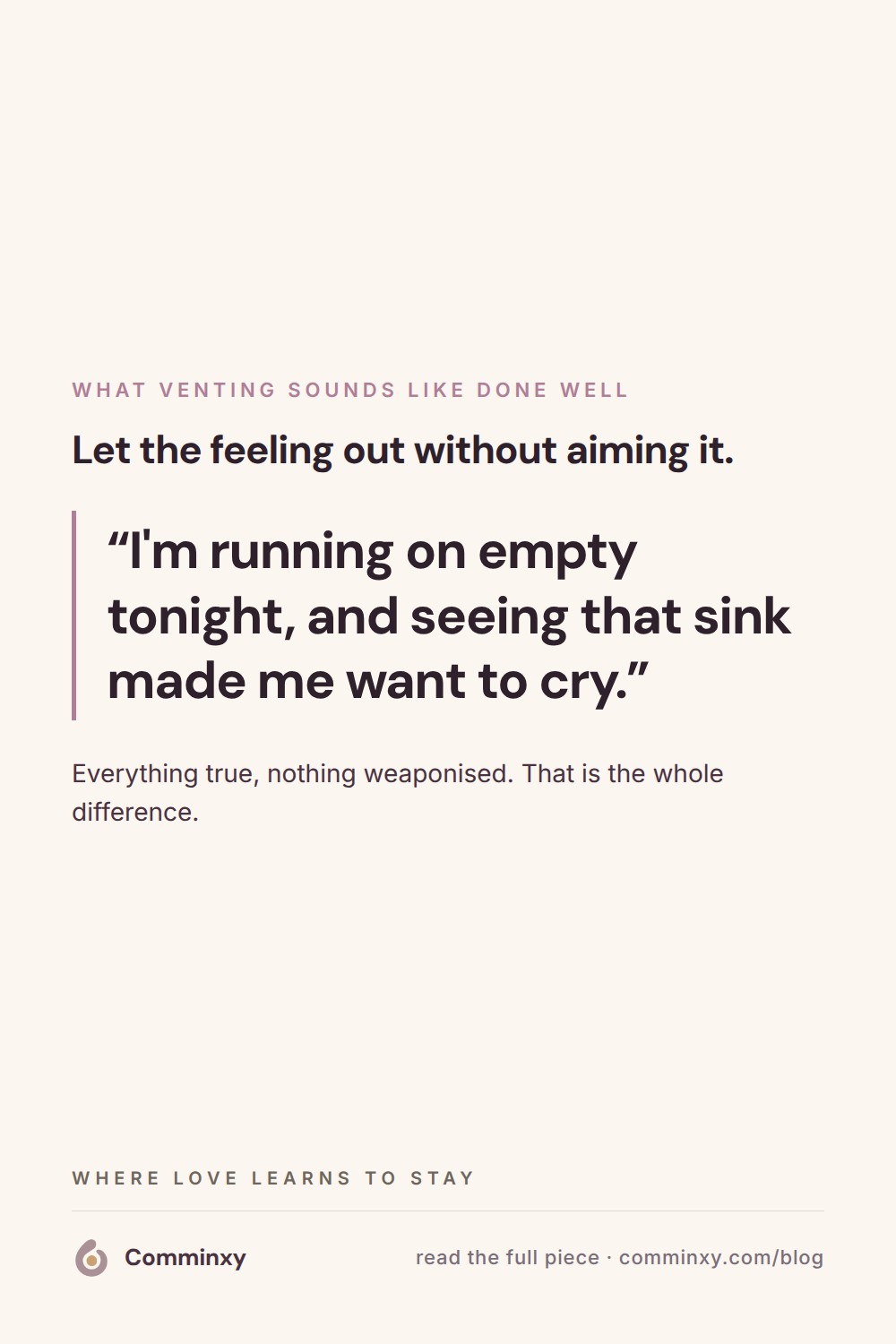
Same tired evening, same dishes. This time the sentence comes out differently. I'm running on empty tonight and seeing that sink made me want to cry. Everything difficult is still in there. Nothing has been swallowed or made polite. The sentence is simply still about you, and it hasn't crossed into who your partner is.
Staying in venting doesn't mean staying calm, which is the part people get wrong. The heat is allowed. Gottman and Krokoff, writing in the Journal of Consulting and Clinical Psychology, found that active disagreement sometimes improved a couple's satisfaction over the following years, while withdrawal, the quiet turning away, was what predicted the long deterioration. Nobody needs you to feel less. They need the loudness pointed at the problem rather than at the person.
Your partner can walk toward a feeling. Walking toward an accusation is much harder, and a lot of people simply won't do it.
What repair looks like once the line has been crossed
Sometimes you catch it too late.
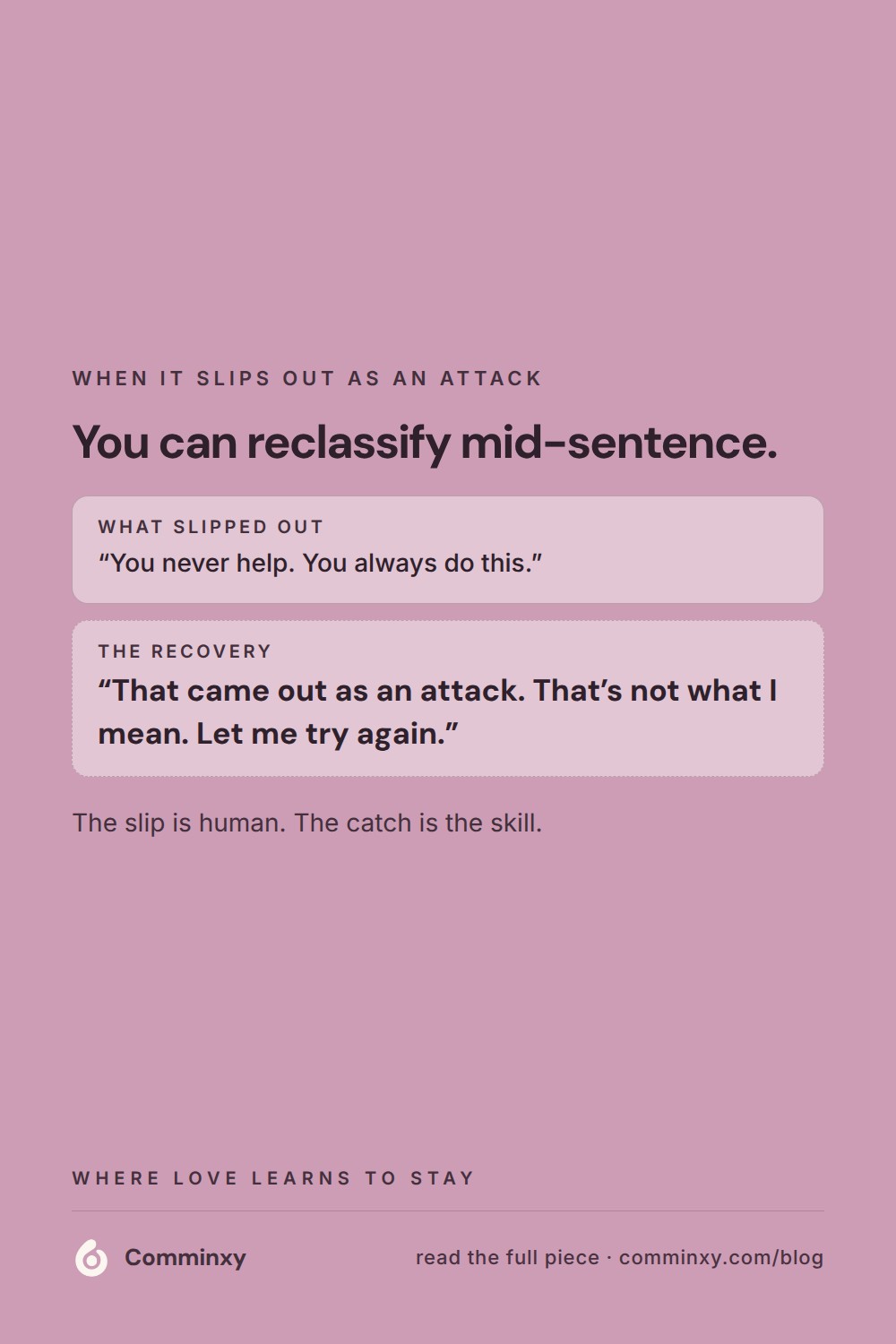
The sentence is already in the room, their face has already changed, and there's no version of this evening where it wasn't said. That is not the end of anything. It's the part where repair actually lives, and repair almost never has to be eloquent. Most of the time it sounds like a small stumble backwards. That came out as an attack. That's not what I mean. Let me try again. You don't have to defend the ugly sentence or explain where it came from. You only have to say that it missed, and reach for whatever was sitting underneath it, which was almost always something softer and more frightened than the thing that made it out.
Carstensen, Gottman and Levenson, following long-married couples for Psychology and Aging, noticed that the ones who stayed close used warmth in the middle of the conflict rather than after it. A bit of humour. A hand on a shoulder. Small things that settled their own bodies before the argument was finished. Those couples crossed lines too. They just had ways of coming back before the crossing set.
And you will do this badly. You'll read all of this, mean every word of it, and then say the wrong thing again on some Thursday when you're tired and the sink is full. That isn't a failure of understanding, it's what having a nervous system costs. Getting better at this was never about stopping the slide. It's about how fast you reach back afterwards.
The line is closer than you think, and so is the way back
If you've been lying awake replaying a sentence you wish you could take back, take this into sleep with you. Being bothered by it is the evidence that you already know the difference. People who don't care about the line don't lie awake near it. You noticed the turn, and noticing is where this starts for everyone who ever got better at it. If you want to see how these turns fit into the larger shapes a relationship can settle into, it's worth looking at the patterns that quietly wear couples down.
Go back, if you can, to that tired evening and the sink full of dishes. The version of you who slid into an attack and the version who could have stayed with the ache are the same person, standing a few seconds apart with a nervous system in between. That gap is smaller than it feels at two in the morning. Comminxy was built to sit in it with you, close enough that you might catch the turn while there's still another sentence available. Not so that you never cross the line. So that you're never on the far side of it by yourself.
Questions people ask
Is it healthy to vent to your partner?
Yes, as long as it stays about your own experience. Venting gives someone a way in. The trouble starts when a sentence stops describing how you feel and starts describing who they are.
How do I know if I am venting or attacking?
Listen for where the sentence points. Pointed at your own experience, it is venting. Pointed at your partner as a person, it has crossed over. The words never, always, and just like your are usually the moment it turns.
What should I say after I have attacked my partner?
Say that it missed and reach for what you meant instead. Something as plain as that came out wrong, let me try again does more than a careful explanation. You do not have to justify the sentence, only take it back.
Why do I do this to my partner and not to anyone else?
Because they are the person you are least braced around. Most of us hold ourselves together all day and let go where we feel safest, so the people closest to us tend to meet our most unguarded version.
Keep the idea with you — pin it, or download the cards.


Noticing the turn is easier when someone is paying attention with you.
Get Comminxy free →