How to Turn Toward Your Partner Instead of Away in the Moments That Matter
There is a moment researchers have named that most people have lived a hundred times without a word for it. Your partner comes in from the garden and says, offhand, that the tomatoes finally came up. Nothing about it demands anything. You could look up, or you could keep reading. That small, unremarkable choice, the psychologist John Gottman called a bid, and what you do with it is one of the quietest and most decisive things happening in your relationship.
To turn toward your partner is simply to meet the bid. To acknowledge the tomatoes. To answer the thing that was never really about tomatoes.
What the couples who stayed were actually doing
Gottman watched couples in a small apartment lab, ordinary people going about ordinary weekends, and he counted these tiny attempts to connect. A comment. A hand on a shoulder. A sound of interest. Then he followed those couples for years. The ones who were still together, and still warm, had turned toward each other's bids around 86 percent of the time. The ones who divorced had managed it around 33 percent (Gottman, University of Washington).
Sit with the gap between those two numbers for a second, because it is not made of grand betrayals. Nobody's marriage ended over a missed comment about tomatoes. It ended over ten thousand of them.
The finding is almost unsettling in how small it is. You keep expecting the thing that decides a relationship to be dramatic. An affair, a screaming row, a line that cannot be uncrossed. Instead the research keeps pointing at the least cinematic part of the whole day: the moment your partner says something minor and you decide, without really deciding, whether to be reachable.
Why turning away almost never feels like turning away
Here is the part that undoes the guilt a little. Turning away is rarely a slammed door. Mostly it is being tired. It is finishing the sentence you were typing before you look up. It is answering the question but not the feeling underneath it. From the inside, it feels like nothing at all, which is exactly why it accumulates unnoticed.
Nobody wakes up planning to become unreachable to the person they love. It happens through a thousand reasonable, defensible half-turns, each one justified on its own, each one landing on the other person as a small closed window.
And the bids themselves are often disguised. Your partner rarely says I need you to reach for me right now. They say the internet is slow again. They read out something from their phone. They start telling you about a colleague you have never met and never will. Underneath the trivial surface is the actual message, and it is nearly always the same one: are you there, are you still interested in me, can I still reach you.
Miss enough of those and the person stops sending them. That is often what people mean when they say they simply stopped talking to each other. If that quiet has crept into your house, it is worth reading why couples stop talking and how to fix it, because the silence usually started somewhere much smaller than either of you remembers.
The cost of turning away when the bid was brave
Some bids are cheap to send. Some cost the sender a great deal, and those are the ones that leave a mark when they go unmet.
When someone finally says the harder thing, that they felt left out at the dinner, that they are frightened about the scan next week, that they miss you even though you are in the same room, they have spent something to say it. If that reaches you and you are distracted, or you correct a detail, or you go quiet, the sting is not proportional to the size of the words. It is proportional to the courage it took to send them.
This is where the numbers stop being abstract. A dropped bid about tomatoes is forgotten by dinner. A dropped bid that took real nerve to make can quietly teach someone that the brave version of themselves is not safe with you. So they send the small, deniable version next time, or nothing at all.
The turn back is smaller than you fear
The reassuring thing about a pattern built from small moments is that it is repaired in small moments too. You do not have to fix months of half-turns in one heroic conversation. You mostly have to start catching the next few bids as they come.
And you will miss them. You will be tired on Thursday, or preoccupied, or genuinely mid-thought, and you will half-answer something that deserved your face. That is not the failure. The failure would be deciding that because you cannot do it perfectly, there is no point turning at all.
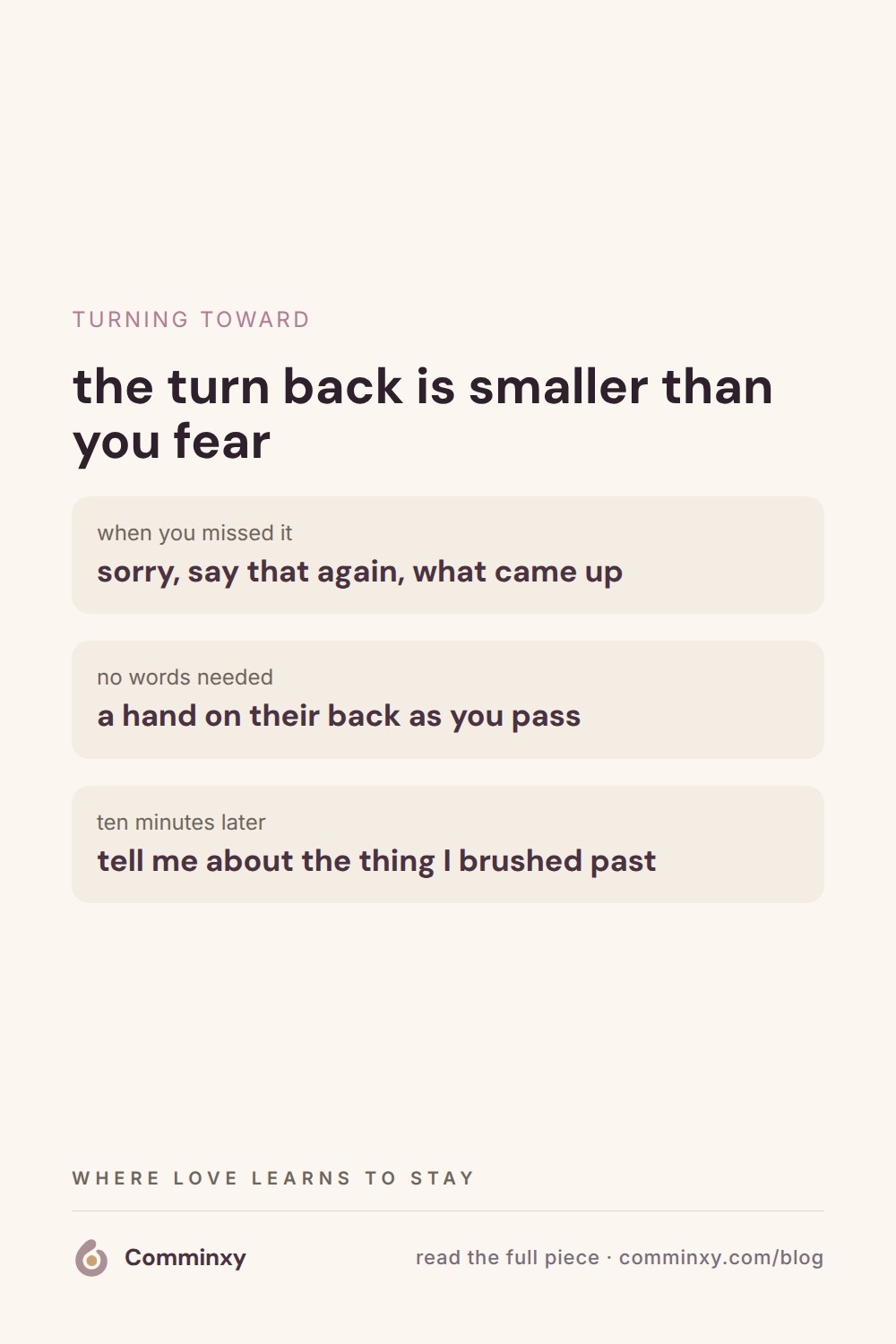
The turn back can be almost nothing. Looking up a beat later and saying, sorry, say that again, what came up. Putting a hand on their back as you pass, no words needed. Coming back ten minutes after you fluffed it and asking about the thing you brushed past. A repair does not have to be smooth. A clumsy return often lands harder than a graceful one, because the effort is visible in it.
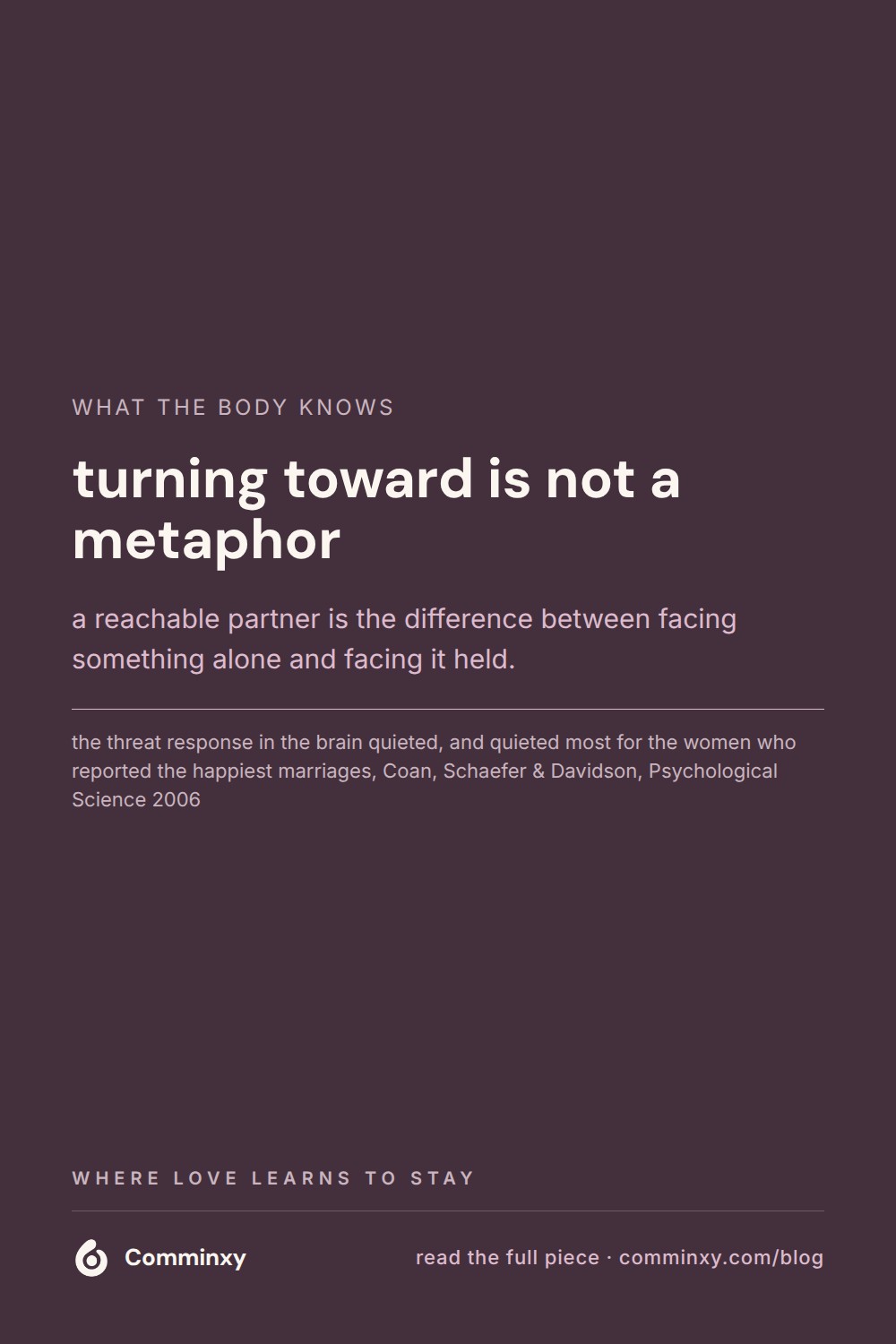
There is even research suggesting how physical this reaching is. When women anticipating a mild electric shock held their husband's hand, the parts of the brain that register threat quieted down, and they quieted most for the women in the strongest marriages (Coan, Schaefer & Davidson, Psychological Science, 2006). Turning toward someone is not a metaphor. At the level of the nervous system, a reachable partner is the difference between facing something alone and facing it held. If putting any of this into words is where it keeps breaking down, how to communicate better with your partner is a gentler place to start than most.
Back to the tomatoes
Think again about that moment at the back door. The tomatoes finally came up. It is the most ordinary sentence in the world, and it is also a hand held out, checking whether anyone is home.
You will not catch every one. You are a tired person with your own long day, and some bids will sail past you unanswered, and that is simply what being human next to another human looks like. The work was never to be perfect at this. It was to keep turning back, again and again, especially after you missed. That is the whole thing the research is quietly pointing at. Comminxy exists to help you notice the bids you are already receiving and to soften the moment of turning back toward each other, because this is where love learns to stay: not in the grand repair, but in the next small time you look up. The tomatoes came up. Go and see them.
Questions people ask
what does it mean to turn toward your partner
It means responding when your partner makes a small attempt to connect, like a comment or a touch. These attempts are called bids, and meeting them shows you are present and reachable. Turning toward is often as simple as looking up and answering.
why do couples stop talking to each other over time
It usually builds from many small missed moments rather than one big fight. When bids for connection keep going unmet, the person slowly stops sending them. The silence often started much smaller than either partner remembers.
how do I fix things after ignoring my partner
Start by catching the next few small moments instead of trying to fix everything at once. A late return works too, like going back and asking about the thing you brushed past. Visible effort often means more than a smooth response.
is my relationship over if we keep missing each other
Missing moments is normal and does not decide a relationship on its own. What matters more is whether you keep turning back after you miss. If the distance feels persistent and heavy, talking with a couples therapist can help.
Keep the idea with you — pin it, or download the cards.



Start noticing the small bids you are already receiving today
Get Comminxy free →