How to Tell Your Partner You Feel Unappreciated Without Starting a Fight
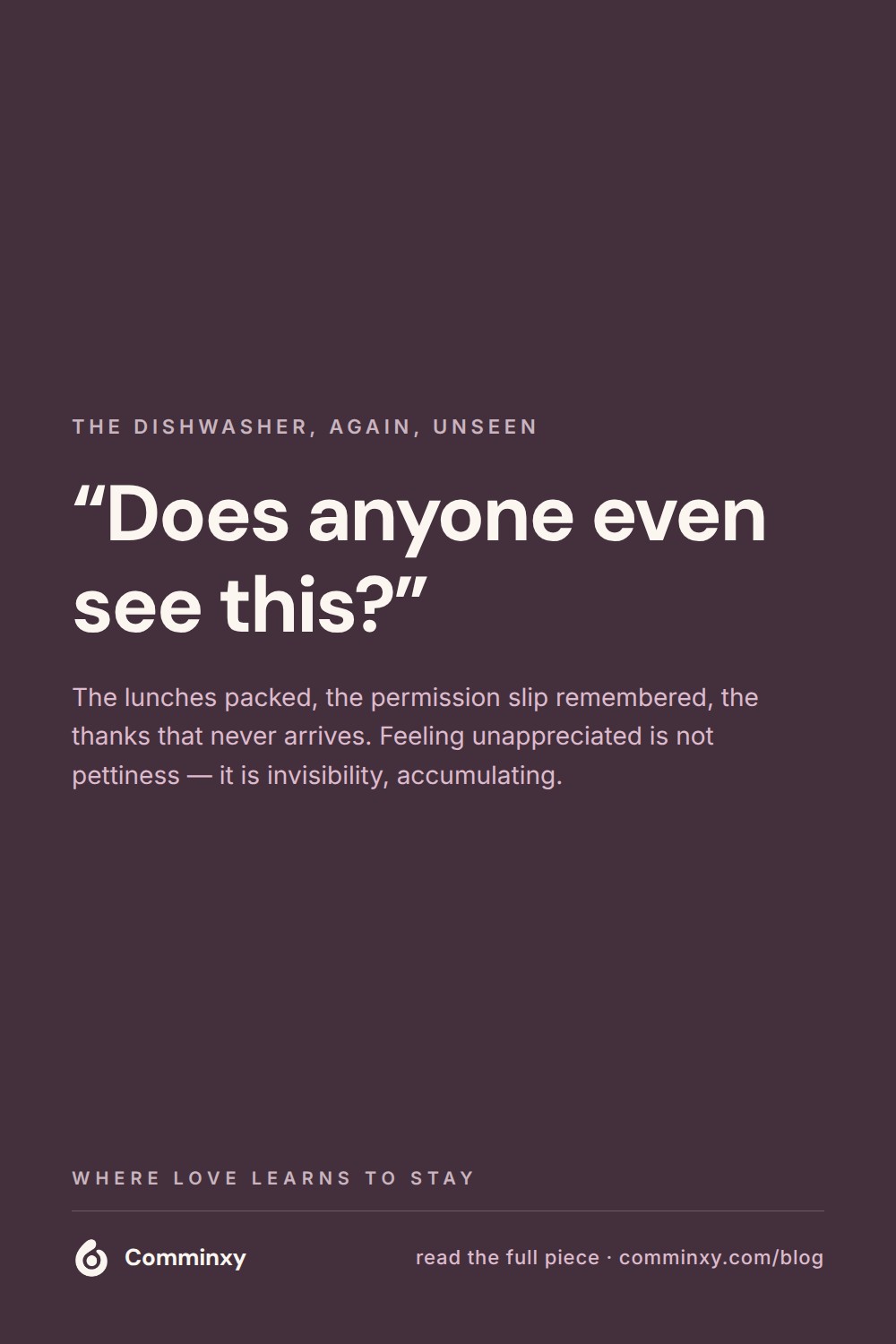
You emptied the dishwasher again this morning. Wiped the counters, packed the lunches, remembered the permission slip that would have been forgotten otherwise. And when your partner walked past all of it, humming, reaching for their coffee, something in your chest went quiet and tight. Not anger, exactly. Something older than that. A small, sinking sense of does anyone even see this?
If you have been lying awake trying to figure out how to tell your partner you feel unappreciated without it turning into another cold, careful evening, the difficulty is real. This is one of the hardest things to say out loud, and there is a reason it keeps catching in your throat.
The word "unappreciated" is hiding something softer
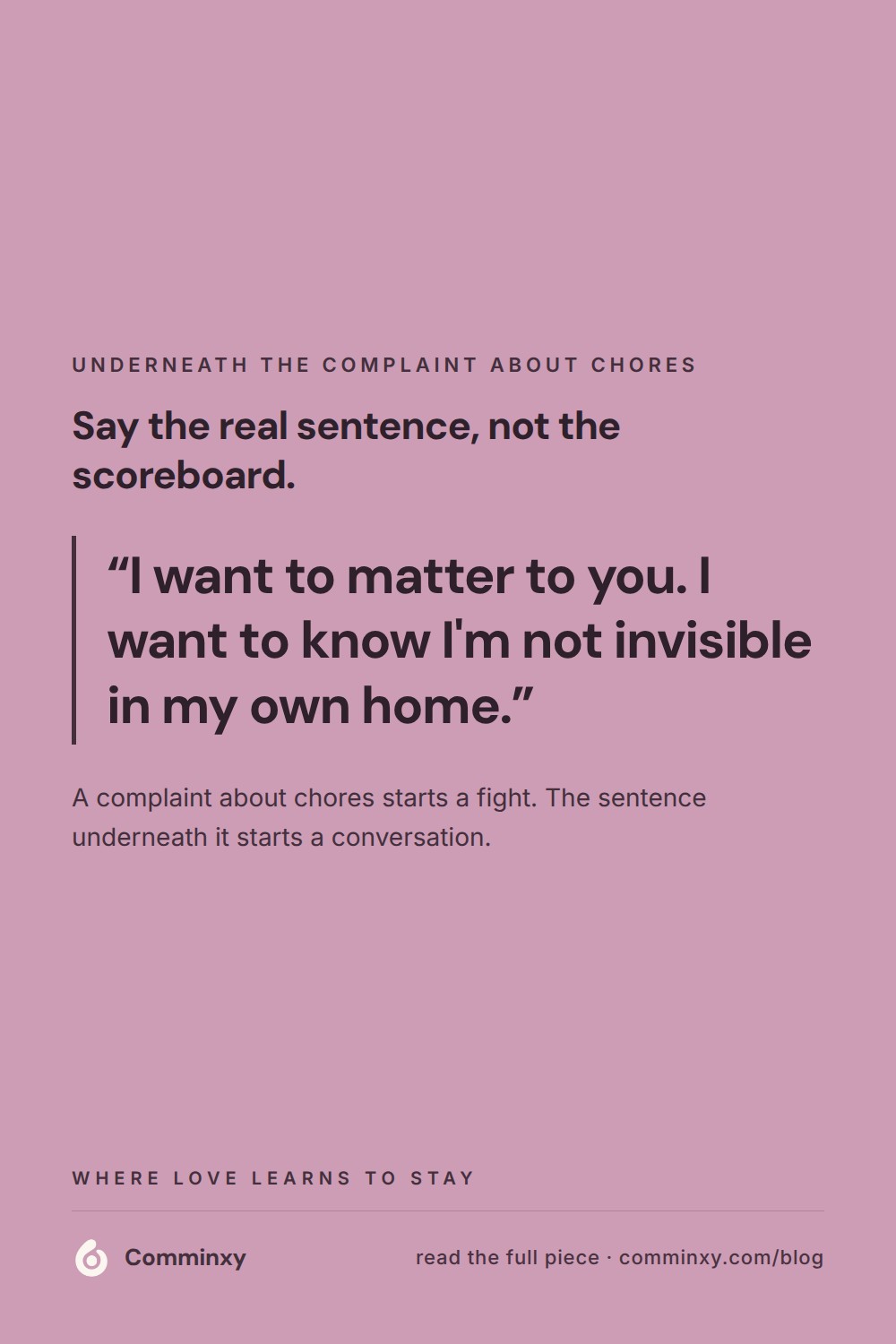
When someone says they feel unappreciated, they almost never mean they want a thank-you note taped to the fridge. Underneath "you never notice what I do" is usually something much more tender: I want to matter to you. I want to know I'm not invisible in my own home.
But that softer thing rarely makes it to the surface. By the time the sentence leaves your mouth, it is often armoured. It comes out as a tally (the dishwasher, the lunches, the slip) because the tally feels safer than the ache. A list cannot be dismissed. A list is evidence. And so we lead with the evidence and bury the feeling, and our partner hears an accusation instead of a longing.
Why it turns into a fight before you finish the sentence
Watch what happens in that first breath. You say, "I feel like I do everything around here," and before you have even reached the real point, your partner's face changes. They stiffen. They start defending, or they go somewhere far away behind their eyes.
This is not because they don't care. Carrère and Gottman, writing in Family Process, found that in the first three minutes of a difficult conversation, you can predict the outcome of the whole thing with about 96% accuracy. The entire fifteen-minute argument was, in a sense, already decided by how the first three minutes felt.
Sit with what that actually means for you. The problem often is not the appreciation, or even your partner's response. The sentence begins with a summary of their failures, and no one, hearing themselves summarised as a disappointment, can stay soft. The defensiveness is not the villain here. It is a reflex, the same one you would have if the words were pointed at you.
What your partner cannot see from where they are standing
There is a strange loneliness in invisible labour. You carry a running list in your head that your partner has no idea exists. The permission slip you remembered was, for you, the visible tip of a hundred quiet calculations. For them, it was just a slip that got signed. They were not ignoring your effort. They genuinely never saw the effort at all.
This is worth pausing on, because it is easy to read silence as indifference. When your partner walks past the wiped counters without a word, the story you tell yourself is they don't care. But the more likely story is they don't know. Those are completely different problems, and only one of them can be solved by telling them.
If this pattern of feeling slowly unseen has been building for a while, you might recognise something in why couples who love each other still grow apart. It is rarely a single dramatic thing. It is a thousand small moments of not being noticed, quietly accumulating.
What actually helps: leading with the ache, not the ledger
The way through is not to swallow the feeling. It is to say the real thing instead of the armoured thing.
Laurenceau, Barrett, and Pietromonaco, writing in the Journal of Personality and Social Psychology, found that intimacy grows through a specific loop: you disclose something real about yourself, and your partner responds to it in a way that makes you feel understood. The closeness does not come from the disclosure alone. It comes from being met. Which means a conversation about feeling unappreciated is, quietly, an opportunity for closeness, but only if you give your partner something they can actually respond to.
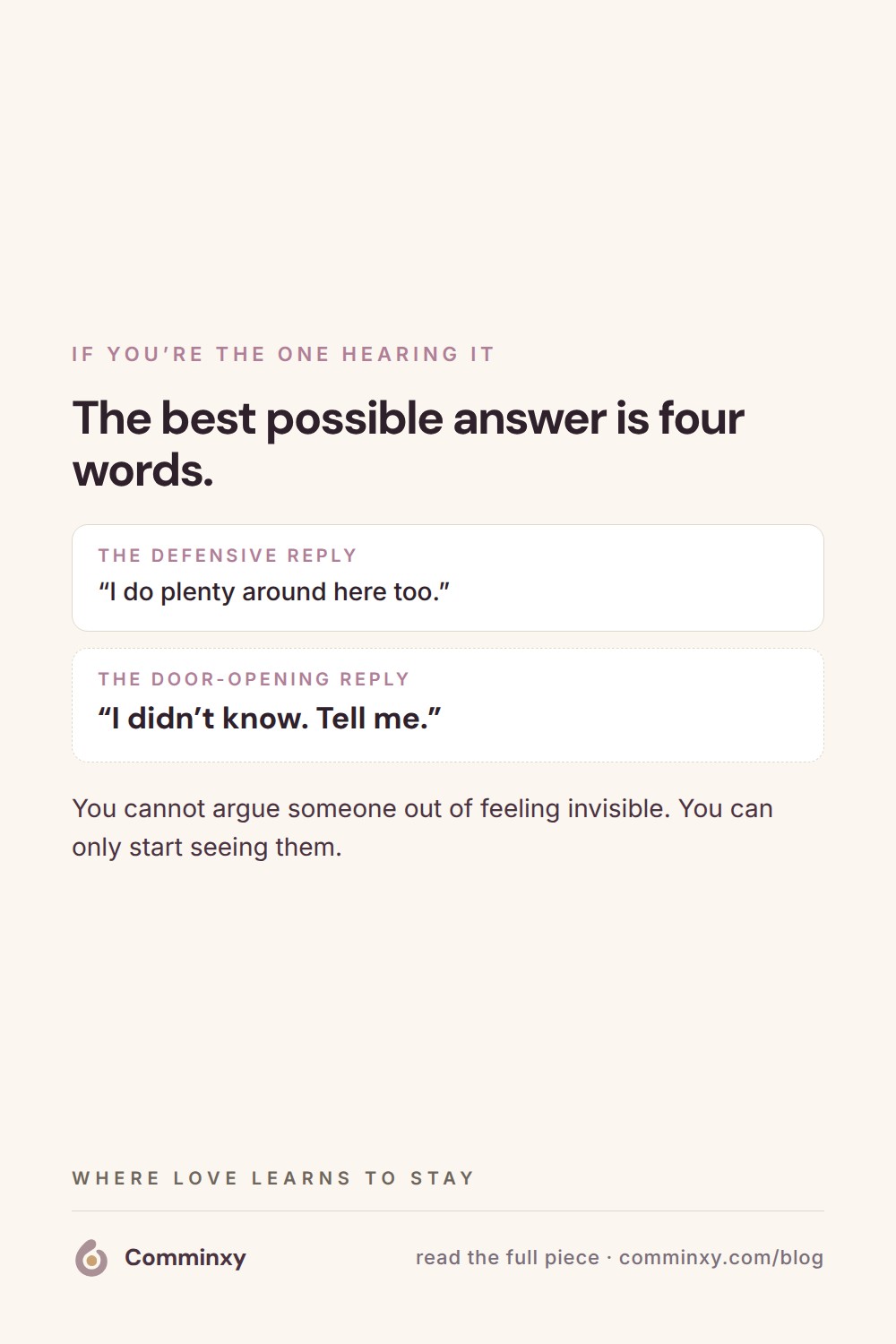
"You never help" gives them nothing to meet. It gives them something to argue with. But "I've been feeling kind of invisible lately, and I don't think you know how much I've been carrying"? That is a door. It is a self-disclosure, not a verdict. Your partner can walk through it. They can say, I didn't know. Tell me.
The difference is whether you hand them your feeling or your evidence. The feeling invites them closer. The evidence puts them on trial. If the mechanics of that softer opening feel hard to find in the moment, there is more on the shape of it in how to communicate better with your partner.
What repair looks like when it has already gone sideways
Maybe you are reading this too late. Maybe you already said the sharp version last week, and it landed badly, and now there is a coolness in the house you do not know how to thaw.
That is not the end of anything. Carstensen, Gottman, and Levenson, writing in Psychology and Aging, studied long-married couples and found that the ones who stayed steady were not the ones who never argued. They were the ones who could reach for warmth inside the hard moment, a bit of humour or affection that softened the whole thing. Repair is not a perfect apology. It is a hand on the arm. It is "I think I came at you sideways the other day, and I'm sorry. Can I try again?"
You do not have to relitigate who was right. You just have to come back and offer the softer version you did not lead with the first time. Most partners, given a genuine second doorway, will walk through it with relief. They wanted to be let in too.
The morning, revisited
So picture that kitchen again. The dishwasher emptied, the counters wiped, your partner reaching for their coffee. Only this time, instead of swallowing the tight feeling in your chest, you catch them before they drift off into the day. Not with the ledger. With the truth underneath it: Hey, I've been feeling a bit unseen lately. Can we talk about it tonight? It's not a big fight, I just miss feeling like a team.
You cannot control what they do with that. But you have given them something soft to hold instead of something sharp to fend off, and that changes almost everything about what happens next. Tools like Comminxy exist for exactly these moments, to help you find the gentler words when the sharp ones are the only ones within reach. Because the wanting-to-be-seen was never the problem. It was only ever waiting for a doorway kind enough to walk through.
Questions people ask
how do i tell my partner i feel unappreciated
Start with the feeling underneath instead of a list of tasks you did. Say something like 'I've been feeling invisible lately and I don't think you know how much I've been carrying' rather than 'you never help.' This gives your partner something to respond to instead of defend against.
why does my partner get defensive when i bring up problems
Defensiveness happens when the conversation starts as a summary of their failures, which triggers a reflex to protect themselves. Research shows the first three minutes of a hard conversation predict the entire outcome. If you lead with accusation instead of vulnerability, their body reacts before their care can.
what do i do if i already started a fight about feeling unappreciated
You can repair by coming back with the softer version you didn't lead with the first time. Try saying 'I think I came at you sideways the other day, can I try again?' Most partners will walk through that second doorway with relief.
Keep the idea with you — pin it, or download the cards.


Comminxy helps you find the softer words when only sharp ones surface
Get Comminxy free →