How to Stop Having the Same Argument, One Repair at a Time
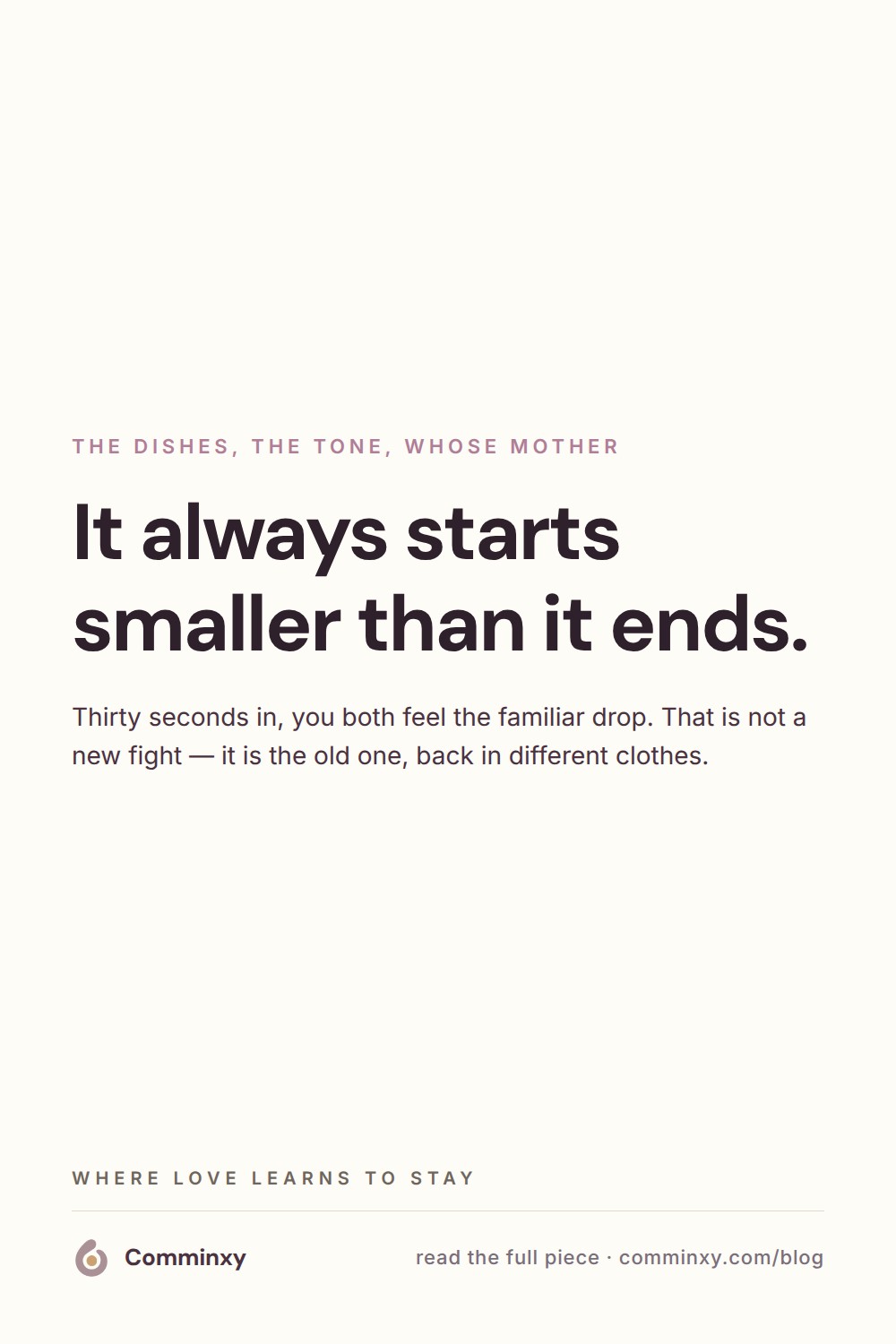
It always starts smaller than it ends. A comment about the dishes, or the tone of a text, or who was supposed to call whose mother back. Thirty seconds in, you both feel it: that familiar drop in your stomach, the way the air in the room seems to shift. You know where this is going because you've been here before. Maybe a dozen times. Maybe a hundred. And somewhere underneath the frustration, there's a quieter, lonelier thought: we are having this exact fight again.
If you've been trying to figure out how to stop having the same argument, you've probably noticed the strangest part of it. The content keeps changing, but the shape stays the same. Different topic, same choreography. Same words, almost. Same silence at the end. It can start to feel like the argument has a life of its own, like it's using the two of you to keep itself alive.
It's not the topic. It never really was.
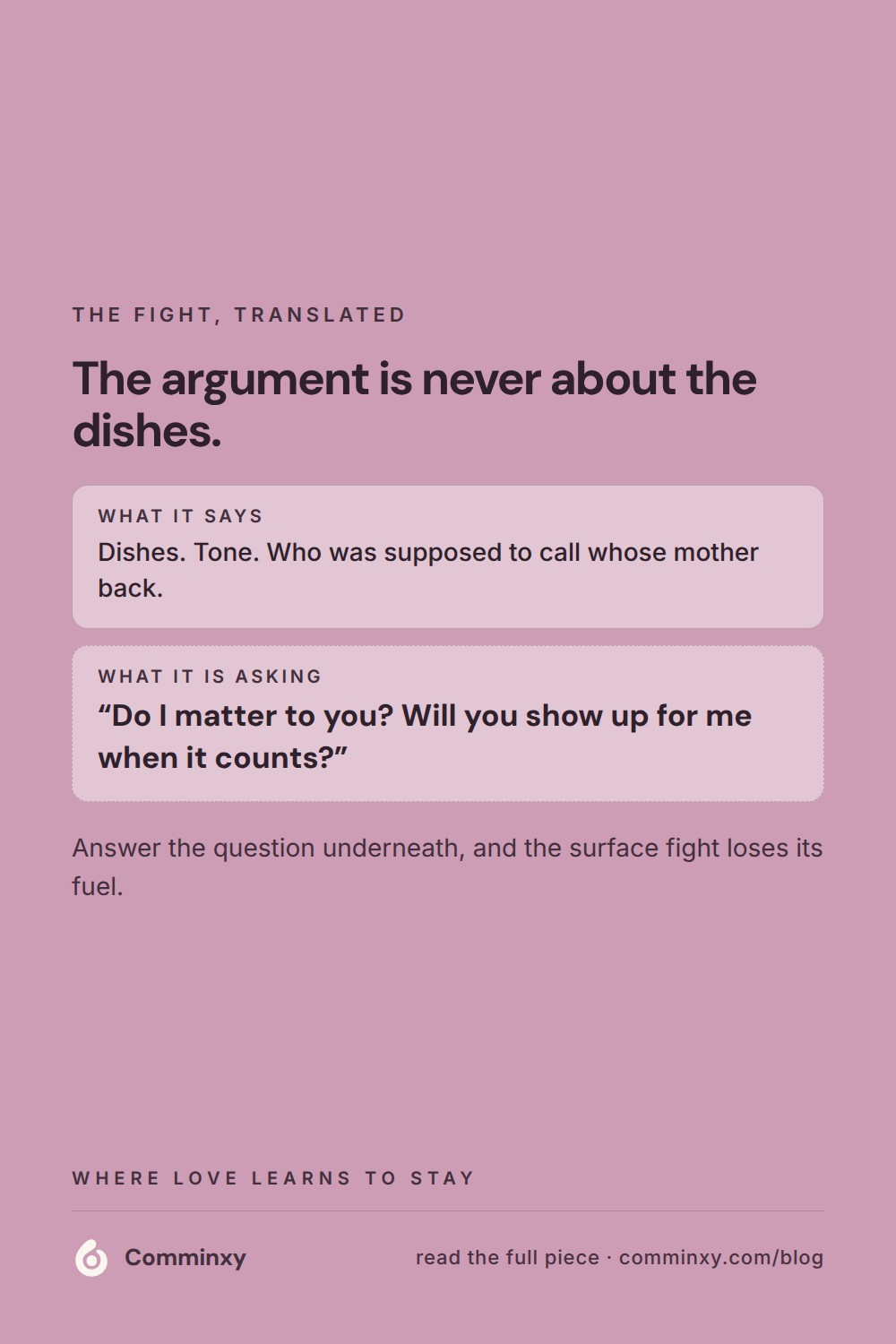
Here's something couples discover slowly, often with a kind of relief: the thing you keep fighting about is rarely the thing you're fighting about. The dishes are not really the dishes. The late text is not really the late text. Underneath the surface argument there's usually an older, tenderer question. Do I matter to you? Am I alone in this? Will you show up for me when it counts?
That's why solving the surface problem never seems to work. You agree on a new chore system, and a month later you're standing in the same kitchen having the same argument in a different costume. The chore was never the point. The question underneath it never got answered, so it comes back wearing whatever it can find.
Your body arrives before your words do
Watch closely next time and you'll notice the fight is often decided before either of you has said anything meaningful. There's a heat that rises in the first few seconds. A tightening, a bracing, a small internal here we go. Once that's happening, the conversation you thought you were about to have is quietly replaced by an older one.
This isn't a feeling. It's measurable. Carrère and Gottman, writing in Family Process, found that they could predict the outcome of a fifteen-minute conflict conversation from its first three minutes with ninety-six percent accuracy. Ninety-six percent. Which means the recurring argument isn't really about who's more stubborn or who won't let it go. It's about how the two of you start, the opening notes you've both learned to play without thinking. The good news buried in that finding is that beginnings are far easier to change than middles. You don't have to argue better for an hour. You have to soften the first ninety seconds.
The loop is made of two people protecting themselves
What keeps the same argument spinning is that both of you are usually reacting to the reaction, not to the original moment. One person feels criticised and pulls back to protect themselves. The other feels the pulling-back as abandonment and pushes harder to get through. Now you're each responding to the thing the other did in self-defence, and neither of you is anywhere near the real hurt anymore.
These are patterns, not character flaws. There's no villain in this room, only two people who learned somewhere along the way how to guard the softest parts of themselves. If you want to see the shapes these loops tend to take, it's worth reading about the four communication patterns that quietly wear a relationship down. Not to grade yourselves, but to recognise the choreography so it stops feeling personal and starts feeling changeable.
What actually breaks the loop
The way out is smaller and stranger than most people expect. It isn't a better argument or the perfect calm sentence. It's the moment one of you steps outside the fight long enough to see it from a little distance, to notice the loop as a loop instead of a battle to be won.
There's a remarkable study on exactly this. Finkel and his colleagues, writing in Psychological Science, asked couples to spend a few minutes writing about their most recent conflict from the perspective of a neutral outsider who wants the best for both of them. Just twenty-one minutes of that kind of writing, spread across a year, completely halted the decline in marital satisfaction that the other couples experienced. Twenty-one minutes. Not because it solved anything, but because it let people step out of their own defensiveness for long enough to see their partner as someone also struggling, rather than as the obstacle.
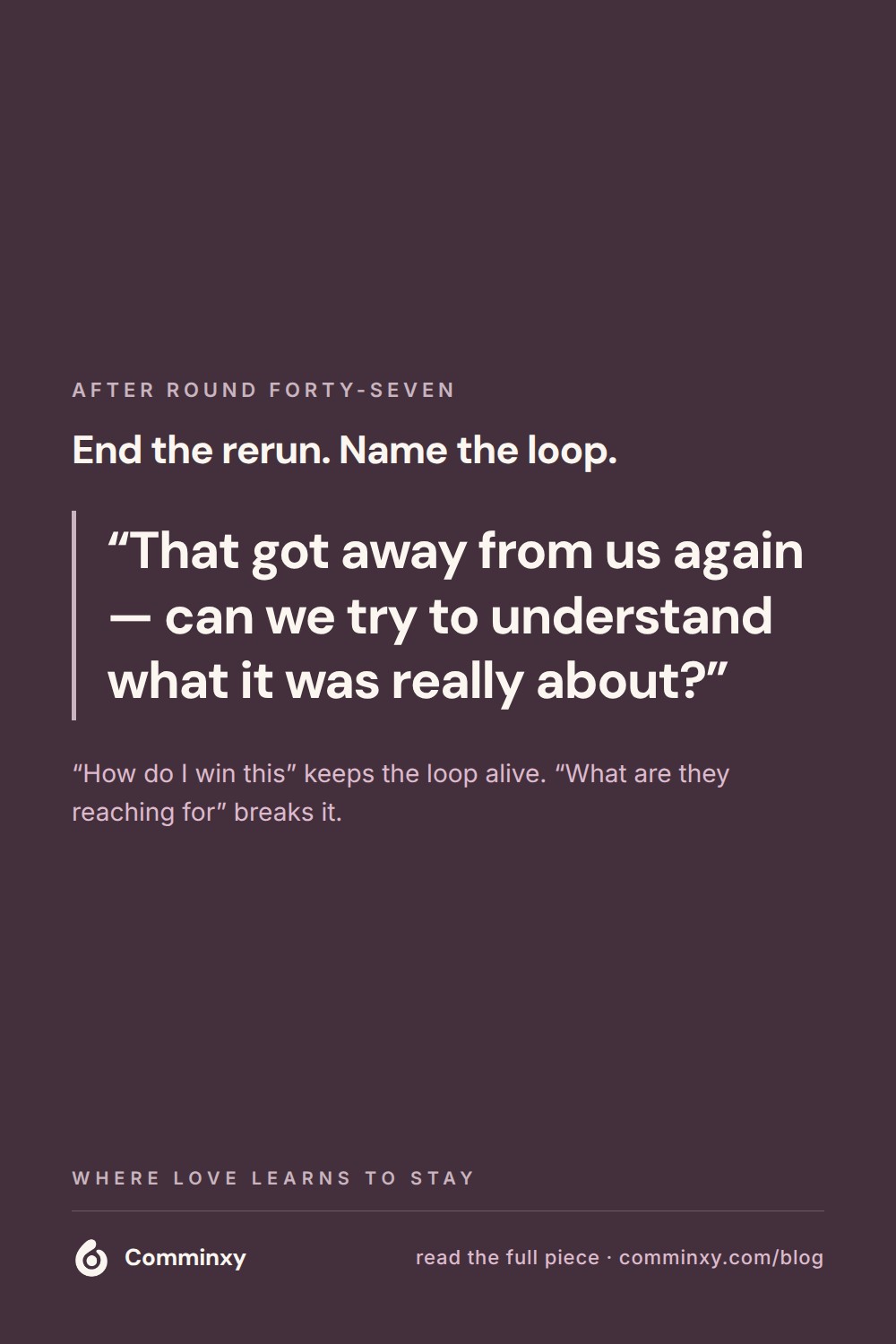
You can borrow that shift in the middle of a real moment. When the heat rises, instead of asking how do I win this, you can ask what is the person I love actually reaching for right now. Usually it's the same thing you're reaching for. That's often where the recurring fight finally loosens, the second one of you names the real question underneath instead of relitigating the surface one.
Repair is the part that changes everything
The couples who stop repeating the same argument are almost never the ones who stopped having it. They're the ones who got better at coming back afterward. At turning toward each other once the heat has passed and saying, gently, that got away from us again can we try to understand what it was really about?
Every time you do that, you're not just resolving one fight. You're slowly answering the deeper question underneath it. You're teaching the tender part of your partner that the answer is yes, you matter, and yes, I'll come back. A question that keeps getting answered eventually stops needing to be asked. This is what emotional safety is actually made of. Not the absence of conflict, but the reliability of return.
So the next time you feel that drop in your stomach in the kitchen, the air shifting, the familiar choreography beginning, you don't have to dread it as proof that nothing changes. It might just be the same old question, knocking again, hoping this time you'll hear what it's really asking. Comminxy exists to help you catch those first ninety seconds and find your way back to each other a little sooner, so the loop has somewhere softer to land. That's how the same argument slowly stops being the same. One repair at a time, love learns to stay.
Questions people ask
why do we keep having the same fight over and over
You keep having the same fight because the surface topic is standing in for a deeper unresolved question, usually about mattering or being alone in the relationship. Solving the surface issue does not answer that question, so it returns in a new form. The content changes but the emotional pattern stays the same.
how to stop repeating the same argument with partner
Soften the first 90 seconds before the loop takes over, and practice repair afterward by naming what the fight was really about. Ask what your partner is actually reaching for instead of trying to win. Over time, answering the deeper question makes it stop needing to ask.
what makes couples have the same argument
Both people are reacting to each other's defensive reactions rather than the original hurt, creating a loop where no one is addressing the real need. One person pulls back to protect themselves, the other pushes harder, and the cycle continues. These are learned patterns of self-protection, not character flaws.
Keep the idea with you — pin it, or download the cards.


Comminxy helps you catch the loop early and find your way back sooner
Get Comminxy free →