How to Stay Connected On Screens as a Couple Without Feeling Like Roommates
You sent a message while lying next to someone who could have heard you speak. Not a work thing. Not urgent. Just something that felt easier to type to a friend three postcodes away than to say aloud to the person whose knee was touching yours under the blanket. And the strangest part was not the message itself. It was that neither of you mentioned it. The tapping, the small laugh at the reply, the fact that you were both awake and alone at the same time.
If you want to stay connected on screens as a couple without slowly becoming two people who share an address, the first thing worth knowing is that what you're feeling isn't distance in the way we usually mean it. You are both very much here. You are just here for someone or something else.
The evening that dissolved without anyone deciding it should
Nobody chose this. There was no fight, no cold shoulder, no moment where one of you turned away on purpose. You made dinner. You cleaned up. You sat down together, actually together, side by side. And then, gently, without ceremony, each of you reached for a small glowing rectangle and disappeared into it.
An hour passed. Maybe two. You were in the same room the whole time. And when you finally put the phones down, there was a strange flatness, like you'd spent the evening in adjacent rooms of the same house, each of you assuming the other was fine.
This is what modern closeness often looks like. Not a slammed door. A screen held six inches from a face, in a bed built for two.
Why the scroll is so hard to put down (and why it isn't a character flaw)
It would be easy to make one of you the problem here. The one who checks first. The one who checks longest. But that framing misses something important, because the pull toward the screen isn't about not loving each other. It's about relief.
A phone offers something a long day rarely does: novelty with no effort, stimulation with no risk. And there's research that makes this ache legible. Tsapelas, Aron, and Orbuch, writing in Psychological Science, followed couples over nine years and found that relational boredom at year seven predicted lower closeness and satisfaction long afterward. What stood out most about their finding wasn't the boredom itself. It was how quietly it arrives. Not as unhappiness. As a slow thinning of the new.
The screen, in that light, isn't the cause of the distance. It's the most available place to go looking for the aliveness you're missing, without having to ask each other for it.
That's a tender thing to sit with. The scrolling isn't you turning away from your partner. It's you reaching for something, in the one direction that asks nothing of you.
The connection that lives in the small returns
What carries couples through decades is smaller than any grand gesture. It lives in the moment your partner laughs at their screen and you say, what? Not out of suspicion. Out of wanting in. That tiny turn toward each other, offered dozens of times a day, is the whole thing.
Stafford and Canary, in the Journal of Marriage and the Family, studied the ordinary behaviors that keep relationships alive and found that a handful of them (warmth, openness, sharing the small stuff) accounted for a striking amount of how satisfied couples actually felt. Not the anniversaries. Not the trips. The daily, unglamorous acts of letting each other into the little rooms of your day.
Which means the screen doesn't have to be the enemy. The problem was never the device in your hand. It was the silence around it. When you read something and turn to show your partner (look at this) the screen becomes a doorway instead of a wall. Connection stops being something you have to schedule and becomes something you fold into the very thing that was pulling you apart. If you want to go deeper on the mechanics of that, we've written more about how to communicate better with your partner in the ordinary hours, not just the hard ones.
What it looks like to find your way back
The way back doesn't begin with a dramatic ban on phones. It begins with a single honest sentence, said without accusation: I miss you, and we were in the same bed. That sentence is hard because it makes you visible. It admits you wanted more and didn't know how to ask.
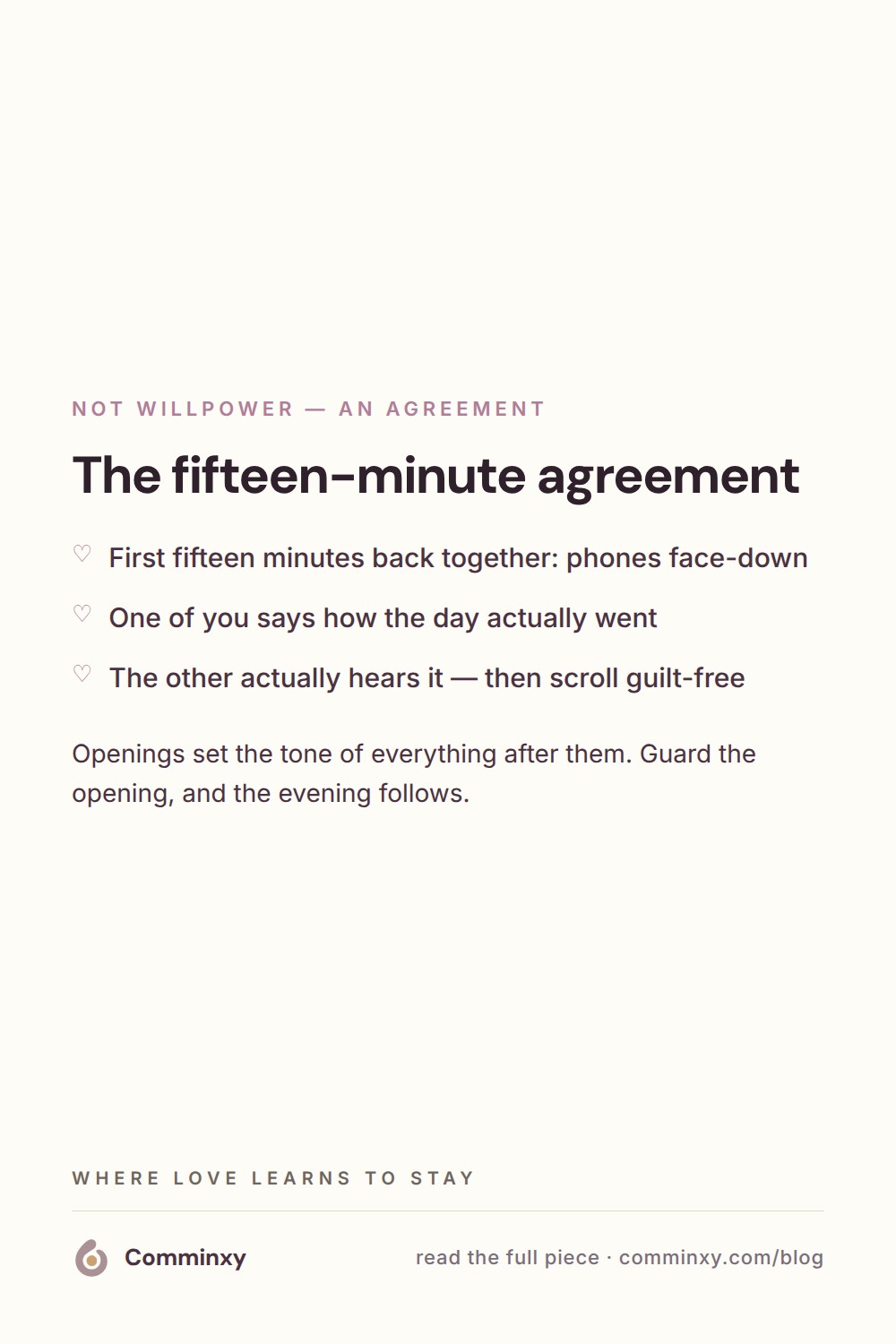
What works isn't willpower. It's a small agreement: the first fifteen minutes when you're back together, the phones face down. Not forever. Just long enough for one of you to say how the day actually went, and for the other to hear it. Because there's a reason the opening matters. Carrère and Gottman, in Family Process, found that they could predict the outcome of a couple's conversation from its first three minutes with 96% accuracy. The beginning sets the temperature of the whole thing.
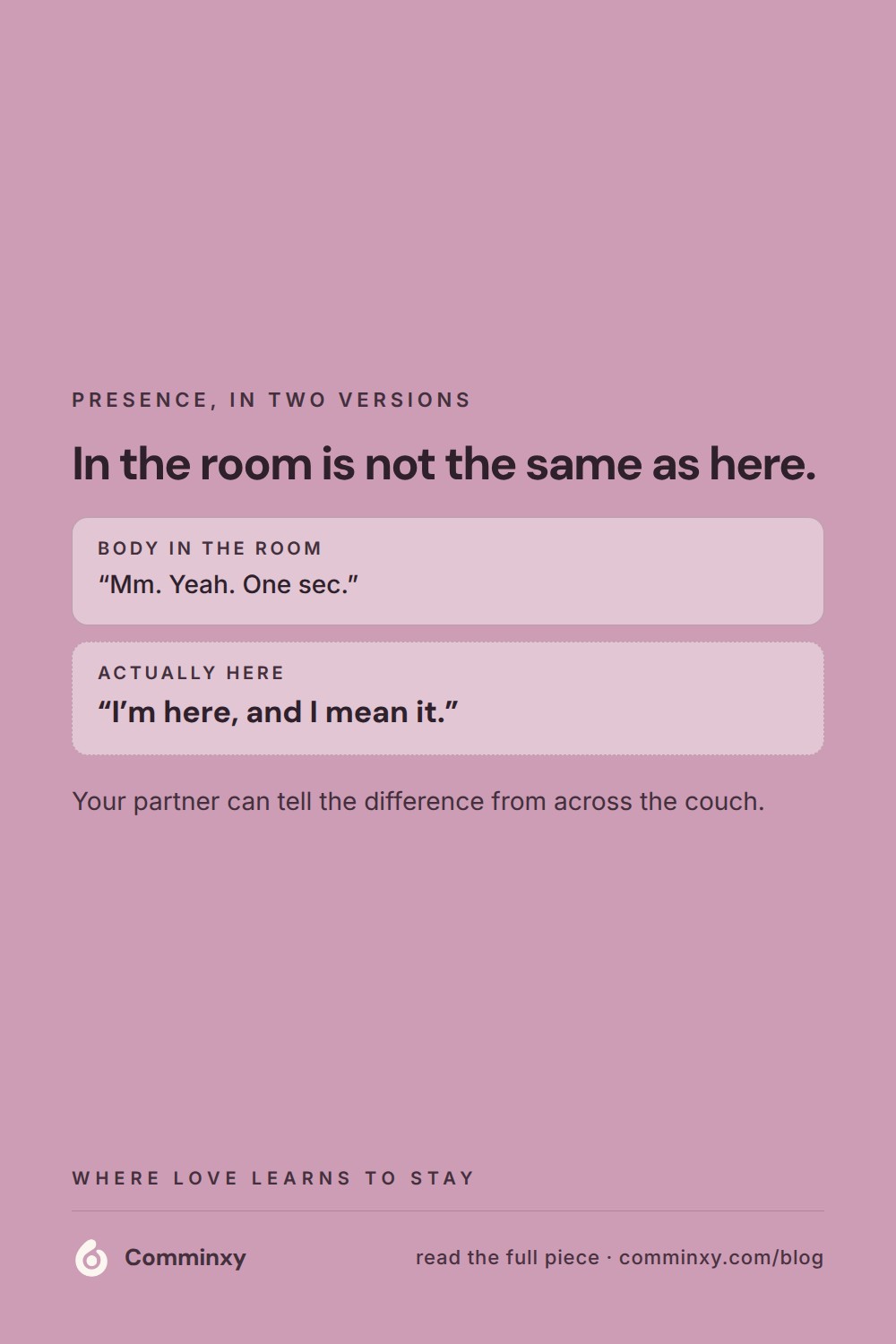
The same is quietly true of an evening. The first few minutes you're back in the same space decide whether the night becomes shared or parallel. Protect that opening, and you don't have to fight the screens for the rest of the night. You've already told each other: I'm here, and I mean it. This is part of what real closeness is made of, the sense that you can reach for each other and someone will reach back. We've written about that feeling more fully in what emotional safety in a relationship actually looks like.
The foot of space between you was never the distance
So come back to that bed. The two of you, the blue light, the foot of space that felt like a mile. That space was never the problem. Distance in a relationship is almost never about how far apart you're sitting. It's about how long it's been since one of you turned toward the other and said what are you looking at and actually wanted the answer.
You can turn tonight. It costs almost nothing. And the strange grace of it is that the same little device that pulled you into separate worlds can become the thing you laugh at together, if one of you simply asks to be let in. Tools like Comminxy exist for exactly these small returns, a companion for the moments you want to reach toward each other and aren't sure how. Because love doesn't stay through grand rescue. It stays through the ten thousand tiny times you looked up from the screen, and found each other still there.
Questions people ask
why do I feel lonely next to my partner when we're both on our phones
You're both physically present but emotionally elsewhere, seeking novelty and relief that requires no effort or risk. The loneliness comes from being awake and alone at the same time, even though you're right next to each other. It is not about loving each other less, it is about the silence around the scrolling.
how do couples stay connected when they both use screens a lot
They turn toward each other during screen time by sharing what they see and asking to be let in, making the device a doorway instead of a wall. Protecting the first fifteen minutes together without phones also sets a tone of connection for the rest of the evening. The key is breaking the silence around the scrolling, not eliminating screens entirely.
is it normal to be on your phone instead of talking to your partner
It is very common and usually not a sign of a failing relationship, but a symptom of seeking relief and novelty without effort. The issue is not the device but the silence that builds when you stop turning toward each other. What matters is whether you eventually look up and invite your partner back in.
how to reconnect with your partner after being on screens all night
Start with an honest sentence like 'I miss you and we were in the same bed,' without accusation or blame. Agree to put phones face down for just the first fifteen minutes together so you can actually hear how each other's day went. The reconnection does not require willpower or bans, just a small return to each other.
Keep the idea with you — pin it, or download the cards.



Start reaching toward each other in the small moments, before the distance feels permanent
Get Comminxy free →