The Science of Staying in Love: What Keeps Couples Together for Decades
There is a number that surprises almost everyone who hears it. Among people married more than ten years, forty percent still report being "very intensely in love" (O'Leary, Acevedo, Aron et al., Review of General Psychology, 2012). Not fond. Not comfortable. Intensely in love, a decade or more in, past the part where the story is supposed to fade into companionship and shared tax returns.
That finding is where the science of staying in love actually begins, because it quietly dismantles the thing most people assume. The assumption is that long love is a slow cooling, and the couples who last are the ones who made peace with less. What the research keeps showing instead is that intensity does not have to leave. It changes shape. And the couples who keep it are not luckier or more compatible. They are doing something, most of it small enough to miss.
The love that lasts is maintained, not preserved
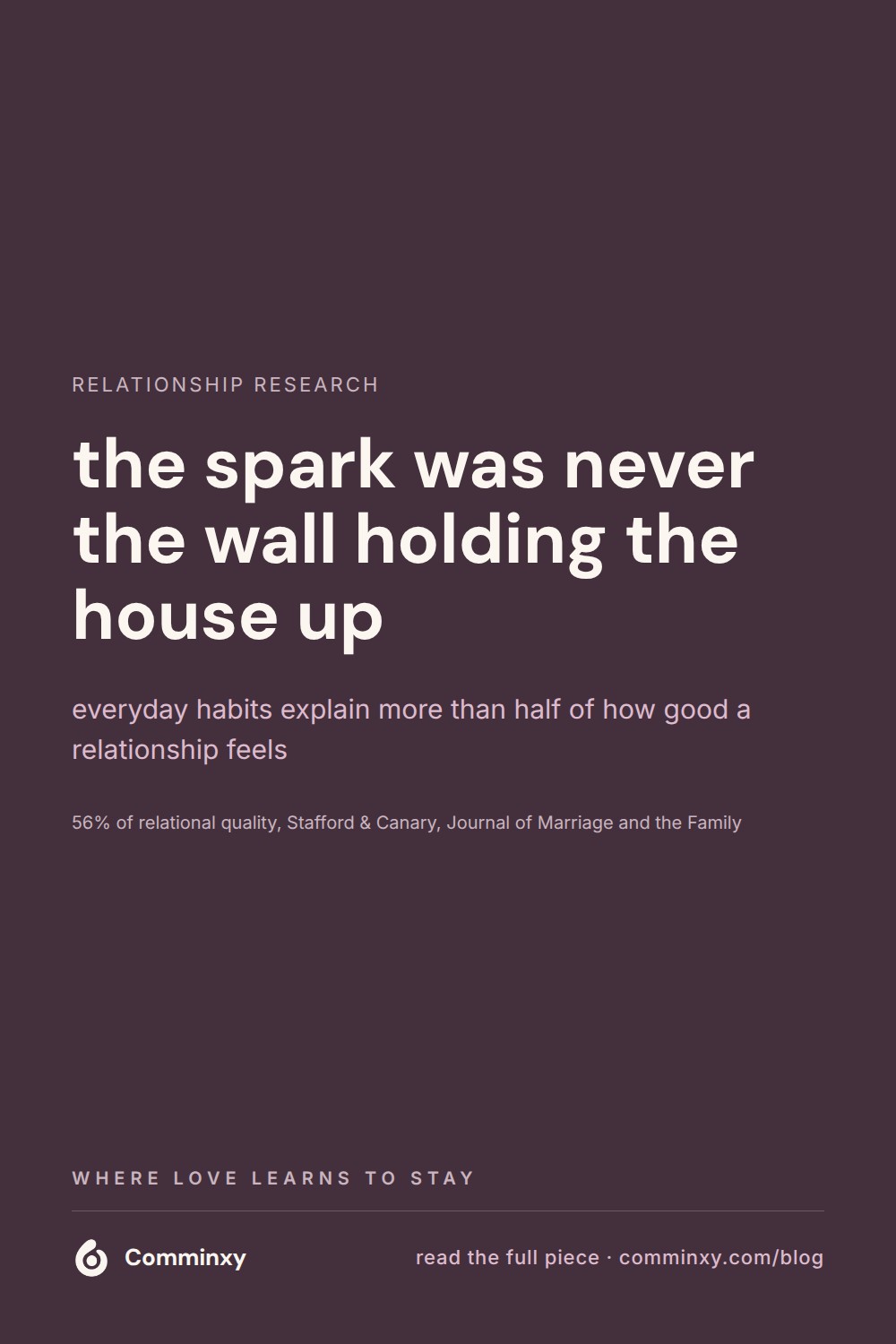
When researchers Laura Stafford and Daniel Canary went looking for what actually holds relationships together, they did not find one grand quality. They found behaviour. Ordinary, repeatable behaviour, sorted into a handful of strategies: staying positive, being open, offering assurance, sharing a life with other people in it, splitting the tasks a shared life requires. Those maintenance strategies accounted for as much as fifty-six percent of the variation in how relationships fared (Stafford & Canary, Journal of Marriage and the Family, 1991).
Read that slowly, because it lands somewhere unexpected. More than half of what determines how a relationship goes is not who you married. It is what the two of you keep doing after the ceremony, on the days nobody is watching.
This is oddly freeing. It means love long term is less a thing you have and more a thing you tend. A plant, not a monument. And plants forgive you. You can forget to water one for a while and it comes back.
Assurance is smaller than you think
Of all those strategies, the one that does the most heavy lifting is also the least dramatic. Assurance. Not grand declarations. Just the steady, low signal that says you are not at risk here, I am staying, we are a we.
It looks like almost nothing from the outside. Someone texts to say they landed safely, knowing the other one worries. Someone says "we'll figure it out" before either of them knows how. Someone leaves the hall light on because the other one gets in late from a shift and hates walking into a dark flat. None of it would make it into a wedding speech. All of it is the actual architecture.
If you have been feeling the distance widen and cannot name why, this is often where it hides. Not in any fight. In the slow disappearance of the small assurances that used to be automatic, back when you had more room to notice each other. Nothing broke. The signal just got quieter. You can learn a lot about why couples stop talking by watching how gently and how gradually it happens.
The story you tell about them decides more than the thing they did
Here is where the science gets uncomfortable, in a useful way. What corrodes long love is often not the behaviour itself. It is the explanation you privately assign to it.
Your partner forgets to pick up the thing you asked for. There are two stories available to you, and you will choose one almost before you are aware of choosing. One story: they were busy, distracted, human. The other story: they don't listen, they never listen, this is who they are. Frank Fincham and Thomas Bradbury found that this second kind of explanation, judging a partner's behaviour as intentional, selfish, and blameworthy, reliably predicts more hostility and more conflict spiralling out of small moments (Fincham & Bradbury, Journal of Personality and Social Psychology, 1992).
Their later work traced it as a loop. The stories feed the dissatisfaction, the dissatisfaction feeds harsher stories, and the whole thing turns slowly in on itself (Fincham, Harold & Gano-Phillips, Journal of Family Psychology, 2000).
You have probably done both, sometimes about the same person in the same week. The generous read on a good day. The brutal read when you are tired and already braced. That is not a character flaw. That is a nervous system doing what nervous systems do. But it means the story is a place where you have more power than you feel like you have.
The way back is a smaller correction than you fear
If the loop runs both ways, then it can be entered from the gentler side. You do not have to fix the relationship. You have to interrupt one story, once, and see what happens.
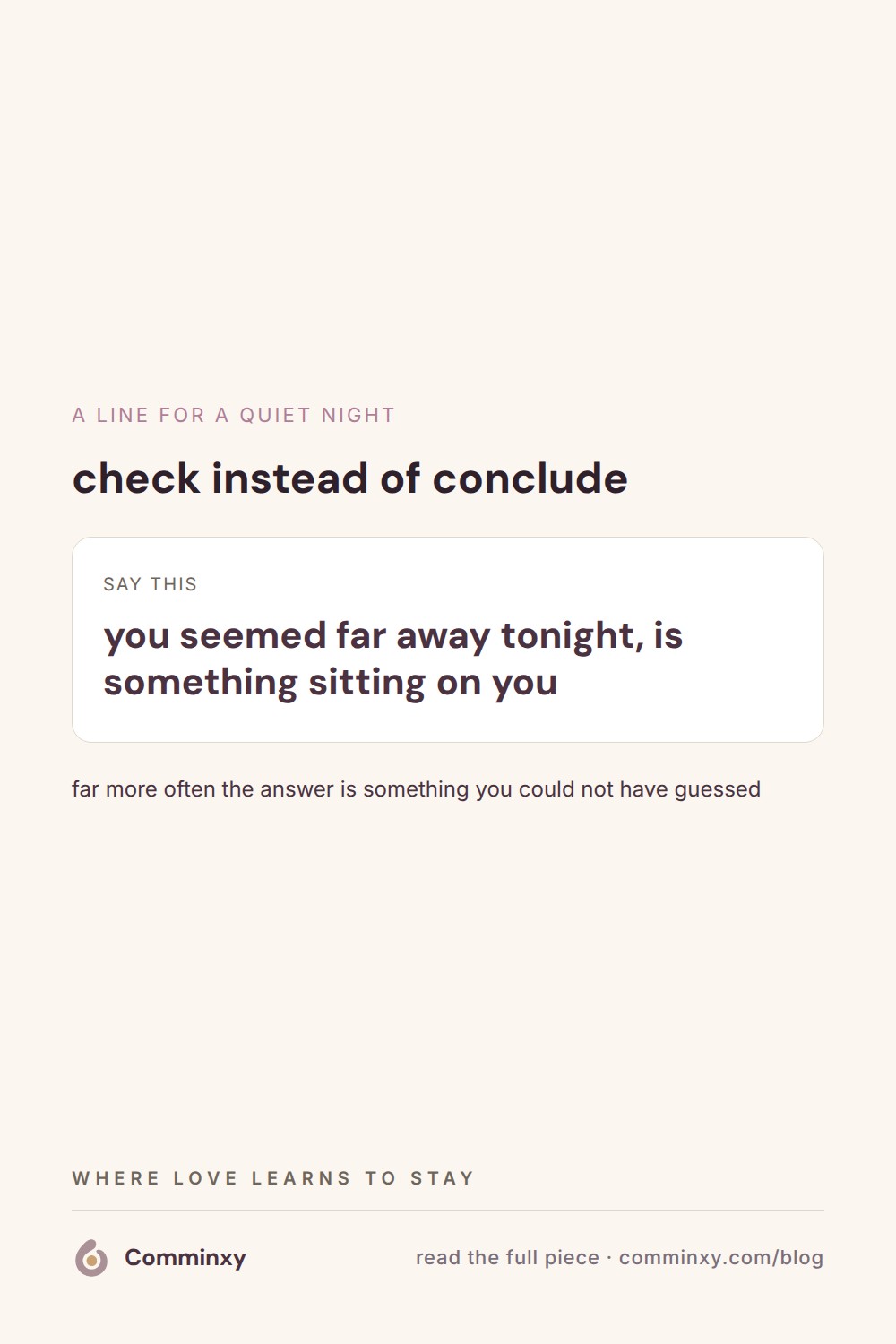
It can be almost nothing. The next time your partner does the thing that usually triggers the worst reading, you pause long enough to try the other explanation out loud. "You seem underwater today" instead of "you forgot again." Same forgotten thing. Completely different room to stand in. You are not pretending it didn't happen. You are choosing the version of it that leaves you both somewhere you can recover from.
And you will get this wrong. You will reach for the generous story and grab the sharp one by accident, because it was closer and you were spent. That does not undo the practice. The couples who stay in love are not the ones who never assign the cruel motive. They are the ones who circle back and revise it. "I was harsh earlier. I know you weren't ignoring me." That sentence is worth more than a hundred days of getting it right silently.
None of this is about doing love perfectly. It is about doing it repeatedly, badly included. If you want the mechanics of turning those quieter stories into something you can actually say to each other, that is nearly the whole of learning to communicate better.
Intense love, ten years in, is built from Tuesdays
Go back to that opening number. Forty percent, still intensely in love, long past the point the story says the fire should be embers.
Those couples did not preserve something fragile under glass. They kept tending it. The assurance that costs almost nothing. The generous story chosen on the average day, and repaired on the bad one. The signal, sent again and again, that the other person is not alone in this. That is what the intensity is made of, and it is far more ordinary and far more within reach than the myth of the perfect match ever let you believe.
If the last while has felt more like drift than fire, that is not a verdict on whether the love was real. It usually means the small maintenance quietly stopped, in a season when you had nothing left over to give it. Comminxy exists to help you notice the story you're about to tell, and reach for the other one before it hardens, because this is where love learns to stay: not in the grand gesture, but in the Tuesday you almost let pass, and turned toward each other anyway.
Questions people ask
why do couples fall out of love after years together
Often the small daily maintenance quietly stops rather than anything dramatic breaking. Steady reassurance, generous interpretations, and shared effort fade during exhausting seasons. Research suggests intensity does not have to disappear if these ordinary habits continue.
can you get intense feelings back in a long relationship
Yes, many long-term couples keep genuine intensity rather than settling for companionship. It tends to come from repeated small acts of assurance and choosing kinder interpretations of each other. It is built over time, not recovered in a single grand gesture.
is it normal to think my partner does things on purpose
It is very common to assume the worst motive when you are tired or already tense. This kind of blaming interpretation tends to increase conflict over small things. Noticing the story and trying a more generous version can shift how an interaction goes.
how do I stop small things turning into big fights
Pausing before assigning a harsh motive to your partner can interrupt the escalation. Naming what you see without blame, then revising it later if you got harsh, tends to help. If arguments feel unsafe or overwhelming, speaking with a qualified counsellor is worth considering.
Keep the idea with you — pin it, or download the cards.



Notice the story before it hardens, and choose the other one
Get Comminxy free →