The Research on Why Relationships Drift Apart Is Not What You Think
Nobody drifts on purpose. That is the strange part. There was no night either of you decided to stop, no conversation where you agreed to let the space between you widen. And yet here you are, sharing a calendar and a kettle and a surname maybe, feeling further from someone than you did when you knew them less. If you have gone looking for the research on why relationships drift apart, you were probably hoping for a reason. Something you could name and then fix.
What the research offers is stranger and, in a way, kinder than that.
Drift is rarely the thing people think it is
When people whose marriages have ended are asked what happened, they name the big, nameable things. Infidelity. Incompatibility. Drinking or drugs. In one study of formerly married people, 21.6 percent named infidelity, 19.2 percent named incompatibility, and 10.6 percent named substance use (Amato and Previti, Journal of Family Issues).
Those are real. But look at the word doing the heavy lifting in the middle of that list. Incompatibility. It is not an event. It is a story a person tells afterward, standing in the wreckage, trying to make the slow thing make sense. "We just grew apart." "We wanted different things." The dramatic causes get the headlines. The quiet one gets a shrug.
So there are two ways to read your own drift, and both deserve to stand.
One reading says the distance is the symptom. Something specific went unaddressed, a hurt that never got spoken, and the space grew up around it like scar tissue. The other reading says the distance is nobody's fault at all, just what happens to two people who stopped tending the same fire while they were busy keeping the rest of their lives alight. The research does not tell you which one is yours. It only tells you that most people, looking back, reach for the dramatic word when the honest one is smaller and sadder.
What actually holds people together, and what lets them go
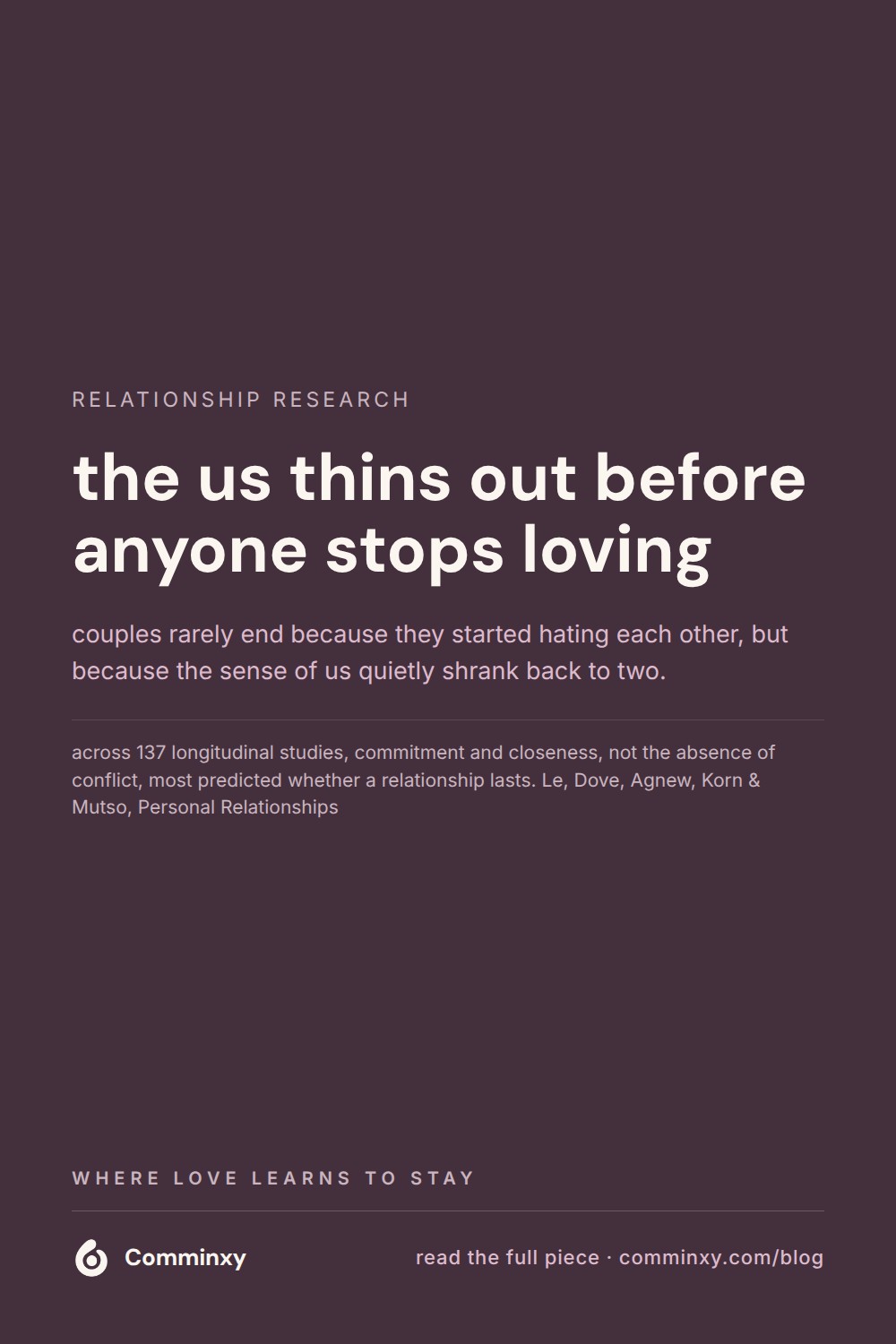
There is a finding that reframes the whole question. Across 137 longitudinal studies followed over thirty years, the strongest predictors of whether a relationship ends were not conflict, not personality, not even satisfaction on its own. They were commitment, love, and the degree to which each person had folded the other into their own sense of self (Le, Dove, Agnew, Korn and Mutso, Personal Relationships).
Read that slowly, because it is doing something gentle. Relationships do not usually end because two people started hating each other. They end because, quietly, they stopped being part of each other. The "us" thinned out. Their day stopped being something you were inside.
You know the feeling even if you have never had the words. It is hearing about their difficult week from a friend before you hear it from them. It is realising you booked the weekend around your own plans without the small instinctive check of what they might want, not out of spite, just because that instinct had gone quiet. The self that used to include them had contracted back down to one person.
Here again, two readings. One is that this shrinking is a warning, a sign the connection is starving. The other is that it is completely ordinary, the natural drift of two people carrying full lives, and that noticing it at all is already the beginning of reaching back. Both are true. The same fact, two temperatures.
The part where the reader may be the one who left first
This is worth saying plainly, because the research on drift is usually written as though it happens to people. Sometimes you are the one who pulled away.
Maybe you got quieter on purpose. Maybe there was a version of you that decided, without announcing it, that it was safer to expect less. You stopped bringing them the small things, the funny thing from work, the worry at 3am, and you told yourself they were busy, or would not get it, or that you had asked before and been left waiting. And each unbrought thing was tiny. None of them felt like a decision. Together they became one.
If that is you, sitting up late reading this and recognising your own hand in the distance, you are not the villain of this story. You were protecting something. People who withdraw are almost always guarding a hope they were afraid to keep exposed. That is not the same as not caring. It often lives right next to caring, closer than either of you can see from where you are standing.
The way back is not a grand gesture
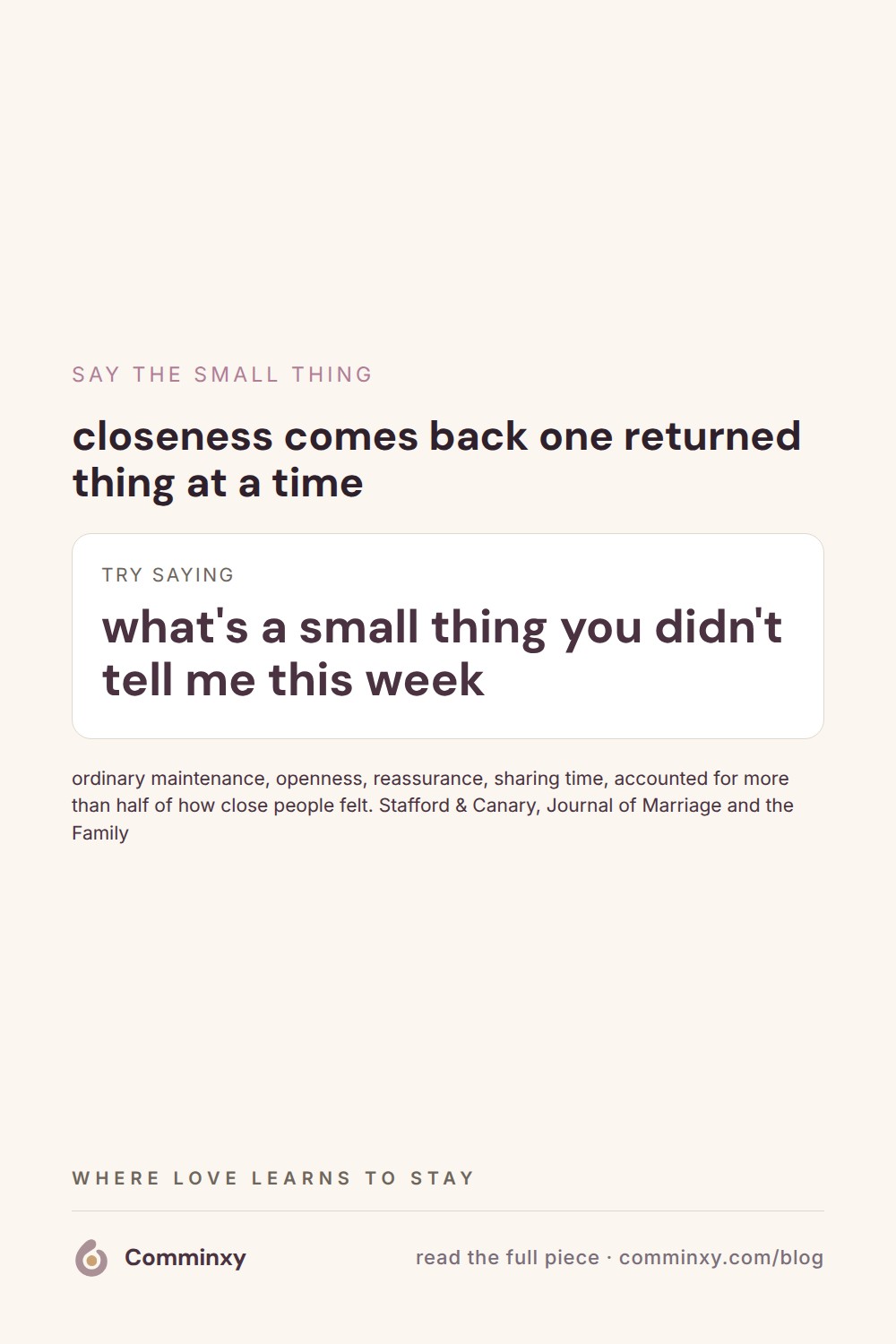
Because drift is built out of small omissions, it turns out it can be un-built the same way. The research on how couples stay close points not to weekend retreats but to a set of unremarkable habits. One study found that ordinary maintenance behaviours, things like openness, reassurance, and simply sharing tasks and time, accounted for more than half of how committed and satisfied people felt (Stafford and Canary, Journal of Marriage and the Family). More than half. From the boring stuff.
What that means, on a Tuesday, is smaller than the fear that brought you here. It is telling them the thing you were about to keep to yourself. It is asking a question you would once have assumed the answer to. It is one of you saying, out loud, a sentence as plain as "I think we've gone a bit far from each other and I don't want to." No apology required. No analysis of who drifted first. Just a hand put back on the fire.
You will do this badly. You will try to say the sentence and it will come out stiff, or you will mean to reach and then let a week pass instead. That is not the plan failing. That is what reaching looks like when you are out of practice. The clumsy attempt counts, often more than the eloquent one, because it is the one that actually happened. If the words keep sticking, it can help to look at why couples stop talking and how it starts again, which sits closer to this than most people expect.
Nobody drifts on purpose, and nobody comes back all at once either. It happens the same way it left, one small returned thing at a time, the day you started including them in again. That is the work Comminxy was built to sit beside, not to fix the distance for you, but to make the next small reach a little easier to take. This is how love learns to stay: not in one grand recovery, but in the quiet decision, made again and again, to keep the other person inside your life.
Questions people ask
why do couples grow apart even when they still love each other
Couples drift because they slowly stop including each other in daily life, not because love disappears. The small habits of sharing, checking in, and turning toward each other fade while busy lives take over. Over time the sense of us shrinks back down to two separate people without anyone deciding it should.
is it normal to feel distant from your partner but not know why
Yes, this is very common and rarely traces back to a single event. Distance usually builds from many tiny moments of not sharing, not asking, and expecting less, none of which felt like a decision at the time. Noticing the gap is often the first step toward closing it.
how do you fix a relationship that has drifted apart
You rebuild closeness through small ordinary habits rather than grand gestures. Telling your partner the thing you were about to keep to yourself, asking questions instead of assuming answers, and sharing time and tasks all rebuild connection over time. If distress feels overwhelming or persistent, talking with a couples therapist can help.
can a relationship come back after growing apart
Many relationships do reconnect, though it happens gradually rather than all at once. Since drift is built from small missed moments, it tends to reverse the same way, through repeated small acts of reaching back. Early clumsy attempts still count and often matter more than perfect ones.
Keep the idea with you — pin it, or download the cards.


The next small reach toward them can start today
Get Comminxy free →