The Research on Why Repair Is Possible in Almost Every Relationship
The argument ended twenty minutes ago, but you can still feel it in the house. You're at the sink filling a glass of water you don't really want, just to have somewhere to stand, and your partner is in the other room doing the same thing with a book they aren't reading. Neither of you knows how to walk the twelve steps back to the other. The words that would do it feel too big and too small at once. So you stand there, glass in hand, waiting for something to shift on its own.
The thing is, standing there feels like proof that something is broken beyond fixing. But the research on why repair is possible keeps pointing somewhere gentler. Repair is possible in almost every relationship, far more often than the moment makes it feel. The question was never whether the rupture happened. Every couple ruptures. The question is whether one of you can find the way back, and that turning is more learnable, and more forgiving, than it seems from inside the silence.
The story you tell in the quiet
What's actually happening while you stand at that sink isn't only the argument replaying. It's the small commentary running underneath it: they always do this, they don't even care, they're waiting for me to cave. The fight was ten minutes. The story you tell about the fight can run for hours, and it's the story, not the fight, that decides whether the two of you find your way back or dig in deeper.
This is one of the quietly devastating findings in relationship science. Fincham and Bradbury, in the Journal of Personality and Social Psychology, found that when we judge a partner's behavior as intentional, selfish, and blameworthy (they meant to hurt me, they knew and did it anyway) we become measurably more hostile, and conflict feeds on itself in the moments that follow. The interpretation arrives before the reaction. The way you name what just happened shapes what happens next.
Why we reach for the worst version
None of this means you're doing something wrong when your mind reaches for the harshest reading. It's what minds do when they're hurt and unsure. The uncertainty is unbearable, so we fill it, and the story we reach for tends to match the ache we're already in. If you feel unimportant, the story becomes I don't matter to them. If you feel controlled, it becomes they always have to win. The interpretation isn't a lie. It's a wound wearing the clothes of a fact.
And here's the part that matters, because it's where hope lives. Fincham, Harold, and Gano-Phillips, tracking couples across three waves of time in the Journal of Family Psychology, found that the link between the stories we tell and how satisfied we feel runs both ways. The attributions feed the unhappiness, and the unhappiness feeds the attributions. A loop. Loops sound like traps. But a loop can be entered from either side, which means it can also be softened from either side. You don't have to fix the whole thing. You only have to loosen your grip on the harshest version of the story, just slightly, and the loop begins to turn the other way.
What a repair actually sounds like
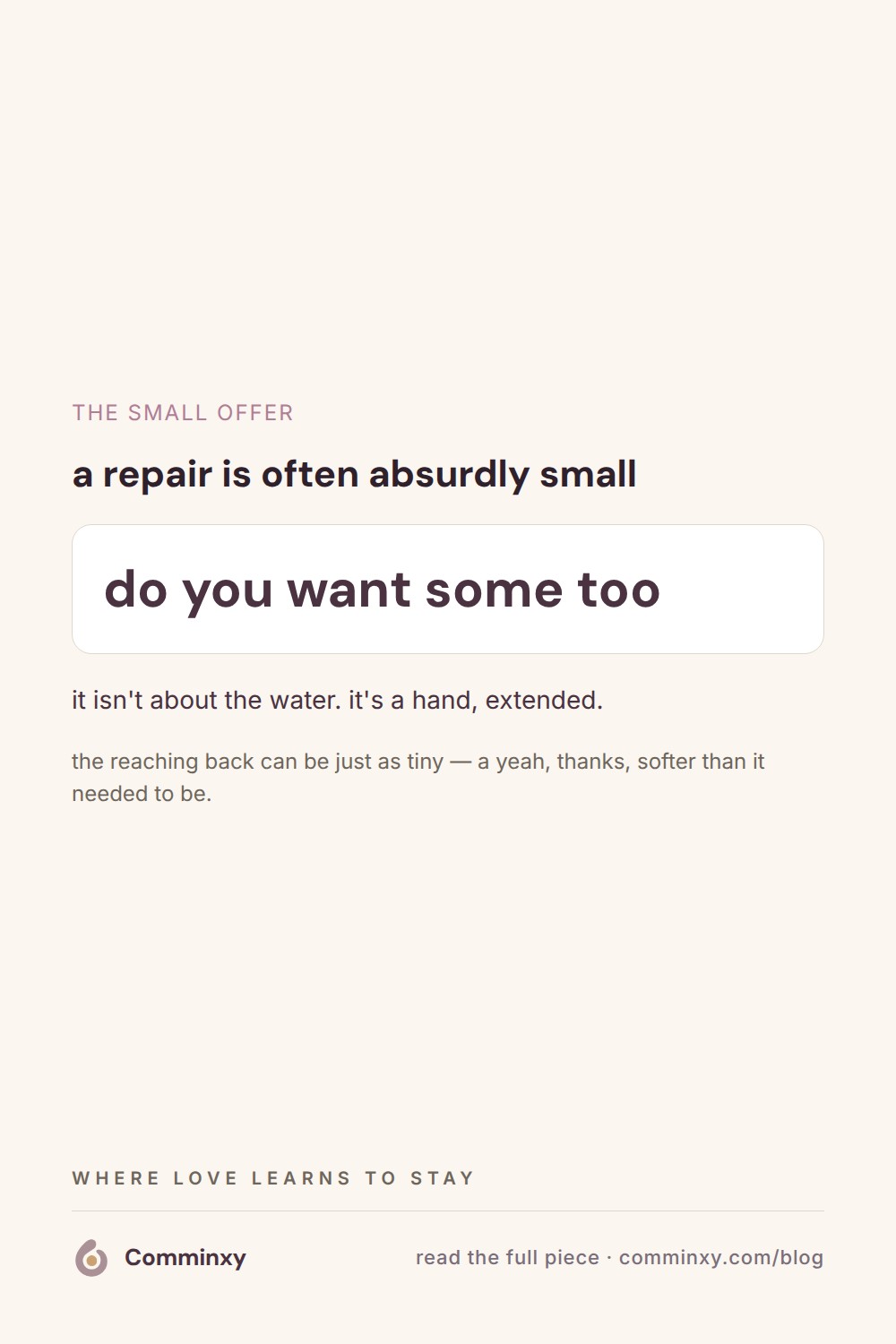
People imagine repair as a grand conversation: the sit-down, the eye contact, the full accounting of who hurt whom. It's almost never that. More often it's absurdly small. It's the one of you at the sink saying, from the other room, do you want some too? Holding up the water glass. It isn't really about the water at all. It's a hand, extended. A test of whether the door is still open.
That small offer has a name in the research world, but the name matters less than what it does. It gives the other person something to reach back toward. And the reaching back can be just as tiny: a yeah, thanks, softer than it needed to be. That's the whole repair, right there. Not the resolution of the disagreement. Just two people signaling, underneath the words, I still want to be on your side of this. If you've felt yourselves go quiet after conflict and not known how to break it, there's more on that particular ache in why couples stop talking and how to fix it.
The evidence that people find their way back
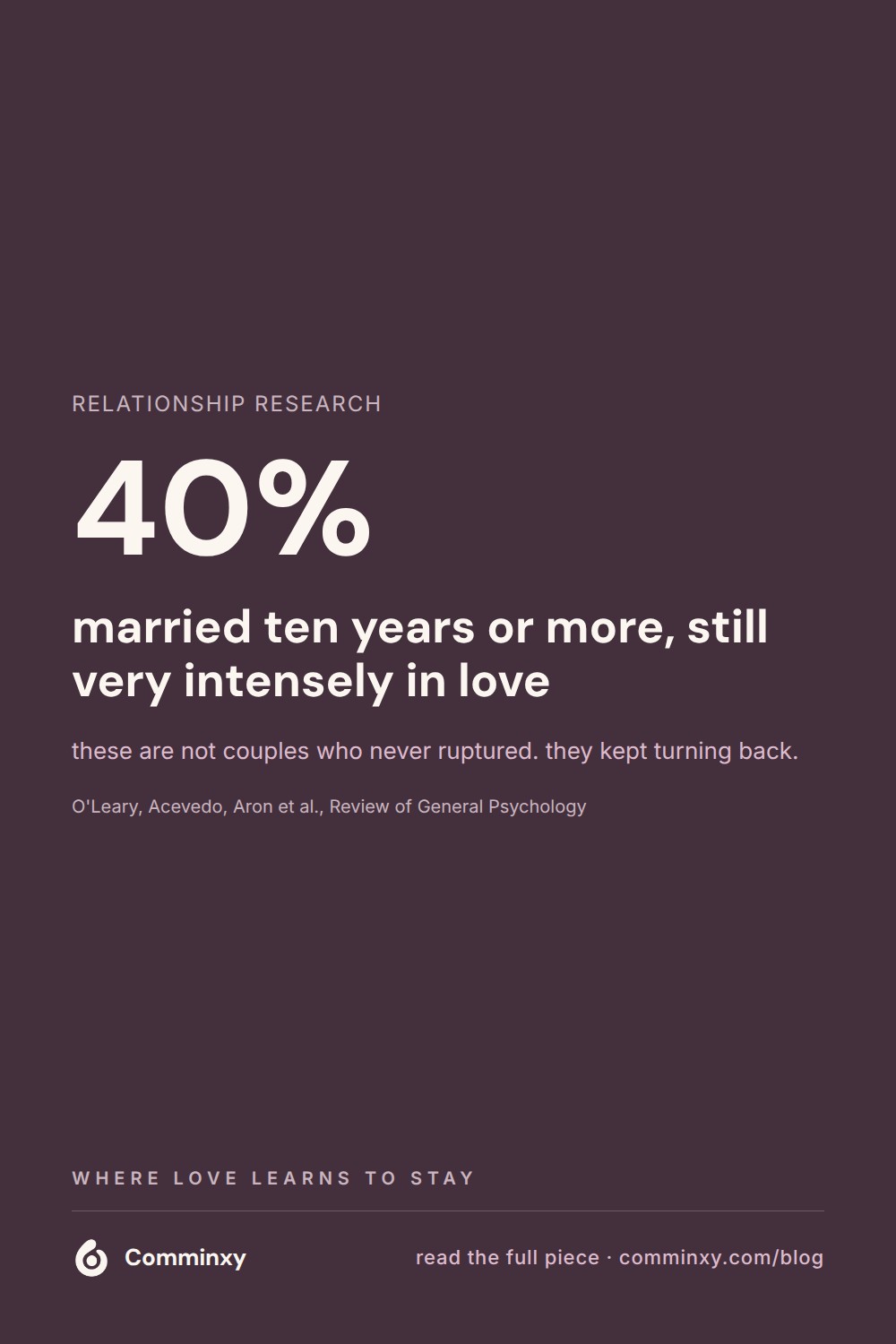
It would be easy to think the couples who last are the ones who don't rupture, or the ones who feel less. The research points somewhere gentler than that. O'Leary, Acevedo, Aron and colleagues, writing in the Review of General Psychology, found that 40% of people married more than ten years reported still being very intensely in love. These are not couples who never stood at the sink in the after-quiet. These are couples who kept turning back toward each other, through years of small ruptures and smaller repairs, and found the love not just intact but alive.
What holds those relationships isn't the absence of injury. Stafford and Canary, in the Journal of Social and Personal Relationships, identified a handful of ordinary maintenance behaviors (positivity, openness, reassurance) that together explained up to 56% of how committed and satisfied partners felt. Ordinary things. Small, repeatable, unglamorous acts of turning back. Not the fight avoided, but the reaching that comes after it. If it helps to see how those small moves fit into the everyday, how to communicate better with your partner holds more of them.
Repair isn't a talent (it's a direction)
What all of this quietly says is that the people who repair well aren't gifted with something you lack. They've simply learned to catch the harsh story before it sets, and to make the small offer before the silence hardens into a wall. That's not a personality. It's a practice, and practices bend toward whoever keeps trying them.
So. Back to the sink, the glass of water, the twelve steps that feel like twelve miles. You don't have to cross them all at once. You don't have to have the words ready or the fight resolved. You only have to hold up the glass. Offer the water. Let the story you were telling loosen by a single degree. That's how the way back begins: not with a summit, but with a small, ordinary turning.
This is the quiet work Comminxy was made to sit beside. Helping you notice the story before it hardens, and find the small offer when the words won't come. Not to fix the fight, but to keep the door between you open a little longer. Because that's where love learns to stay: not in the arguments you avoid, but in the twelve steps you keep finding your way back across.
Questions people ask
how do you fix things after a fight with your partner
Start with something absurdly small, like offering them water or asking a gentle question from another room. The repair is not about resolving the argument right away, it is about signaling that you still want to be on their side. Often that small gesture is enough to soften the silence and let you both begin finding your way back.
why do I always assume the worst about my partner during arguments
Your mind is trying to make sense of the hurt and uncertainty, so it fills the gap with a story that matches whatever ache you are already feeling. If you feel unimportant, the story becomes that you don't matter to them. It is not that you are doing something wrong, it is just what minds do when they are wounded and unsure.
can a relationship survive constant fighting
What matters is not whether you fight, but whether you turn back toward each other afterward. Research shows couples who stay deeply in love over decades are not the ones who never rupture, they are the ones who practice small, repeatable acts of repair after conflict. The reaching back is more important than the argument avoided.
is repair possible after a bad argument
Yes, repair is possible in almost every relationship, far more often than the silence makes it feel. You do not need to fix everything at once or have all the right words ready. You only need to make one small offer that signals the door between you is still open.
Keep the idea with you — pin it, or download the cards.



Comminxy helps you notice the story before it sets and find the small offer when words fail
Get Comminxy free →