The Morning After: How to Reconnect After a Fight Without Pretending It Never Happened
The kettle is on. One of you filled it, flicked the switch, and now it is roaring away in a quiet neither of you has decided how to break. Last night's fight is still in the room, folded into the ordinary business of two mugs on the counter. You slept badly, or you slept at all and now feel guilty for it. There is a decision hanging in the steam, and neither of you is saying it out loud: do we mention it, or do we let the morning smooth over the top and pretend.
To reconnect after a fight without pretending it never happened is one of the quietly hardest things two people do. Not because the words are complicated. Because the two of you are standing at a fork, and both directions feel wrong.
Two ways to read the silence over the mugs
One reading goes like this. The silence is kindness. You have both been through it, you are tired, and dragging last night back into the daylight would only reopen something that has finally, mercifully, stopped bleeding. You hand over the tea. You say something about the weather, or the dentist appointment, and the ordinariness itself is a kind of peace offering. See, we are still a we. We can stand in a kitchen together.
The other reading is harder to sit with. The silence is not kindness but avoidance wearing its coat. Something was said last night that mattered, and if you both step over it now, it does not disappear. It goes underground. It waits. And the next fight will not really be the next fight, it will be this one, plus interest.
Both of these can be true of the same morning. That is the part nobody tells you. The tea can be a genuine act of tenderness and a way of not looking at the thing. People are rarely doing only one thing at once.
Why "let's just move on" costs more than it looks
There is a finding that reframes the whole choice you are standing inside. For a long time the assumption was that the happiest couples were the ones who fought least, who kept the peace, who let things go. When researchers followed married couples over years, what they found ran the other way. Couples who withdrew from conflict, who went quiet and stepped around the hard thing, saw their marital quality deteriorate over the long term. Active disagreement, the messy business of actually staying in the room and hashing it out, sometimes led to satisfaction going up (Gottman & Krokoff, Journal of Consulting and Clinical Psychology, 1989).
Sit with that for a second. The instinct to smooth it over, to protect the calm morning, is not a character flaw. It comes from a good place, from wanting to stop the hurt. But the calm bought by never returning to the thing is a calm with a leak in it.
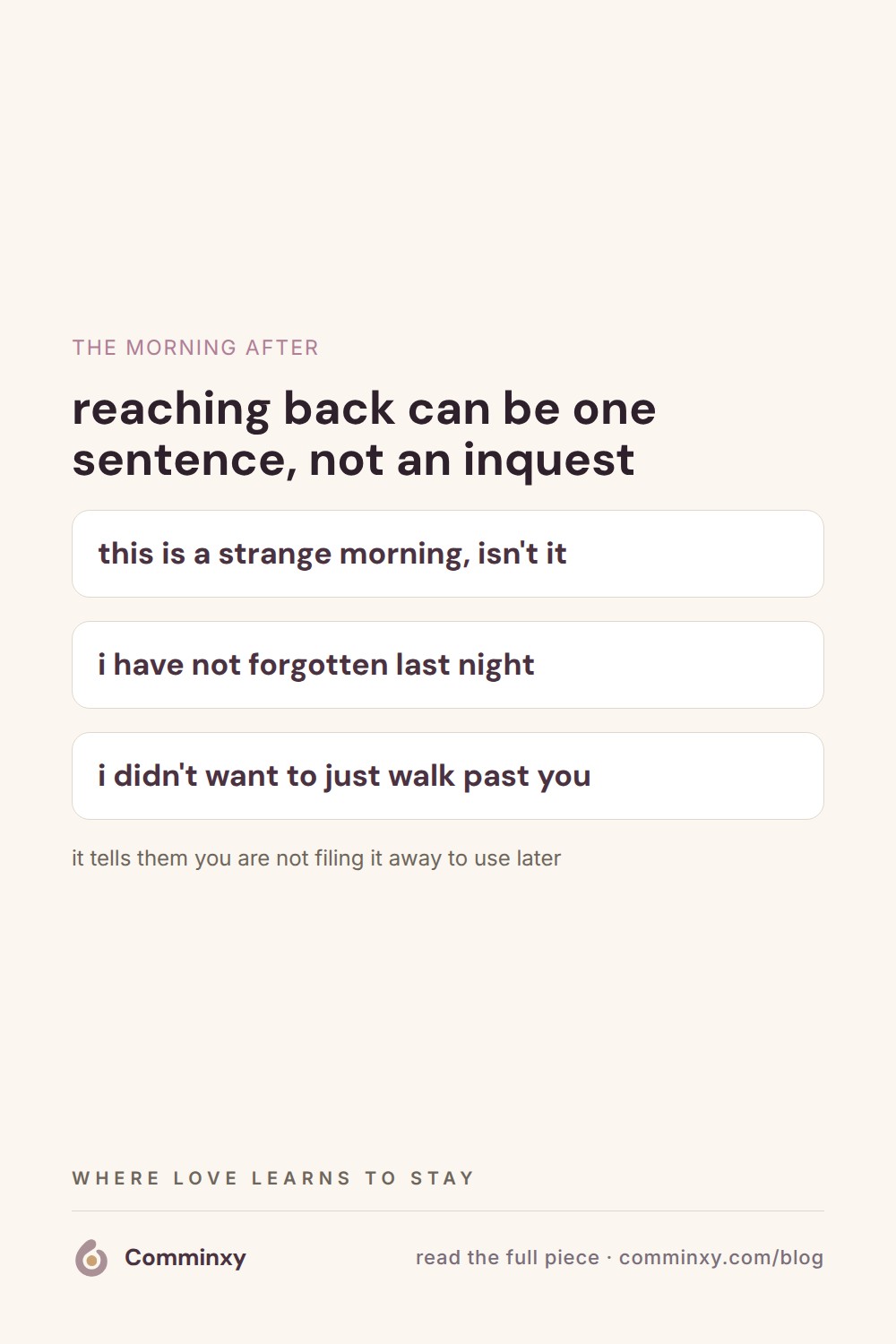
This does not mean you owe each other a full inquest before nine in the morning. Returning to a fight is not the same as reopening it at full volume. It can be small. It can be a single sentence that says, without drama: I have not forgotten last night, and I do not want to pretend it did not happen. That one line does more than an hour of careful avoidance, because it tells your partner the thing they are most afraid of is not true. That you are not filing it away to use later.
The morning is doing a quieter job than you think
What passes between you now, in the flat light before either of you is properly awake, is not only about last night. It is about what kind of story you are both building, sentence by sentence, about who you are together.
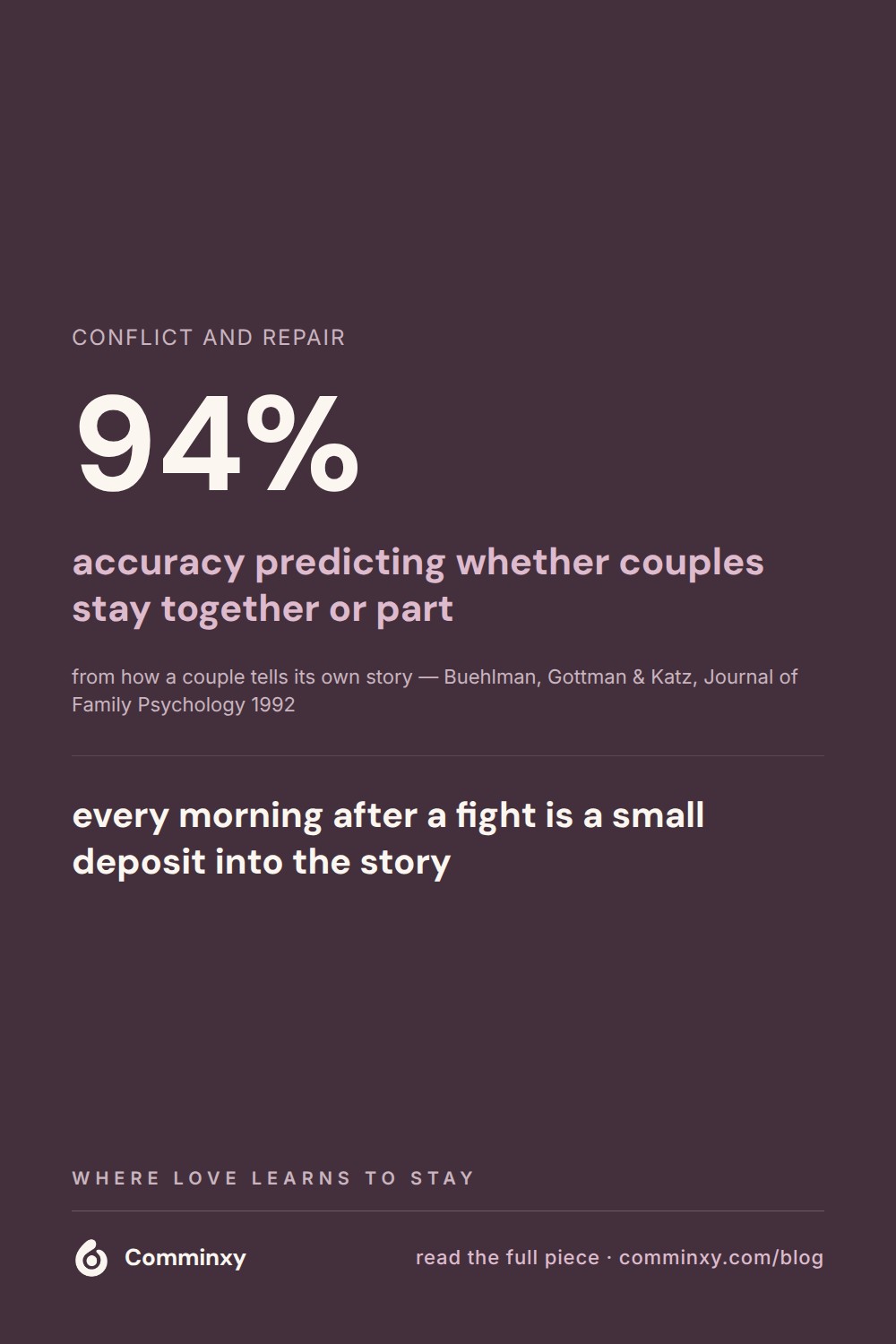
Couples carry a running narrative of their own relationship, and it turns out to be startlingly powerful. When researchers listened to how couples told the story of their history, their early days, their rough patches, how they got through things, they could predict whether those couples would stay together or divorce with 94% accuracy over three years (Buehlman, Gottman & Katz, Journal of Family Psychology, 1992). The story was not decoration on top of the marriage. It was the marriage, in a way.
Every morning after a fight is a small deposit into that story. Not the fight itself, but what you do with the morning. A couple who can say, we had a bad night and we found our way back to the kettle, are writing a line that says we are people who repair. A couple who quietly agree never to speak of it are writing a different line, one about things that cannot be touched.
You will not always get this right. You will smooth it over on a Tuesday because you cannot face it, and that is allowed. Doing it badly once does not rewrite the whole story. The story is made of hundreds of mornings, not one.
What reaching back can actually look like
The way back is smaller and clumsier than the version you are rehearsing. It does not require the right words, and it does not require agreeing about last night. Those are two separate things, and confusing them is what keeps people stuck at the counter.
Sometimes it is a hand on a shoulder before anyone says anything, a touch that means I am still here even though we are not okay yet. Sometimes it is naming the awkwardness out loud, which instantly halves it: this is a strange morning, isn't it. Sometimes it is offering the smallest true thing, I did not like how last night went, and I do not fully know how to fix it, but I did not want to just walk past you. You do not need to have solved anything to say that. In fact saying it before you have solved anything is exactly the point.
If words feel impossible face to face, there are other doors. Some couples find it easier to reach back in writing, where there is time to find the sentence and no one has to watch the other's face while they do. If that is you, it may help to read how to stop fighting over text messages with your partner first, so the reaching-out does not accidentally reopen the wound. And if the pattern you keep hitting is the going-quiet one, the slow drift into not talking at all, why couples stop talking and how to fix it sits close to what you are feeling this morning.
Neither reading of the kettle is wrong. The tea might be love, and it might be avoidance, and this morning it is probably a little of both, which is what being two tired people who hurt each other last night actually looks like. What matters is not choosing the perfect move. It is that one of you reaches, however awkwardly, across the quiet before it hardens. Comminxy exists for exactly that reach, the small return after the hard night, because that is where love learns to stay: not in the mornings that go smoothly, but in the ones you find your way back through.
Questions people ask
should we talk about the fight the next morning or just move on
Acknowledging it briefly tends to work better than silently moving on. You do not need a full conversation, just a sign that you have not buried it. Stepping over something that mattered often means it resurfaces later with more force.
how do I break the awkward silence after an argument
Naming the awkwardness out loud often halves it, something as simple as saying this is a strange morning. A hand on a shoulder can also say you are still here before any words come. You do not have to have solved anything to reach out.
is it bad if we never talk about our fights again
Quietly agreeing never to mention conflicts can build a calm that leaks over time. Unspoken hurts often go underground and show up in the next disagreement. Repairing does not require reopening everything at full volume, just not pretending it never happened.
why is it so hard to reconnect with my partner after arguing
It feels hard because both options, mentioning it or letting it slide, can seem wrong at once. The instinct to smooth things over usually comes from wanting to stop the hurt, not from not caring. The way back is often smaller and clumsier than the version you rehearse.
Keep the idea with you — pin it, or download the cards.



Sometimes the smallest reach across the quiet is enough to begin
Get Comminxy free →