The Quality Time Love Language: Why Presence Matters More Than Hours
You booked the whole weekend off. Drove two hours, checked into the place with the good reviews, and somewhere around the second evening you watched the person across the table from you answer an email between courses, and felt a small, specific loneliness that made no sense given where you were. You had done everything right. You had made the time. And still something in you was reaching across the table for someone who was technically already there.
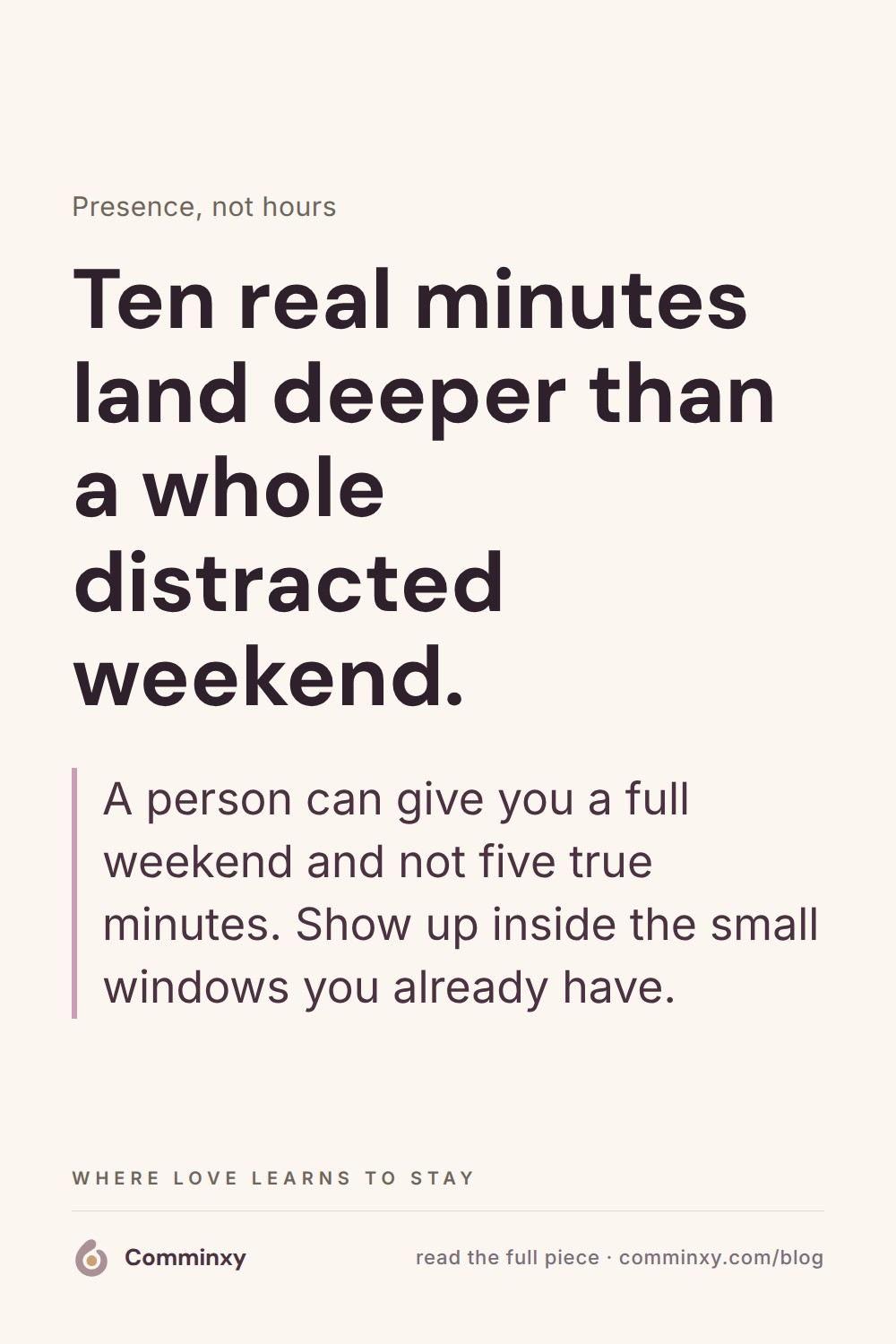
Quality time as a love language means feeling loved through a partner's full attention, their presence rather than their proximity, the sense that for this stretch you are the thing they are actually with. The hours matter less than whether someone is inside them with you. A person can give you a whole weekend and not give you five real minutes. A person can give you ten minutes in a hospital car park and you feel held for a week.
If you have ever been surrounded by someone and still ached for them, you are not confused and you are not asking for too much. You were reaching for the part of them that had stepped out.
Quality time meaning: presence, not proximity
The word "quality" is doing quiet, heavy lifting in that phrase, and most of us hear "quantity" instead. We think the problem is we do not spend enough time together, so we try to buy more of it. More dinners, a trip, a standing Sunday. Then the dinner happens and one of you is somewhere else behind your eyes, and the loneliness arrives anyway, now with a side of confusion, because you did the thing that was supposed to fix it.
Presence is not the same as being in the room. It is a particular feeling in the body: that the person in front of you is not waiting for you to finish, not mentally drafting the reply, not half-gone into the day ahead. Attention has a texture, and we can all feel the difference between the real thing and its polite impression.
Which is why a short, undivided ten minutes can land deeper than an afternoon spent side by side with someone's mind elsewhere. The afternoon measures longer. The ten minutes reaches further.
Quality time examples, and the small thing they share
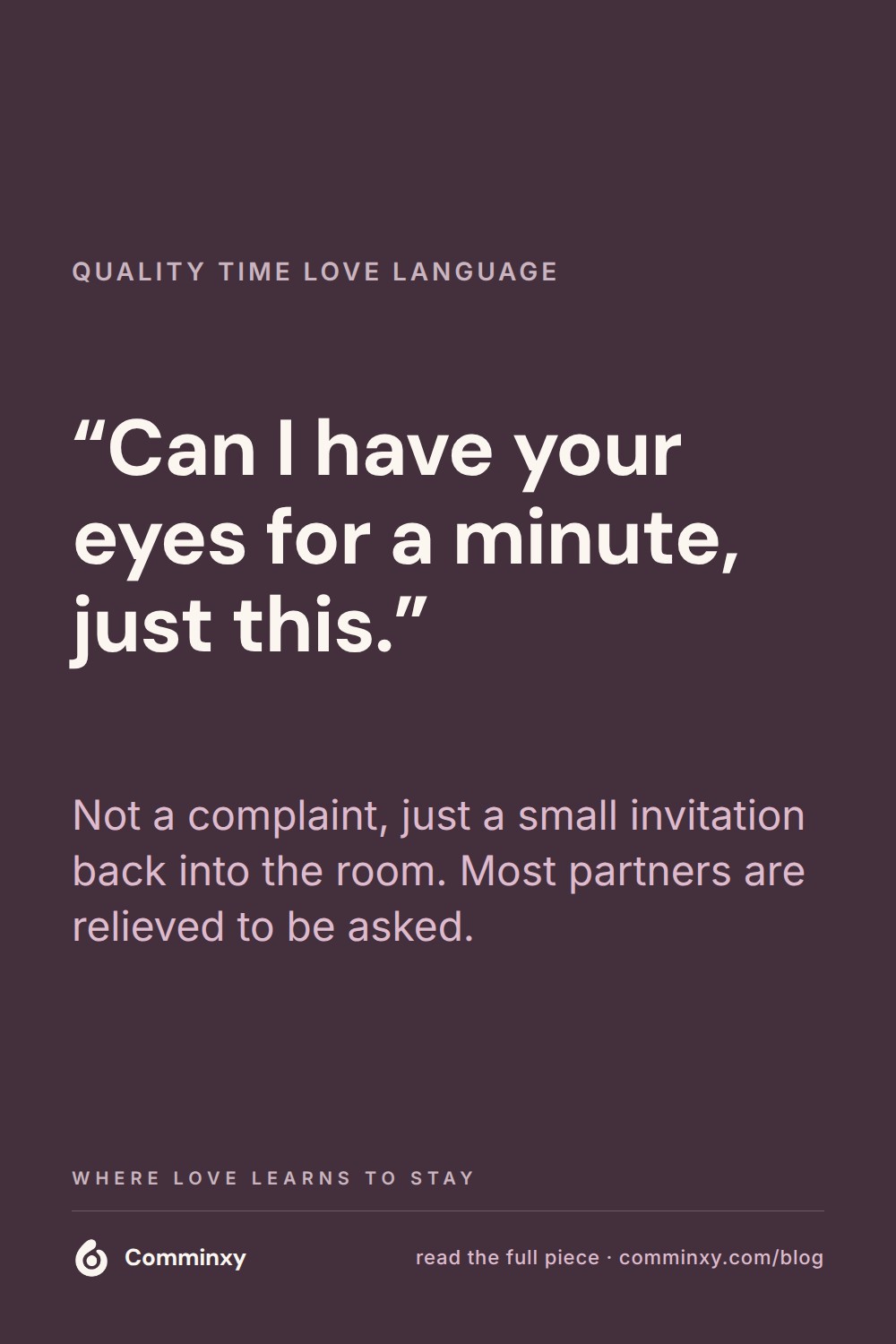
It helps to be concrete, because quality time gets described in ways so grand they feel impossible on a Tuesday. A boyfriend who puts his book face-down on the arm of the chair when you walk in, and turns toward you, is doing it. A wife who asks a second question, the follow-up one, the one that proves she actually heard the first answer, is doing it. Someone who stays on the phone through the boring part of your day because it is your day.
None of these cost money and none of them need a weekend. What they share is a decision, usually invisible, to be interruptible by the other person. To let them matter more, for a minute, than whatever else is pulling.
And the ones that miss tend to miss in the same way. The trip where the logistics ate the point. The anniversary dinner spent recapping the week's admin. Time was spent. Nobody arrived.
Why it is so easy to be there without being present
Nobody drifts out of a moment on purpose. Attention is not something you hand over by choosing to. It gets pulled, by work that followed you home, by a worry you are carrying, by a phone that was designed by people far smarter than any of us to be more interesting than the person beside you. You can love someone completely and still be absent from the room they are sitting in, because the absence is rarely about them.
This is worth saying plainly, because many people reading this are carrying a quiet guilt. Maybe you are the one who checks out. Maybe your partner has said, in a tired voice, that they feel alone even when you are together, and you did not know what to do with that because you were right there. You were right there. The hurt and the effort are both real at once, and neither one cancels the other.
The checked-out partner is usually not withholding. They are flooded, or scattered, or running on a kind of autopilot that feels like coping. The reaching partner reads it as not mattering. Both readings make sense from the inside. If that gap has started to harden into a wider quiet, there is more on how that happens in why couples stop talking and how to fix it.
The way back is smaller than a cleared schedule
The relief here is that you do not need more time. You need to be more present inside the time you already share, and presence can be practised in units of minutes.
It takes surprisingly little focused attention to change things. Married couples were asked to spend a few short sessions across a year writing briefly about a recent conflict from the point of view of a neutral third person who wants the best for both of them, totalling about twenty-one minutes of writing across the whole year. That alone completely eliminated the decline in satisfaction the other couples experienced over that year (Finkel, Slotter, Luchies, Walton, and Gross, Psychological Science, 2013).
What matters here is not the writing. It is the scale. Twenty-one minutes of genuine, focused attention, aimed well, changed the trajectory of a year. One way to read this is that small amounts of focused attention, aimed well, matter more than hours. The couples who feel close are not the ones logging the most hours together. They are the ones who show up fully for the small windows they do get, and let those windows count.
So the way back might be ten minutes with the phone in another room and a real question asked. It might be putting down the thing in your hand when they walk in, even when the thing in your hand feels urgent, because being interruptible is the gift. You will do this badly sometimes. You will mean to be present and find yourself drifting by the third sentence, and that is not proof you have failed, it is just Thursday. The attempt itself, clumsy and half-distracted, still reaches the other person more than a flawless weekend they could feel you leaving.
If the drifting has become the pattern more than the exception, it is worth naming gently together rather than carrying alone. There are ways to open that conversation without it becoming an accusation, in how to communicate better with your partner.
What changes when presence becomes the point
When you stop measuring time together by the hour and start measuring it by whether anyone was actually there, the pressure comes off in a strange way. You no longer need the perfect evening. You need five honest minutes, and those you can almost always find.
Go back to the table two hours from home. The thing missing that night was never the location, or the effort, or the booking made weeks ahead. What was missing was the simple experience of being fully met by the person across from you, and the quiet ache of reaching for someone who had stepped out without meaning to.
That person can come back into the room. Usually they are relieved to be asked. Learning to notice the drift, in yourself or in them, and to find the way back toward each other before the distance sets, is slow work, and it is the work Comminxy was built to sit beside you through. Not more hours. More of each other, inside the hours you have. That is where love learns to stay.
Questions people ask
What are examples of the quality time love language?
It looks like a partner putting down their book to turn toward you when you walk in, or asking the follow-up question that proves they heard your first answer. Staying on the phone through the boring part of your day counts too. What these share is a choice to be interruptible by you.
What does quality time mean as a love language?
Quality time means feeling loved through someone's full presence rather than just their proximity. It is the sense that for this stretch you are the thing they are actually with, not waiting to finish or mentally somewhere else. The hours matter less than whether anyone was truly there inside them.
What are some quality time examples?
Small moments where someone gives you their undivided attention, like a real conversation with the phone in another room. It does not need to be grand or cost money. The ones that miss are often the big plans where the logistics ate the point and nobody arrived.
Keep the idea with you — pin it, or download the cards.


Noticing the drift is where finding your way back begins.
Get Comminxy free →