Why Every Couple Needs a Private Space That Belongs Only to the Two of You
Everyone at the dinner knew about the promotion before you did. Your partner had mentioned it to their brother on the drive over, casually, the way you mention something already settled, and now the table was raising glasses and you were lifting yours a half-second late, smiling with your mouth while something in your chest went quiet. Later, in the car, you would say it was fine. You were happy for them. You were. But there was a small, specific sting in learning the shape of your own life from someone else's reaction to it.
A private space for couples is not a luxury or a romantic flourish. It is the place where news like that lands first, with you, before it belongs to anyone else. Most couples do not lose that space in a single moment. It erodes. The group chat gets the funny version. The family dinner gets the headline. The colleague gets the venting. And slowly, without anyone deciding it, the two of you become the last to hear each other properly.
The relationship becomes a thing that happens in public
Think about where your relationship actually gets discussed. A friend hears about the argument before your partner hears how it landed for you. A sibling knows you are worried about money. The group thread has a running commentary on your partner's habits, affectionate mostly, but aired. None of this is betrayal. It is how modern life metabolises feeling. We process out loud, with the nearest willing ear, and the nearest ear is rarely the person we are actually in it with.
What gets lost is harder to name. When the first telling of something happens elsewhere, the version your partner eventually receives is already secondhand. It has been shaped, softened, performed for an audience. By the time it reaches them, it is a report, not a confiding. They are no longer the person you turn to. They are the person you update.
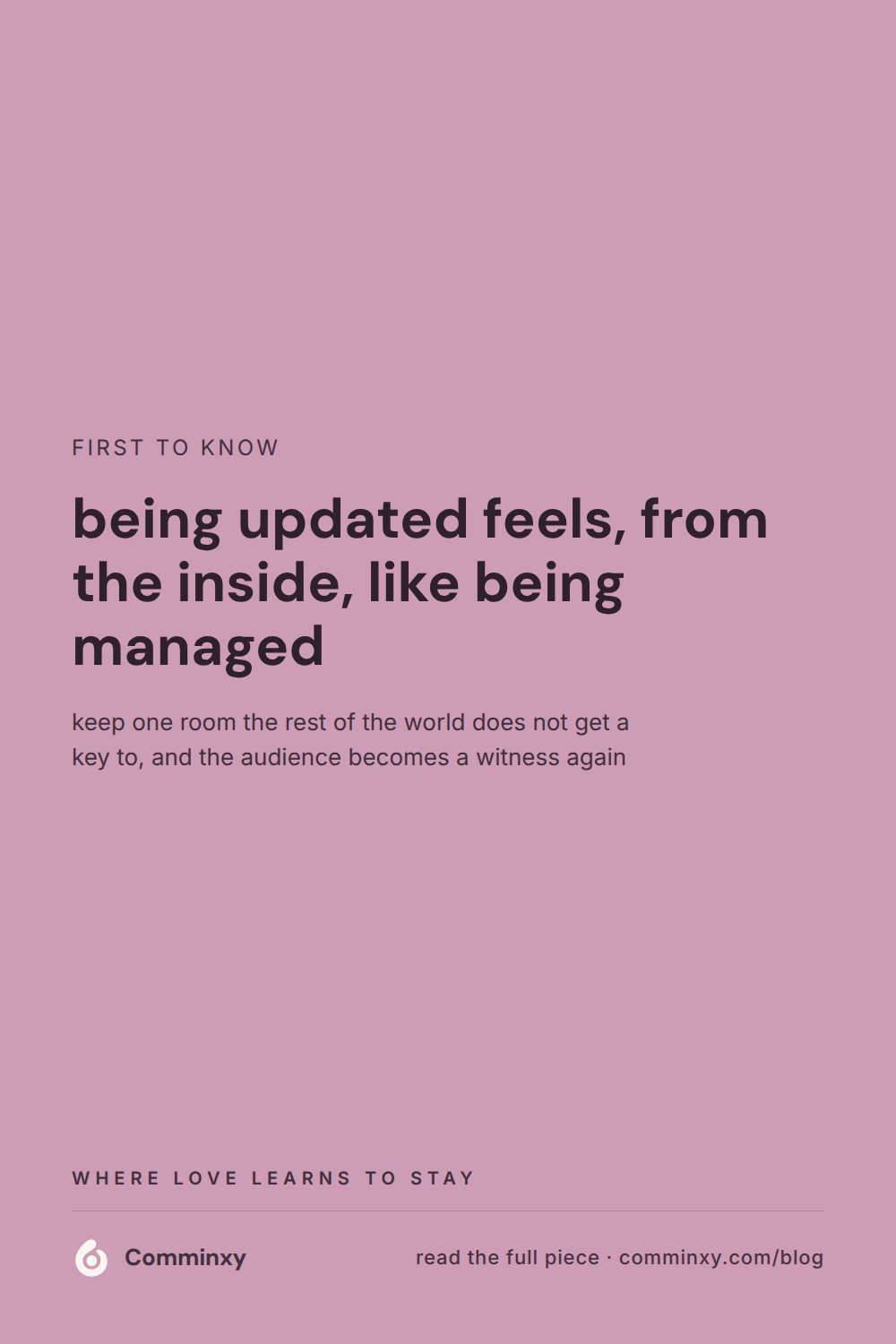
And the thing about being updated is that it feels, from the inside, like being managed.
Why the two of you need somewhere that is only yours
There is a kind of intimacy that only exists in privacy, because it depends on not being watched. You cannot be fully clumsy, fully unsure, fully mid-thought in front of an audience. You edit. In a space that belongs only to the two of you, the editing can stop. You can say the half-formed thing. You can admit the promotion stung a little even though you are proud. You can be someone who feels two things at once, which is most people, most of the time.
This matters more than it sounds like it should. One way to read the slow drift in long relationships is that couples stop having anywhere to be unfinished together. Everything becomes a conclusion delivered to a third party. The private middle, the part where you are still working out what you think, goes homeless. If you have felt the two of you turning into co-managers of a shared life rather than confidants inside it, the quiet way couples stop talking often starts exactly here.
What the research reframes about staying together
It is tempting to believe the couples who last are the ones who agree, who fight less, who have fewer problems to take elsewhere. The evidence points somewhere stranger. When researchers interviewed newlyweds about their shared history and the meaning they made of it, the way a couple told their own story predicted whether they would stay together with around 94% accuracy over three years (Buehlman, Gottman, and Katz, Journal of Family Psychology).
Sit with what that means. The strongest signal was not how well they communicated in the moment, or how compatible they were on paper. It was whether they had a shared narrative, a private, co-authored sense of us that both of them recognised. Couples who kept that story alive tended to stay. Couples who had quietly stopped writing it together tended not to.
A shared story cannot be built in public. It is made in the small, unglamorous exchanges nobody else sees. The inside joke that would need ten minutes of context to explain. The shorthand for a feeling. The memory of a bad week that only the two of you carry the same way. When those exchanges move outward, told to friends, performed for family, the private story thins. There is still a relationship. There is just less of it that belongs only to you both.
The way back is smaller than a conversation
If this is already how things feel, the instinct is to plan some large repair. A big talk. A reset. The research would gently point you elsewhere. Rebuilding a private space rarely happens in one dramatic exchange. It happens in the decision, made quietly and often, to let your partner be the first to know.
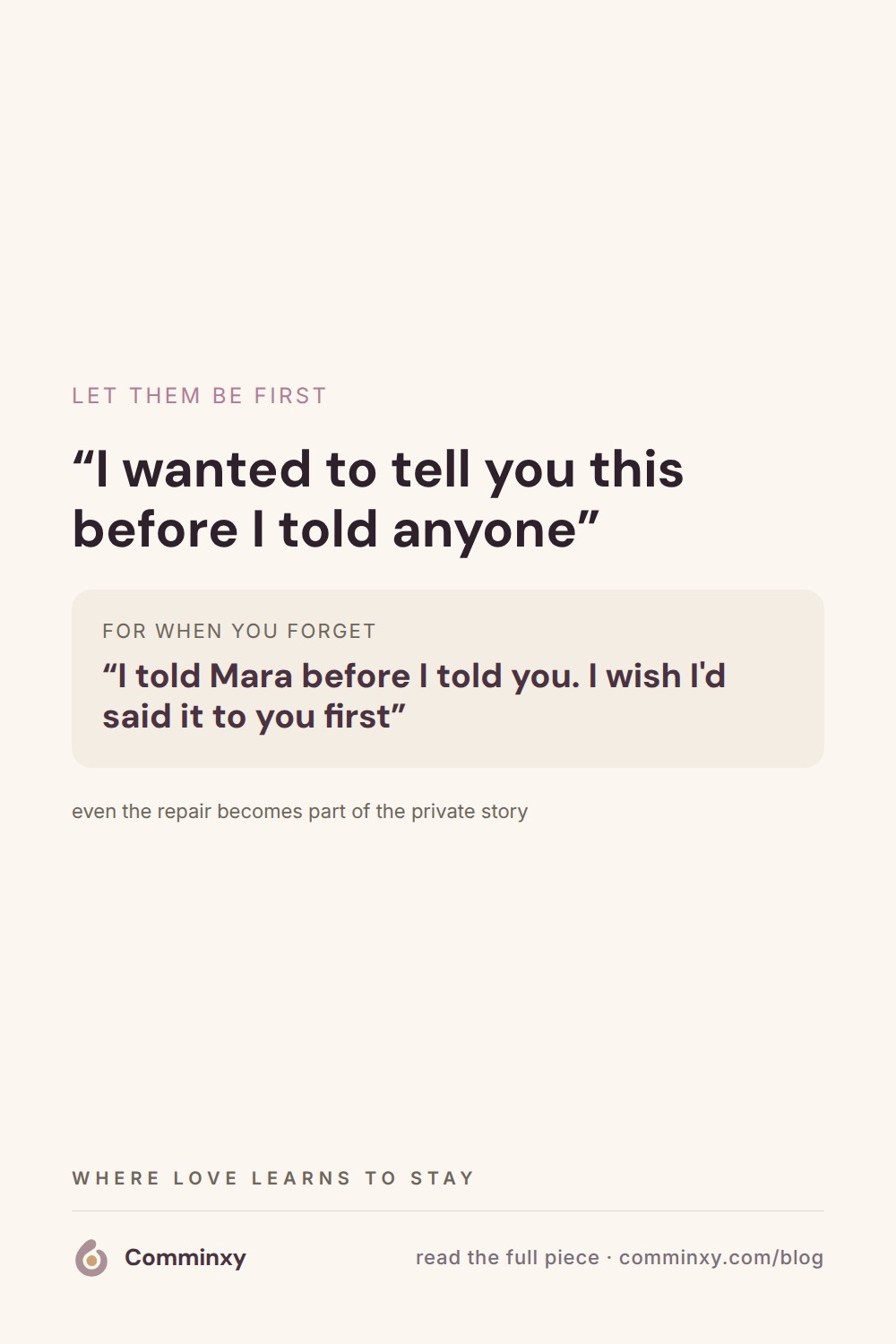
Not everything. Not a rule. Just the next real thing. The next time something lands, good or bruising, you let it go to them before it goes to the thread. You might say, out loud, something as plain as I wanted to tell you this before I told anyone. That sentence does more than it looks like it does. It puts them back in the centre. It says the inside of your life is still a place they live, not a place they visit.
You will forget to do this. You will tell your sister first out of habit on a Tuesday and only remember afterward. That is not failure. The story a couple shares is not ruined by one secondhand telling, and it is not saved by one perfect one. It is the direction that matters, the slow re-pointing of your first instinct back toward each other. On the days you get it wrong, you can simply catch it later. I told Mara before I told you. I wish I'd said it to you first. Even the repair becomes part of the private story.
What changes when the space comes back
Couples who find their way back to this describe something quieter than romance. A sense of having somewhere to put things. The relief of not having to be interesting about your own life, of being allowed to be boring and uncertain and still fully received. When your partner is the first to know, they stop being the audience and become the witness again. And being witnessed, really witnessed by one person who is not keeping score, is close to the whole point of being with someone.
Protecting that space is itself a skill, and the way the two of you talk when nobody else is listening is where most of it lives. It does not require you to withdraw from your friends or stop venting entirely. It only asks that the two of you keep one room that the rest of the world does not get a key to.
Picture the next dinner. Some good news arrives, and this time it is already known between you, carried in the particular quiet of two people who told each other first. You catch their eye across the table. Nobody else sees it. That look is the private space, still intact, still yours. Comminxy exists to protect exactly that room, the one where the two of you are the first to know, because that is where love learns to stay.
Questions people ask
why do I tell my friends things before my partner
Often it is just habit, because the nearest willing ear is usually a friend or sibling rather than your partner. We tend to process feelings out loud with whoever is around. The fix is small, which is choosing to bring the next real thing to your partner first.
is it normal to feel like roommates instead of a couple
Yes, many long term couples drift into feeling like co-managers of a shared life rather than confidants. It often happens when the private, unfinished conversations move outward to other people. Turning your first instinct back toward each other can slowly shift that feeling.
how do couples keep their relationship private
They keep one part of their life that only the two of them share, like inside jokes, shorthand, and news told to each other first. It does not mean cutting off friends or never venting. It means the two of you hold on to a space nobody else gets a key to.
what does it mean when your partner is the last to know things
It usually means the first telling of your news is happening somewhere else, so your partner receives a secondhand version. Over time that can make them feel like an audience rather than the person you confide in. Letting them be first again tends to rebuild that closeness.
Keep the idea with you — pin it, or download the cards.



Keep one room where the two of you are first to know
Get Comminxy free →