Phone Addiction and Relationships: How Couples Lose Each Other One Scroll at a Time
You are telling them about the thing your sister said, the one that has been bothering you all day, and somewhere in the middle of the sentence you notice their eyes drop. Not far. Just down, to the bright rectangle in their hand, for half a second, and then back up to you. They heard you. Mostly. But you felt the half a second, and now you are deciding whether to keep going or to let the story go quietly small and end early.
If you have lived some version of that, you already know the strange thing about phone addiction in relationships. It rarely arrives as a fight. It arrives as couples losing each other in these tiny withdrawals, one glance at a time, until one day the storytelling just stops. Nobody chose it. It accumulated.
You are not weak for feeling that pull, and neither is the person across from you. The phone is built by people whose entire job is to make it slightly more interesting than whatever else is happening. Sometimes whatever else is happening is your partner's voice. This is not a character flaw. It is a very good machine doing exactly what it was designed to do.
What actually leaves the room when the phone comes in
The problem was never the screen itself. It is what the screen quietly takes with it.
When you are telling someone something and their attention is whole, you get a hundred small confirmations you never consciously count. A nod. A softening around the eyes when the story turns sad. The little sound they make that means keep going. Those signals are how you know you are being received, and they are the first thing a phone eats. The person is still there. The receiving is not.
So you shorten the story. Not out of anger, out of self-protection. There is no point spending the good version of a thing on someone who is only half in the room, so you save it, or you tell it flatter, or you tell it to a friend later instead. Multiply that by a year of evenings and you get two people who technically talk all the time and somehow feel unknown.
If that quiet drift sounds familiar, it may help to read why couples stop talking and how to fix it, because the stopping almost never announces itself. It just gets a little easier to say nothing.
Why the phone wins even when you love the person more
Here is something that has probably confused you. You would choose your partner over almost anything, and still the phone gets picked up. That gap between what you value and what your thumb does is not hypocrisy. It is design meeting exhaustion.
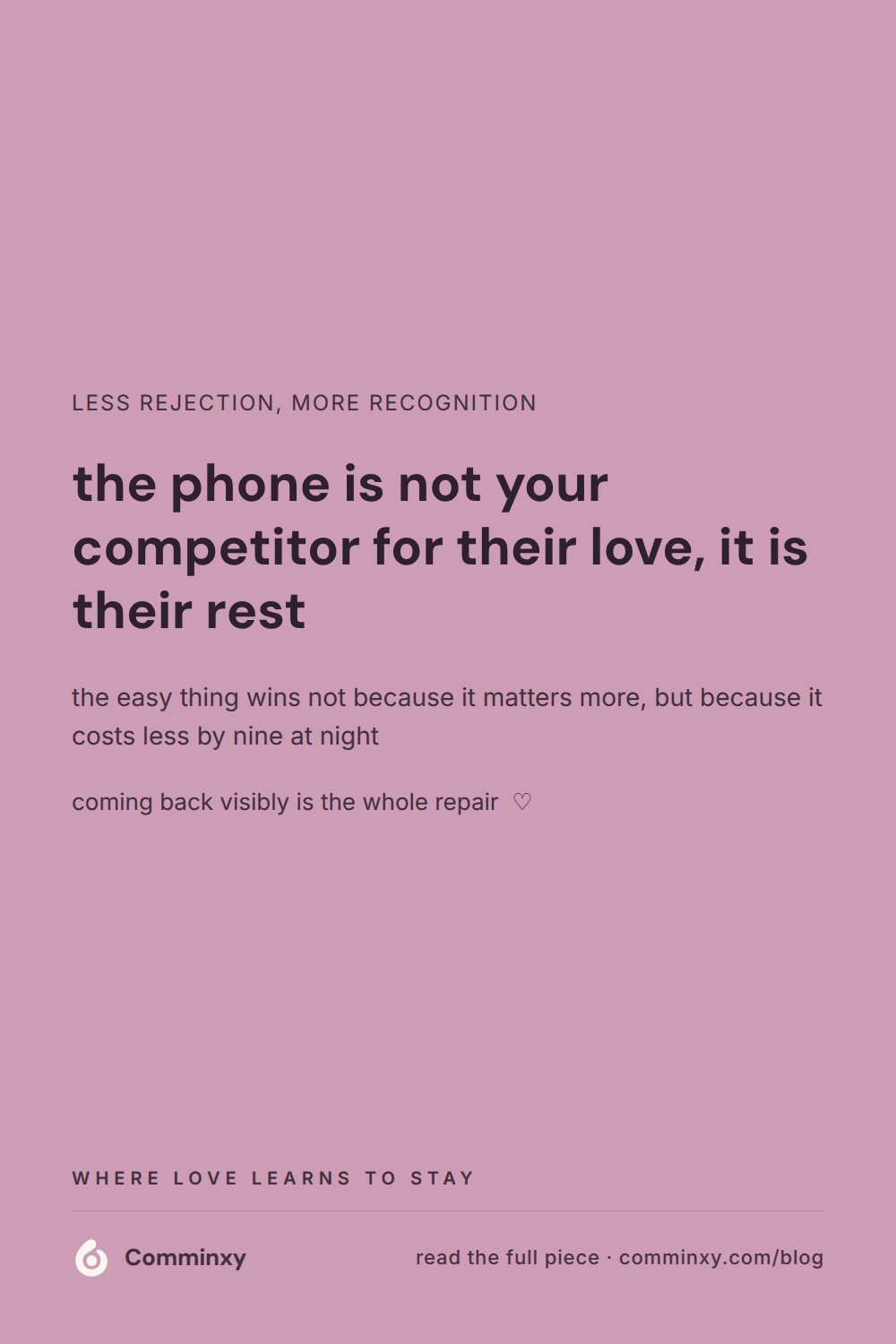
Attention is not infinite, and by the time you are both home it is nearly spent. The phone asks nothing of you. It never needs you to be patient or curious or generous. Your partner, the person you actually love, is the one relationship in the room that requires effort, and effort is precisely what you have run out of by nine at night. So the easy thing wins, not because it matters more, but because it costs less.
That is worth sitting with for a second before rushing to fix it. The phone is not your competitor for their love. It is their rest. Understanding that changes what you feel when their eyes drop. Less rejection, more recognition.
What the research says the small moments actually decide
You might assume the state of a relationship is written in its big conversations, the heavy talks, the anniversaries, the fights that go until two in the morning. The research points somewhere much smaller and much closer to that half-second glance.
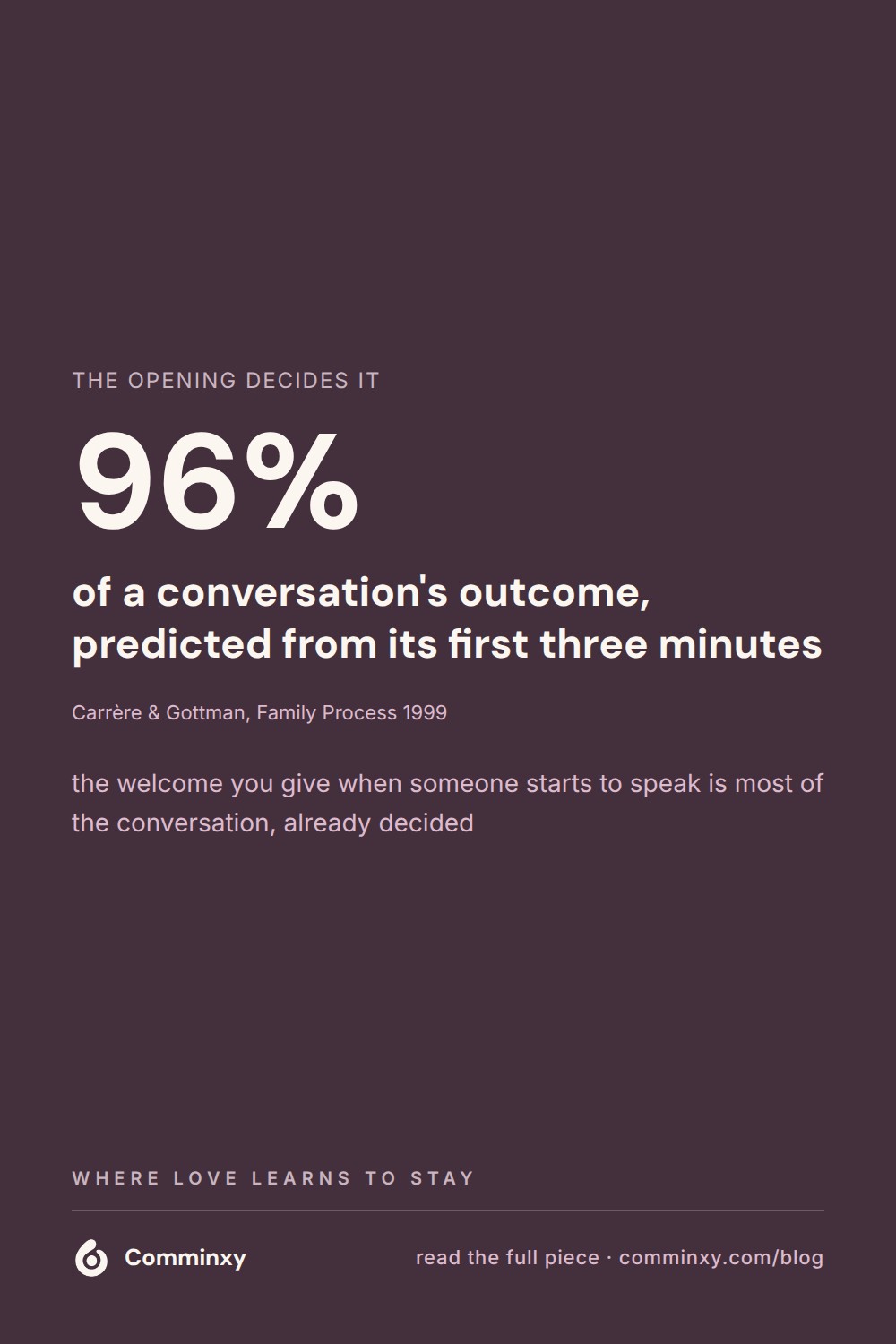
When Carrère and Gottman studied newlyweds beginning a difficult conversation, they found that the outcome of a fifteen-minute discussion could be predicted from its first three minutes, ninety-six percent of the time (Carrère and Gottman, Family Process, 1999). How something starts sets almost the whole of how it ends.
Sit with what that means for a phone on the coffee table. The moment your partner starts to tell you something is one of those first three minutes. Your face in that opening moment, present or absent, warm or distracted, is doing more than you think. This is not pressure to be perfect. Nobody is present for every opening. It is just a reason to know that the small welcome you give someone when they begin to speak is not small at all. It is most of the conversation, already decided.
The way back is a single glance, not a rule
Couples who try to fix this tend to reach for rules. No phones at dinner. No phones in bed. Charging stations by the front door. Some of that helps, and if it works for you, keep it. But rules break by Thursday, because they ask tired people to have willpower they do not have, and then the broken rule becomes one more thing to feel bad about.
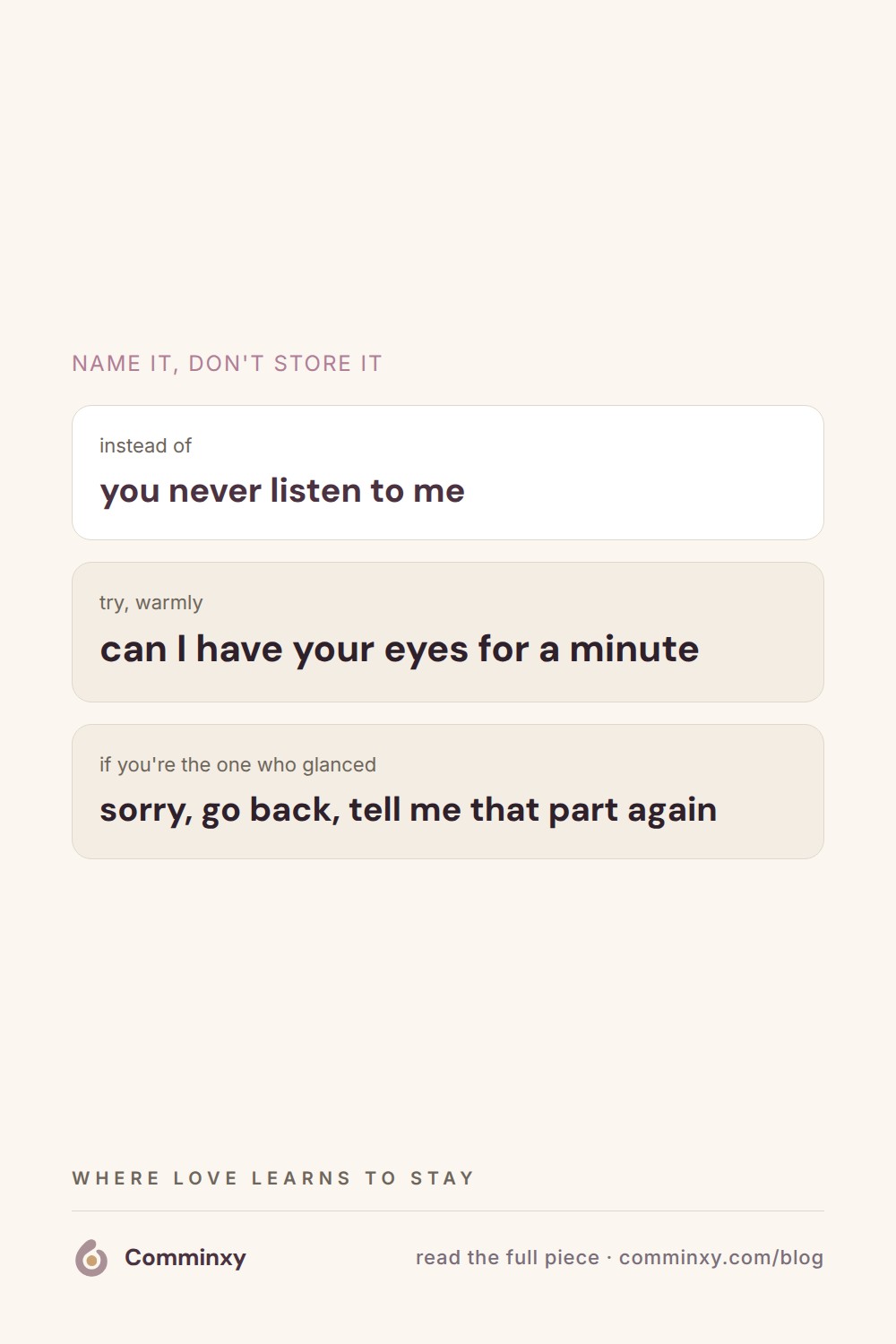
The way back is smaller and more forgiving than a rule. It is the willingness, once you notice the glance, to name it kindly instead of storing it. Not you never listen to me. Something more like, "Wait, I actually want to tell you this properly, can I have your eyes for a minute." Said warmly, it is not a complaint. It is an invitation, and most people say yes to being wanted.
The partner holding the phone has a version too. Putting it face down and saying "sorry, go back, tell me the sister part again" undoes almost all of the half-second. The glance stings because it feels like disappearing. Coming back visibly is the whole repair. You do not have to have been perfectly present. You have to return.
You will both forget this. You will do it badly. Someone will reach for the phone mid-sentence again this week, probably tomorrow. That is not proof it is hopeless. It is just what living with these machines is like now, and the couples who stay close are not the ones who never drift. They are the ones who keep coming back to the room. If naming these small returns out loud is hard, learning to communicate better with your partner is often less about big talks than about these tiny, repeated re-entries.
So the next time you are telling them something and you feel their eyes drop, you have somewhere to stand. You can let the story stay full. You can ask for their eyes without it being a fight. And if you are the one who glanced, you can look up and say tell me again, and mean it. Comminxy exists for exactly these small returns, the ones too quiet to fight about and too important to keep losing. That is where love learns to stay: not in the grand talk, but in the moment you put the bright rectangle down and let someone finish their sentence.
Questions people ask
why does my partner always look at their phone when i'm talking
Usually it is exhaustion and habit rather than a lack of interest in you. Phones are designed to be effortless while conversation asks for energy that is often spent by the end of the day. It tends to be a rest response, not a rejection, even though it can still hurt.
how do i tell my partner their phone use is hurting our relationship
Name the specific moment kindly instead of making it a broad accusation. Asking for their attention as an invitation, like saying you want to tell them something properly, lands better than telling them they never listen. Most people respond well to feeling wanted rather than blamed.
do no phone rules actually work for couples
They can help some couples but often break down because they rely on willpower that tired people run out of. When the rule breaks it can become one more thing to feel bad about. Small habits of returning attention tend to be more forgiving and sustainable.
is it normal to feel lonely even though we talk every day
Yes, this is common when attention is divided even while words are still being exchanged. Feeling unknown often comes from missing the small signals of being fully received, not from a lack of conversation. If the loneliness feels persistent or heavy, talking to a couples therapist can help.
Keep the idea with you — pin it, or download the cards.


Notice the glance, then come back to the room together
Get Comminxy free →