Misreading Your Partners Texts? Why Tone Gets Lost and How to Find It Again
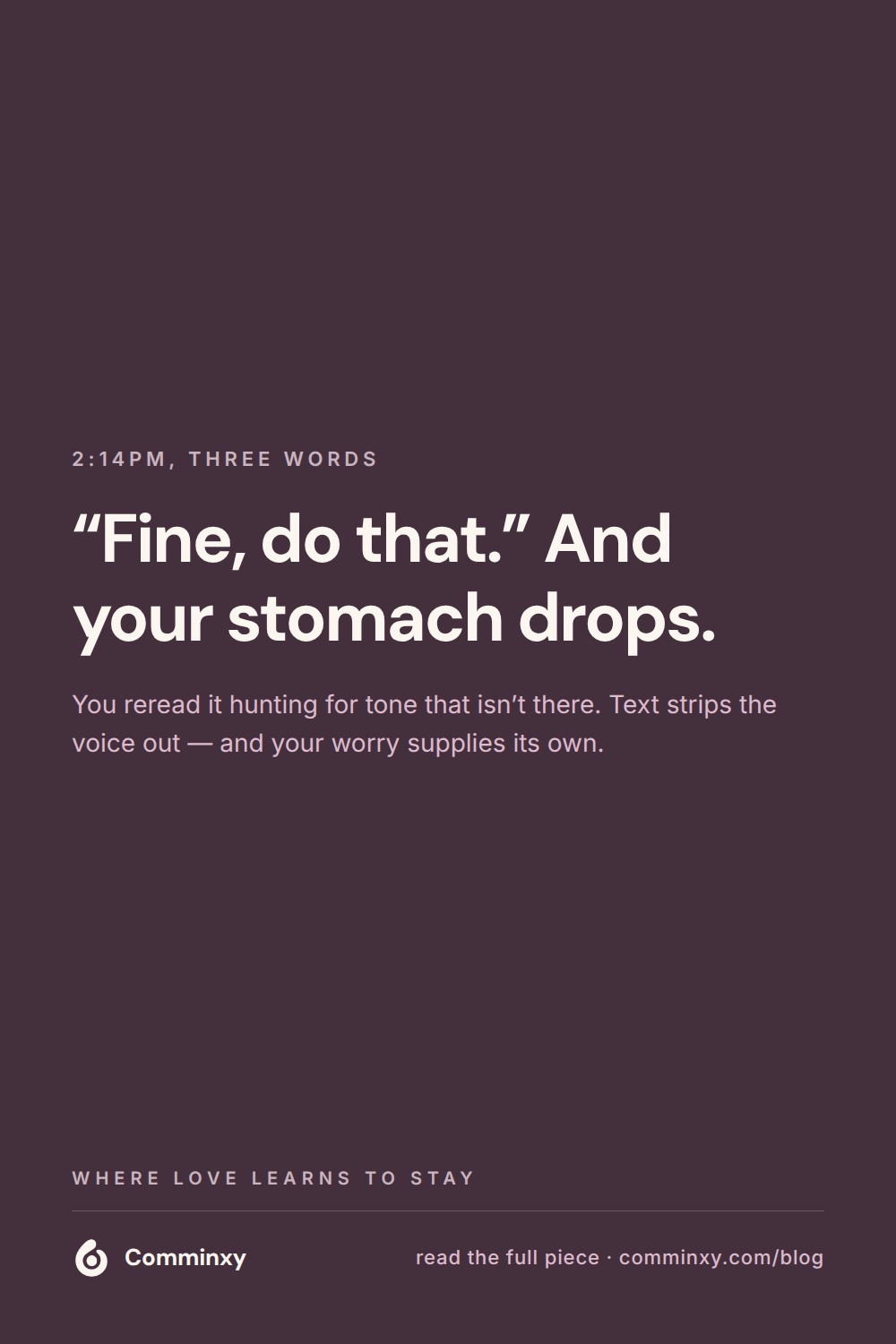
You send a message at lunchtime asking if they can pick something up on the way home. Hours pass. Finally, late afternoon, your phone lights up: "Fine, do that." Three words. You read them once, then again. Are they annoyed? Tired? Something worse? The screen gives you nothing, so your mind fills the gap, usually with the version you're most afraid of.
If you've ever spent an afternoon rewriting a reply in your head because you couldn't tell whether your partner was joking or hurt, you already know the strange ache of misreading partners texts. Not because you don't know them. Because the medium keeps hiding the very thing you rely on most: their tone.
The message was never the whole message
Think about how you actually understand your partner in a room together. They say "fine, do that," but their eyebrow lifts. Their voice curls up at the end. They're half-smiling as they say it. You don't hear a threat. You hear a tease. The words are the smallest part of what you're receiving.
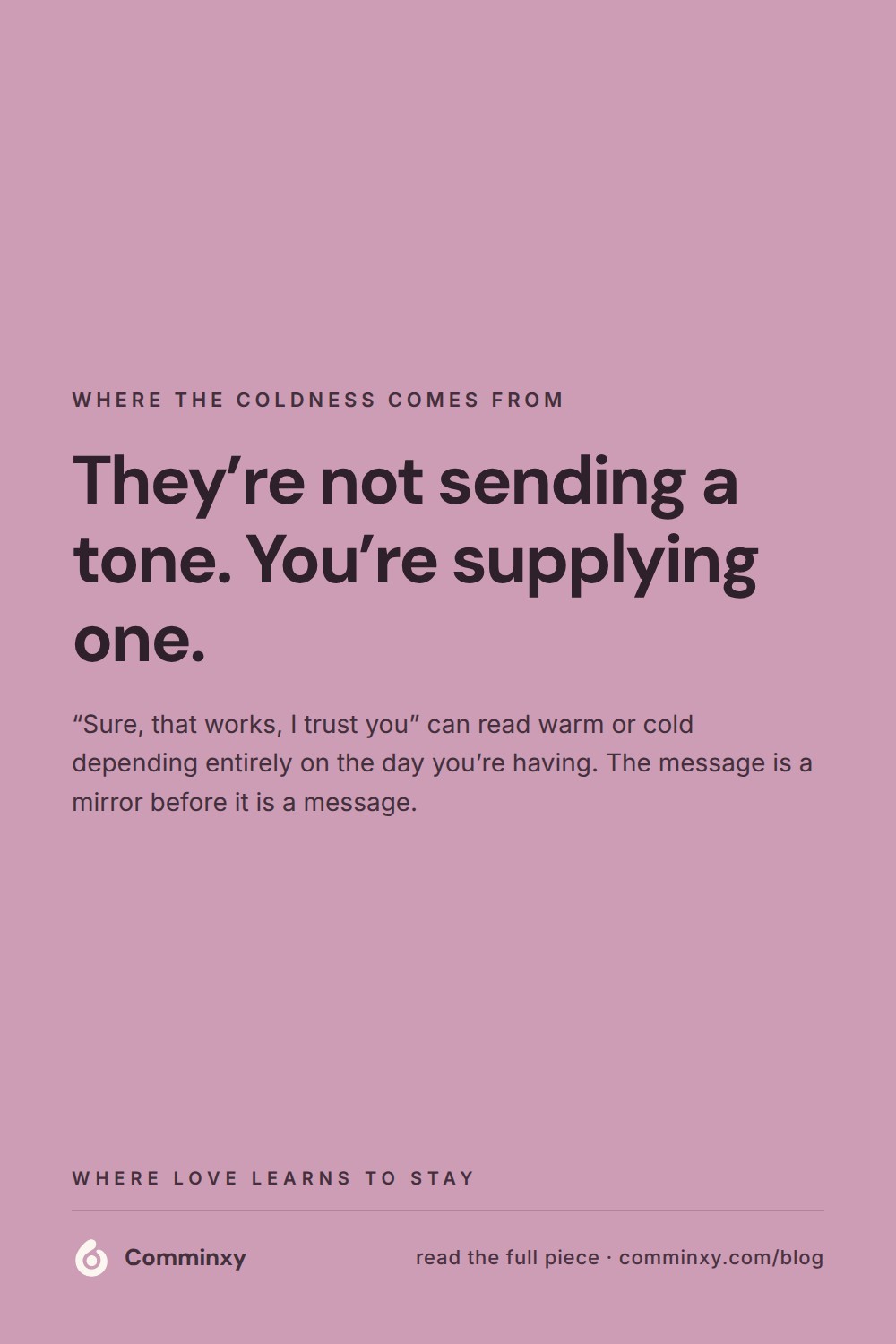
Now strip all of that away. Take the face, the breath, the pause, the warmth in the voice, and leave only the letters. That's what a text is. Your partner speaking to you through a keyhole. You get the words and nothing else, and your mind, which hates a blank space, rushes in to fill the rest with meaning. Usually the meaning it reaches for is the one you're most afraid of.
Why you fill the silence with the worst version
When you can't read tone, your nervous system doesn't shrug and wait for more information. It leans toward threat. Safer, evolutionarily speaking, to assume the ambiguous thing is danger. So a neutral text lands as a cold one. A short reply lands as an annoyed one. The gap between what they typed and what you felt widens, and you're already halfway into an argument that hasn't happened yet.
This matters more than we tend to admit, because of how those small misreads shape the bigger conversation. Carrère and Gottman, writing in Family Process, found something quietly staggering: in 96% of cases, the outcome of a fifteen-minute conflict conversation could be predicted from just its first three minutes. How a hard conversation begins tends to decide where it ends up. When the beginning is a misread text, a tone you invented, a coldness that was never there, you can walk into that conversation already braced for a fight. Already sharp. Already hurt by something your partner didn't actually do.
The misread isn't a small thing. It's the opening line. And the opening line, it turns out, carries almost everything.
What the flat text usually actually is
The person who sent the "cold" text is almost never cold. They're driving. They're between meetings. They're holding a baby with one arm and typing with a thumb. They fired off "fine, do that" while genuinely thinking, sure, that works, I trust you. The flatness wasn't a feeling. It was a lack of time.
The gap between how a message is sent and how it's received is one of the quiet ways partners drift into the communication patterns that slowly wear a relationship down. Not through any cruelty, but through a hundred small tones that were never actually there. You react to the version you imagined. They defend against an accusation they don't understand. And now you're both fighting a ghost.
What helps, more than anything, is remembering that a text is a draft, not a verdict.
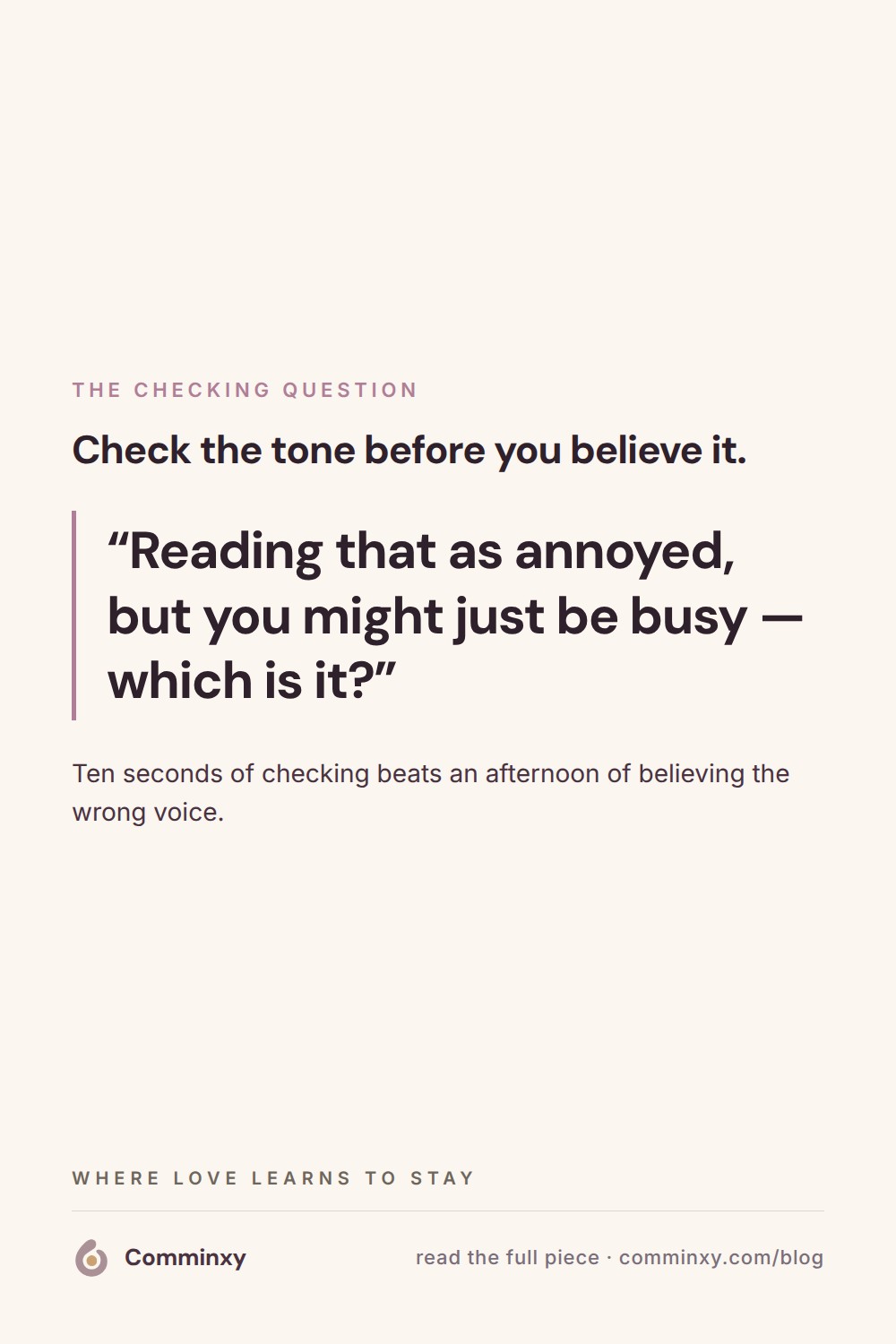
Before you respond to the tone you think you heard, you can ask about it. Not with an accusation ("why are you being like this") but with something that leaves room: "reading that as annoyed but you might just be busy, which is it?" Almost every time, they'll tell you it's the second one. The whole invented argument dissolves.
The repair is a single honest question
The way back from a misread is smaller than the size of the hurt would suggest. It's the willingness to check before you conclude. To treat the blank space around the words not as evidence, but as a question you haven't asked yet.
There's a tenderness in this. When you say "I couldn't tell your tone, so I imagined the worst. Was I right?", you're doing two loving things at once. You're admitting your own fear, and you're giving your partner a chance to be softer than the screen made them look. That's repair. Not grand. Just honest, and it happens in real time, before the small wound has a chance to calcify.
If you find yourself reaching for a sharp reply in these moments (and most of us do), it's worth understanding why the things we say over text so often aren't what our hearts meant. The same keyhole that hides their tone hides yours, too. The kindness you feel doesn't always survive the trip through the screen.
You know them better than the screen does
The misreading isn't a sign that something is wrong between you. It's a sign that you care what they think, and that the tool you're using to reach each other was never built to carry the tenderness you actually share. The flatness lives in the medium, not in your partner, and not in you.
So the next time you're staring at three words that seem to have gone cold, try to remember what you know about the person who typed them. The eyebrow, the half-smile, the way they've reassured you a hundred times before. The screen forgot to include all of that. You don't have to.
At Comminxy, we built for exactly these moments, the small misreads that grow teeth in the silence, because we believe most of the distance between two people isn't distance at all. It's tone that got lost on the way over, waiting for one honest question to find it again. That's where love learns to stay: not in getting it right the first time, but in reaching back across the gap and asking.
Questions people ask
why do i always think my partner is mad at me over text
Your brain fills the blank space where tone should be with the meaning you most fear, usually interpreting neutral or short texts as cold or angry. The flatness is almost always about lack of time, not actual emotion. A single honest question asking about their tone before you respond usually clears it up.
how do you tell if someone is actually upset through text
You usually cannot tell from the text alone, which is why asking directly works better than guessing. Try something like 'reading that as frustrated but you might just be busy, which is it?' Most of the time they will tell you it was never upset at all.
why does my boyfriend text so dry
Dry texts almost always mean someone is distracted, busy, or typing quickly, not that they feel distant or cold toward you. They are usually between tasks, driving, or using one hand, and the brevity has nothing to do with how they actually feel. The medium strips out warmth that would be obvious in person.
Keep the idea with you — pin it, or download the cards.


We built Comminxy for the moments tone gets lost and the gap starts to ache
Get Comminxy free →