Why You Feel Lonely Next to Your Partner Even When Nothing Is Wrong
You are both awake. The lamp on your side is still on because you were reading, and their breathing next to you has that slow, even weight that means they have crossed over into sleep. You are not fighting. There is nothing to point to. And still, lying there in the warm dark with someone you love an arm's length away, you feel more alone than you did on the crowded train home. This is the strange thing about feeling lonely next to your partner. It does not need a reason to explain it, and it does not go away just because the person is right there.
You might have felt it and then talked yourself out of it. Nothing is wrong, so what is there to say. But the feeling keeps its own record, quiet and stubborn, and it does not much care that on paper everything is fine.
The same evening, felt two ways
Here is a night that could belong to either of you. You cooked, they cleared up, you watched something, you went to bed. Warm enough. Ordinary.
One reading of that night is that nothing happened, and so nothing was lost. You were together for hours. You were kind to each other. The absence of trouble is its own kind of good, and there are seasons in a life when a calm, uneventful evening is exactly what two tired people can manage, and it is enough.
The other reading is that you were beside each other for hours and never once reached each other. You passed the salt. You laughed at the same joke on the screen. But nothing crossed the small gap between you, nothing that told either of you I see you, specifically, tonight. Two people can share every minute of an evening and end it holding very different amounts of it.
Both readings are true at the same time. That is what makes this so disorienting. The loneliness is not proof that something is broken, and it is not nothing either. It is a signal about closeness, and closeness turns out to be made of something more particular than time.
Why nearness is not the same as being reached
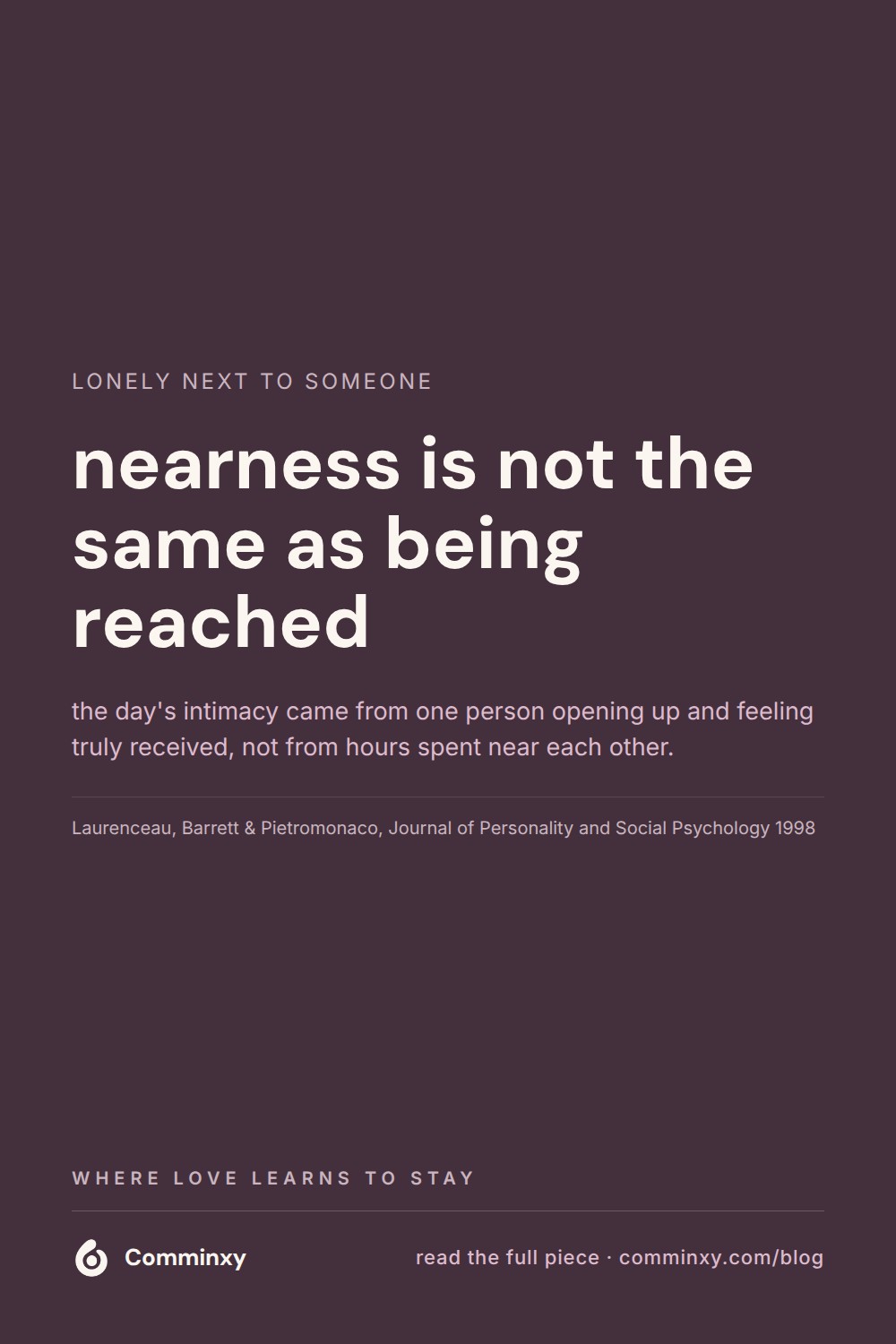
There is a difference between being near someone and being met by them, and the research puts a surprisingly clean edge on what the difference is made of. In a study that had couples record their daily interactions, closeness on a given day did not come simply from talking, or from being together. It came from a specific loop: one person revealing something real, the other responding, and the first person feeling that the response actually landed on them (Laurenceau, Barrett, and Pietromonaco, Journal of Personality and Social Psychology, 1998). The felt part mattered most. Not just that your partner spoke, but that you sensed they had truly received you.
Which explains the lamp-lit loneliness better than anything. You can spend a whole evening trading words with someone and never once open the small door that says this is what today actually did to me. And so nothing comes back through it, because nothing was sent.
This is oddly kind news, if you sit with it. The distance you are feeling is not a verdict on how much you love each other. It is the gap that opens when the reaching-and-being-reached has gone quiet for a while. Two people who love each other completely can still let that loop lapse without noticing, the way you stop hearing a clock you have lived with for years.
And if you are the one who has gone quiet, who has been answering in the shorthand of a long day rather than the longer sentences of a real one, that is not a character flaw. It is what tiredness does to the door. It shuts it gently and asks nothing of you, and you let it, because opening it costs something you did not have that night.
The loneliness that hides inside not fighting
Some of the ache next to a partner is not softness at all. It is the residue of things left unsaid to keep the peace.
Withdrawal is easy to mistake for maturity. You did not make a scene. You let the comment go. You decided it was not worth it, and on any given night that is a reasonable decision. But when the small pulling-away becomes the usual way of handling things, it does something quiet and slow. In long-term observation of couples, conflict withdrawal predicted a serious decline in how the marriage felt over time, while active disagreement, the willingness to actually stay in the room and say the difficult thing, was sometimes followed by things getting better, not worse (Gottman and Krokoff, Journal of Consulting and Clinical Psychology, 1989).
Read one way, this is unsettling, because it means the peaceful evenings might be costing something the fights would not. Read another way, it is a relief. It means the distance you feel is not built from anger you have failed to control. It is built from the honest things that never got said, and unsaid things can still be said. A closed door is not a wall. This is part of what happens when couples slowly stop talking, not with a decision, but with a hundred small choices to keep it simple.
How the door opens again
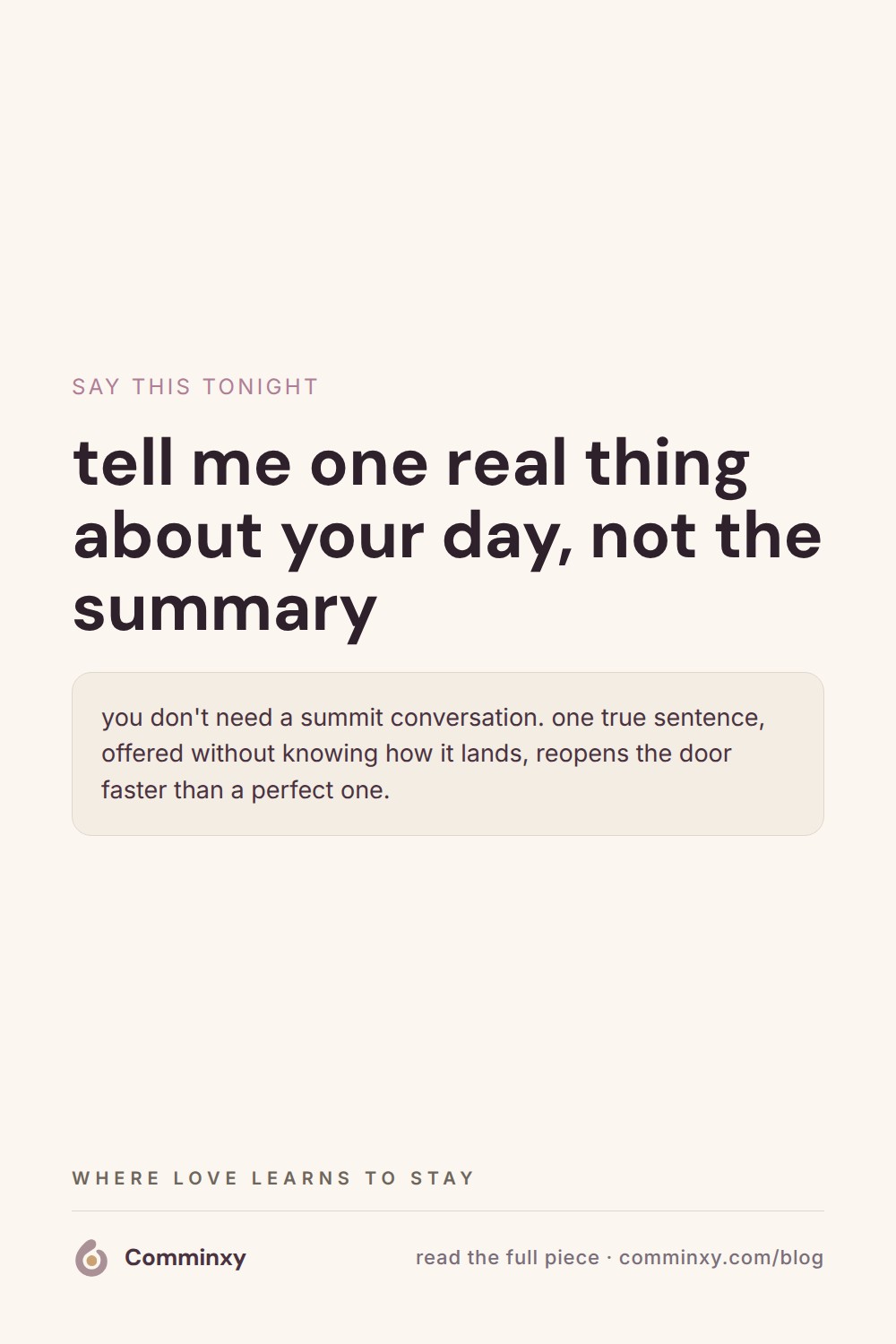
The way back is smaller than the loneliness makes it seem. It is not a summit conversation about the state of the relationship. It is one true sentence offered without knowing how it will land.
Something like: I felt a bit far from you tonight and I don't really know why. Or, if that is too much: Tell me one real thing about your day, not the summary. The point is not to say it well. The point is to open the door and let something cross. It can be clumsy. It can come out sideways at the wrong moment while one of you is looking for a phone charger. A clumsy reach still counts, and it often counts for more than a graceful one, because the person can hear that you meant it.
And when it is your partner who reaches, the whole thing turns on what you do in the next few seconds. You do not have to have a perfect answer. You have to let them see it landed. A hand moved across the sheet. A that sounds like a hard one, tell me more. That is the responsiveness the research kept finding underneath closeness, and it is not a technique. It is just staying in the room a beat longer than tiredness wants you to. If words are the hard part, some couples find it easier to start by simply learning to say the real thing to each other in low-stakes moments, so the door is not stiff when it matters.
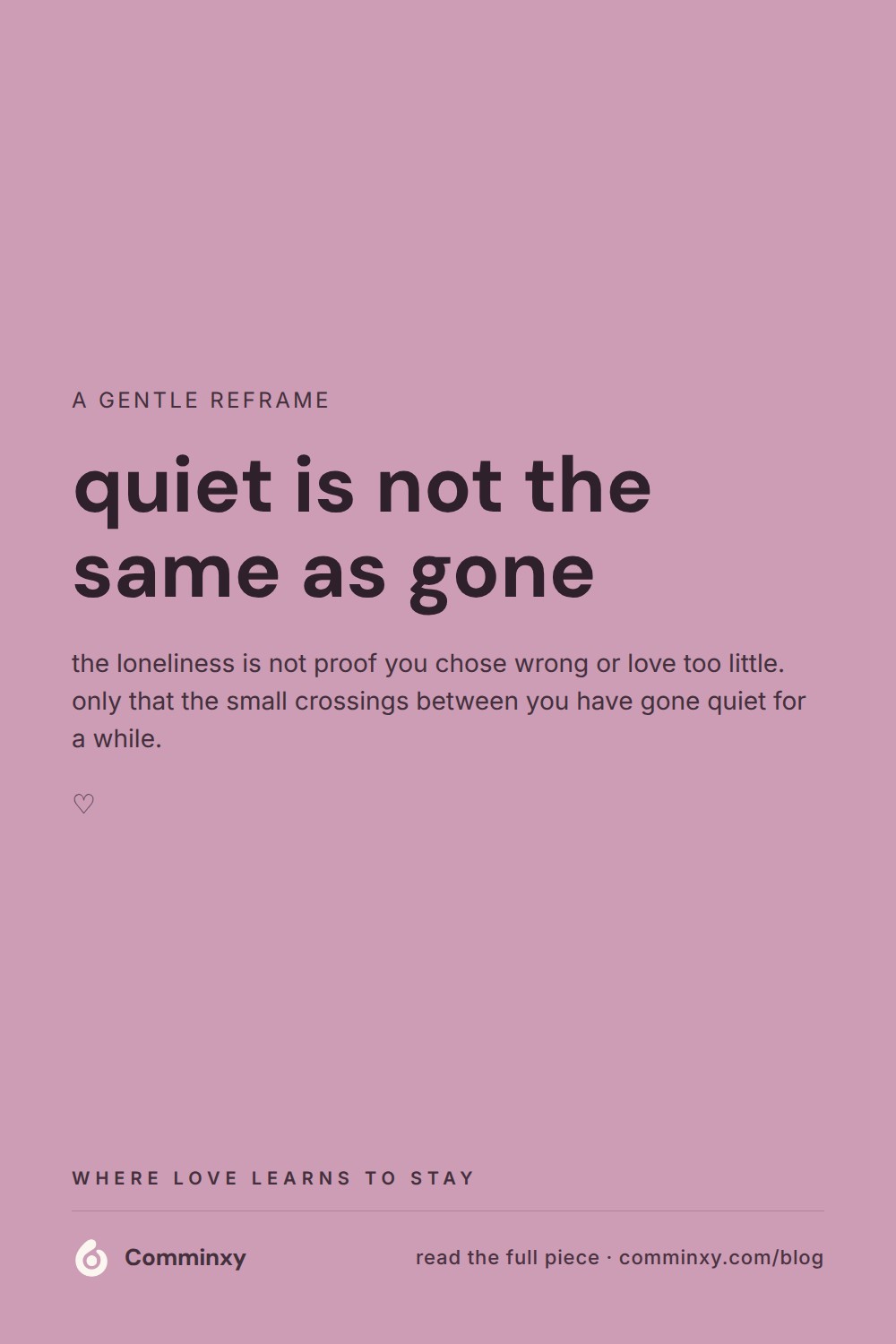
The lamp is still on. Their breathing is still slow and even beside you. Nothing about the night has to change for the loneliness to loosen its grip, because you understand now what it was telling you. Not that you chose wrong, or love too little. Only that the small crossings between you have gone quiet, and quiet is not the same as gone. Comminxy exists for exactly this hour, the one where you feel the gap and cannot find the sentence, offering a gentle way to reach across it before the door stiffens shut. You can turn the lamp off now. In the morning, there is one real thing you can tell them, and one you can wait to hear. That is usually where love learns to stay.
Questions people ask
why do I feel lonely with my partner even though we get along
Getting along is not the same as feeling met, and you can spend calm evenings together without either of you sharing anything real. The loneliness usually points to a lapse in the small back-and-forth where one person opens up and the other genuinely responds. It often has nothing to do with how much you love each other.
is it normal to feel alone in a relationship when nothing is wrong
Yes, this is common and it does not mean the relationship is failing. Two people can be kind, present, and comfortable while the deeper reaching between them has quietly gone silent. The absence of conflict can hide the absence of real connection.
does avoiding arguments hurt a relationship
It can, when keeping the peace turns into a habit of never saying the difficult things. Withdrawing to avoid conflict tends to let distance build slowly, while honestly staying in the conversation can actually bring people closer over time. The unsaid things can still be said later.
how do I feel closer to my partner again without a big talk
Start small by offering one honest thing about your day instead of the usual summary. You do not need a serious relationship conversation, just a genuine sentence that opens the door a little. When your partner reaches back, letting them see it landed matters more than answering perfectly.
Keep the idea with you — pin it, or download the cards.


When the gap feels wide, one real sentence can start crossing it.
Get Comminxy free →