Keeping Score in a Relationship: Why the Tally Never Wins
You did the dishes last night. You remember it clearly: the water gone cold, the one pan that never comes clean, the small ache in your lower back. And so when they leave their plate on the counter this morning, something in you tightens. Not anger, exactly. More like a quiet accounting. I did mine. You didn't do yours. A number gets written down somewhere you can't see.
Almost everyone who has ever loved someone has, at some point, found themselves keeping score in a relationship. It rarely begins as bitterness. It begins as fairness, a wish to be seen for what you give. But the tally has a strange property: the longer you keep it, the less it ever seems to balance.
The ledger you never meant to start
It starts small. You drove to the airport. They forgot your work thing. You took the kids on Saturday so they could rest. They went out with friends and came home late, and you said it was fine, and mostly it was, except a small mark went into the column anyway.
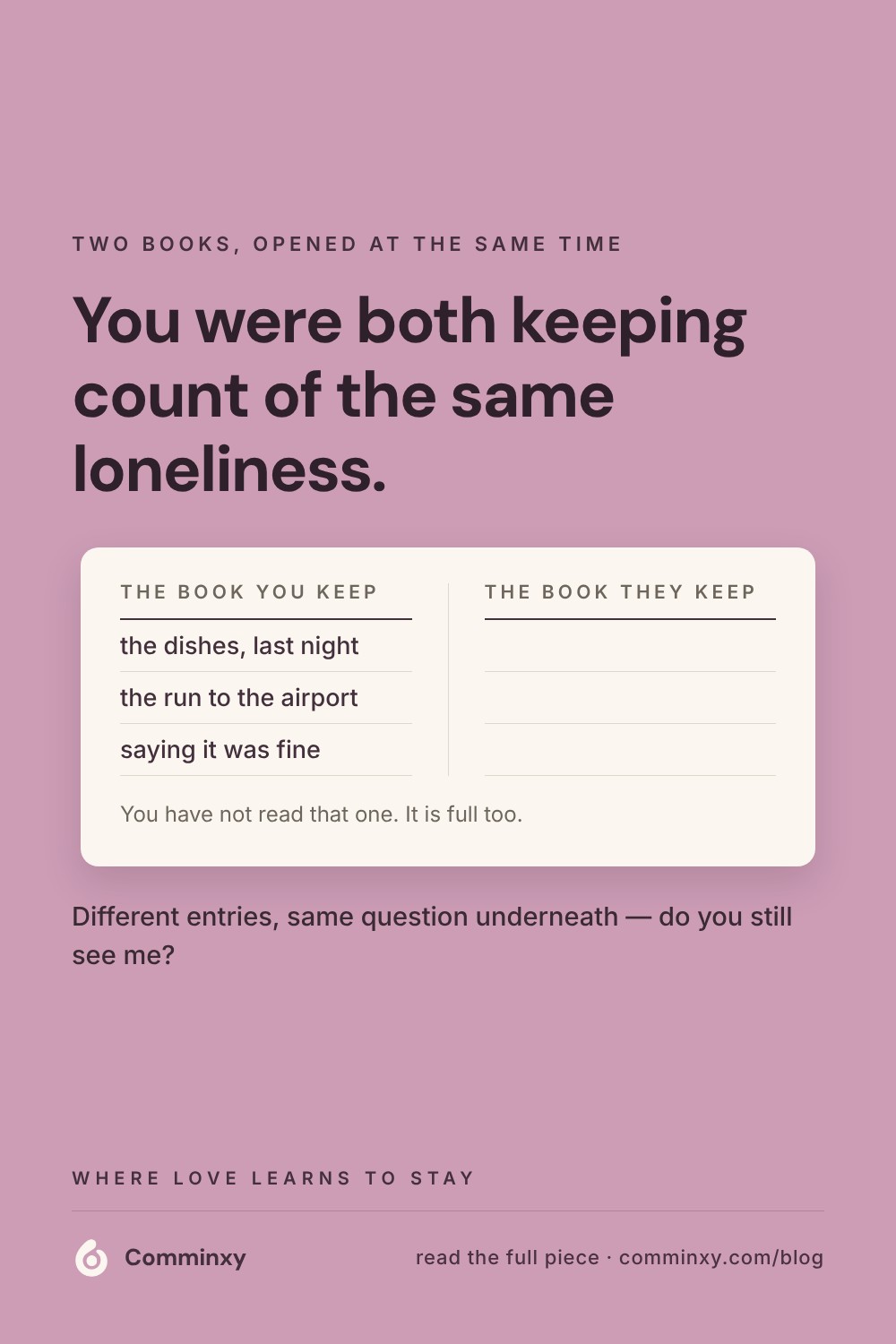
The ledger is quietly painful for a particular reason. You are the only one keeping it. Your partner has a ledger too, a completely different one, with completely different entries, in which they're the one who gives and gives. Two people, each privately certain they are owed. Neither book balances against the other, because they were never the same book.
And the entries are not equal in weight. The thing you did, you remember from the inside: the cost, the effort, the tiredness. The thing they did, you only see from the outside, the finished result, which always looks easier than it was. So your own contributions feel heavy and theirs feel light, not because you are selfish, but because that is simply where you are standing.
Why we start counting in the first place
Nobody wakes up wanting to tally their love. Counting is what we reach for when we stop feeling certain we are valued. The score is not really about the dishes. It is a way of asking a question we are afraid to ask out loud: Do you still see me? Does what I give still matter to you?
When the answer feels uncertain, the mind does something protective. It starts gathering evidence. Every unreturned gesture becomes proof, and slowly the relationship reorganises itself around grievance rather than around the person you fell for. This is part of what Gottman and Krokoff found in the Journal of Consulting and Clinical Psychology: it is the quiet withdrawal, the turning away, that predicts the deepest long-term erosion of a marriage, more than open disagreement ever does. The score is a form of withdrawal that wears the costume of fairness. You are still in the room, but you have started keeping your love in reserve until the books are settled.
The story underneath the scorekeeping
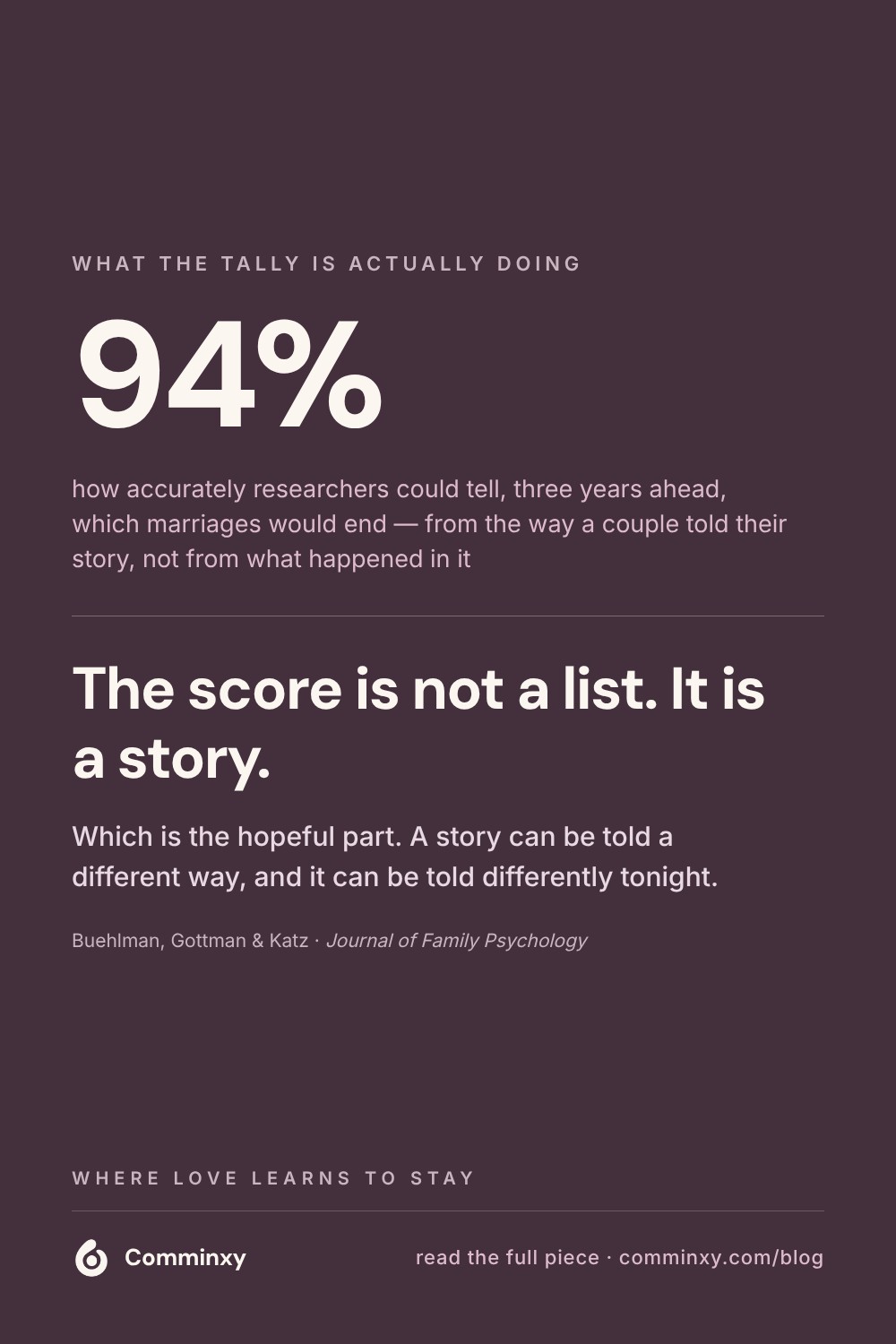
The score is never really a list of facts. It is a story. And the story is usually some version of I am giving more than I am getting, and one day there will be nothing left of me.
That story matters more than the actual tally, because of something Buehlman, Gottman, and Katz found in the Journal of Family Psychology. Simply listening to how a couple tells the story of their relationship (not the events themselves, but the way they narrate them) predicted whether they would divorce within three years with around 94% accuracy. The facts of a marriage are rarely the thing. The story the couple tells about those facts is almost everything.
Which means the score you are keeping is shaping you more than you realise. Every time you add an entry, you are not just recording a grievance. You are quietly rewriting the story of who your partner is. From someone who loves me imperfectly to someone who keeps taking. And the more you tell that second story, the more true it begins to feel.
Setting the ledger down
You don't stop keeping score by trying harder to be generous. That just becomes another entry: look how much I'm not keeping score now. The tally loosens when you change where you are standing.
Finkel and his colleagues in Psychological Science asked couples, three times a year, to spend a few minutes writing about their most recent conflict, but from the perspective of a neutral outsider who wants the best for both of them. Twenty-one minutes of writing across an entire year. That was all. And it completely flattened the decline in marital satisfaction that the other couples experienced. Twenty-one minutes of stepping outside your own column in the ledger.
That is what the way back looks like. Not grand gestures of fairness, but a small shift in vantage point. Seeing the morning plate on the counter not as the latest entry against you, but as one tired person living alongside another tired person, both of whom forget things, both of whom are trying. If you want a gentler way into that conversation when the tension is already high, how to have a calm conversation when you're both upset sits close to this.
What it sounds like to put the book down
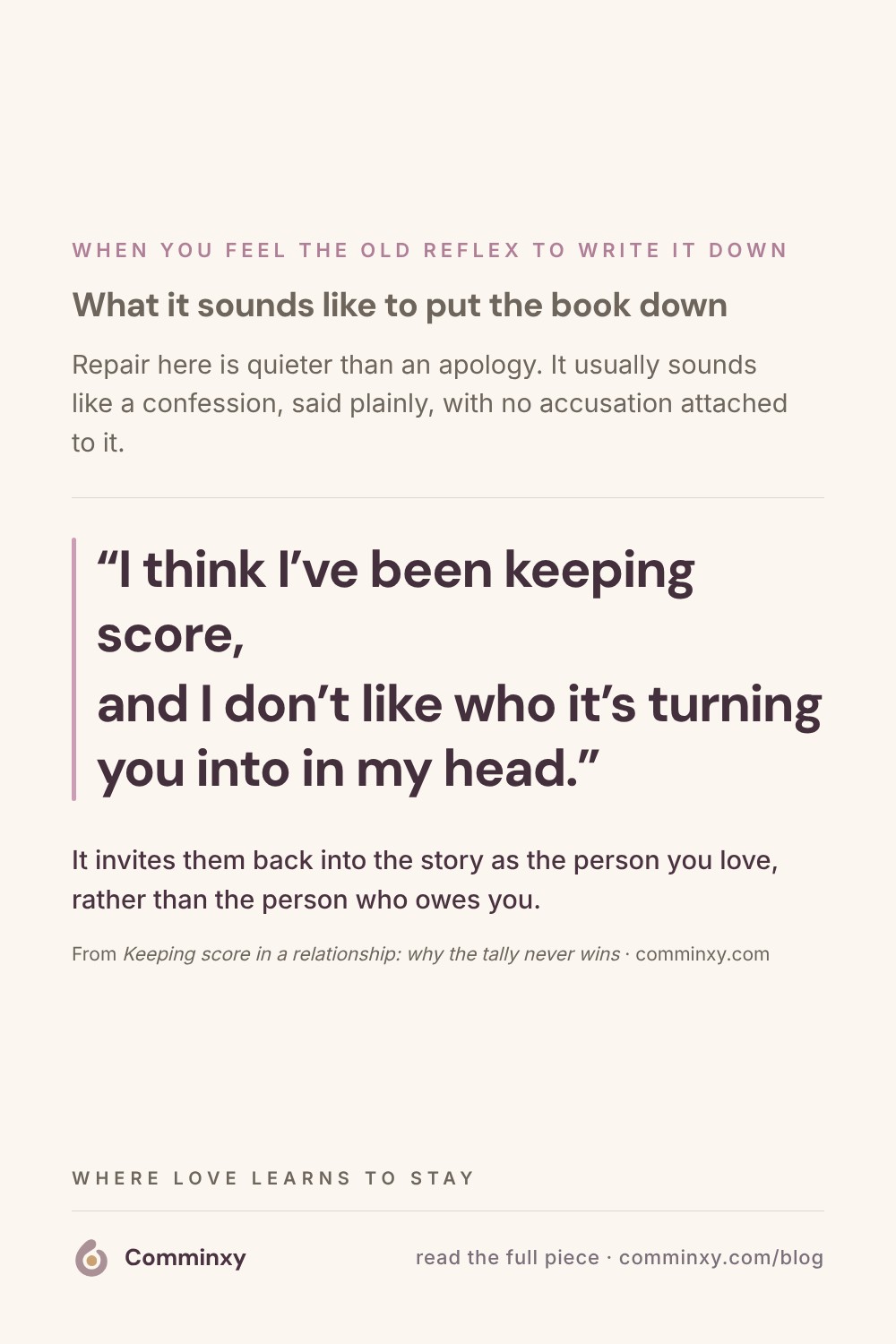
Repair here is quieter than an apology. It often sounds like a confession: I think I've been keeping score, and I don't like who it's turning you into in my head. Said plainly, without accusation. What you are really doing is inviting your partner back into the story as the person you love rather than the person who owes you.
And something tender tends to happen when one person sets the book down first. The other often realises they were holding one too. The two ledgers, opened at the same time, almost never match. And in that mismatch is a strange relief. Oh. You felt unseen too. We're both keeping count of the same loneliness. If the scorekeeping has already hardened into something colder between you, the four communication patterns that destroy relationships may help you name what has been happening.
So tonight, when the plate is on the counter and you feel the old reflex to write it down, you might pause, just for a breath, and remember that they are not your opponent. They are the person you are trying to stay close to, doing their imperfect best, the same as you. The dishes will get done by one of you, or both, or neither, and the love is not actually stored in that. It is stored in whether you keep facing each other. Comminxy exists to sit beside you in those small, ordinary moments, not to settle the score, but to help you set it down, so that, gently, love learns to stay.
Questions people ask
why do i keep score in my relationship
You start keeping score when you stop feeling certain that your partner values what you give. The tally is a protective way of asking whether they still see you and whether your efforts still matter to them. It rarely begins as bitterness but as a wish for fairness.
how do i stop keeping score with my partner
You stop by stepping outside your own perspective, not by trying harder to be generous. Research found that writing about conflicts from the view of a neutral outsider for just 21 minutes across a year completely stopped the usual decline in relationship satisfaction. The shift is seeing your partner as another tired person trying their best, not as someone who owes you.
is keeping score in a relationship toxic
Keeping score is a form of quiet withdrawal that wears the costume of fairness, and withdrawal predicts deep long-term erosion in marriage. It rewrites your partner from someone who loves you imperfectly into someone who keeps taking. The ledger shapes you more than you realize and organizes the relationship around grievance instead of connection.
Keep the idea with you — pin it, or download the cards.


Comminxy helps you set the ledger down and face each other again
Get Comminxy free →