The Gottman State of the Union: A Weekly Ritual That Keeps Love From Quietly Drifting
You know the small resentments before you can name them. The thing they said at your sister's birthday that you decided to let go, except you didn't. The way the holiday planning fell to you again. The feeling, driving back late from somewhere, that you are both being perfectly polite and something underneath has gone quiet. None of it is big enough to start a fight over. So you don't. And it collects.
A Gottman State of the Union is a weekly conversation, usually set aside for the same hour each week, where two people take turns saying what felt good between them and what didn't, and the listener's only job is to understand before defending. It was developed by John and Julie Gottman as a way to give small grievances a scheduled home, so they stop leaking out sideways on a Wednesday night over something that was never really the point.
That is the whole idea. A standing appointment for the things that are too small to raise and too persistent to ignore.
Why the small things are the dangerous ones
The arguments people fear are the loud ones. But the ones that quietly unpick a relationship tend to be the opposite. They are the comments you swallowed, the ask you decided not to make because it felt like too much on an already full day. Each one is minor. The problem is that nothing minor ever actually leaves. It waits.
And waiting changes it. A forgotten errand, left alone for three weeks, stops being an errand. It becomes evidence. By the time you finally say something, you are not talking about the errand at all, you are talking about who you have both decided the other person is.
There is research on exactly this slide. Fincham and Bradbury found that when a partner's behaviour gets read as intentional, selfish, and blameworthy, hostility and conflict reciprocation rise sharply in the conversations that follow (Fincham and Bradbury, Journal of Personality and Social Psychology, 1992). The story you build in the silence becomes the thing you fight.
Which is what the weekly check-in is quietly working against. Not the grievance itself. The story that grows around it while nobody is saying anything.
What a Gottman relationship checkup actually looks like
It is less formal than it sounds. Two people, a pot of coffee going cold, an agreement that for the next while, this is the thing you are doing.
You start with what went right. Not as a warm-up to soften the blow, though it does that too. You start there because by Thursday most couples have genuinely forgotten the good parts of their own week together, and saying them out loud is half the repair. The time they covered for you when you were sinking. The text that made you laugh in a dull meeting. Naming it returns it to both of you.
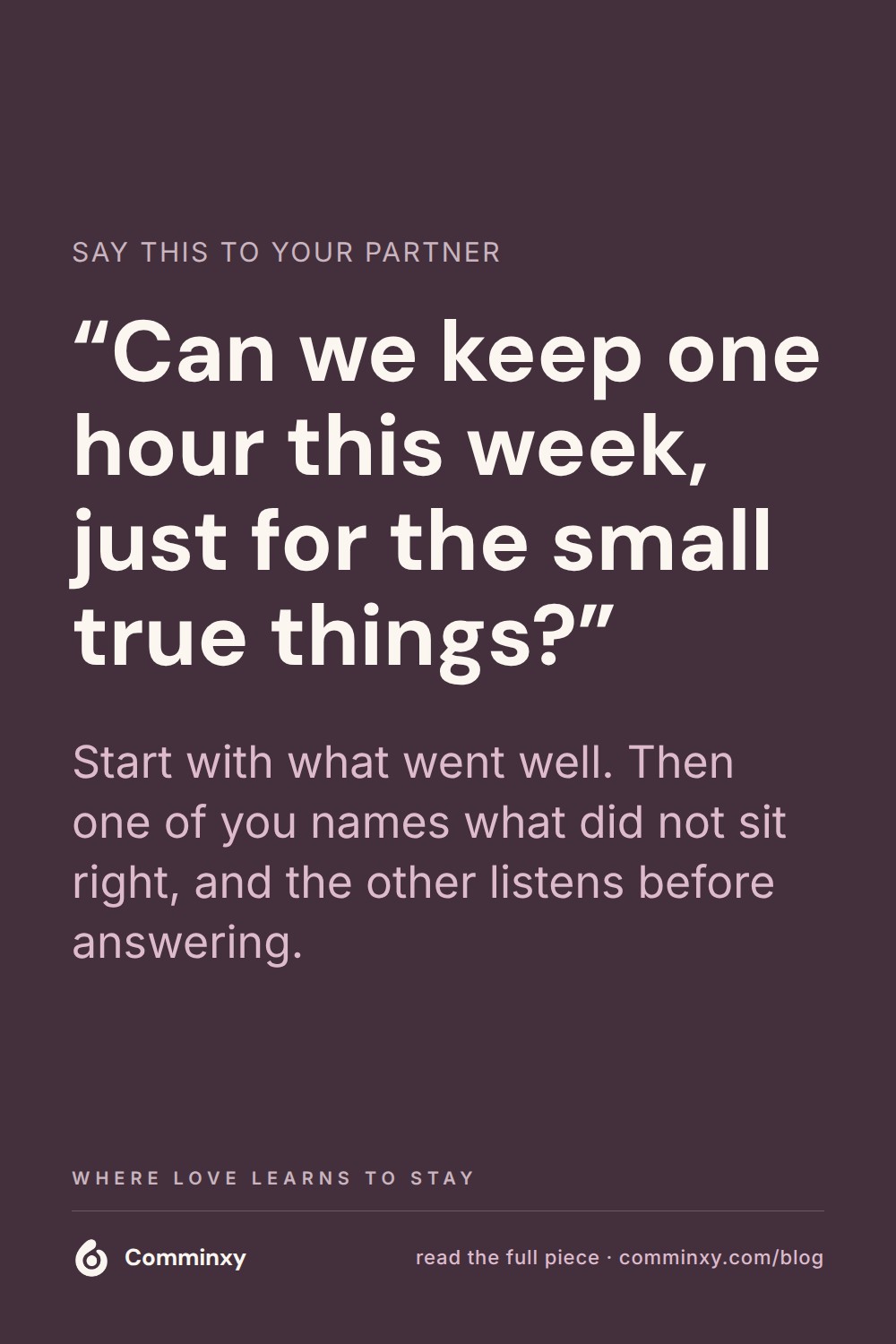
Then one person raises something that didn't sit well, and the other person listens. Really listens, the uncomfortable kind, where you are not quietly assembling your rebuttal while they talk. You ask what it was like for them. You repeat back what you heard before you say a word about your own side. Then you swap.
It will be awkward the first few times. Possibly the first ten times. Sitting down on purpose to say "here is a thing that bothered me" feels staged when you are used to letting it surface mid-disagreement. That awkwardness is not a sign you are doing it wrong. It is just what a new habit feels like from the inside. If talking to each other at all has started to feel hard, it may help to read why couples stop talking and how to fix it before you begin, because sometimes the silence runs deeper than any single week's complaints.
The repair is in the structure, not in getting it right
People assume the ritual works because it makes you better at communicating. That is part of it. But the quieter mechanism is that the meeting exists at all.
When there is a standing time to raise things, each grievance has somewhere to go that isn't the worst possible moment. You are not deciding, in the heat of being hurt, whether this is worth bringing up right now. You already know when it gets brought up. Friday, or Sunday morning, or whenever you landed on. That alone takes the pressure off a hundred small tensions that would otherwise detonate when one of you is tired and the other is already late.
The size of this effect is easy to underestimate. Stafford and Canary studied what actually keeps relationships healthy and found that a handful of ordinary maintenance behaviours, openness and positivity and assurance among them, were linked to how satisfied couples were (Stafford and Canary, Journal of Social and Personal Relationships, 1991). The weekly meeting is not some advanced technique. It is a container that makes those small, dull, essential behaviours happen on a schedule instead of only happening when you both feel like it, which, in a hard stretch, is never.
And you will do it badly. You will skip a week. You will go in calm and get defensive anyway and say the thing you promised yourself you wouldn't. None of that undoes it. A clumsy check-in where one of you gets prickly and the other reaches over and says "okay, let's slow down" is still worth more than three weeks of careful silence. The point was never a flawless conversation. The point was that you both showed up to have one.
What changes when it becomes a habit
The first thing couples usually notice is not the meeting itself. It is the rest of the week. The small irritations feel lighter because they are no longer load-bearing. You can let something go on a Tuesday, genuinely let it go, because you know it has a place to land on Sunday if it still matters then. Half the time it won't.
The other change is slower and harder to see from inside it. You start to trust that things get said. Not everything, not perfectly, but enough that the quiet between you stops feeling like something is being withheld. If you have felt that unspoken weight building, there is more on untangling it in how to communicate better with your partner, though honestly, the weekly habit teaches most of it by doing.
This will not fit every couple the same way. Some find the formality helpful and some find it stiff and need to loosen it into something that feels like theirs. The research does not tell us there is one correct version. It tells us that couples who find a regular way to say the small true things tend to drift less.
Think back to that late drive home, the politeness, the quiet underneath it. That quiet was never the problem. The problem was that it had nowhere else to go. A weekly meeting is simply a door you leave open on purpose, so the small things can walk out before they grow teeth. Comminxy was built to sit beside couples in exactly these conversations, holding a little of the structure so you can hold each other. Love does not stay by accident. It stays because, most weeks, clumsily, you both keep turning up to say the quiet thing out loud.
Questions people ask
gottman relationship checkup
It is a weekly conversation where both partners take turns naming what felt good and what did not that week. The listener focuses on understanding the other person before explaining their own side. It gives small ongoing tensions a regular place to be raised instead of building up in silence.
how often should you do a gottman state of the union
Most couples do it once a week at the same set time, like Friday evening or Sunday morning. The regular schedule matters more than the exact day because it means every small issue has a known place to go. Skipping a week occasionally does not ruin it.
what do you talk about in a state of the union meeting
You start with what went well between you that week, then one person raises something that bothered them while the other listens. After that you swap roles. The focus stays on recent small things rather than old or sweeping complaints.
why does the gottman check in feel so awkward at first
Sitting down on purpose to name a complaint feels staged when you are used to issues surfacing mid-argument. That awkwardness is normal for a new habit and usually fades after several weeks of practice. It is not a sign you are doing it wrong.
Keep the idea with you — pin it, or download the cards.

A set time each week keeps the quiet things from piling up
Get Comminxy free →