How to De-escalate a Fight With Your Partner Before It Spirals
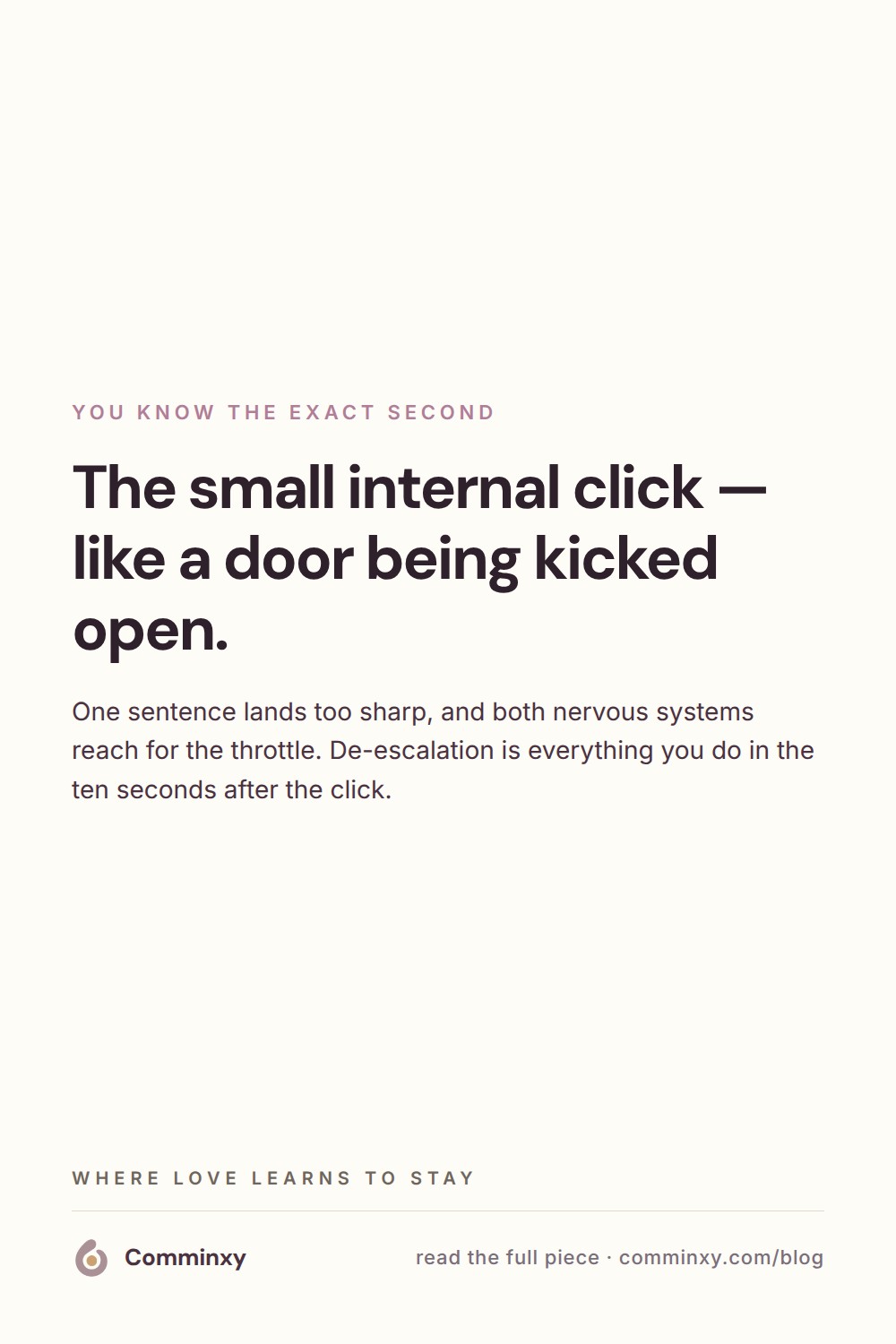
You know the exact second it turns. One of you says something a little too sharp, and the other one hears it, and there's this small internal click like a door being kicked open. Your chest tightens. The thing you were arguing about (who forgot to text, whose turn it was, why the tone) suddenly matters less than the fact that you're now in it, and you can feel yourself reaching for the next line before your partner has even finished theirs. If you've ever tried to de-escalate a fight with your partner in that moment and found yourself pouring gasoline on it instead, you are not doing anything unusual. You are doing something almost everyone does, and it makes more sense than you think.
The fight isn't spiraling because of what you're saying
We tend to believe a fight spirals because someone said the wrong thing: picked the cruel word, brought up the old grievance, went one sentence too far. So we try to fix escalation by choosing better words. And sometimes that helps. But watch closely and you'll notice something stranger. By the time the words are coming out badly, the escalation has already happened. The sharp sentence isn't the cause. It's the exhaust.
What if the thing spiraling isn't the conversation at all, but your body? Long before the argument gets loud, something quieter has shifted. Your heart rate has climbed. Your breathing has gone shallow. Your attention has narrowed to a pinhole aimed at whatever feels like a threat. In that state, you are not really talking to your partner anymore. You're talking to a version of them your nervous system has decided is dangerous.
Why your body gets there before you do
Gottman and Levenson spent years wiring couples up and watching their physiology in real time, and what they found reframes the whole idea of a "bad fight." The couples who struggled weren't necessarily meaner or worse at communication. They were more physiologically flooded, caught in what the researchers called destructive interactive cascades, the "Four Horsemen," that predicted marital decline (Gottman & Levenson, Journal of Personality and Social Psychology, 1992). The key insight isn't that some people are bad at conflict. Once the body floods, the tools you'd normally use (patience, curiosity, generosity) go offline. You can't reason your way out of a state your body has already entered.
Which means the moment you feel that click in your chest, you're not facing a communication problem. You're facing a regulation problem. And those are solved very differently. You can read more about that cascade of patterns in the four communication patterns that destroy relationships, but the short version is this: the goal isn't to win the point. It's to keep both of you in the room, in your bodies, still reachable.
The move that feels like giving up but isn't
There's a small gesture that satisfied couples make in the middle of conflict that looks, from the outside, like they're not taking the fight seriously. A dry joke. A ridiculous face. A hand on a knee mid-sentence. An affectionate eye-roll that somehow lands as we're okay instead of you're absurd.
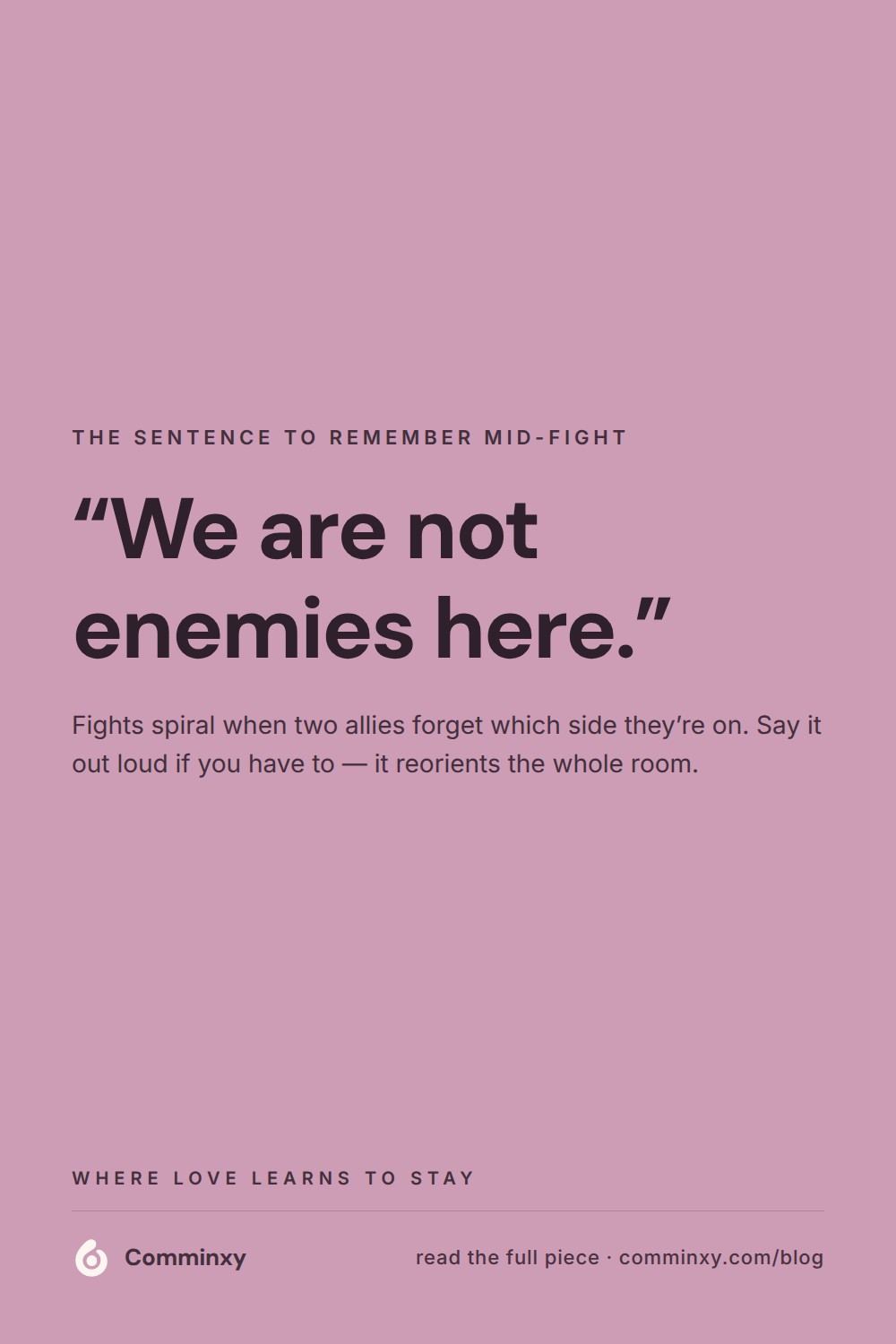
Carstensen, Gottman, and Levenson studied long-married couples and found it was doing real work: partners who used humor and affection during conflict were literally soothing their own physiology, bringing their bodies back down from the flood, which let the bond stay stable (Carstensen, Gottman, & Levenson, Psychology and Aging, 1995). The joke isn't a distraction from the conflict. It's a nervous system reaching across to another nervous system and saying, we are not enemies here.
This is why de-escalation so often fails when you approach it as a debate tactic. You can't lower the temperature by being more correct. You lower it by reminding both of you, in some small physical or tender way, that you're on the same side of the table even while you disagree.
What it actually looks like to catch it early
The most useful moment to de-escalate isn't in the middle of the fight. It's about four sentences before the fight fully arrives, that narrow window where you feel the shift but haven't yet committed to it. This is uncomfortable, because catching it early feels like conceding. You have to interrupt your own momentum right when the momentum feels like the only thing protecting you.
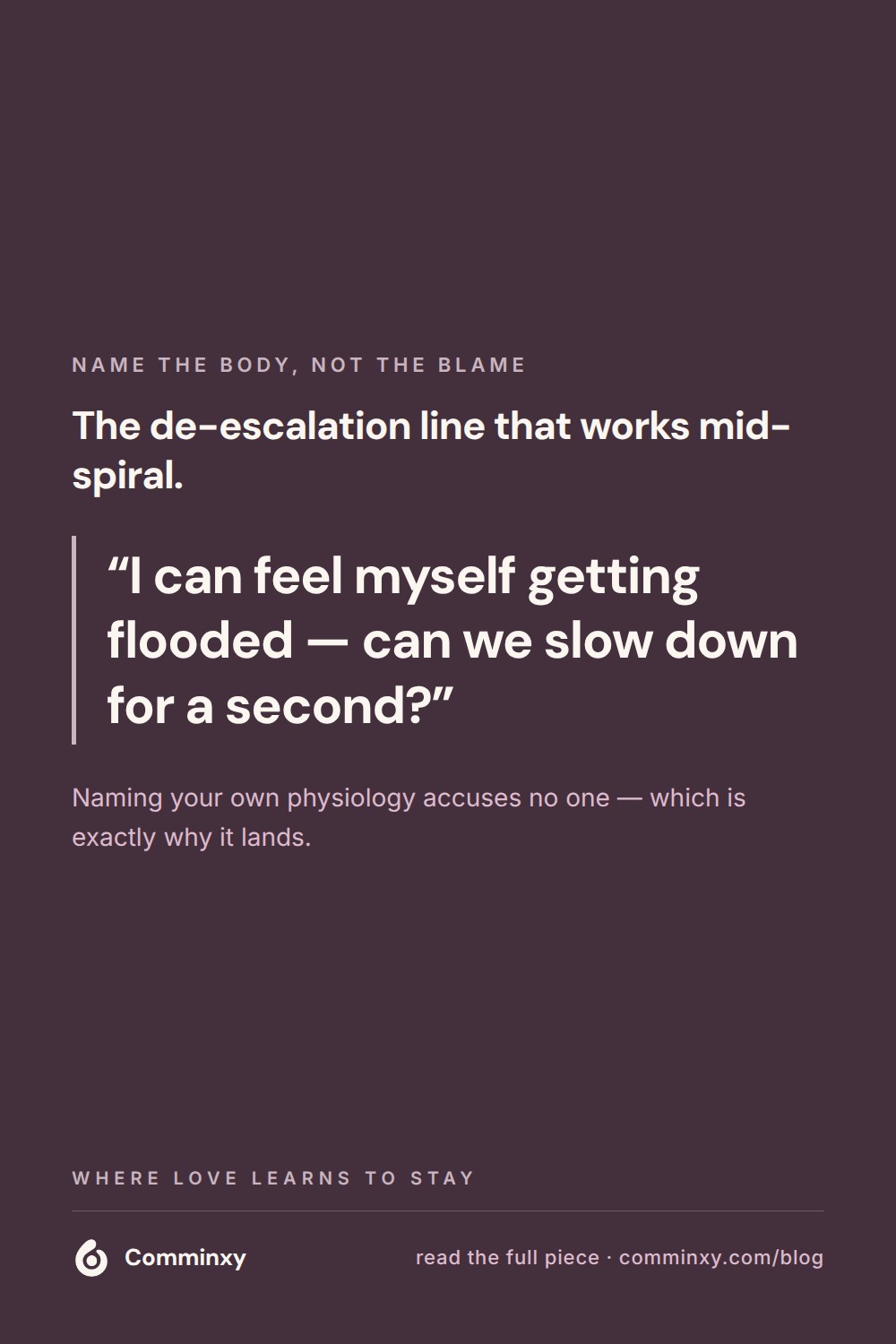
What helps here is naming the state instead of arguing the point. Not "you always do this," but something closer to "I can feel myself getting flooded can we slow down for a second?" It sounds almost too simple. But you're doing something profound: you're stepping out of the content of the fight and into the reality of your own body, and inviting your partner to meet you there. If you want to go deeper on how the entrance to these conversations shapes everything that follows, how to communicate better with your partner sits right alongside this.
The way back is shorter than the fight makes it feel
When you're flooded, the distance between you feels enormous, like you'll need hours, or a whole conversation, or an apology neither of you knows how to give. But repair rarely needs all that. It usually needs one person to do something small and human first: soften their voice, reach out a hand, say this isn't going how I wanted. The other body feels it. The flood starts to recede. And the argument you were having turns out to be much smaller than the panic around it.
That's the strange mercy of de-escalation. The fight almost never required winning. It required someone to notice the temperature rising and choose, quietly, to bring it back down. Not because they were wrong, but because staying close mattered more than being right in that moment.
So the next time you feel that click in your chest (the door kicking open, the sharp reply loading itself) you might remember that it isn't a sign you've failed. It's just your body arriving early, scared, trying to protect something it loves. You don't have to obey it. You can put a hand on it, and on your partner, and let the room cool. Comminxy exists for exactly those moments, a quiet companion that helps you notice the temperature before it decides the conversation for you. Because love doesn't stay by never fighting. It stays by learning, again and again, how to find its way back.
Questions people ask
how do you know if you're flooded during a fight
Your heart rate climbs, breathing gets shallow, and your attention narrows to whatever feels like a threat. You stop talking to your actual partner and start responding to a version your nervous system sees as dangerous. These physical changes usually happen before the argument gets loud.
why does my partner make jokes during serious arguments
They might be instinctively trying to lower the temperature by reminding both of you that you're not enemies. Research shows humor and affection during conflict actually help couples soothe their own stress responses. It's not dismissiveness, it's often a nervous system trying to stay connected.
what do you say to de-escalate a fight with your boyfriend
Name the state you're in instead of arguing the point, like 'I can feel myself getting flooded, can we slow down for a second.' You're stepping out of the content and into the reality of your body, which invites them to meet you there. It works better than trying to be more correct.
how long does it take to calm down after a fight
Repair usually needs something small and human first, like softening your voice or reaching out a hand, not hours of conversation. Once one person does that, the other body often feels it and the flood starts to recede. The distance almost always feels bigger than it actually is.
Keep the idea with you — pin it, or download the cards.


Comminxy helps you notice the temperature before it decides the conversation
Get Comminxy free →